Financial Education
How to Set Up Bill Pay in Online Banking
Banking security systems often decrease once transactions become recurring in the same destination account. This.
8 min read

26 Oct 2022
Linking payments in online banking lets you connect external accounts or cards to manage your finances in one place. With Común you can link an external debit card from another U.S. bank to send and receive payments.
Banking security systems often decrease once transactions become recurring in the same destination account. This process is called enrollment, and it can be useful for speeding up payment and debt processes. In this article we will tell you why it is necessary to enroll payments, and which protocols are used by platforms to establish payment enrollment.
Why Is It Useful to Enroll Payments in Online Banking?
We will point out the aspects that make it necessary to enroll payments on the bank platform where you keep your money, and the reasons are as follows:
- Security levels: It is necessary that you establish which people or services you make frequent, occasional, or one-time payments to. In this way, some will need to be controlled through security factors such as coordinates, random codes, or another authentication element required by the bank.
- Practicality: You have the ability to speed up the payments you make through your app. That way you do not have to wait for additional security elements to complete them.
- Avoid duplicate tasks: With enrollment you do not need to have the details on hand to make the transfer (deposit or payment) to the account. It is simply stored in a database. Then, by simply selecting the service or person you are going to pay, you can select it with one click and streamline the process.
- Control: By enrolling the account you can view the person or institution. You can also remove it from your database if you determine that the payment is no longer recurring. The process of removing it from the database involves a small protocol. The purpose is to ensure that you are truly ending your financial relationship with the person or entity that owns the account.
Requirements to Enroll Payments in Online Banking
One of the requirements for carrying out this process is having, in the bank platform’s database, the ability to speed up the deposit or payment process. To do so, you must have the following:
- The same mobile phone: Used to authenticate banking operations.
- Have some additional two-factor authentication elements granted by the bank under its security protocols (in some cases this requirement is optional).
- Email address: This applies if an authentication code is sent through this channel.
How to Enroll Payments in Online Banking
At first, enrollment can be somewhat cumbersome. But you will get used to doing it and establishing the criteria that indicate payments or deposits are recurring. For this, it is necessary to explain the general enrollment steps, which are the following.
Steps to Add the List.
- Log in to the bank platform by entering your username and password.
- After entering the platform or app, find the "Enroll payments" option in your bank’s menu and click it.
- It will display a list of the people you have enrolled; if it is empty, it is time to add to the list.
- Find the "Add" option
When Adding, do the following.
- Select the payment category.
- Enter details such as: First and last name, ID card or ID (depending on the region), account number.
- Accept the details and an authentication code will be sent to you (by email or through your mobile phone).
- Enter the code sent.
- Done! You now have the account number enrolled.
aWhat does it mean to link payments in online banking?
It's the process of connecting an external account or card to your financial app so you can move money between them or make payments directly.
How do I link an external card in Común?
From the app, add your external debit card (from a U.S. bank, in your name). Común verifies the card with a micro-deposit you confirm in the app.
What can I do once I've linked my external card?
Send and receive payments and remittances using that card, even if you don't have funds in your Común balance.
Frequently asked questions
What do I need to link an external card to my Común account?
A valid debit card, issued in the U.S., in your name.
How does Común verify the card is mine?
With a micro-deposit of less than $1.00 that you confirm in the app.
Can I link a credit card?
No, Común only accepts personal debit cards, not credit or prepaid cards.
How many cards can I link?
Up to 2 debit cards during your first 60 days with the account.
Why can't I link my card?
Common reasons include the name not matching, the card not allowing funds to move both ways, or it not being issued in the U.S.
Is it safe to link an external card?
Yes, Común never asks for your bank password during the verification process.
About Común
Común aims to support the Latino community in the United States. It offers a debit account that can be opened with more than 100 valid Latin American IDs and an app available in Spanish.
Visit Común's website or download the app for free to learn more about the full offer and applicable terms.
Olivia Rhye
Community Partner


Instant payments
How to send money to someone using Zelle from Común: 2026 guide
8 min de lectura
With Común you can link a debit card from another U.S. bank to your account — no Común physical card required — to send and receive money right away, even if you don't have funds in your balance.
How do I link an external card to my Común account?
In the app, go to the external cards section and add your debit card from another U.S. bank (Bank of America, Wells Fargo, Chase, or another). Común verifies the card is yours with a micro-deposit of less than $1.00 that you confirm in the app — we'll never ask for your bank password.
What can I do once the card is linked?
Send and receive payments and remittances using that card, even if your Común balance is $0. This is useful if you just opened your account and don't have your physical card yet, or if you prefer to keep your main money in another bank while using Común to move payments.
What cards can I link?
Valid debit cards, issued in the U.S., in your name, that allow sending and receiving funds. You can add up to 2 cards during your first 60 days with the account. Credit and prepaid cards aren't accepted.
Frequently asked questions
Do I need my physical Común card to send money?
No, if you have a linked external card, you can send and receive money right away without it.
Which banks can I link?
Any U.S. bank that issues debit cards in your name — Bank of America, Wells Fargo, Chase, and many others.
How does Común verify the card is mine?
With a micro-deposit of less than $1.00 to the linked account, which you confirm in the app. That money is yours to keep.
How many external cards can I add?
Up to 2 debit cards during your first 60 days with the account.
Why was my card rejected?
The most common reasons: the name doesn't match your account, it's a credit card, or it wasn't issued in the U.S.
Is it safe to link an external card?
Yes — Común never asks for your bank password or sensitive information during the process.

Living in the United States
Father's Day in the United States and Latin America: When it's celebrated and how to send money?
8 min de lectura
Father's Day in the United States and Latin America
When is Father's Day? In the United States, Father's Day in 2026 falls on June 21, the third Sunday of June. However, if your dad lives in Mexico, Guatemala, Honduras, or other countries across Latin America, his day might land on a completely different date. This guide provides an overview of Father's Day dates across the United States and Latin America so you can plan ahead and stay connected with family members abroad.
One holiday, many dates
Father's Day is an important occasion for many families across the continent. Yet, not every country celebrates Father's Day on the same fixed dates. In the US and most of Latin America, it falls on the third Sunday of June. However, Honduras celebrates it on March 19, Guatemala and El Salvador on June 17, and the Dominican Republic on the last Sunday of July.
If your family is spread across countries, it's easy to lose track. Here's a full breakdown so you have everything in one place.
When is Father's Day in each Latin American country and the US? (2026)
| Date | Countries | 2026 Calendar date |
|---|---|---|
| Third Sunday of June | United States, Mexico, Colombia, Venezuela, Peru, Chile, Argentina, Costa Rica, Panama, Paraguay, Puerto Rico | June 21 |
| Second Sunday of June | Ecuador | June 14 |
| Second Sunday of July | Uruguay | July 12 |
| Last Sunday of July | Dominican Republic | July 26 |
| Second Sunday of August | Brazil | August 9 |
| June 17 (fixed) | Guatemala, El Salvador | June 17 |
| June 23 (fixed) | Nicaragua | June 23 |
| March 19 (fixed) | Honduras, Bolivia | March 19 |
You can save this table and share it with your family group chat!
When's Father's Day in the United States?
In the US, Father's Day is celebrated on the third Sunday of June. In 2026, that's June 21.
The tradition dates back to the early 1900s, when Sonora Smart Dodd advocated to recognize fathers after being raised by a single dad. Over time, it became a national celebration of fatherhood and family.
Today, Father's Day in the US is a major occasion. Families gather for backyard barbecues, attend church services, catch a game together, or simply spend time at home. Restaurants fill up for Sunday brunch. Gift cards, tools, grilling accessories, and heartfelt cards dominate store shelves the week before.
For many immigrant families in the US, Father's Day can also carry some emotional weight. Many fathers are in the U.S. working thousands of miles away from their own fathers back home, building a future for their children. On an occasion like this, distance can feel heavy and a phone call becomes more than a call. For many families sending money back home becomes more than a transaction.
Father's Day in Mexico
Mexico celebrates on the same date as the US, the third Sunday of June; in 2026, the holiday falls on June 21. While it is not an official public holiday, it is widely celebrated.
In Mexico, Father's Day traditions are rooted in family. Mothers and children often wake up early to prepare a special breakfast, from chilaquiles, tamales to whatever papá loves the most. Schools hold events in the days leading up to it, where children make gifts and perform songs. The whole family tends to gather for a long lunch or dinner, and it's common for the celebration to include music, toasts, and storytelling that lasts well into the evening.
If your father is in Mexico and you're in the US, June 21 in 2026 is your shared moment. A video call during the family meal means you're at the table even when you can't be.
Father's Day in Central America
Father's Day dates vary throughout Central America.
Guatemala and El Salvador both celebrate on June 17. This is rare as it is a fixed date not tied to a Sunday. Families tend to celebrate in two ways: a smaller, symbolic recognition on June 17 itself (calls, gifts, meals), and a larger gathering on the nearest weekend if needed.
Nicaragua celebrates on June 23, also a fixed date. This year, it falls just two days after the US date, but those two days are important if you're planning to make a call or even a money transfer.
Honduras is an exception in the region, as Father's Day there is celebrated on March 19, the feast day of Saint Joseph. This Catholic tradition, also observed in Spain, Bolivia, and parts of Europe, associates fatherhood with the figure of Joseph as a protector and provider. If your father is in Honduras, it's worth keeping in mind that his day comes in the spring, not the summer.
Father's Day in South America
Colombia, Venezuela, Peru, Chile, and Argentina all celebrate Father's Day on the third Sunday of June. In 2026 that would be on June 21. In Colombia, it is treated as a major family occasion, often centered around a long Sunday lunch with live music. Venezuela and Peru follow similar traditions of home gatherings and special meals. Children participate by preparing performances, arts and crafts.
Ecuador is a slight variation: the celebration occurs on the second Sunday of June, which in 2026 falls on June 14, one week earlier than the US.
Father's Day in the Caribbean
The Dominican Republic is an exception in the region, celebrating on the last Sunday of July, which falls on July 26 in 2026. If your dad is from the Dominican Republic, it's important to remember that his special day is a full month after most of Latin America.
Gift ideas when your father is in another country
Distance doesn't change Father's Day, but it does change how you can show up. Not being there in person can feel difficult and sometimes you can struggle to find ways to show that you care. That can also feel like pressure, but what you do carries more intention, and that intention is what matters.
- Call him, but plan it. Don't just dial and hope he's free. Coordinate with family members so that when you call, he is available. Some people even plan to call during the special celebration, as people are gathered, the meal is on the table and your face on the screen is part of the festivities
- Send a voice message or video. A fun video showing him some parts of your life in the U.S. — your family, your city. A voice message with a special message that he can replay. These might feel like small efforts but when it comes from the heart and distance is involved they matter the most
- A treat for the party. Sometimes paying for the whole meal on Father's Day or the live music or even the decorations can show that even if you're far you can still get involved. To make sure you can contribute you can always send a remittance to your family members who are organizing the celebration
- Send money with meaning. While sending a remittance on Father's Day might feel familiar if you're supporting your family, the reality is that the context changes it. Choosing to send money on that specific day signals attention and care. It shows that you're present while you give your father the freedom to spend on what he needs or wants the most
- Make it specific. A new pair of shoes, the gadget he's been talking about for weeks or tickets to something he enjoys. To make sure he can experience it, you can transfer the money directly to him or a family member if he loves a surprise
How to send money to your dad for Father's Day?
There are many service providers for remittances and international transfers, the choice is between how it will reach him and what it will cost you. The right option depends on your priorities whether that's speed, cost fees, and how your dad actually receives money where he lives.
Digital remittance services
Companies like Remitly, MoneyGram, Wise and Común are becoming a more common way for people in the U.S. to send money abroad.
They often offer:
- Fast delivery options. Many transfers generally arrive the same day or within minutes, especially with debit card payments
- Flexible deliveries. You can send it to a bank account, mobile wallet, or cash pickup depending on the country
- Easy to use services. Sending a remittance from your phone without having to go to a location. Some apps are even built specifically for sending money internationally. For example, Común's app is available in Spanish
What to be mindful of?
- Costs. The costs can either be presented with a fixed fee and/or a markup within the exchange rate. It is important to understand the costs of the selected services
- Rates change constantly. Exchange rates are often changing and it's important to be considerate of those changes
- Some might not offer cash pickup options. Remitly, MoneyGram and Común offer cash options that can change depending on the country where the money is sent. For example, Común offers cash options at Elektra and Oxxo in Mexico
Traditional bank transfers
This means sending a wire from your U.S. bank directly to your dad's bank account.
These transfers often offer:
- Familiar banking infrastructure. Banks are regulated and familiar to many people
- Higher transfer limits. They tend to offer higher limits for transfers than other digital services
What to be mindful of?
- Costs. Fees for sending and receiving, as well as exchange rates can be less competitive than other service providers
- Slower timing. Some transfers may take several business days
- Limited flexibility. No cash pickup or alternative delivery methods
Cash pickup transfers
You can send money in person or online for cash pickup through services like Western Union or MoneyGram.
These may be useful for recipients who:
- Prefer cash. This is useful if your dad prefers cash or doesn't have a bank account
- Fast availability. Often available within minutes
- Wide accessibility. Some companies have large networks with locations available in many countries
What to be mindful of?
- Costs. Fees and exchange rates tend to be less favorable
- Less transparent pricing. Harder to compare total cost upfront
- Location considerations. Cash pickups rely on the locations being open and having sufficient cash on site
What to prioritize for a Father's Day remittance?
- If timing is what matters the most. It could be worth considering a service with same-day delivery or cash pickup
- If cost matters most. It is advisable to compare options, especially fixed fees and exchange rate markup within exchange rates
- If convenience matters most. It might be more important to choose the option that requires less effort for your dad on his special day
Frequently Asked Questions
When is Father's Day in the United States in 2026?
June 21, 2026.
When is Father's Day in Mexico in 2026?
June 21, 2026.
When is Father's Day in Colombia in 2026?
June 21, 2026, same as the U.S.
When is Father's Day in Guatemala and El Salvador?
Both countries celebrate on June 17, a fixed date each year. In 2026, that's a Wednesday.
When is Father's Day in Honduras?
Honduras celebrates on March 19 each year.
Why does Father's Day fall on different dates in different countries?
Two main traditions shaped the holiday globally. The U.S. model, established in the early 20th century, set the third Sunday of June. Catholic countries in Europe and Latin America often tied the celebration to March 19, the day of Saint Joseph, considered the earthly father of Jesus and protector of fathers and workers. Countries adopted one tradition or the other, or in some cases chose their own fixed date entirely.
When is Father's Day in the Dominican Republic?
The last Sunday of July. In 2026, that's July 26.
When is Father's Day in Ecuador?
The second Sunday of June. In 2026, that falls on June 14.
Can I send money to my dad for Father's Day?
Yes. There are many financial institutions and remittance service providers in the US that offer many different options such as wires to cash pickups.
Will my remittance arrive to my father the same day?
It depends on how you send it, when you send it, and how your dad receives it. Same-day delivery is possible from the U.S., but it's not automatic. Check with your chosen service provider to understand the times and if there are fees for faster delivery.
Being there, even from far away
No matter where your dad is, Father's Day is about showing up in a way that reaches him. The date might change from country to country, and the way you celebrate might look different from what you grew up with, but the intention carries across borders. When you know when the day is, you can plan ahead, and support the celebration from wherever you are. If sending money is part of how you show up, Común offers different delivery options for remittances to México, Guatemala, Honduras, El Salvador, Nicaragua, Costa Rica, Panamá, Colombia, Ecuador, Perú, Chile, Brasil, Argentina, Bolivia, Uruguay, Paraguay, and Dominican Republic. Don't let distance get in the way of building long lasting memories with your loved ones.
Remittance service provided by Service UniTeller, Inc. Service UniTeller, Inc. is licensed in all states that require one. Común Inc. may earn revenue from foreign currency conversion.

Financial Education
How to fill out a check in the United States in 5 simple steps (+ Example)
8 min de lectura
Have you ever filled out a check? Although most transactions today are digital, knowing how to fill out a check is essential—especially if you are just beginning your financial life.
According to recent data, one-third of Americans paid by check in 2024, demonstrating that checks still play an important role in the U.S. economy.
You might consider checks an outdated payment method; the reality is that they are useful in specific situations. For that reason, we will explain what a check is, the different types of checks, and how to complete them properly.
What Is a Check and What Is It Used For?
Despite the digital era, checks remain a relevant traditional payment method due to their formality and traceability. They are used for rent payments, purchases, and service payments.
Additionally, checks are a common payment method among the immigrant community, who often use them while adapting to the U.S. banking system.
But what exactly is a check and what are its characteristics? It is a physical document issued by an individual or business (the drawer) to order a bank to pay a specified amount to a third party. For the payment to be processed, the drawer must have sufficient funds in their checking account.
In general, a check contains the following information:
- Name of the drawer, whether an individual or a business
- Name of the payee
- Financial institution where the money will be drawn
- Amount to be paid, both in numbers and in words
- Signatures of the drawer
What Are the Different Types of Checks?
There are different types of checks in the United States. In this case, we will focus on the personal check, although you may choose the option that best suits your needs.
Personal Check
A personal check is a payment order issued by an individual to another individual using the funds in a checking account.
What Is a Personal Check Used For?
The most common uses for personal checks include:
- Rent and utility payments
- Purchase of everyday goods
- Legal agreements requiring documentary support
Certified Check
A certified check serves the same purpose as a personal check but is reviewed and guaranteed by the issuing bank, which verifies that the drawer has sufficient funds and holds them until the check is cashed.
A certified check provides certainty of available funds, making it a more secure method for making and receiving payments.
Cashier’s Check
Unlike a personal check, a cashier’s check is issued directly by the bank, offering greater security for the payee, as the bank is responsible for issuing and safeguarding the funds.
To obtain a cashier’s check, the drawer must visit a bank branch and pay the amount to be transferred. The bank then issues the check in the name of the payee, guaranteeing that it can be cashed using the institution’s own funds and not a personal account.
It is commonly used for high-value purchases such as homes and vehicles.
Money Order
While not strictly a check, it is a traditional payment method with similar functionality.
A money order is a financial instrument that allows funds to be sent via traditional mail using a certified check, which must be purchased and paid for by the drawer at an authorized location.
It allows secure money transfers without requiring a bank account.
How to Fill Out a Check in the U.S.
Before issuing this type of payment order, you must know how to do it properly. Below is an example of how to fill out a check easily, starting from step one:
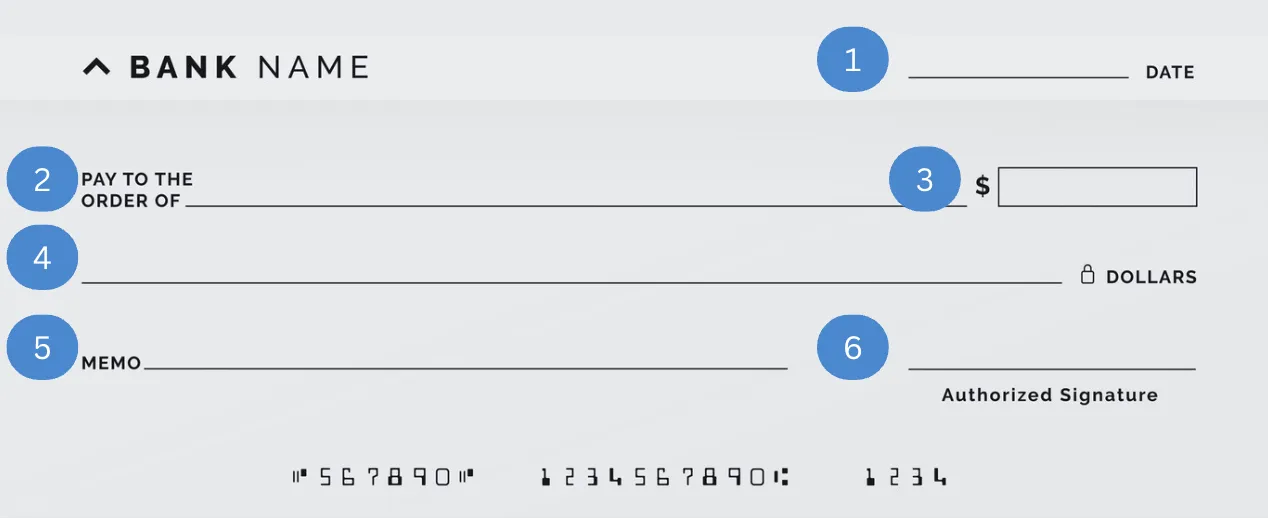
1. Write the Date
Remember that in the United States, the date format is mm/dd/yyyy.
2. Payee’s Name
Write the full name of the person to whom you are issuing the check, exactly as it appears on their official identification.
3. Amount in Numbers
Write the numerical amount clearly.
4. Amount in Words
Write the amount in words, including cents.
5. Add a Memo
You may include a note specifying the reason for the payment.
6. Sign the Check
Sign the check legibly in the space designated for the drawer.
7. Review the Information
Ensure that all information is accurate to avoid issues for the payee when cashing the check.
It is essential to complete checks legibly, without strike-throughs or corrections, as these may invalidate the document.
How to Correctly Write Numbers in Words on a Check
Writing amounts in words may be confusing when dealing with U.S. dollars. The following points should be kept in mind:
- Dollar amounts must be written in full words
- Cents must be written as fractions
- Avoid using dollar symbols or similar notations
- If there is leftover space at the end of the line, draw a line to prevent fraud
- For example, $1,000.75 is written as: One thousand and 75/100 dollars
Cash Checks and Manage Your Money Easily with Comun
As you can see, knowing how to fill out a check is useful for sending and receiving money in the United States. It is a reliable and accessible alternative if you do not have a banking account.
However, issuing and cashing a check can also require significant time and effort. That’s why you can skip the trip to the bank, avoid wasting time or money on gas, and cash your check directly from your phone using Comun—no lines, no questions, no complications.
Discover Comun, the only platform designed to serve the needs of immigrant communities in the United States, with support available in Spanish.
Why Choose Comun?
- Open your account with an official ID from your country
- Access a mobile app specifically designed for immigrants in the U.S.
- Make payments, receive your salary, and manage your finances
- Send money to your loved ones in LATAM for just a $2.99 transfer fee
Frequently Asked Questions
Still have questions about how to fill out a personal check? See our FAQ section.
What if I Make a Mistake Filling Out a Check?
If there are strike-throughs or inconsistencies in the amounts, the check must be voided and a new one used.
How Do I Void a Check?
Write the word VOID in large letters on the front of the check.
What Information Appears on the Back of a Check?
The back of the check contains the endorsement, meaning the payee’s signature for cashing the check.

Financial Education
How to Emigrate to the United States: Practical Guide and Helpful Tips
8 min de lectura
Complete Guide to Emigrating to the United States
Have you thought about alternatives to build a better future? You probably share the dream of thousands who long to emigrate to the U.S. in search of job and financial stability. Although the idea is tempting, it’s important to do it in an orderly and legal way to avoid issues with the U.S. government.
Beyond better job opportunities, people emigrate seeking education, family reunification, and safety.
The process to live legally in the U.S. can be overwhelming and confusing. This guide explains, step by step, how to emigrate to the United States to work, study, and reside.
Main Options to Emigrate to the United States
First, understand the different visa categories you can apply for to legally enter the U.S.—whether for work, family ties, or other categories.
These are the visa categories:
Employment
If your goal is to find job opportunities in the United States, you need to understand the work visa options.
- H-1B visa: for specialized professionals with a university degree or equivalent experience.
- H-2B visa: temporary non-agricultural workers.
- H-2A visa: temporary agricultural workers.
- TN visa: (NAFTA/USMCA) for Mexican and Canadian citizens in specific professions.
- EB-5 visa: for investors able to create at least 10 U.S. jobs. Also a pathway to permanent residence.
Family
Another path is the family-sponsored Green Card, which lets U.S. citizens and permanent residents help certain relatives obtain legal status.
U.S. citizens may petition for a spouse, unmarried or married children, parents, and siblings; permanent residents may petition for a spouse and unmarried children under 21.
Processing times vary but can be around 18 months. In general, the card is issued with a 10-year validity.
Visa Lottery
If you don’t fit employment or family categories, you can consider the Diversity Visa (DV Lottery), which grants 55,000 lawful permanent resident visas to nationals from countries with low U.S. immigration rates.
These are the requirements to apply:
- Be from an eligible country.
- Have a high school education and at least two years of experience in an occupation.
- Complete the online form during October–November.
Other options
Lastly, there are other alternatives for foreign nationals who don’t fit the categories above.
- Student visa (F-1 or M-1).
- Exchange visitor visa.
- Asylum or refugee status.
- Humanitarian parole or special programs.
Step-by-Step to Start Your Immigration Process
Below is the visa application process step by step.
Step 1. Research the most viable path for your profile.
First, analyze your goals in the U.S. and which visa category best fits your profile.
Step 2. Estimate process costs and initial cost of living in the U.S.
Immigrant visa costs vary by category. For example, in family sponsorship, Form I-130 or I-140 ranges from $535 to $700.
Check exact fees on the official U.S. Citizenship and Immigration Services website.
Step 3. Gather required documents (certificates, passports, diplomas, records, proof of income, etc.).
Each visa type requires specific documents; below is a general list of the most important items.
Valid passport.
- DS-160 (temporary visas) or DS-260 (immigrant visas).
- Proof of consular fee payment.
- Recent visa-style photo (2x2 inches).
- Job offer letter.
- USCIS employment authorization document.
- Academic certificates, diplomas, professional degrees.
- Proof of work experience.
- Proof of financial solvency or bank statements.
Step 4. If needed, improve your English before emigrating.
While the immigrant community is large, you’ll still need at least basic English to communicate.
Step 5. Check USCIS official sources to confirm current forms and fees.
Forms and fees vary by visa type. Always consult USCIS official information.
Also keep these practical tips in mind to avoid common mistakes.
- Avoid unlicensed consultants.
- Don’t make payments on unofficial sites. Make sure URLs end in .gov.
- Keep digital copies of all official documents for easy backup.
State Options for Emigrating to the U.S. and Costs to Consider
The next key step is choosing the state where you’ll arrive once you get your visa. This choice can directly impact your success due to the cost of living, job opportunities, and minimum wage.
Several states are attractive due to job variety, access to services, and support networks.
Here is a comparative table of some of the U.S. states for immigrants.
State
Average cost to rent a room
Average cost to rent a family home
State or federal minimum wage
Texas
$1,130
$1,400
Federal minimum wage $7.25 per hour
California
$2,600
$3,500
$14.00 per hour
Florida
$1,290
$2,000
$11.00 per hour
New York
$2,125
$2,300
$15.50 per hour
Illinois
$1,140
$1,300
$15.00 per hour
Arizona
$1,171
$1,400
Federal minimum wage $7.25 per hour
Helpful Tips for a Successful Transition
Emigrating requires financial, legal, and emotional preparation. These tips help you transition more smoothly.
- Once in the U.S., open a checking account to facilitate payments and salary deposits.
- Create an initial budget for the first 3–6 months.
- Line up temporary housing before traveling—family or friends if possible.
- Learn how the healthcare system and insurance work.
- Learn how credit history works and how to start building it.
Build Your New Financial Life in the U.S. with Común
You’re one step closer to starting a new life in the U.S. Once there, you’ll need a reliable service to manage your money.
Meet Común, the financial platform in the U.S.!
Open a checking account with qualifying ID from your home country and send money to Latin America with clear, competitive fees.
Open your Común checking account and take the first step toward financial stability in the U.S.
Frequently Asked Questions (FAQ)
If you still have questions, see the section below.
How much money do I need to emigrate to the United States?
Costs depend on the visa type—check USCIS’s official site. Also include travel, housing, and basic living expenses.
Which visas are faster to emigrate with?
The TN visa takes about 2–8 weeks; temporary work visas take around 3 months.
What happens if my application is denied?
You can request a review or appeal and make the necessary corrections. If not accepted, you may submit a new application.

Living in the United States
The cheapest states to rent in the United States in 2026
8 min de lectura
The cheapest states to rent in the United States in 2026
Based on recent rental market data, West Virginia continues to rank among the lowest-cost states for renters, with a 2025 Fair Market Rent of approximately $801 per month for a one-bedroom apartment. Arkansas and Mississippi also remain among the most affordable states to rent, with estimated one-bedroom Fair Market Rents of roughly $811 and $910 per month respectively. Other states frequently appearing among the cheapest states to rent include Oklahoma, Kansas, Iowa, Alabama, Indiana, Wyoming, and Ohio.
The national average asking rent for a one-bedroom apartment in the US sits at around $1,576 per month — a figure that can consume a significant share of the household's income. However, the average masks the variations across the country.
Why do rent prices vary so much by state?
Rent prices are not a single national market, they are thousands of local ones. The gap between the cheapest and most expensive states may be more than $1,600/month for a comparable unit. Several structural factors explain why a one-bedroom in Iowa can cost a fraction of what it does in California:
- Housing supply and construction pace. States with fewer building restrictions and lower land costs tend to have more available units, which keeps prices more accessible.
- Local economy and wages. Higher-income cities attract more renters competing for the same units, pushing prices up.
- Urban vs. rural mix. A state dominated by mid-sized cities will register lower averages than one anchored by major coastal cities.
- Regulatory environment. Zoning laws, permitting processes, and landlord-tenant regulations influence how fast housing supply can respond to demand.
- Climate and geography. Desirable coastal cities or warmer climates attract more people, which drives up rents over time.
The 10 cheapest states to rent in the U.S. in 2026
1. West Virginia — 1BR FMR: ~$801/month
West Virginia holds the lowest 1-bedroom Fair Market Rent of any state in the US at $801/month. The median rent statewide sits around $883/month across all unit types, with West Virginia apartments running roughly 41.6% less expensive than the national 2BR average. In 2024, 64.8% of leased homes in West Virginia rented for less than $1,000/month.
2. Arkansas — 1BR FMR: ~$811/month
Arkansas is consistently cited among the states with the lowest rent in the US. The 2025 HUD Fair Market Rent for a 1-bedroom is $811/month, and the state's apartments run roughly 41.4% less expensive than the national 2BR average. In 2024, 51.9% of leased homes in Arkansas rented for less than $1,000/month.
3. Mississippi — 1BR FMR: ~$910/month
The 2025 HUD Fair Market Rent for a 1-bedroom is $910/month, and some market-rate data places average 1BR asking rents lower, around $785–$825/month. In Jackson, the state capital, a 1-bedroom apartment may average around $785/month. The state has a notable Latino community in agricultural and food-processing hubs.
4. Oklahoma — 1BR avg: ~$850–$875/month
Oklahoma may offer some of the most affordable urban rent in the country. Oklahoma City's average 1BR rent sits around $875/month, ranking among the cheapest large cities to rent in the US. The state's housing index sits at approximately 67.9, meaning homes and rentals cost about 32% less than they do nationally.
5. Kansas — 1BR FMR: ~$885/month
Kansas delivers consistent affordability, with a 2025 HUD Fair Market Rent for a 1-bedroom at $885/month, roughly 35.6% below the national 2BR average. The median home price in Wichita, Kansas' largest city, was approximately $198,000 in Q1 2026.
6. Iowa — 1BR FMR: ~$839/month
The 2025 HUD Fair Market Rent for a 1-bedroom is $839/month, with Iowa apartments running 38.3% less expensive than the national 2BR average. Iowa households spend just 17% of their income on housing, the lowest share of any state in the country.
7. Alabama — 1BR FMR: ~$905/month
Alabama's apartments run roughly 36.4% less expensive than the national 2BR average. The 2025 HUD Fair Market Rent for a 1-bedroom is $905/month. The median home price of approximately $179,400 is among the lowest in the country. In 2024, 42.8% of leased homes in Alabama rented for less than $1,000/month.
8. Indiana — 1BR avg: ~$900–$950/month
Indiana sits comfortably in the affordable tier, with average 1BR rents well below $1,000/month in most markets. Indianapolis offers sub-$1,000 rents in a metro with a job market ranging from logistics, healthcare, technology, to life sciences. Indianapolis' growing Latino community has made the city an increasingly relevant destination for immigrant families relocating to the Midwest.
9. Wyoming — 1BR FMR: ~$836/month
Wyoming's sparse population keeps rental demand low and rents affordable. The 2025 HUD Fair Market Rent for a 1-bedroom is $836/month. In 2024, 50.2% of leased homes in Wyoming rented for less than $1,000/month. Wyoming has no state income tax.
10. Ohio — 1BR avg: ~$950–$1,000/month
Average 1BR rents hover near $950–$1,000/month while the state's cost of living runs roughly 8–9% below the national average. Ohio's combination of major metro accessibility and rental affordability makes it a compelling option.
Comparison table of the cheapest states to rent in the US (2026)
| State | 1BR FMR / Avg. Rent | vs. National 1BR FMR (~$1,393) | Cost of Living Index |
|---|---|---|---|
| West Virginia | $801 (FMR) | ~42% less | 83.2–86.6 |
| Arkansas | $811 (FMR) | ~42% less | 87.6 |
| Mississippi | $910 (FMR) | ~35% less | 83.3 |
| Oklahoma | ~$850–$875 (market) | ~37–39% less | 85.5–88.8 |
| Kansas | $885 (FMR) | ~36% less | 89.0 |
| Iowa | $839 (FMR) | ~40% less | 90.4 |
| Wyoming | $836 (FMR) | ~40% less | 92.3 |
| Alabama | $905 (FMR) | ~35% less | 89.3 |
| Indiana | ~$900–$950 (market) | ~32–35% less | 90.1 |
| Ohio | ~$950–$1,000 (market) | ~28–32% less | 91.2 |
1BR FMR = HUD Fair Market Rent FY2025. National 1BR FMR baseline: $1,393. Market-rate averages from PropertyCEO. Cost of Living Index from costoflivingbystate.com (C2ER Q1 2026). All figures are estimates and may vary by city, unit type, and data provider.
How to choose the right State for your budget and lifestyle?
Rent-to-income ratio, not just the rent number:
Some cheap-rent states also have lower wages. Mississippi, for example, ranks near the bottom for rent in dollars, but can rank near the top in terms of what percentage rent makes up of earned income.
Job availability in your field:
Employment opportunities can vary significantly from state to state. States such as Ohio, Indiana, and Alabama tend to have more diversified economies. For remote workers, lower-cost states may provide greater financial flexibility.
Community and support networks:
For immigrants and families relocating to a new area, access to established communities can make a major difference. Cities with growing Latino populations, bilingual services, and community organizations may help newcomers feel more connected.
Climate and weather risk:
States in the Midwest can experience colder winters and higher heating costs, while Southern states may bring higher air conditioning expenses. Some regions may also face increased risks related to hurricanes, tornadoes, or flooding.
Compare the total cost of living:
Rent is only one part of a household budget. Groceries, utilities, transportation, healthcare, childcare, and taxes can also vary significantly by state.
Manage your finances in any state with Común
Moving to a more affordable state may help reduce financial pressure, but managing your money efficiently remains important no matter where you live. Visit Común's website or download the app to learn more.
FAQ
What is the cheapest state to rent in the US in 2026?
Based on HUD Fair Market Rent data, West Virginia has the lowest 1BR FMR of any state at $801/month and the lowest median rent overall at approximately $883/month.
Which states have the lowest average rent for an apartment?
The states with the lowest average apartment rent in 2026 are West Virginia, Arkansas, Iowa, Wyoming, Mississippi, Oklahoma, Kansas, Alabama, and Indiana. Average 1-bedroom rents in these states range from approximately $785 to $950/month.
How much should I budget for rent in the US?
The commonly cited guideline is to spend no more than 30% of gross monthly income on rent. In the cheapest states, where 1BR rents may run $800–$900/month, the same guideline requires roughly $2,667–$3,000/month in gross income.

Financial Education
How to transfer money between banks? 2026 guide
8 min de lectura
How to transfer money between banks
To transfer money between banks in the United States, you can use an ACH transfer, wire transfer, online bank transfer, peer-to-peer payment app, or a fintech app connected through Plaid. The right option will depend on how quickly you need the money to arrive, how much you are sending, and the transfer fees.
Some bank transfers take minutes, while others can take several business days. Wire transfers are typically faster for large payments, ACH transfers are commonly used for everyday banking, and P2P apps are often used for sending money between friends or family members.
Quick comparison: 6 methods at a glance
| Method | Speed | Typical fees | Common use |
|---|---|---|---|
| ACH transfer | 1–3 business days | Typically no fee | Everyday bank transfers |
| Wire transfer | Same day | Fees vary by financial institution | High value or time-sensitive payments |
| Online bank transfer | Instant to same day | Typically no fee | Transfers between accounts at the same institution |
| Plaid-linked transfer | 1–3 business days | Typically no fee | Linking external accounts to apps |
| P2P payment apps | Seconds to hours | Varies by app | Sending money to another person |
| In-person branch transfer | Same day to several days | Varies by financial institution | In-person assistance or high-value transfers |
ACH transfer
ACH transfers are one of the most common ways to transfer money between banks in the United States. ACH stands for Automated Clearing House, the electronic network financial institutions use to process transfers between accounts. This method is commonly used for paying bills, sending payroll deposits, and moving money between personal accounts.
Wire transfer
Wire transfers are electronic transfers of funds between financial institutions through secure financial networks. They are typically used for larger amounts, urgent payments, real estate transactions, and business payments. Domestic wire transfers generally process the same business day. Fees vary significantly by institution.
Online bank transfer
Many banks allow customers to transfer money between their own accounts instantly or same-day through their app or online portal. This is commonly used for moving money between a checking and savings account at the same institution.
P2P payment apps
Peer-to-peer payment apps like Venmo, Cash App, Zelle, and Común's Pay allow users to send money quickly using just a phone number, email, or QR code. They are ideal for everyday payments between people who know each other.
How long does a bank transfer take?
Times vary: ACH transfers typically take 1 to 3 business days. Domestic wire transfers can complete the same business day. Transfers between accounts at the same institution can be instant. P2P apps can be instant or take up to 1 business day.
How much do banks charge for transfers?
Fees vary widely by institution and method. ACH transfers are generally no fee. Domestic wire transfers can cost $15–$35. International wire transfers can cost $35–$75. P2P apps are generally no fee for standard transfers.
FAQ
Can I transfer money between banks without a fee?
Yes, ACH transfers are generally no fee. Many P2P apps also offer standard transfers without a fee.
How long does an ACH transfer take?
Generally 1 to 3 business days, although same-day ACH is available at some institutions.
What do I need to make a wire transfer?
You generally need the recipient's bank account number and routing number, and for international wires, the SWIFT/IBAN code.
Común is a financial technology company and not a bank. Banking services are provided by Community Federal Savings Bank, Member FDIC. Peer-to-peer payments services are provided by Cross River Bank.
Financial Education
How to fill out a money order: step-by-step guide
8 min de lectura
How to fill out a money order
A money order is a prepaid paper payment often used for rent, bills, or sending money securely through the mail. To fill one out correctly, you need to add the recipient's name, your information, sign the front, and keep the receipt for tracking or replacement purposes.
Money orders are still widely used in the United States, especially for situations where people need a secure paper payment method. Even in 2026, many landlords, utility companies, government offices, and individual recipients continue to accept or require money orders for certain payments.
For many people, especially immigrants, newcomers to the United States, or people without a traditional bank account, money orders can feel more accessible than personal checks. Filling out a money order incorrectly can cause delays, make the payment invalid, or create problems if the money order is lost. Knowing exactly what information to write and where to write it can help avoid unnecessary stress.
What is a money order?
A money order is a prepaid paper payment that works similarly to a check. Instead of drawing money directly from a bank account, you pay the full amount upfront when purchasing the money order.
Once completed, the money order can usually be:
- Mailed to a recipient
- Deposited into a bank account
- Cashed at approved locations
Because the payment is prepaid, money orders are often considered safer than mailing cash. Money orders are commonly used for:
- Rent payments
- Utility bills
- Government fees
- Payments sent through the mail
- Sending money to family members
- Situations where personal checks are not accepted
Most money orders also include a receipt or tracking number that can help verify whether the payment was cashed. Unlike many digital payment apps, money orders are not typically trackable in real time.
When to use a money order vs other options
Money orders can still make sense in certain situations, especially when:
- A landlord only accepts money orders
- You do not have a U.S. checking account
- You need to mail a secure payment
- The recipient does not use digital payment apps
- You do not want to share banking information
Where to buy a money order
USPS (United States Postal Service):
One of the most common places to buy money orders. Domestic money orders typically cost between $1.45 and $1.95. USPS money orders never expire.
Walmart:
Many Walmart locations offer money orders through MoneyGram services. Fees can be lower than traditional banks, although limits apply depending on the location.
Western Union:
Western Union locations also sell money orders. Some stores offer extended hours.
Banks and credit unions:
Some banks and credit unions issue money orders to account holders. Fees may vary depending on whether you already bank with the institution.
Step 1: Fill out the recipient's name
Write the recipient's full legal name in the "Pay to," "Pay to the Order of," or "Payee" section.
Tips:
- Write clearly using black or blue ink
- Double-check spelling
- Avoid nicknames unless specifically requested
- Do not leave this section blank
If the name is incorrect, the recipient may have trouble depositing or cashing the money order. Once the recipient's name is written, only that person should be able to cash or deposit the money order with valid identification.
Step 2: Fill out the sender's name and address
Write your own information in the purchaser or sender section. The form may ask for: full name, address, city and state, phone number. This helps identify who purchased the money order if there is a problem later.
Step 3: Sign the front and add a memo
Sign only where the purchaser or sender is instructed to sign on the front.
Do not sign the back.
The back is reserved for the recipient when they cash or deposit the money order.
Some money orders also include a memo or account number section. Examples: apartment number for rent, utility account number, invoice number, purpose of payment.
Step 4: Keep your receipt
The receipt usually contains: tracking information, serial number, purchase amount, date of purchase.
Keep the receipt until the money order has been cashed or deposited successfully. If the money order is lost, stolen, or delayed, the receipt may help you: request a replacement, verify whether it was cashed, contact customer support, file a claim.
Common mistakes to avoid
Leaving fields blank:
Fill out the money order completely before handing it over or mailing it.
Using incorrect recipient information:
Misspelled names or incorrect business information can delay the payment process.
Signing the back:
Only the recipient should sign the back of the money order.
Throwing away the receipt:
Always keep your receipt until the payment is confirmed.
Using pencil or unclear handwriting:
Use permanent ink and write clearly.
Mailing cash instead:
Money orders are generally safer than sending cash through the mail.
Alternatives to money orders (digital options)
Common digital alternatives include: Venmo, Cash App, bank transfers, debit card payment apps.
For people who regularly send money within the United States or to Latin America, Común offers digital transfer options through ComunPay.
ComunPay allows eligible users to send money using: payment links, QR codes, phone numbers, email addresses, usernames, debit cards. Unlike traditional mailed money orders, digital transfers inside apps can usually be tracked directly from the phone.
Común also offers international remittances to Latin America starting at $2.99.
Choosing the right payment option for your needs
Money orders continue to play an important role for many people in the United States, especially for rent payments, government forms, mailed payments, or situations where paper documentation is preferred. For everyday sending between family members, friends, or trusted contacts, digital payment tools may feel more practical and easier to track.
FAQ
How much does a money order cost?
Money orders typically cost between $1.45 and $10 depending on the issuer, amount, and location. USPS money orders commonly range from $1.45 to $1.95.
Can a money order be cashed by anyone?
No. Once the recipient's name is written, only that person should be able to cash or deposit it with valid identification.
How long is a money order valid?
Many money orders do not expire. USPS money orders do not expire.
What happens if I make a mistake on a money order?
Avoid crossing information out. Contact the issuer about replacement options.
Can I track a money order?
You can usually verify whether it was cashed by contacting the issuer with your receipt information.
What is a digital alternative to a money order?
Venmo, Cash App and ComunPay for peer-to-peer transfers. Común also offers international remittances to Latin America starting at $2.99.
Común is a financial technology company and not a bank. Banking services are provided by Community Federal Savings Bank, Member FDIC. The Común Visa® Debit Card is issued by Community Federal Savings Bank. Peer-to-peer payments services are provided by Cross River Bank. No minimums, no maintenance fees. Remittance service provided by Service UniTeller, Inc. Remittance fees start at $2.99 but may vary. Común Inc. may earn revenue from the conversion of foreign currencies.
.avif)
Financial Education
Your essential guide to the bank routing number in the U.S.
8 min de lectura
The bank routing number, or ABA Routing Number, is essential information for making money transfers. It is a 9-digit code used to identify each financial institution in the United States.
This code is so important because it ensures that electronic transactions are carried out correctly and that funds reach the designated bank.
In this article, we offer a complete guide to help you understand what a bank routing number is, what it does, where to find it, and how it is used in everyday electronic financial transactions.
What is a bank routing number (ABA), and why is it essential in the U.S. banking system?
An ABA routing number, or transit routing number, is a unique 9-digit code that serves as an identifier for each financial institution in the United States.
It differs from a bank account number in that an account number is personal, valid for the use of a single user only. By contrast, the routing number is a unique identifier for banks, credit unions, and digital banks.
The primary function of the routing number is to allow financial institutions to precisely identify which bank to send to or receive from during routine operations such as direct deposit of payroll, automatic payments (ACH), and electronic transfers.
It is important to note that this code is different from a bank account number and is not equivalent to the IBAN (International Bank Account Number), which is a set of numbers used especially in Europe to identify international bank accounts and is composed of the country code, check digits (the checksum of the bank account number), and a bank account number.
In the United States, however, the SWIFT/BIC code is used for international money transfers, not the IBAN.
Here are some crucial functions of the bank routing number in digital transactions.
Unique bank identification
The bank routing number helps prevent errors when identifying a specific bank and processing a transfer from one institution to another, even when they have similar names or many branches across the country.
Facilitates electronic transfers
This code is also indispensable so that ACH systems and wire transfers can send funds to the correct destination, quickly and securely.
Key for direct deposits
The ABA number is also essential for employers to make direct deposits, using that code together with the checking account number, without the need for checks or cash.
Automated bill payments
To set up automated payments for services such as electricity, water, and online subscriptions, you must provide the bank routing number so the billing system can process the transaction automatically.
Handling funds between banks
This number is also indispensable for transactions involving multiple financial institutions, such as interbank transfers or check clearing.
How to find a bank routing code and your bank account number
By now, the importance of the ABA number is clear. But how do you find a bank routing code? Knowing this information is the first step to making transfers correctly.
Likewise, it is essential to understand how to find your bank account number and to tell one number from the other to avoid confusion.
The routing number consists of 9 digits and identifies the bank. The account number has usually 10 to 12 digits and identifies the individual account within the bank.
To find your account number, look at the bottom of a check; it is the series of numbers that follows the routing number. You can also find it at the top of a statement or directly in the mobile application.
It is essential to make sure you have the correct routing number before making a transfer. Therefore, it is advisable to confirm it directly with your financial institution to avoid errors.
Many users ask where to find the routing number on a physical debit card. However, the routing number is not printed on such instrument because it is intended for digital transfers, not for payments at physical merchants.
These are the most common places to find the routing number for your bank or financial institution.
On your checks
Check the lower left corner of your personal or business checks; the routing number is the 9 digits shown there.Another relevant detail is the check number, which is usually at the top.
Mobile application
Another way to find this code is to access your mobile application and go to the transfers or direct deposit information section.
Bank statements
Check your latest bank statement, whether physical or digital; the routing number may appear in a section of that document.
Direct contact with your bank
If you have any doubt about the routing number, you can contact your bank by phone or visit a branch so they can clarify any questions before you make a bank transfer.
Your routing number and account: Key tools for your finances in the U.S. with Comun
Throughout this article, we have learned the importance of both the bank routing number and the bank account number in the U.S. financial system. Both are indispensable for carrying out fast and secure digital transactions.
Being clear about what a bank’s ABA number is not only lets you carry out digital transactions with ease but also gives you financial autonomy to allocate your resources toward the services you need for your well-being.
The U.S. financial system can seem complicated, especially for immigrant communities. That is why Comun seeks to streamline processes and offer transactions without complications.
- Receive and send money easily from your mobile application
- Integrate other applications and enhance your experience
- Access support available in Spanish and English
- Send international remittances with fees starting at $2.99 USD, up to the applicable limits.
- Get started with official ID from your country
Open your account today and discover an ally to manage your finances in the United States.
Frequently Asked Questions
If you have more questions, check our frequently asked questions section.
Where can I find my routing number if I don’t have checks?
You can find it on your account statement or by calling the bank directly.
What is the routing number for ACH transfers?
It is the code that identifies each bank and consists of 9 digits.
Is the routing number the same for all banks?
No. Each bank has a different routing number.
What is the routing number on a card?
The routing number does not appear on physical cards.
What is the routing number on a check?
It is found at the bottom of a check and consists of 9 digits.

International Money Transfers
Money Transfers: From Traditional Methods to Digital Innovations
8 min de lectura
Money transfers have evolved from traditional methods like checks and money orders to instant digital solutions. With Común, most international remittances arrive within minutes, with no need to visit a branch.
The financial evolution of money transfer methods from traditional practices to digital innovations marks a crucial shift, revolutionizing how we think about and manage our finances in our bank accounts and beyond. This transition isn't just about technological advancement — it reflects a fundamental shift in user expectations, security standards, and global connectivity, especially in international money transfers and seamless bank account integration.
Accelerating Transactions: The Digital Revolution in Money Transfers
The rise of digital platforms and money transfer apps has transformed the speed and accessibility of transactions. Where bank transfers between financial institutions once took days to complete, digital innovations now enable instant money transfers, letting users transfer money around the world in just a few business days or even instantly. This monumental shift in convenience lets users send money or transfer funds from one bank account to another 24/7, without the traditional visit to a bank or credit union.
These changes encapsulate the journey from traditional methods like bank transfers and bank-to-bank transfers to the digital innovations now dominating our financial ecosystem. As we continue exploring these developments, it's clear that ways of transferring money — from using a debit card for instant transfers to leveraging payment app capabilities like Google Pay and Apple Pay — aren't just evolving, they're being redefined for a new era of global connectivity and digital empowerment, making money transfer apps an indispensable tool in our daily lives.
Navigating International Money Transfers: Considerations
Additionally, the rise of mobile apps, from money transfer services like Cash App to full banking apps, has democratized access to financial services. These platforms offer user-friendly interfaces that simplify the money transfer process, whether sending money abroad through international transfers or managing domestic transfers between checking and savings accounts within the same bank. This broadens financial inclusion, letting even those with a basic savings account or checking account participate easily in bank transfers and person-to-person payments.
It's equally important to have a solid understanding of the regulatory framework surrounding international money transfers. This includes being aware of anti-money laundering (AML) laws and the various transfer limits imposed by different countries. These regulations are designed to prevent financial crimes and ensure the security of cross-border transactions. Following these laws not only helps avoid legal complications, but also ensures your transactions process without unnecessary delays.
In addition to choosing the right service and understanding regulations, it's also helpful to be aware of the exchange rates offered by different services. Exchange rates can significantly affect the final amount received on the other end, especially for large transactions. It's also crucial to consider delivery times, especially if the transfer is time-sensitive. While some services can transfer funds almost instantly, others may take several business days. This can be particularly important in emergency situations or when making payments with strict deadlines.
Exploring Different Money Transfer Options: Wire, ACH, and Beyond
Digital advances have also introduced a new level of security and transparency to money transfers. With modern encryption and authentication technologies, including features like fraud detection, financial transactions — whether internal transfers, external transfers, or even online payments for online purchases — are safer than ever.
Money transfer apps have become a safe haven for personal finances, offering real-time transaction tracking and ensuring that transferring money — from a linked bank account via Automated Clearing House (ACH) transfers or direct deposit — stays secure and straightforward. ACH transfers stand out for domestic efficiency and cost-effectiveness, ideal for regular payments like salaries and bills. Additionally, traditional methods like checks, cash deposits, and money orders retain their usefulness for specific scenarios, offering tangible options in a predominantly digital world.
The Rise of Person-to-Person (P2P) Money Transfer Apps
P2P transfer apps have fundamentally transformed how we exchange money, making transactions as simple as sending a message. These apps let users send funds directly to others, using just an email address or phone number, eliminating the need for intermediaries. Among the many options available, several apps have gained prominence, each standing out for its distinctive features.
For example, some apps are celebrated for their integration with social networks, enhancing the social aspect of money transfers. Others prioritize security, offering advanced encryption and authentication methods to protect transactions. There are also apps designed to facilitate cross-border payments by simplifying the process of sending money internationally, offering competitive exchange rates and low fees. This diversity ensures there's a P2P transfer app suited to practically every need and preference, reflecting the dynamic, user-centered evolution of financial technology.
Decoding the Costs: Fees in Money Transfers
The rise of mobile apps, from money transfer services like Cash App to full banking apps, has democratized access to financial services. These platforms offer user-friendly interfaces that simplify the money transfer process, whether sending money abroad through international transfers or managing domestic transfers between checking and savings accounts within the same bank. This broadens financial inclusion, letting even those with a basic savings account or checking account participate easily in bank transfers and person-to-person payments.
Understanding the fees associated with money transfers is pivotal for managing your finances effectively and avoiding unexpected costs. The fee landscape for transfers can vary significantly, spanning service charges, transaction fees, and currency conversion fees, among others. Transparency around these fees is crucial — so it's essential to choose services that offer clear, straightforward information about all the costs involved.
Service charges and transaction fees are often the most visible costs associated with transferring money. These can vary widely depending on the provider and transfer method chosen. For example, traditional bank transfers might carry higher fees compared to online platforms or mobile apps. Currency conversion fees also play a significant role, especially for international transfers, where money needs to be exchanged from one currency to another. Some services build their profit into the exchange rate offered, making it less favorable than the market rate. This practice underscores the importance of scrutinizing the exchange rates provided, not just the explicit fees.
This approach not only helps you make informed decisions, but also helps avoid hidden charges that can add up. To minimize these costs, adopting strategies like selecting the transfer method best suited to your needs — considering factors like speed, destination, and amount — and diligently comparing providers to find the best rates and lowest fees can lead to significant savings. By prioritizing transparency and using cost-minimizing strategies, users can navigate the complexities of money transfers more confidently and economically.
Send abroad with peace of mind with your Común account¹
Open your account in 3 minutes!
Conclusion
In conclusion, the shift from traditional methods to digital innovations in money transfers represents a significant advancement in financial management. Digital platforms and money transfer apps have revolutionized how we send money, providing unprecedented convenience, speed, and security. From seamless bank account transfers to the global reach of international money transfers, these digital solutions offer a full range of services that meet our diverse financial needs.
By emphasizing transparency, these platforms minimize hidden fees, making it easier than ever to manage our savings and checking accounts. Additionally, innovations like instant transfers and robust fraud detection technology have made money transfer apps a reliable option for consumers. As we continue embracing these digital advances, the essence of mastering money transfers lies in leveraging technology to enhance our personal finance capabilities, ensuring we can navigate the complexities of modern financial transactions with confidence and cost-effectively.
How have money transfers changed over time?
From checks, money orders, and bank transfers that took days, to mobile apps that process payments and remittances in minutes.
What advantages do digital transfers have over traditional methods?
Greater speed, real-time tracking, and the ability to send money without leaving home. With Común, you can send a remittance from the app anytime.
Are traditional methods still useful?
Yes, checks and cash are still relevant in certain cases, such as when the recipient doesn't have a digital bank account.
Frequently asked questions
Why are digital transfers faster than traditional ones?
Because they use real-time processing networks, instead of the multi-day cycles of traditional banking methods.
Do I need to visit a branch to send money with Común?
No, the entire process happens through the app, with no need to visit any physical location.
Are traditional methods like checks still valid?
Yes, they're still useful in certain cases, though digital apps tend to be faster and more convenient.
How fast does a remittance sent through Común arrive?
Most arrive within minutes, depending on the country and delivery method.
Can I track my transfer in real time?
Yes, the app shows you your transfer's status while it's being processed.
Is sending money digitally safer than by check?
Both methods have different protections; digital apps usually offer additional verification and encryption.
.avif)
Immigration
What is SSN? Everything you need to know if you are a resident in the U.S.
8 min de lectura
An SSN (Social Security Number) is a 9-digit number issued by the U.S. government. It is required for working legally, filing taxes, and accessing financial services in the United States. As an immigrant, you may apply for an SSN if you have an eligible visa or Green Card — or use an ITIN as an alternative. If you have newly arrived in the U.S., you likely have questions about how to handle certain procedures. Therefore, we will explain what the SSN is, what it is for, how to apply for it, how much it costs, and what the benefits are of having this identifier.
What is the Social Security Number (SSN)?
The Social Security Number (SSN) is a series of 9 digits issued by the Social Security Administration (SSA, or Administración del Seguro Social in Spanish). It is issued to citizens, permanent residents, and eligible temporary residents, in accordance with their immigration status.
Its main function is to serve as a unique identification number that allows the government to track specific data for each person, such as their income, financial information, and employment history. This makes it possible to determine, in each particular case, eligibility to access Social Security benefits such as retirement, disability, among others.
In addition to facilitating access to these benefits, the Social Security card serves as official identification for employment onboarding, driver’s licenses (in some states), and opening bank accounts.
How to obtain the Social Security Number in the United States?
An important point about the Social Security Number in the U.S. is that there are three different types:
- For citizens born in the United States
- For citizens born abroad
- For non-citizens with lawful resident status
In the case of lawful permanent residents, it is necessary to obtain a Green Card or a visa with valid work authorization issued by the Department of Homeland Security (DHS), such as H-1B or L-1.
The process of obtaining the SSN varies depending on immigration characteristics. If you requested the SSN during your visa processing—through the “Application for Immigrant Visa and Alien Registration” form or the DS-260 electronic format, “Immigrant Visa Electronic Application”—DHS will contact the Social Security Administration directly to carry out the process.
Get your SSN in just 4 steps
If you did not request the SSN during your visa process, the first thing you should do is gather the following documentation:
- A valid passport with the Machine Readable Immigrant Visa (MRIV) or a Permanent Resident Card (Form I-551)
- Birth certificate
Once you have gathered the documentation, follow these steps:
- Download and complete the SS-5 application
- Go to an SSA office
- Present the original documents
- Wait 7 to 14 days to receive the Social Security card by mail
What to do if your SSN card is lost?
If your Social Security card is lost, it is important to take security measures immediately to avoid identity theft, fraud, or misuse of your personal data.
Report the theft or loss of this document to the police and then file a complaint with the Federal Trade Commission (FTC).
Afterwards, go to the Social Security Administration, complete the SS-5 form again, and bring the corresponding documents for replacement of the card.
Avoid carrying the card with you unless necessary and keep it in a safe place. Generally, you do not need to present your physical card but rather the number, which does not change even if you replace the card.
5 benefits of having an SSN
If you are still wondering what the SSN is for, you should know that this document provides multiple benefits of different kinds, such as the following:
1. Employment
For permanent residents, the greatest benefit of the SSN is that it grants work authorization, enables income tracking, as well as the payment of taxes and legal obligations. Presenting this document is an indispensable requirement during formal hiring processes in the United States.
2. Credit
The SSN is also typically required to apply for loans and credit from banks and financial institutions in the United States; in this way you can access assets such as real estate, a car, or other types of services.
3. Banking services
Accessing financial services is essential for immigrant workers in the United States, whether to receive wages or send money to their countries of origin. Generally, the SSN is a requirement to access a bank account and credit and debit cards, among other services.
4. Government benefits
There are other benefits available, such as unemployment insurance in the event of dismissal, and access to retirement and Medicare starting at age 65, for eligible permanent residents.
5. Taxes
The SSN functions as the taxpayer’s personal identification number, which makes it easier to file tax returns and report income and expenses. Another alternative for residents who do not have an SSN is the ITIN, issued by the Internal Revenue Service (IRS), which serves to fulfill tax obligations and grants other benefits.
In short, the Social Security Number—beyond being an administrative procedure—facilitates economic and social integration in the United States because it serves to track income and expenses and facilitates access to basic rights such as work, health, and banking, which are essential for integrating into society.
How much does it cost to get an SSN?
It is important to clarify that the Social Security card process does not involve any cost, whether you do it for the first time or as a replacement due to theft or loss.
Stay alert to potential fraud and avoid making payments to unauthorized third parties. If you have any doubts, go directly to your local Social Security office and report any suspicious activity.
Read more: Don’t miss our guide to investment basics for immigrants
Simplify your financial life upon arriving in the United States with Comun
As you can see, the SSN is highly relevant to establishing a stable life in the United States because it facilitates access to work, health services, and financial products that are essential for carrying out daily tasks such as payments and money transfers.
Comun is a financial platform designed to make life easier for immigrants in the United States by facilitating their integration into the financial system from day one.
- Open your account with an official ID from your country of origin
- Receive a Visa debit card and make purchases easily in physical stores and online
- Access a mobile application and manage your finances from the palm of your hand
- Send remittances to your home country for a fee starting at $2.99 USD, up to the applicable limits
- Forget about hidden fees and complicated processes
- Access support available in Spanish and English
With Comun, discover the most accessible way to manage your finances for everyday life in the United States.
Frequently Asked Questions
If you still have questions, consult our Frequently Asked Questions section.
What should I do if someone uses my SSN without permission?
Report immediately at IdentityTheft.gov and place a fraud alert.
How many times can I replace my SSN card?
Up to 3 times per year and a maximum of 10 times in your lifetime.
Is it mandatory to have an SSN to open an account with Comun?
Comun allows you to open an account with official ID from your country.
Financial Education
What is a certified check and how does it work?
8 min de lectura
What is a certified check and how does it work?
Certified checks are a common form of payment for thousands of immigrants living in the United States, especially for major purchases such as rent payments, buying a car, and legal settlements.
However, it is not always clear why the certification process matters and how it differs from other types of checks.
A certified check is a physical payment order that has been reviewed in advance by a financial institution to ensure there are sufficient funds in the issuer’s bank account. This is the fundamental reason it’s considered a safer form of payment than a personal check.
Below, we explain in detail what a certified check is, how it works, and why it’s important to understand the differences from other types of checks.
What is a certified check?
A certified check is a type of check with guaranteed funds, since the issuing bank has verified the money exists in the checking or personal account.
This makes it a safer form of payment than personal checks, because the bank sets aside the amount to be paid so it can be collected by the payee.
How is a certified check issued?
Issuing a certified check is a straightforward process you can complete directly at the financial institution of your choice.
- The customer requests the check
The account holder must go to a bank and request a certified check, specifying the payee and the amount.
- Customer identification
You must present an official ID to verify that you are the holder of the savings or checking account from which the funds will be drawn.
- The bank freezes the amount in the account
The bank then certifies there are sufficient funds to cover the check and freezes them to ensure the payee can cash it.
- Signature certification
You must sign the check before finishing the process so the bank can confirm the signature matches the one on file.
Affixing the certification stamp
Finally, once the bank has verified the funds and the signature, it places a certification stamp to document completion of the process.
Differences between a certified check and a cashier’s check
A cashier’s check is another way to make secure payments using a physical instrument. In this case, the bank branch issues the check after receiving the customer’s payment, so the funds come from the bank itself.
Below is a comparison between a cashier’s check and a certified check.
Cashier’s check
Certified check
Security
High; the bank verifies sufficient funds and places a hold for the payee.
Very high; the check is backed by the bank and does not depend on the issuer’s account.
Cost
At some banks they have no cost at others up to approximately $15.
Depends on the bank; typically $10–$20.
Issuance time
At the branch, after funds are verified.
Immediate.
When is a certified check typically required?
A certified check is commonly used for significant transactions or large amounts. This gives the recipient assurance that funds are available.
- Paying an apartment security deposit.
When finalizing a lease or purchasing an apartment, the landlord or agent may request payment via certified check to guarantee funds.
- Buying a used car.
Whether dealing directly with owners or dealerships, a certified check can be a suitable option because of the security it provides.
- Closing an important contract or legal settlement.
For example, to pay fees, settlements, or indemnities, certified checks provide security for both parties.
- For tuition or school fees.
Some educational institutions accept certified checks as a form of payment, especially for international or first-time payments.
Do you know what to do if a check is stolen or lost? We explain it here!
Practical tips for using certified checks safely
While certified checks are among the safest payment methods due to the bank’s verification process, there are still fraud attempts using forged documents.
With this in mind, keep these tips in mind to avoid becoming a victim of check fraud.
How to know if a check has funds and avoid scams
- Verify with the issuing bank.
Call the bank directly and provide the check number, account holder, and amount; ask them to confirm authenticity and that funds are guaranteed. Make sure you call the bank’s official number, not the one printed on the check.
- Be alert if you receive an overpayment check.
A common scam is sending a check for more than the amount due and asking for the difference in cash. Confirm the check’s validity with the bank before proceeding.
- Wait for the check to clear before handing over any goods.
Clearing can take 3–10 days. Make sure the funds have fully settled and are not just on hold.
- Avoid accepting checks from unknown parties.
Whenever possible, accept checks only from people you trust. If you must take a check, follow the security measures above.
Manage your money securely with Común
In this article we explained what a certified check is, how it’s issued, how it differs from cashier’s checks, and how to use this payment method safely.
While certified checks can be a good payment option, a checking account in the U.S. is a much more secure and practical way to manage money.
Meet Común, your financial ally in the United States!
Send, receive, and cash money within and outside the United States. Our platform lets you move your money easily, quickly, and securely. You need a qualifying official ID from your country of origin to get started.
Open your account with Común today and discover a financial platform tailored to you.
Frequently Asked Questions (FAQ)
Where can I get a certified check in the United States?
You can request certified checks at financial institutions such as banks, credit unions, and some digital banks.
How much does it cost to get a certified check at the bank?
The cost depends on the bank but is typically between $10 and $15.
What other types of checks exist in the U.S. besides certified checks?
Other types of checks in the United States include: Money order; Personal check; Cashier’s check.
Community
How Common Makes Money: A Transparent Look at Our Business
8 min de lectura
Like most financial apps that don't charge a monthly fee, Común generates revenue mainly through interchange fees (a small fee paid by the merchant, not you, every time you use your debit card) and international remittance fees.
Founded by Mexican co-founders who themselves navigated the banking system as immigrants in the United States, Común brings a unique perspective to the challenges faced by its target audience.
Let’s look at how Común remains profitable through innovative revenue streams, cost-saving strategies, and a deep commitment to its customers, emphasizing how these factors contribute to the ease and benefits of virtual banking for newcomers to the financial world.
Revenue Streams: Banking Services
Común not only offers essential banking services¹, but also features such as international remittances⁴, which provide significant benefits for Común customers. Común monitors cash flows and payment channels to ensure efficient and secure transactions. Consumers often pay high remittance fees with other services, but Común offers a cost-effective alternative.
This service is crucial for immigrants who regularly send money home, increasing Común’s appeal as a banking solution that understands and responds to the specific financial dynamics of its users.
Cost-Saving Strategies: Financial Inclusion
The strategic absence of physical branches allows Común to minimize operating costs and maximize profits. Común allocates resources to expand its reach and improve financial services for Latina immigrant families. These savings are passed on to customers through lower fees and better rates, making financial services more accessible. Común’s digital platform makes banking easier to access, offering 24/7 services that make money management secure and efficient from any browser or app.
Company Values and Customer Relationship
Común champions financial inclusion, particularly within the Latino community, positioning itself among companies dedicated to serving Latino communities and enabling account setup with a variety of international IDs. This inclusivity strengthens trust and understanding between Común and its customers, fostering a supportive banking environment.
Competitive Advantage
By creating a customer-focused digital bank that offers services in Spanish and accepts nontraditional IDs, Común specifically addresses the barriers faced by Latino immigrants. This personalized service not only sets Común apart from its competitors, but also deepens customer loyalty and trust.
Target Audience
Común focuses on Latino immigrants, a group often overlooked by traditional banks. In its latest funding round, Común raised $5 million in June 2022 to further develop its services. By offering accessible and empathetic financial services, Común not only meets a significant market need, but also empowers its customers toward greater financial stability and integration into the U.S. economy. South Park Commons, along with Costanoa Ventures, has played a key role in supporting financial inclusion banking solutions for Latina immigrant families in the United States.
Conclusion
Virtual banks like Común present an easy-to-use, cost-effective, and inclusive alternative to traditional banking, particularly beneficial for those who are new to banking or marginalized by conventional financial institutions. By focusing on accessibility, cost efficiency, and customer-oriented services, Común not only maintains profitability, but also significantly improves the banking experience for its users.
If Común doesn't charge a monthly fee, how does it make money?
Mainly through interchange fees — a small fee the merchant pays (not the user) every time the debit card is used — and international remittance fees, which start at $2.99 per transfer.
Does this mean using Común is "free"?
Using your checking account (no monthly fee, no minimum balance) is at no cost to you. International remittances do have a fee, shown transparently before you confirm each transfer.
Why does it matter to understand how your financial provider makes money?
Understanding the business model helps confirm incentives are aligned — a provider that earns from interchange fees benefits from you using your card, not from charging you hidden fees.
Frequently asked questions
Does Común charge any hidden fees if there's no monthly fee?
No, using the checking account is at no cost; the only visible fee is for international remittances, shown before you confirm.
What's an interchange fee?
It's a small fee the merchant pays to the payment network (Visa) every time a customer uses their debit card — the user doesn't pay it.
Does Común make money from my remittances?
Yes, remittance fees (starting at $2.99) are one revenue source, shown transparently before each transfer.
Why do some banks charge a monthly fee and Común doesn't?
It depends on each institution's business model; Común relies more on interchange and remittance fees than account fees.
Does this affect the safety of my money?
No, your money is FDIC-protected up to $250,000 through Community Federal Savings Bank, regardless of Común's revenue model.
Where can I see exact fees before using them?
The app shows applicable fees (like remittance fees) before you confirm any transaction.






Thousands of immigrants are already achieving more with their money. You can too.
Comun is a financial technology company and not a bank. Banking services are provided by Community Federal Savings Bank; Member FDIC. The Comun Visa® Debit Card is issued by Community Federal Savings Bank, pursuant to a license from Visa U.S.A Inc. and may be used everywhere Visa Cards are accepted.
Comun is a fintech company and not a bank or licensed money transmitter.
* Results may vary. For a complete list of eligible IDs and application requirements, follow this link.
^ No minimums, no maintenance fees. ATM or transfer fees may apply. See app for fee details.
‡ Direct deposit funds are typically available when we receive the payment file, up to two days before the scheduled payment date. This early availability is not guaranteed.
** A service provided by Service UniTeller, Inc. Service UniTeller, Inc. is licensed in all states that require a license. Remittance fees start at $2.99 but may vary. Please check the app for more details. Comun Inc. may earn revenue from the conversion of foreign currencies.
† Funds in your account are FDIC insured up to $250,000 by ownership category through Community Federal Savings Bank (CFSB), Member FDIC, in the event CFSB fails.