Financial Education
Quick guide on how to call Mexico from the USA
Do you know how to dial Mexico from the USA? We show you the dialing sequence: exit code + country code + local number.
8 min read

17 Dec 2025

How to call Mexico from the United States easily and affordably
There’s no doubt about the impact the Mexican community has had in the United States due to the number of immigrants who have arrived in recent decades and who, despite the distance, need to stay in touch with their loved ones.
One of the most common points of confusion when making an international call has to do with the order of the required codes. However, with the right information, placing a call from the United States to Mexico is very simple.
Below, we’ll show you step by step how to dial, practical examples for major cities, as well as modern options to save money no matter how long you’re on the phone with your loved ones in Mexico.
Basic steps to call Mexico from the USA
To connect a phone call from the United States to Mexico, you need three basic pieces of information: the exit code, Mexico’s country code, and the local number.
These are the steps to call Mexico.
Dial the international prefix
011 from a U.S. landline or “+” from a mobile phone.
Add Mexico’s country code
The code is 52.
Dial the 10-digit national number
Include the area code plus the local number
Practical examples:
- Mexico City: 011 + 52 + 55 123 1234
- Guadalajara: 011 + 52 + 33 123 1234
- Monterrey: 011 + 52 + 81 123 1234
It’s important to clarify that it used to be necessary to add the prefix 1 for cell-phone calls, but this requirement was eliminated in 2019.
Area codes and example calls to Mexican cities
In Mexico, each city has an area code (lada) made up of 2 or 3 digits. Taking that into account, all Mexican phone numbers have 10 digits in total.
Below is a table with examples of how to dial from the United States to Mexico.
City
Area Code
Dialing example from the United States
Mexico City
55
011 + 52 + 55 + ########
Guadalajara
33
011 + 52 + 33 + ########
Monterrey
81
011 + 52 + 81 + ########
Puebla
222
011 + 52 + 222 + #######
Tijuana
664
011 + 52 + 664 + #######
León
477
011 + 52 + 477 + #######
Querétaro
442
011 + 52 + 442 + #######
Mérida
999
011 + 52 + 999 + #######
Cancún
998
011 + 52 + 998 + #######
Chihuahua
614
011 + 52 + 614 + #######
Modern and more affordable options for calling Mexico
Long-distance calling used to be very expensive, especially when made directly— a drawback for people who wanted to keep in touch with family abroad since costs were charged per minute.
Fortunately, today you can choose far more affordable alternatives that also offer unlimited minutes and other communication benefits such as messaging and video calls.
These are the most popular low-cost options for calling Mexico from the United States.
VoIP apps and services over Wi-Fi
VoIP (Voice over IP) apps are one of the most accessible alternatives for communicating with people worldwide.
The main advantage of mobile apps is that they allow domestic and international calls over a Wi-Fi or data connection. This significantly reduces costs and eliminates the need for local phone coverage, though a good internet connection is important.
WhatsApp is a popular app of this kind, given its large user base and a variety of features beyond calls, such as voice notes, voice dictation, video notes, and video calls.
Other similar alternatives include Skype, Google Voice, and Telegram.
International plans from your carrier
If you want to make long calls and not rely on Wi-Fi, a recommended alternative is to get an international plan with included or unlimited minutes to Mexico.
For example, Verizon Global Calling has a plan that includes unlimited minutes to Mexico and Canada.
If you’re still in Mexico, Telcel offers international roaming packages and eSIM for travelers.
Prepaid calling cards
Another solution for calling Mexico is using a prepaid calling card.
Here are some examples.
Company | Cost | Validity/Expiration Enjoy Prepaid | From 0.9¢/min to landlines, 2.9¢/min to mobiles. | After 183 days of inactivity. BOSS Revolution | 1.9¢/min to landlines and mobiles. | Credit remains while the user is active. Calling Card Plus | From 0.8¢/min to landlines and 2.5¢/min to mobiles. | Depends on the plan; may include per-minute rounding or a weekly charge.
Company
Cost
Validity/Expiration
Enjoy Prepaid
From 0.9¢/min to landlines, 2.9¢/min to mobiles.
After 183 days of inactivity.
BOSS Revolution
1.9¢/min to landlines and mobiles.
Credit remains while the user is active
Calling Card Plus
From 0.8¢/min to landlines and 2.5¢/min to mobiles.
Depends on the plan; may include per-minute rounding or a weekly charge.
Bundles with included minutes
A bundle is a package that, in addition to international calls, includes other related services. For example, Verizon Global Choice offers 300 minutes for $10 per month.
Practical tips for immigrants
Taking care of your finances is essential to stay in touch with your family in Mexico. Here are some tips to keep you connected.
- Use apps over Wi-Fi whenever possible: they’re a very affordable alternative, as long as you have a good internet connection.
- Compare rates from different companies: take time to review each provider’s international rates as well as specific terms.
- Consider family bundles or special plans for Mexico: given the geographic proximity between Mexico and the United States, there are several communication options designed for families who frequently contact relatives.
Stay connected with your family in Mexico thanks to Común
In this article, we showed you how to call Mexico from the United States with the correct code sequence, via mobile and landline. We also shared tips to keep in touch with your family through more accessible means such as mobile apps and international plans with minutes to Mexico.
In addition to staying in touch with family, Mexican immigrants also often need services that let them send money home.
- Discover the benefits of Común, the platform that brings you closer to the people you love most!
- Checking account with clear, competitive fees.
- Accessible international money transfers.
- Común’s mobile app is available in Spanish and accepts more than 100 eligible official IDs for account opening.
- Debit card for everyday purchases and payments.
Don’t lose touch with your country! Open your account with Común and connect with the financial platform dedicated to shortening the distance.
Frequently Asked Questions (FAQ)
If you still have questions, see this section.
What happens if I dial the number without the 011 prefix?
If you don’t dial 011 or “+” on mobile phones, your call won’t be recognized as international and will either connect as a local call or return an error.
Is it better to use apps or international calling plans?
It depends on your needs. Apps are an excellent alternative but depend on a good internet connection. International plans require a SIM, but they offer more stable calls along with other communication services.
Which option is best for saving money?
A very convenient option to save money is an app like WhatsApp, since it works over an internet connection.
How can I dial an 800 number from the United States to Mexico?
800 numbers are toll-free within Mexico, but from the United States they do carry a cost. To dial, you must enter the exit code and the country code.
Another option is to look for that institution’s alternate number for international calls.
About Común
Común aims to support the Latino community in the United States. It offers a debit account that can be opened with more than 100 valid Latin American IDs and an app available in Spanish.
Visit Común's website or download the app for free to learn more about the full offer and applicable terms.
Olivia Rhye
Community Partner

Financial Education
Apps like Chime: Best alternatives for 2026
8 min de lectura
Apps like Chime: Best alternatives for 2026
Digital banking apps have changed how many people in the United States manage their money. Instead of visiting physical branches, people can now open accounts, receive direct deposits, send payments, and manage spending directly from their phones.
Among these apps, Chime has become one of the most recognized names in digital banking. However, for many immigrants in the United States, traditional fintech apps may not fully meet everyday financial needs. Some people may need an app that supports ITIN-based onboarding, offers easier ways to send money to Latin America, or provides customer support in both English and Spanish.
What is Chime and why look for alternatives?
Chime is a financial technology company that offers mobile-first banking services through partner banks. Its features include early direct deposit, debit cards, fee-friendly banking options, and automatic savings tools. Some users may look for alternatives because they want: international remittance options, ITIN or passport-based onboarding, bilingual customer support, or cash transfer flexibility.
Comparison of apps like Chime (2026)
| App | Sin comisión mensual | Acepta ITIN/Sin SSN | Soporte en español | Remesas internacionales | Transferencias P2P | Depósito directo anticipado |
|---|---|---|---|---|---|---|
| Chime | Sí | No | No | No | No | Sí* |
| Común | Sí* | Sí | Sí | Sí | Sí | Sí* |
| Current | Sí | No | No | No | Sí | Sí |
| Varo | Sí | Sí (ITIN) | No | No | No | Sí |
*Terms and conditions apply. Verify current requirements with each provider.
Común — The alternative designed for Latino immigrants
Común is a digital financial platform built specifically for the Latino community in the U.S. Unlike Chime and other digital banking apps, Común accepts more than 100 valid Latin American IDs to open an account, offers 24/7 customer support in Spanish, allows sending remittances to Latin America starting at $2.99, and has an app available fully in Spanish. Visit comun.app to learn more.
Varo
Varo accepts ITINs for account opening, making it more accessible for some immigrants. It offers basic banking features without monthly fees. However, it does not offer international remittances or Spanish-language support.
Current
Current offers digital banking with early direct deposit and P2P transfers. However, it does not accept ITINs for account opening and has no Spanish support or international remittances.
Which is the best Chime alternative for immigrants?
It depends on your specific needs. If you need remittances to Latin America, Spanish-language support, and the ability to open an account without an SSN, Común may be the most complete option.
FAQ
Can I open a Chime account without an SSN?
Chime generally requires an SSN to open an account. For immigrants who do not yet have an SSN, there may be better alternatives like Común.
What is the best banking app for Latino immigrants?
Común is designed specifically for Latino immigrants in the U.S. with Spanish support, account opening with Latin American IDs, and international remittances.
Común is a financial technology company and not a bank. Banking services are provided by Community Federal Savings Bank, Member FDIC.

Living in the United States
5 Apps to Earn Money Fast in the United States
8 min de lectura
Are you looking for ways to make extra money from the comfort of your home or during your free time? Thanks to technology, it is now possible with just a mobile phone and an internet connection. In this article, we present five apps that will let you earn money quickly and easily.
You can earn money from your phone in the U.S. with paid surveys (Eureka Surveys, Google Opinion Rewards), freelance work (Fiverr), selling used items (Mercari), or driving for Uber or Lyft. With Común, you can receive all of those payments in an account without SSN, without monthly fees, and in Spanish.
Eureka Surveys or Survey Pop:
1. Eureka Surveys is a platform that lets you earn money by answering surveys in minutes on your own schedule. You will accumulate points that you can redeem for gift cards or cash through PayPal.
Google Opinion Rewards:
2. Google Opinion Rewards is an app created by Google that lets you earn money by answering short surveys. For each completed survey, you will receive a reward redeemable in Google Play.
Fiverr:
3. Fiverr is a freelance services platform where you can offer your skills and knowledge in exchange for money. You can find jobs in design, writing, digital marketing, programming, and more. Remember to connect your Común account to Fiverr.
Mercari:
4. Mercari is a buying and selling app where you can sell new or used items. The app keeps a small commission for each sale made.
Uber or Lyft:
5. If you have a car and free time, you can take advantage of transportation apps like Uber or Lyft to earn extra money as a driver.
Making money quickly is easier than it seems thanks to these apps. Remember that with Común you get a free checking account and a VISA debit card with access to more than 57,000 ATMs.

Financial Education
How to renew your ITIN: step-by-step guide
8 min de lectura
How to renew your ITIN: step-by-step guide
Your ITIN may have expired if you have not used it on a federal tax return for three consecutive tax years. To renew it, you must submit Form W-7 to the IRS, which is the same form used to apply for a new ITIN. You do not need to wait until tax season to start the renewal process, and you can submit your renewal before filing a tax return.
When does an ITIN expire?
An ITIN (Individual Taxpayer Identification Number) is a 9-digit tax processing number issued by the IRS. It is designed specifically for individuals who need to report income and file taxes in the United States but are ineligible for a Social Security Number (SSN).
An ITIN expires when it has not been used on a federal tax return for three consecutive tax years. The IRS explains that the expiration takes effect on December 31 of the third year of non-use.
An ITIN does not expire because time has passed, but because it has not been used for federal tax filing. Once expired, the number remains the same and can usually be renewed rather than replaced. An expired ITIN does not erase previous tax filings or financial records associated with it.
How do you know if your ITIN has expired?
One sign that an ITIN may have expired is not having filed a federal tax return with that number for several years. If three consecutive tax years have passed without using the ITIN, the number may no longer be active according to current IRS rules.
The IRS may also send a notice informing you that your ITIN needs to be renewed. Receiving a renewal notice does not mean there is a problem with your record. It simply means the IRS has determined that renewal is required before the number can be used again for tax filing purposes.
Tax software may also indicate that an ITIN has expired when preparing a return. If you are unsure if your ITIN has expired, checking IRS correspondence or reviewing past tax filings can also be a way to confirm status.
What happens if your ITIN expires?
An expired ITIN can delay the processing of a federal tax return. According to the IRS, certain tax credits and benefits associated with a return may not be available until the ITIN has been renewed.
An expired ITIN does not cancel previous tax filings, change your tax history, or create a new tax identity. The IRS maintains records associated with the original number even if that number has expired due to non-use.
An expired ITIN also does not automatically affect financial accounts that were opened using that number. However, an active ITIN may be required when completing future tax-related paperwork or applying for certain financial products and services.
If your ITIN has expired, the most practical step can be to start the renewal process before filing your next federal tax return. Taking action early can help avoid delays and additional paperwork during tax season.
What do you need to renew your ITIN?
To renew an ITIN, you must complete Form W-7 and mark it as a renewal application.
You also need documentation that proves identity and foreign status. The IRS lists acceptable documents in its official instructions, which include: passport, U.S. Citizenship and Immigration Services (USCIS) photo identification, visa issued by the U.S. Department of State, U.S. driver's license, foreign driver's license, foreign military identification card, national identification card (must contain name, photograph, address, date of birth, and expiration date), among others.
If your legal name has changed since your ITIN was issued, supporting documentation such as a marriage certificate or court order may be required.
How to renew your ITIN: step by step
1. Complete Form W-7
Fill out Form W-7 and indicate that you are renewing an existing ITIN. Make sure all personal details match your official documents.
2. Gather required documents
Collect identification documents that prove identity and foreign status. The IRS outlines acceptable documents in the Form W-7 instructions.
3. Attach supporting documentation
Include any additional documents required for your situation, such as name change records or prior IRS notices.
4. Submit your application
You can submit Form W-7 by mail, through an IRS-certified Acceptance Agent, or at select IRS Taxpayer Assistance Centers.
5. Wait for IRS processing
The IRS reviews the application and supporting documents before issuing confirmation. Keep copies of everything submitted for reference.
How long does ITIN renewal take?
Processing times vary throughout the year, but the IRS currently advises applicants to allow approximately seven to eleven weeks to receive notification regarding an ITIN application or renewal. Processing may take nine to eleven weeks during peak tax season or when applications are submitted from outside the United States.
Submitting a complete application can help prevent unnecessary delays. Applications that are missing required documents may take longer because the IRS must request additional information before processing can continue.
Can Común help me renew my ITIN?
Yes. Común's ITIN service helps with both new ITIN applications and ITIN renewals.
Común's ITIN service costs $199 and includes guidance throughout the renewal process. The service works with IRS-certified agents who help prepare the required paperwork, explain the requirements, and answer questions in Spanish.
The process can be completed from your phone, making it easier to organize documents and track progress without visiting multiple offices. Común also offers a money-back guarantee if the ITIN application is not approved according to the program terms.
FAQ
Do all ITINs expire?
Not all ITINs expire immediately or at the same time. An ITIN expires if it has not been used on a federal tax return for three consecutive tax years.
Can I renew my ITIN without filing taxes?
In some cases, yes. The IRS allows exceptions where Form W-7 can be submitted without a tax return depending on eligibility.
What form do I use to renew my ITIN?
You use Form W-7 for both new applications and renewals.
How long does it take to renew an ITIN in 2026?
The IRS estimates about seven weeks for processing. Processing may take approximately nine to eleven weeks during tax season or for certain international applications.
Can I still use my Común account if my ITIN expires?
An expired ITIN does not erase your financial history. If you have questions about how an expired ITIN may affect your specific account, contact Común directly for guidance.
What happens to my tax refund if my ITIN expires?
If an ITIN is expired, the IRS may delay processing a return until it is renewed. Certain tax benefits may not be available until the ITIN has been renewed, which can affect the timing of a refund.
Común is a financial technology company and not a bank. Banking services are provided by Community Federal Savings Bank, Member FDIC. The Común Visa® Debit Card is issued by Community Federal Savings Bank.
Living in the United States
Step by step: how to file taxes for the first time as an immigrant in the U.S.
8 min de lectura
Basic requirements to file taxes for the first time in the United States
Although getting a job in the United States brings a series of benefits for the quality of life of immigrants and their families, it also means committing to fulfilling the obligations required by the country's laws.
Filing a tax return is one of the processes everyone who has earned income must complete. This is done by submitting a report of annual income to the Internal Revenue Service (IRS).
Filing a tax return is particularly important for everyone, as it opens the door to access financial services such as mortgage and personal loans, which in turn help build a financial record especially for immigrants.
Filing taxes is a stressful and often confusing process for most people, especially when it involves understanding the tax institutions of another country.
Below, we show you a step-by-step guide to help you fulfill your tax obligations in the U.S. and access the benefits that come with it, such as receiving refunds and building a financial record in the country.
What documents do you need to file your taxes?
The first thing you should know to file your tax return in the U.S. is the documentation required by the IRS to process your information.
Make sure you have the following documents:
- Tax Identification Number: if you do not have a Social Security Number (SSN), you must apply for an Individual Taxpayer Identification Number (ITIN).
- Qualifying official identification from your home country: valid passport, driver’s license, or any official document that verifies your identity.
- Proof of income: W-2 forms if you are a salaried employee and your employer withholds taxes, and Form 1099 if you are self-employed.
- Proof of address in the United States: utility bill or rental agreement.
- Financial information: checking account and routing number to receive your refund through direct deposit, if any.
Tax preparation: step by step for your first filing
It is important to stay alert during tax season and prepare in advance to meet the deadlines established by law.
Follow these steps to ease the stress of tax obligations.
Step 1. Gather all your documents
The first step is to gather all the necessary documents to file your annual tax return.
- Form W-2: this document details your salary and the amount of taxes already withheld; request it directly from your employer.
- Form 1099: used by people who work independently.
- Benefit or assistance letters: if you receive any government benefit or tax credit, the IRS sends letters to include in your tax return.
Step 2. Choose how to file
Once you have your documentation in order, you must decide how you will file your return: on your own or with professional help.
- Self-prepared tax filing: you can use various IRS-approved tax preparation software such as IRS Free File, TaxSlayer, or TurboTax, which simplify the process by automatically calculating your taxes.
- With the help of a tax preparer, if you have multiple income sources or are self-employed, the best option is to hire an authorized preparer to ensure everything is filed correctly. You can also go to a community organization that offers low-cost assistance.
Step 3. File your tax return in the United States on time
Keep in mind that the deadline to file your tax return is usually April 15 each year. It is essential to submit your tax return within the deadline to avoid penalties and delays in receiving your refund.
How much does it cost to file taxes, and which option is best for you?
As mentioned before, there are different ways to file your tax return, which vary in cost and level of support offered. The best option depends on several factors, such as your income level and how familiar you are with tax topics.
Below is a comparative table of the different ways to file taxes in the United States.
Method
Approximate cost
Level of support
Doing it yourself with IRS-approved software
Free or up to $25
Low. Although the platform guides you step by step, you must enter all the information yourself.
With the support of community organizations
Free or up to $50
Medium. You receive assistance from certified volunteers.
With private preparers or accountants
$150 to $500, depending on complexity
High. The preparer does all the work and answers your questions.
Practical tips to avoid mistakes in your first tax filing
If this is your first time filing taxes in the United States, it may seem like a very complex task. Keep these tips in mind to ease the stress associated with the process.
- Don’t wait until the last minute to file: keep the deadline in mind and prepare several weeks in advance.
- Verify that all forms match your income: remember that the required form depends on your type of work. Make sure your income matches what you report.
- Keep copies of all submitted documents: create both a physical and digital file to have every record handy.
- Check official IRS resources for immigrants: always access official websites ending in .gov.
- Avoid relying on third parties that promise higher refunds: remember that tax preparers or community organizations must be certified by the IRS to ensure your filing is done properly and your personal data remains secure.
Común, your financial support after filing your taxes
We’ve shown that the tax filing process is not as complicated as it seems. Now you know which steps to take and which method to use based on your situation.
Just as filing taxes helps you organize your financial situation, Común helps you manage your day-to-day finances.
Discover all the benefits of Común!
- Open a checking account with a qualifying official identification from your home country.
- Mobile app available in Spanish and English, specially designed for the immigrant community.
- Ability to receive your tax refund directly into your account.
- Debit card for daily expenses and international money transfers to Latin America.
Discover Común, the option dedicated to serving the needs of immigrant communities in the United States, with support available in Spanish.
Frequently Asked Questions (FAQ)
If you still have questions, check this section.
What happens if I don’t file my taxes in the U.S.?
Not filing your tax return may result in IRS penalties, accumulated interest, and withheld future refunds.
Can I file taxes without a Social Security Number?
If you do not have a Social Security Number, you can apply for an ITIN.
Is it better to file my taxes myself or with a tax preparer?
It depends on your situation: if you have only one source of income, you can use software, but if your income is higher or more complex, the best option is to consult a professional.

Financial Education
Emergency Fund: Guide to Build It and Save in the U.S.
8 min de lectura
How to create an emergency fund and save in the U.S., step by step
If you’re new to the United States or facing financial challenges, it’s very important to have strategies to prepare for any eventuality.
An emergency fund is an excellent way to do this, and it also builds your financial literacy. It’s a cash reserve meant to cover unexpected expenses such as illness, job loss, home repairs, etc.
Having this cushion gives you peace of mind and removes uncertainty about the future, since it provides the liquidity you need to handle the unexpected.
You might think you need to earn a lot to build an emergency fund. Below, we’ll show that even with limited resources, you can start securing a future without financial complications.
What is an emergency fund and why is it key to your financial peace of mind?
Surely at some point during your time in the U.S., you’ve faced financial emergencies that made it hard to cover daily expenses—traffic fines, immigration procedures, illnesses, unemployment, repairs, etc.
An emergency fund is meant to support your finances precisely when those events occur. It’s savings set aside to handle all kinds of unforeseen expenses.
Beyond a stash of money, think of the emergency fund as a way to maintain peace of mind and reduce stress; it helps you preserve financial stability and avoid going into debt.
How much should you save in your emergency fund?
Knowing how to size an emergency fund is the first dilemma for many who aren’t used to long-term saving. While the ideal target is 3–6 months of basic expenses, if your income is limited you can start with small savings goals.
Below is a comparison of how your emergency fund would grow assuming expenses equal to 50% of total monthly income.
Monthly income
Approx. monthly expenses
3-month savings target
6-month savings target
$1,500
$750
$2,250
$4,500
$2,500
$1,250
$3,750
$7,500
$3,500
$1,750
$5,250
$10,500
Where should you keep your emergency fund so it’s safe and accessible?
It’s very important to choose a safe, easy-access place for your emergency fund and keep it separate from the money you use for daily expenses.
Today there’s a wide variety of savings accounts, both from traditional financial institutions and online platforms.
Whatever you choose, the following options are not recommended for storing your emergency fund.
- Cash at home
Whether under the mattress or in a piggy bank, keeping your emergency fund in cash is not a good idea for several reasons. First, there’s the risk of theft or loss. Also, the cash earns no interest and loses value to inflation. Another drawback is low accessibility if you need to cover expenses digitally.
While it’s true that opening a checking account can be challenging for immigrants in the U.S., there are accessible options so you don’t have to keep the emergency fund in cash.
- In high-risk investments
Although investments have advantages, high-risk ones involve sharp fluctuations that could cause losses. They also often require locking funds for a long period.
Simple strategies to build your emergency fund
If you’re new to personal finance, the first thing to know is that an emergency fund isn’t just for high earners. The key is to examine your lifestyle and spend according to a savings plan.
Step 1. Calculate your basic monthly expenses
The first step is to list all your fixed monthly expenses and the amount for each.
Example:
- Rent: $1,300
- Transportation (public or private): $100
- Tuition: $200
- Subscriptions: $50
Then list your variable expenses and calculate a budget. To be more accurate, track all your spending by category.
Example:
- Food: $300
- Leisure: $200
Finally, total your monthly spending. In the example above, monthly expenses add up to $2,100.
Step 2. Set your first goal
At first, reaching 3–6 months of expenses can sound impossible. You don’t have to give up what you enjoy—start with a small amount each month and increase gradually.
Your first savings target depends on your income, your expenses, and the resulting capacity to save.
Step 3. Adjust your budget and allocate a fixed percentage to savings
After doing the math, add “savings” as a fixed expense so you set that money aside every month.
Step 4. Automate with scheduled transfers
Ideally, open a new account so your emergency fund doesn’t mix with daily-use money.
An easy way to fund it is with automatic transfers so you don’t have to remember to move money each time.
Step 5. Review and raise your goal until you reach 3–6 months of expenses.
After a few months of hitting a small goal, reassess your budget and consider increasing your savings as you’re able.
Organize and protect your money with Común
As you can see, an emergency fund provides financial security for unexpected events. It’s also easy to start with small goals and increase gradually until you reach financial peace of mind.
The next step is choosing a safe place to keep your emergency fund secure.
Meet Común, the financial platform dedicated to making life easier for immigrants in the United States!
- Open your checking account at Común with a qualifying official ID from your country of origin.
- Send money to your family with clear, competitive fees.
Común is a financial platform designed to support your first steps toward financial stability in the U.S.
Open your account with Común today and start your emergency fund with a financial ally that truly understands you.
Frequently Asked Questions (FAQ)
If you still have questions, check this section.
Is it better to save for the emergency fund or pay debts first?
Having debts doesn’t prevent you from starting an emergency fund. Just include debt payments among your fixed monthly expenses and set your savings goal accordingly.
What happens if I use the fund and end up with no savings?
If you use your emergency fund for unexpected expenses, that’s fine—that’s its purpose. If you run it down, don’t worry; just start again based on your budget.
When should I use my emergency fund?
Your emergency fund is intended to cover unexpected events like medical bills, appliance breakdowns, layoffs, etc. When that happens, use it—and keep saving afterward.

Financial Education
How to fill out a money order: step-by-step guide
8 min de lectura
How to fill out a money order
A money order is a prepaid paper payment often used for rent, bills, or sending money securely through the mail. To fill one out correctly, you need to add the recipient's name, your information, sign the front, and keep the receipt for tracking or replacement purposes.
Money orders are still widely used in the United States, especially for situations where people need a secure paper payment method. Even in 2026, many landlords, utility companies, government offices, and individual recipients continue to accept or require money orders for certain payments.
For many people, especially immigrants, newcomers to the United States, or people without a traditional bank account, money orders can feel more accessible than personal checks. Filling out a money order incorrectly can cause delays, make the payment invalid, or create problems if the money order is lost. Knowing exactly what information to write and where to write it can help avoid unnecessary stress.
What is a money order?
A money order is a prepaid paper payment that works similarly to a check. Instead of drawing money directly from a bank account, you pay the full amount upfront when purchasing the money order.
Once completed, the money order can usually be:
- Mailed to a recipient
- Deposited into a bank account
- Cashed at approved locations
Because the payment is prepaid, money orders are often considered safer than mailing cash. Money orders are commonly used for:
- Rent payments
- Utility bills
- Government fees
- Payments sent through the mail
- Sending money to family members
- Situations where personal checks are not accepted
Most money orders also include a receipt or tracking number that can help verify whether the payment was cashed. Unlike many digital payment apps, money orders are not typically trackable in real time.
When to use a money order vs other options
Money orders can still make sense in certain situations, especially when:
- A landlord only accepts money orders
- You do not have a U.S. checking account
- You need to mail a secure payment
- The recipient does not use digital payment apps
- You do not want to share banking information
Where to buy a money order
USPS (United States Postal Service):
One of the most common places to buy money orders. Domestic money orders typically cost between $1.45 and $1.95. USPS money orders never expire.
Walmart:
Many Walmart locations offer money orders through MoneyGram services. Fees can be lower than traditional banks, although limits apply depending on the location.
Western Union:
Western Union locations also sell money orders. Some stores offer extended hours.
Banks and credit unions:
Some banks and credit unions issue money orders to account holders. Fees may vary depending on whether you already bank with the institution.
Step 1: Fill out the recipient's name
Write the recipient's full legal name in the "Pay to," "Pay to the Order of," or "Payee" section.
Tips:
- Write clearly using black or blue ink
- Double-check spelling
- Avoid nicknames unless specifically requested
- Do not leave this section blank
If the name is incorrect, the recipient may have trouble depositing or cashing the money order. Once the recipient's name is written, only that person should be able to cash or deposit the money order with valid identification.
Step 2: Fill out the sender's name and address
Write your own information in the purchaser or sender section. The form may ask for: full name, address, city and state, phone number. This helps identify who purchased the money order if there is a problem later.
Step 3: Sign the front and add a memo
Sign only where the purchaser or sender is instructed to sign on the front.
Do not sign the back.
The back is reserved for the recipient when they cash or deposit the money order.
Some money orders also include a memo or account number section. Examples: apartment number for rent, utility account number, invoice number, purpose of payment.
Step 4: Keep your receipt
The receipt usually contains: tracking information, serial number, purchase amount, date of purchase.
Keep the receipt until the money order has been cashed or deposited successfully. If the money order is lost, stolen, or delayed, the receipt may help you: request a replacement, verify whether it was cashed, contact customer support, file a claim.
Common mistakes to avoid
Leaving fields blank:
Fill out the money order completely before handing it over or mailing it.
Using incorrect recipient information:
Misspelled names or incorrect business information can delay the payment process.
Signing the back:
Only the recipient should sign the back of the money order.
Throwing away the receipt:
Always keep your receipt until the payment is confirmed.
Using pencil or unclear handwriting:
Use permanent ink and write clearly.
Mailing cash instead:
Money orders are generally safer than sending cash through the mail.
Alternatives to money orders (digital options)
Common digital alternatives include: Venmo, Cash App, bank transfers, debit card payment apps.
For people who regularly send money within the United States or to Latin America, Común offers digital transfer options through ComunPay.
ComunPay allows eligible users to send money using: payment links, QR codes, phone numbers, email addresses, usernames, debit cards. Unlike traditional mailed money orders, digital transfers inside apps can usually be tracked directly from the phone.
Común also offers international remittances to Latin America starting at $2.99.
Choosing the right payment option for your needs
Money orders continue to play an important role for many people in the United States, especially for rent payments, government forms, mailed payments, or situations where paper documentation is preferred. For everyday sending between family members, friends, or trusted contacts, digital payment tools may feel more practical and easier to track.
FAQ
How much does a money order cost?
Money orders typically cost between $1.45 and $10 depending on the issuer, amount, and location. USPS money orders commonly range from $1.45 to $1.95.
Can a money order be cashed by anyone?
No. Once the recipient's name is written, only that person should be able to cash or deposit it with valid identification.
How long is a money order valid?
Many money orders do not expire. USPS money orders do not expire.
What happens if I make a mistake on a money order?
Avoid crossing information out. Contact the issuer about replacement options.
Can I track a money order?
You can usually verify whether it was cashed by contacting the issuer with your receipt information.
What is a digital alternative to a money order?
Venmo, Cash App and ComunPay for peer-to-peer transfers. Común also offers international remittances to Latin America starting at $2.99.
Común is a financial technology company and not a bank. Banking services are provided by Community Federal Savings Bank, Member FDIC. The Común Visa® Debit Card is issued by Community Federal Savings Bank. Peer-to-peer payments services are provided by Cross River Bank. No minimums, no maintenance fees. Remittance service provided by Service UniTeller, Inc. Remittance fees start at $2.99 but may vary. Común Inc. may earn revenue from the conversion of foreign currencies.

Financial Education
Digital Banks in the United States: How to Open Your Account Easily and Quickly
8 min de lectura
Digital Banks in the United States: A Clear Guide to Opening Your Account
Having access to affordable financial services with features that let you carry out multiple operations in one place is essential for immigrants living and working in the United States.
Digital banks are a comprehensive solution that combines financial management with mobile technology to streamline processes compared with traditional banks.
These features are especially beneficial for immigrants looking for an alternative to access services that are often less feasible through institutions with physical branches.
In this guide, we explain why you should consider integrating digital banking into your lifestyle, how to open an account, and options for digital banks in the United States.
What Is a Digital Account and How Does It Work?
A digital account is a financial product that operates entirely online through mobile applications and digital platforms (website), removing the need to travel to a physical location to complete banking operations.
Here are some benefits of digital accounts.
- Mobility and 24/7 access from anywhere: they are not limited to teller hours and allow transactions at any time and place.
- Convenience for making payments and international money transfers: they allow sending money within and outside the country quickly.
- Security and transaction control from the app: they include safeguards to prevent misuse of personal data and crimes such as fraud.
How to Open a Digital Account in the United States Step by Step
Opening a digital account is usually simpler than with traditional financial institutions—not only because it can be done from a mobile device, but also due to flexible requirements that allow immigrant communities to access financial services with the same quality standards.
These are the steps to open a digital account in the United States.
Required Documents
Unlike traditional banking services, you can open a digital account with documents you use day to day.
- Official identification from your home country (valid passport, consular ID, driver’s license).
- In some cases, proof of address in the United States.
Account Opening Process
Once you have your documents ready, follow these steps.
Step 1. Register on the digital platform/mobile app.
Go to the digital bank’s website or mobile application of your choice and enter your personal information to register.
Step 2. Identity Verification and Approval.
For security reasons, digital banks require an identity verification process that includes submitting an official ID, a selfie, and, in some cases, facial recognition.
Step 3. Account Activation and Access to the Mobile App.
Once the digital bank verifies your identity, you’ll receive an activation notice. Immediately afterward, you can access all services, set up direct deposits, send money in real time, and manage your finances.
U.S. Financial Platforms Recommended for Immigrants
If you’re wondering which digital platform for immigrants is ideal, there are several effective options, so it’s best to compare them and choose the one that best fits your expectations.
Común
Fees: Affordable fees for international money transfers to Latin America.
Ease of use: Open an account from a mobile device with a qualifying official identification from your home country.
Spanish support available: offers 24/7 customer service also available in Spanish via WhatsApp or the mobile app itself.
Mobile access: you have access to a mobile app for comprehensive financial management.
Zelle compatibility: not integrated.
Ally Bank
Fees: most accounts do not charge monthly maintenance fees. Approximately $20 for domestic wire transfers.
Ease of use: a 100% digital platform offering a mobile application and a website.
Spanish support: limited Spanish-language service.
Mobile access: service compatible with mobile devices.
Zelle compatibility: integrated.
Wells Fargo
Fees: maintenance and overdraft fees vary by account type.
Ease of use: offers mobile banking, online banking, and a digital assistant.
Spanish support: available.
Mobile access: full mobile features.
Zelle compatibility: integrated.
Revolut
Fees: charges a 1–3% fee for adding money via credit or debit card.
Ease of use: offers comprehensive, easy-to-use digital products.
Spanish support: you can change the app language, but there is no Spanish-language support.
Mobile access: fully available.
Zelle compatibility: not integrated.
Mercury
Fees: offers international USD transfers at no additional cost.
Ease of use: focused on corporate and tech companies.
Spanish support: not available.
Mobile access: fully available, but more focused on web dashboards.
Zelle compatibility: not integrated.
Cash App is another efficient financial platform—here we explain its benefits.
The Importance of Using Your Account Safely and Efficiently
Although digital platforms offer security measures to protect your assets, it’s always wise to keep the following recommendations in mind to reduce risks.
- Set up transaction notifications and security alerts: they help you stay on top of your activity and detect any suspicious behavior.
- Use strong passwords and enable two-step verification: this reduces the risk of falling victim to hackers.
- Review activity regularly and learn to identify suspicious alerts: check text messages and transaction notifications, and report any unrecognized charges immediately.
- Take advantage of the mobile app’s functionality for quick and reliable transfers: send and receive money easily within and outside the United States.
Discover Común, the Financial Option for Immigrants
In this article, we presented a practical alternative to traditional institutions so you can decide which digital bank in the United States fits your needs.
Común is not a bank, but a digital platform, it offers a mobile app and a debit card that work together to provide a service ideally for the immigrant community.
You can open an account with qualifying official identification from your home country and a mobile device to access the financial service you deserve.
Open your account with Común and start sending, receiving, and withdrawing money.
Frequently Asked Questions (FAQ)
If you still have questions, see the section below.
Can I open a digital account without a Social Security Number?
Unlike traditional banks, digital accounts often have more flexible requirements, and it may be possible to open one with a qualifying official identification from your home country and, in some cases, proof of address in the United States.
Are digital banks in the U.S. safe?
Yes, digital banks in the United States have security measures such as two-step verification and encryption. It’s advisable to apply all possible security measures, such as using a strong password and enabling notifications.

Immigration
H-1B visa: what it is, requirements, and process explained for immigrants
8 min de lectura
Finding a path that gives you job opportunities in the United States can be hard work, especially if you’re unfamiliar with the different visa types offered by the U.S. government.
The H-1B visa is an option that could open the door to a new life in the U.S. In this guide, we explain what it is, what it’s for, who can apply, when it applies, and its benefits and limitations.
It’s essential to understand this visa’s features—as well as how it differs from other work visas—so you can ensure it fits your professional goals in the country.
With this information, you’ll be able to plan a strategy to obtain the visa and fully establish yourself in the United States.
What is the H-1B visa in the United States?
The H-1B visa is authorization granted to foreign workers to temporarily perform specialty occupations that generally require specialized knowledge and prior experience.
It is a nonimmigrant visa with an initial duration of 3 years and, in most cases, can be extended up to a maximum of 6 years.
There are exceptions, such as when the temporary worker is in the process of obtaining permanent residence, in which case the visa may be extended for a longer period.
4 main requirements to obtain the H-1B visa
Before starting the immigration process, you should know the H-1B requirements and verify that your background aligns with them to determine eligibility.
1. Minimum education level
To obtain an H-1B visa, you must have a higher education degree or its U.S. equivalent. The job offer must also be related to the specialty area of the degree presented.
2. Job offer from a U.S. employer
As with the EB-3 visa, the H-1B also requires a job offer from a U.S. employer, who must file Form I-129 with USCIS.
3. Common professions where it applies
Keep in mind that this visa is used for jobs requiring specialized knowledge, and openings most often arise in the following areas:
- Various branches of engineering.
- Information technology, such as programming, software development, etc.
- Sciences, such as chemistry, biology, and physics.
- Healthcare.
- Finance, economics, and accounting.
- Architecture, mathematics, and technical fields.
4. Annual visa cap and the lottery process.
Another key point is that this visa has an annual issuance cap, divided as follows:
- Regular H-1B: 65,000 per fiscal year.
- Advanced degree exemption: more than 20,000 for U.S. master’s and doctoral degrees.
Because filings often exceed these limits, USCIS established a selection system consisting of electronic registration and a random lottery.
The draw occurs in two phases: first the 65,000 regular slots are selected, and then 20,000 additional slots are drawn for U.S. advanced degree holders.
Between March and April, employers receive notification of the lottery results. If not selected, you may wait for a second round if quotas aren’t filled or, otherwise, apply the following year.
What is the H-1B application process?
Below is how the H-1B application process works.
1. Register in USCIS’s system
First, the U.S. employer must register the candidate on USCIS’s official site during the designated window, generally in March. The registration fee—listed on the same site—must also be paid.
If the candidate is selected, the employer receives a USCIS notice and can proceed to the next stage.
Note that before filing with USCIS, the employer must obtain a certified Labor Condition Application (LCA) from the Department of Labor (DOL).
2. Employer files the petition
After selection, the employer has 90 days to file Form I-129, Petition for a Nonimmigrant Worker, along with required documentation.
At this stage, it’s necessary to show the position is a specialty occupation and that the candidate meets the requirements.
3. USCIS review and approval
USCIS reviews the filing and, if needed, issues a Request for Evidence to seek additional information or clarification.
If everything is in order, the employer receives an approval notice, and the candidate proceeds with consular processing or a change-of-status request.
4. Consular processing or change of status
If the candidate is outside the U.S., they must attend a U.S. consulate, complete Form DS-160, and appear for a consular interview.
If the candidate is already in the U.S. under another status, the employer files the H-1B petition indicating the worker is in the United States.
In both cases, USCIS approval is required before visa issuance can proceed.
Benefits and limitations of the H-1B visa
H-1B holders enjoy several benefits that can improve their lives and those of their families; however, it’s also important to note the limitations.
Benefits
Lawful work in the United States
Although temporary, the H-1B allows you to work legally in the United States in your field of specialty. This can open many doors and strengthen your professional experience.
Potential path to permanent residence
H-1B workers may later pursue permanent residence (a Green Card) and extend benefits to immediate family members such as a spouse and unmarried children under 21.
Limitations
Maximum duration of 6 years
As noted, this visa does not automatically confer permanent residence; it lasts a maximum of 6 years. Still, it can be a first step toward it.
Employer dependency
This visa depends entirely on the employer extending the job offer and completing the filing process.
Annual cap
The visa is numerically capped, and filings typically exceed the annual cap, reducing the likelihood of selection.
To prevent these limits from becoming obstacles, consider planning ahead if you intend to pursue permanent residence. You can also evaluate other work visas, such as EB-2 and EB-3, which may be more suitable for long-term plans in the United States.
Take the next step on your immigration path with Común
Here we covered how to file for the H-1B visa, the requirements, benefits, limitations, and who it’s ideal for.
When you arrive in the United States, you’ll need an ally to help you manage your finances easily. Meet Común!
- Debit card for everyday purchases and payments.
- Fast money transfers to your home country.
- Secure payment options.
Open your Común account today and manage your money in the U.S.
Frequently asked questions
How do I go from H-1B to a Green Card?
Your employer must sponsor permanent residence under an employment-based category, file PERM with the DOL, and then file Form I-140.
How long does the H-1B last?
A maximum of 6 years.
How much does an H-1B visa cost?
Form I-129: from $460 to $780.
An anti-fraud fee may apply.
.avif)
Instant payments
How do I send money through Xoom? Your complete 7-step guide
8 min de lectura
Today, sending money to other countries has become a basic need for millions of immigrants living in the United States.
According to the IDFR ( International Day of Family Remittances) campaign in 2025, over the last decade, immigrants sent around 5 trillion dollars in remittances to their countries of origin, which are essential for food, housing, health, and other basic expenses.
To meet this need, there are applications such as Xoom, a PayPal service for transferring money using various payment methods and in a secure manner.
In this guide, we will review how to send money with Xoom step by step, its main features, and some alternatives to connect with your family outside the U.S.
What is Xoom, and is it safe to send money with this service?
Xoom is a digital transfer network owned by PayPal that operates entirely online and offers different sending options to facilitate transactions.
It has become one of the most popular options for making international digital money transfers, due to the backing provided by PayPal, which gives users a sense of security.
In addition to PayPal’s backing, Xoom has high security standards for transferring money, such as SSL encryption and the VeriSign seal.
Additionally, its services are available to send money from the United States to more than 70 countries, including Mexico, Guatemala, Honduras, Peru, among others.
7 detailed steps to send money with Xoom
To send money through Xoom, just follow the steps below.
Access Xoom (web or mobile application) and sign in or register
You can choose to log in via the website www.xoom.com or the mobile application. Once there, sign in or open an account with your email address. You can also use your PayPal account to access.
Select the destination country and the amount to send
Choose the country to which you want to send the transfer. Then you will see the sending options available for the selected destination.
Choose the sending method
Xoom offers the following payment methods:
- Bank deposit
- Cash pickup at physical locations, such as Oxxo or Elektra
- Mobile top-up
- Bill payment
- Cash delivery
Provide the recipient’s details
The information you must enter is:
- Full name, as it appears on their official ID
- Address
- Phone number
- Bank account (if applicable, depending on the sending method)
Select your payment method
Next, enter the amount you want to send and select the payment method, among which are:
- Linked bank account
- Debit card or credit card
- Available balance in your PayPal account
Review and confirm the transaction
Before confirming the transfer, Xoom will display the details so you can verify they are correct, along with the amount corresponding to fees, as well as the exchange rate used for the currency conversion.
Track your transfer with the tracking number
Obtain a tracking number and check the status of your transfer directly in Xoom’s application or website.
Key aspects to consider when using Xoom
Although Xoom is a popular alternative for making fast and secure transfers, it is important to consider several aspects before choosing this option.
Sending fees
Xoom’s sending fees are not fixed; they depend on the destination country, the amount to send, and the payment method.
Generally, the most expensive method is with a credit card and the least expensive is through an account.
| Platform | Fee | Exchange rate | Delivery time | Delivery options |
|---|---|---|---|---|
| Xoom | From 2.99 USD, depending on the sending type | Less favorable | Minutes to hours | Bank deposit, cash pickup, home delivery |
| Común | Fee starting at 2.99 USD, up to the applicable limits | Competitive (Clarification: Results may vary depending on destination country and sending method) | Minutes | Cash pickup, bank deposit |
Exchange rate
The exchange rate can be another drawback because, in addition to being calculated directly on Xoom’s platform, it varies depending on the selected transfer method.
Sending limits
Xoom imposes sending limits that depend on each account’s verification level. For unverified users residing in the U.S., the daily limit is $2,999 USD. By contrast, verified users can send up to $10,000 or $50,000 USD per day, depending on their verification level.
Receiving options
Xoom has different receiving options, but they may vary depending on the destination country.
In general, it is possible to send money for cash pickup at different payout locations, by bank deposit, top-up, or bill payment.
Security and reliability
Xoom is backed by PayPal, in addition to SSL/TLS encryption to protect your financial information and anti-fraud monitoring to ensure your money reaches its destination.
Delivery times
Generally, money transfers via debit card and cash are reflected within minutes. However, other sending methods, such as bank deposit, can take from 1 business day.
The total time will appear before you confirm your transaction in Xoom’s application or on its website.
Accessibility
Xoom is also available in Spanish and, overall, is easy for migrants in the United States to use.
Modern alternatives to sending money with Xoom: Why is Común a smart choice?
Sending money outside the U.S. is essential, as is having efficient international transfer services such as Xoom. However, there are also more innovative options that offer you greater advantages and lower costs so that your family and friends receive much more.
Común is an innovative and comprehensive financial service that meets the financial needs of users living in the United States, especially immigrants. Unlike Xoom, Común has a specialized focus and transparent fees.
With Común:
- Open your account with an official ID from your country; more than 100 identifications are accepted.
- After your first free transfer, pay a fee starting at $2.99 USD per transfer, up to the applicable limits.
- Access customer service in Spanish and English, available 24/7.
- Get a Visa debit card to make purchases at physical merchants.
- Manage your finances from Común’s mobile platform, where you can sync your external bank account and manage your finances from the Común platform.
Still unsure which option is most convenient for sending money? Discover Común and get to know the easy and safe side of finance.
Frequently asked questions
If you want to learn more, see our FAQ section
How do I send money from Mexico to the United States using Xoom?
It is not possible to send money from Mexico through Xoom, since it only allows transfers from the United States, Canada, and other European countries.
How long does it take for money to arrive via Xoom?
Depending on the sending method, it ranges from minutes to up to 3 business days.
Is it safe to use Común to send money to Latin America?
Yes, Común has the necessary security measures in place to keep your money and personal data safe.
Can I use Común even if I don’t have a PayPal account?
Yes, Común is an independent platform from PayPal, and you can open an account with official ID from your country.
Can I make cash deposits if I don’t have a bank account in the U.S.?
Yes, Común allows you to deposit cash at numerous locations near you.

Immigration
How much does it cost to renew permanent residence in the U.S.?
8 min de lectura
Obtaining a Green Card or permanent residence is one of the most important steps a migrant can take in the United States, as it allows them to reside and work legally and access the same benefits as a U.S. citizen.
If you already have your permanent resident card in hand, congratulations! The next step is to stay alert to renewal, since it is crucial for maintaining your legal status and keeping the benefits it provides.
If you have had your green card for several years, it is even more important to be clear on the requirements, costs, and procedures needed to renew it and thus avoid any setbacks that could cause problems related to your immigration status.
In this article we provide an overview of the process, including key aspects such as how much it costs to renew permanent residence, the requirements, Green Card validity, and everything you need to know to comply on time and in proper form with U.S. immigration authorities.
What is the eligibility criterion?
The first thing to know is that there are two types of residence: permanent and conditional. These are the main differences:
- Permanent residence: this is Lawful Permanent Resident (LPR) status. Although the residence is permanent, the physical card does have a validity period, so it must be renewed at least 6 months before the expiration date. Although some residence permits do not show their validity explicitly, most are valid for 10 years.
- Conditional residence: this is a step prior to obtaining permanent residence, such as a period following a marriage between a foreign national and a U.S. citizen or lawful permanent resident. It is valid for 2 years and cannot be renewed.
These are the eligibility criteria for both types of residence.
Eligibility criterion for permanent residence
To obtain permanent resident status, your profile must fit one of the eligibility categories and meet the requirements set by USCIS (U.S. Citizenship and Immigration Services).
Family
It is divided into two subcategories:
- Immediate relatives of U.S. citizens: spouses and unmarried children under 21.
- Family preference category: unmarried children over 21 of citizens; spouses and children of permanent residents; married children of citizens; and siblings of citizens.
Employment
There are five employment-based residence categories:
- EB-1 visa: workers with extraordinary ability.
- EB-2 visa: accomplished professionals with an advanced degree and exceptional ability.
- EB-3 visa: skilled workers, professionals, and “other workers.”
- EB-4 visa: religious workers, U.S. government employees, members of the Armed Forces, among others.
- EB-5 visa: investors who allocate substantial funds to businesses that generate at least 10 jobs in the country.
Refugees and asylees
People who entered the United States through an asylum petition, and their family members, may apply for permanent residence after completing at least 1 year in the country.
Special immigrants
This category includes people who have been victims of abuse by U.S. citizens (VAWA visa) and minors who have been harmed and/or abandoned by their parents (SIJ visa).
Special categories
This category includes the Diversity Visa or Green Card Lottery, an annual drawing with up to 50,000 consular interview slots, as well as special provisions for Cuban citizens and other nationalities.
Eligibility criterion for conditional permanent residents
Conditional residence, in most cases, is valid for 2 years. Then it is necessary to file the petition to remove conditions within the 90 days prior to expiration.
- Conditional residence based on a marriage of less than 2 years at the time status is obtained.
- Conditional residence through investment under the EB-5 category.
What are the requirements to renew permanent residence?
Currently, there are three ways to complete the renewal process to obtain a new resident card.
File online
The easiest way is through the USCIS website, since you can do it anywhere and at any time of day. You only need to create an account, upload your documents, and track your status.
Paper filing
Another alternative is to mail Form I-90 to the USCIS office. It is advisable if you prefer handling physical documents, although processing time is usually longer.
In-person filing
You can also apply in person, though it is limited to exceptional cases such as humanitarian emergencies or technical issues. It is suitable if you urgently need USCIS guidance; otherwise, the recommended route is through the website.
Documents needed to renew a Green Card
These are the documents you must attach to your renewal application, regardless of the method you use.
- Form I-90 to apply for renewal of the Permanent Resident Card.
- Payment of the applicable fee, biometrics (if required), a copy of the expired card, or a theft/loss report.
How much does it cost to renew residence?
Most residents must pay a filing fee when applying to renew the card.
The current cost to file Form I-90 for Green Card renewal is:
- $415 USD if you file online.
- $465 USD if you file on paper.
In some cases, you may be required to provide biometrics (fingerprints, photo, and signature), but since 2024 there is no longer a separate fee.
What are the consequences of not renewing residence on time?
It is very important to complete the process in time to obtain a new permanent resident card. Although expiration of your card does not mean you will automatically lose permanent residence, you could face a number of issues with U.S. authorities, for example:
Difficulties renewing your driver’s license
In many states, a valid Green Card is required as proof of legal residence when issuing or renewing a driver’s license.
Losing access to certain benefits and services
Various public services and state and local programs may request a valid Green Card as proof of eligibility. Otherwise, they may request additional documents and delay processing.
It is also common for financial institutions to request valid proof of status when processing applications to open a bank account or obtain a credit card.
In such cases, you can present your Form I-90 receipt number or other identity documents, such as a valid passport and Social Security number.
Difficulties reentering the United States
If your Green Card expires while you are outside the U.S., you may have problems with the authorities upon reentry, because U.S. immigration laws require proof of status.
In this case, you will need to request a reentry permit via Form I-131 or an ADIT stamp in your passport.
If you plan to be outside the United States for an extended period, consider applying for a reentry permit even if your expiration date is not near. This will help you avoid problems or delays when reentering.
Not being able to prove you have valid authorization to work in the U.S.
To work legally in the United States, employers must present proof of eligibility along with Form I-9. When a Green Card expires, it is no longer considered valid proof.
In this case, you may present the Form I-90 receipt as temporary proof. If the employer does not accept it, you can contact USCIS directly or seek advice from an immigration attorney.
To avoid greater complications at work and in other aspects of your life, it is best to keep your Green Card expiration date top of mind and start the renewal process at least 6 months in advance.
Simplify your financial management with Común
As you can see, renewing the Permanent Resident Card is fundamental to maintaining legal status and the rights it provides. Therefore, it is essential to understand the requirements, costs, and procedures clearly so you can approach the process with greater confidence and efficiency.
Always remember to stay informed about available options, such as fee waivers, and to follow the established steps to ensure successful renewal of your Green Card.
Making the payments for your immigration process can be challenging if you don’t have the right financial tools. That’s what Común is for!
Común is a financial platform that addresses day-to-day needs in the United States through an easy-to-use mobile app, where you can open an account with qualifying official identification from your country of origin.
It also offers remittance services to several countries, with competitive fees that help you save. Discover Común, an excellent option dedicated to serving immigrant communities in the United States, with support available in Spanish.
Haven’t tried Común yet? Open your account today and discover a reliable option to manage your money in the U.S. safely and efficiently.
Frequently Asked Questions
If you still have questions, consult our FAQs.
How much time do I have to renew my permanent resident card?
USCIS allows you to file Form I-90 up to 6 months before your Green Card’s expiration date.
How long does it take to renew a permanent resident card?
Renewal times vary widely depending on the service center, application volume, and whether there are errors to resolve. A routine renewal takes around 2 months; in cases of theft or loss, it can exceed 20 months. However, note that for most permanent residents the process tends to take between 7 and 11 months.

Financial Education
How to fill out a check in the United States in 5 simple steps (+ Example)
8 min de lectura
Have you ever filled out a check? Although most transactions today are digital, knowing how to fill out a check is essential—especially if you are just beginning your financial life.
According to recent data, one-third of Americans paid by check in 2024, demonstrating that checks still play an important role in the U.S. economy.
You might consider checks an outdated payment method; the reality is that they are useful in specific situations. For that reason, we will explain what a check is, the different types of checks, and how to complete them properly.
What Is a Check and What Is It Used For?
Despite the digital era, checks remain a relevant traditional payment method due to their formality and traceability. They are used for rent payments, purchases, and service payments.
Additionally, checks are a common payment method among the immigrant community, who often use them while adapting to the U.S. banking system.
But what exactly is a check and what are its characteristics? It is a physical document issued by an individual or business (the drawer) to order a bank to pay a specified amount to a third party. For the payment to be processed, the drawer must have sufficient funds in their checking account.
In general, a check contains the following information:
- Name of the drawer, whether an individual or a business
- Name of the payee
- Financial institution where the money will be drawn
- Amount to be paid, both in numbers and in words
- Signatures of the drawer
What Are the Different Types of Checks?
There are different types of checks in the United States. In this case, we will focus on the personal check, although you may choose the option that best suits your needs.
Personal Check
A personal check is a payment order issued by an individual to another individual using the funds in a checking account.
What Is a Personal Check Used For?
The most common uses for personal checks include:
- Rent and utility payments
- Purchase of everyday goods
- Legal agreements requiring documentary support
Certified Check
A certified check serves the same purpose as a personal check but is reviewed and guaranteed by the issuing bank, which verifies that the drawer has sufficient funds and holds them until the check is cashed.
A certified check provides certainty of available funds, making it a more secure method for making and receiving payments.
Cashier’s Check
Unlike a personal check, a cashier’s check is issued directly by the bank, offering greater security for the payee, as the bank is responsible for issuing and safeguarding the funds.
To obtain a cashier’s check, the drawer must visit a bank branch and pay the amount to be transferred. The bank then issues the check in the name of the payee, guaranteeing that it can be cashed using the institution’s own funds and not a personal account.
It is commonly used for high-value purchases such as homes and vehicles.
Money Order
While not strictly a check, it is a traditional payment method with similar functionality.
A money order is a financial instrument that allows funds to be sent via traditional mail using a certified check, which must be purchased and paid for by the drawer at an authorized location.
It allows secure money transfers without requiring a bank account.
How to Fill Out a Check in the U.S.
Before issuing this type of payment order, you must know how to do it properly. Below is an example of how to fill out a check easily, starting from step one:
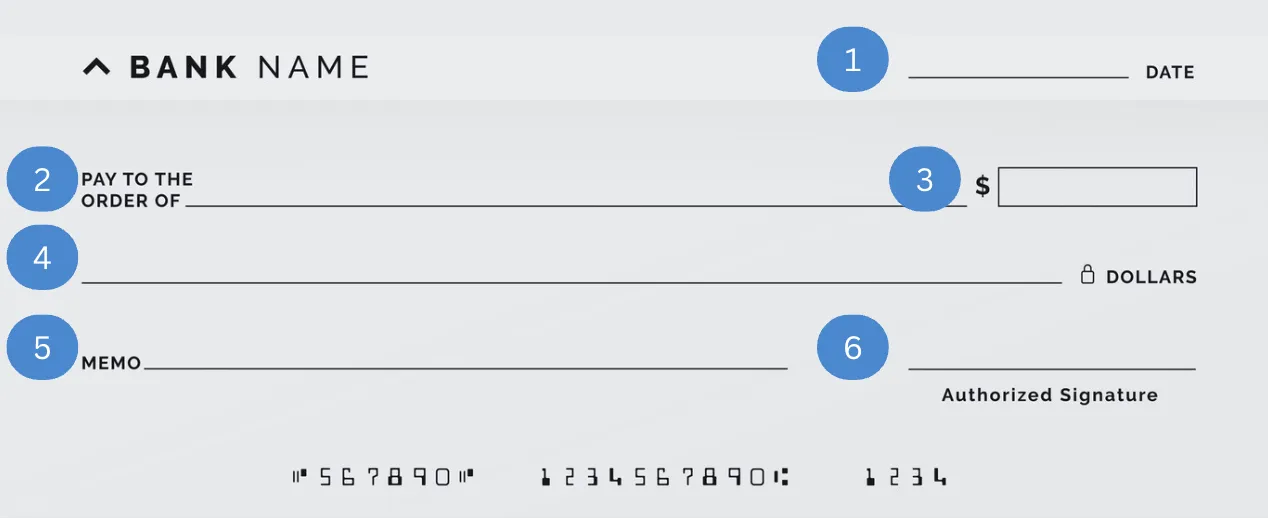
1. Write the Date
Remember that in the United States, the date format is mm/dd/yyyy.
2. Payee’s Name
Write the full name of the person to whom you are issuing the check, exactly as it appears on their official identification.
3. Amount in Numbers
Write the numerical amount clearly.
4. Amount in Words
Write the amount in words, including cents.
5. Add a Memo
You may include a note specifying the reason for the payment.
6. Sign the Check
Sign the check legibly in the space designated for the drawer.
7. Review the Information
Ensure that all information is accurate to avoid issues for the payee when cashing the check.
It is essential to complete checks legibly, without strike-throughs or corrections, as these may invalidate the document.
How to Correctly Write Numbers in Words on a Check
Writing amounts in words may be confusing when dealing with U.S. dollars. The following points should be kept in mind:
- Dollar amounts must be written in full words
- Cents must be written as fractions
- Avoid using dollar symbols or similar notations
- If there is leftover space at the end of the line, draw a line to prevent fraud
- For example, $1,000.75 is written as: One thousand and 75/100 dollars
Cash Checks and Manage Your Money Easily with Comun
As you can see, knowing how to fill out a check is useful for sending and receiving money in the United States. It is a reliable and accessible alternative if you do not have a banking account.
However, issuing and cashing a check can also require significant time and effort. That’s why you can skip the trip to the bank, avoid wasting time or money on gas, and cash your check directly from your phone using Comun—no lines, no questions, no complications.
Discover Comun, the only platform designed to serve the needs of immigrant communities in the United States, with support available in Spanish.
Why Choose Comun?
- Open your account with an official ID from your country
- Access a mobile app specifically designed for immigrants in the U.S.
- Make payments, receive your salary, and manage your finances
- Send money to your loved ones in LATAM for just a $2.99 transfer fee
Frequently Asked Questions
Still have questions about how to fill out a personal check? See our FAQ section.
What if I Make a Mistake Filling Out a Check?
If there are strike-throughs or inconsistencies in the amounts, the check must be voided and a new one used.
How Do I Void a Check?
Write the word VOID in large letters on the front of the check.
What Information Appears on the Back of a Check?
The back of the check contains the endorsement, meaning the payee’s signature for cashing the check.

Immigration
What is needed to obtain a Green Card in the United States?
8 min de lectura
Surely during your stay in the United States you have heard about the well-known Green Card or permanent resident card.
It is a document issued by the U.S. government that allows immigrants to reside and work legally and permanently.
For immigrants, obtaining it is of utmost importance, as it also opens the door to several benefits, such as legal protection, the right to purchase property, and the ability to apply for lawful permanent residence for family members.
Thousands of migrants in the United States often ask the big question: “How can I live legally in the United States?” We know how important it is for you to achieve better living conditions to support your family and loved ones. Therefore, below you’ll find a guide with practical steps, eligibility categories, and the documents needed to obtain a Green Card and change your life in the United States.
Eligibility categories for the Green Card
There are several paths to obtain a green card. To know which one to take, you need to be clear about both your immigration status and the eligibility category that applies to your profile.
Family-based Green Card
The first category refers to permanent residence granted through immediate family members who already have legal status in the United States.
It is divided as follows:
- Immediate relatives of U.S. citizens: spouses and unmarried children under 21.
You must wait for approval of Form I-130 and then apply for residence; there is no annual cap.
- Family preference category: unmarried children over 21 of citizens; spouses and children of permanent residents; married children of citizens; and siblings of citizens.
You must file Form I-485. For this, you must wait until your priority date becomes current on the Visa Bulletin. Otherwise, you can only file the I-130.
Employment-based Green Card
- EB-1 visa: individuals with extraordinary ability, such as distinguished professors or researchers.
- EB-2 visa: accomplished professionals with an advanced degree and exceptional ability.
- EB-3 visa: skilled workers, professionals, and “other workers.”
- EB-4 visa: special categories such as religious workers, U.S. government employees, members of the Armed Forces, among others.
- EB-5 visa: for investors who allocate substantial funds to businesses that create at least 10 jobs in the country.
Process to obtain a work-based visa
- The employer files the PERM Labor Certification, demonstrating that there are no qualified or available U.S. workers for the position. To do this, they must submit Form ETA-9089 to the Department of Labor.
- Once employment authorization is obtained, the employer must file Form I-140 with USCIS, along with the approved PERM certification.
- The employee must apply for adjustment of status via Form I-485 (if in the United States) or do consular processing at a U.S. embassy.
- For the EB-2 visa, applicants may choose the National Interest Waiver (NIW), which eliminates the need for PERM.
Remember that to work legally in the United States you must obtain an SSN. Before obtaining residence, migrants often use an ITIN to file their tax returns.
Green Card for special immigrants
- VAWA visa: victims of abuse by a U.S. citizen or permanent resident.
- SIJ visa: minors who have been abused or abandoned by their parents.
- In both cases, applicants must file Form I-360.
Green Card through refugee or asylee status
- People admitted through an asylum claim or refugee status, as well as their immediate family members.
- In both cases, applicants must be physically present in the United States for at least 1 year and then file Form I-485.
Other categories
In addition, there are other less common categories:
- Diversity Visa (Green Card Lottery): an annual lottery of up to 50,000 slots. Selectees receive a consular interview, though it does not guarantee a visa.
- Cuban Adjustment Act: a special adjustment program for Cuban nationals.
Each category has different eligibility requirements and processing times, so it is very important to consult U.S. government guidance and, if needed, seek the support of an immigration attorney.
Steps to apply for a Green Card
Once you know, in broad strokes, the requirements to obtain a Green Card, you need to be clear about the application process you must follow.
Determine eligibility
Before starting any process, review the categories above and determine which best fits your profile—family, employment, special immigrants, etc.
We recommend reviewing the Visa Bulletin to verify the documents required for your category and ensure you have them.
File the initial petition
Once you are clear on the category that applies to you, you must file the form indicated for that category, along with the required supporting documents, for example:
- Valid passport (required for any category).
- Evidence of the family relationship, such as birth or marriage certificates.
- Job offer letter.
Adjustment of status or consular processing
After your corresponding form is approved, you must apply for adjustment of status or consular processing and pay the fee required by the Department of State.
- If you are in the United States, file Form I-485 along with evidence of eligibility.
- If you are in another country, you must submit the DS-260 at a U.S. consulate. This is the immigrant visa application for permanent residence.
Interview and biometrics
In the next step, you must attend an adjustment-of-status appointment, at which USCIS will take your fingerprints, biometrics, photo, and signature.
You must also attend an interview to answer questions related to your eligibility category.
Receiving the Green Card
Finally, your Green Card will be mailed to your address. Make sure to check that all details are correct and keep it in a safe place.
After some time, you may apply for citizenship if you meet the necessary requirements.
Maintaining and renewing the Green Card
Once you have your green card in hand, you must keep track of renewal periods to avoid issues after the expiration date.
Renewal and replacement
- A regular Green Card is valid for 10 years.
- To replace your Green Card, you must file Form I-90 at least 6 months before the expiration date.
- The same form is also used in case of damage or loss.
Removal of conditions
- Applies to conditional residents with a 2-year Green Card, generally based on a recent marriage to a U.S. citizen.
- File Form I-751 for marriage-based cases or the corresponding form for your category.
- You must submit the documentation required by USCIS, as well as attend an additional interview.
Important rules
- If you change your address, be sure to report it to USCIS promptly.
- If for any reason you need to spend more than 6 consecutive months outside the United States, be sure to obtain a reentry permit (Advance Parole or Reentry Permit). Otherwise, you could risk losing your residence.
- Refrain from actions considered abandonment of residence, such as surrendering the card or voting in foreign countries.
- Keep an eye on your Green Card’s validity and renew it when appropriate.
Organize your financial life in the U.S. with Común
As you can see, the process of obtaining a Green Card is long and exhausting. Therefore, it is essential to understand the different categories, steps, forms, and the key points to maintain your permanent residence.
Another relevant point for improving your stay in the United States is having partners who understand your needs.
We present Común, the financial platform that addresses day-to-day needs through an intuitive mobile app, where you can easily open an account with qualifying official identification from your country of origin.
It also offers remittance services to several countries, helping your family receive more for less.
- Open a secure account with clear and competitive fees.
- Receive deposits and send remittances home.
- Get a debit card for daily expenses and financial control.
- Ability to save and plan your finances as you settle in the United States.
Open your account with Común today and get financial services tailored to you.
Frequently Asked Questions (FAQ)
If you still have questions, consult our FAQs.
Can I travel outside the U.S. while my application is in process?
You need to obtain Advance Parole (Form I-131), since leaving the country could cancel your application.
When can I apply for citizenship after obtaining a Green Card?
You must be a permanent resident for at least 5 years, or 3 if based on marriage, and have lived continuously in the United States and fulfilled tax obligations.
How long does the Green Card process take?
It depends on the category and whether you apply inside or outside the country. In general, the wait time is approximately 1 to 3 years.
How much does it cost to apply for a Green Card?
The cost varies by category. Check USCIS’s fee calculator to get a clear figure.
What is the difference between the I-485 and the DS-260?
The I-485 is the adjustment-of-status application to permanent resident filed within the United States, whereas the DS-260 is the immigrant visa application filed from another country.
What happens if your Green Card is denied?
You can appeal the decision via Form I-290B or refile the application.







Thousands of immigrants are already achieving more with their money. You can too.
Comun is a financial technology company and not a bank. Banking services are provided by Community Federal Savings Bank; Member FDIC. The Comun Visa® Debit Card is issued by Community Federal Savings Bank, pursuant to a license from Visa U.S.A Inc. and may be used everywhere Visa Cards are accepted.
Comun is a fintech company and not a bank or licensed money transmitter.
* Results may vary. For a complete list of eligible IDs and application requirements, follow this link.
^ No minimums, no maintenance fees. ATM or transfer fees may apply. See app for fee details.
‡ Direct deposit funds are typically available when we receive the payment file, up to two days before the scheduled payment date. This early availability is not guaranteed.
** A service provided by Service UniTeller, Inc. Service UniTeller, Inc. is licensed in all states that require a license. Remittance fees start at $2.99 but may vary. Please check the app for more details. Comun Inc. may earn revenue from the conversion of foreign currencies.
† Funds in your account are FDIC insured up to $250,000 by ownership category through Community Federal Savings Bank (CFSB), Member FDIC, in the event CFSB fails.