Financial Education
What is a W-2 form? Complete 2026 guide for immigrant workers in the U.S.
The W-2 is the most important tax document you receive as an employee in the U.S. Learn what it contains, when you receive it, and how to use it to file taxes in 2026.
8 min read

17 Jul 2026
.png)
What is a W-2 form? Complete 2026 guide for immigrant workers in the U.S.
A W-2 form is one of the most important tax documents employees receive in the United States. If you worked for an employer during the year, your W-2 shows how much money you earned and how much money was withheld for taxes.
For many immigrant workers, this may also be the first time dealing with U.S. tax documents. Understanding how to read a W-2, when you should receive it, and what to do if something is incorrect can help you file taxes more confidently and avoid delays during tax season.
This article is for informational purposes only and does not constitute legal or tax advice. It is recommended to consult a qualified tax professional for guidance specific to your situation.
What is a W-2 form?
A W-2 form, officially called the Wage and Tax Statement, is a tax document employers send to employees every year. The form reports: total wages earned, federal income taxes withheld, Social Security and Medicare taxes withheld, state or local tax withholdings if applicable.
The IRS requires employers to provide a W-2 to employees who earned wages during the tax year. You typically receive a W-2 if you are considered an employee of a company. Independent contractors and certain gig workers generally receive Form 1099 rather than a W-2.
When should you receive your W-2?
Employers must send W-2 forms to employees by January 31 of the year following the reported tax year. If you haven't received your W-2 by early February, contact your employer. If you still don't receive it, you can contact the IRS for assistance.
What information does the W-2 contain?
- Box 1: Wages, tips, and other compensation
- Box 2: Federal income tax withheld
- Box 3: Social Security wages
- Box 4: Social Security tax withheld
- Box 5: Medicare wages
- Box 6: Medicare tax withheld
- Boxes 15–17: State tax information
W-2 vs. 1099: what is the difference?
| W-2 employee | 1099 contractor |
|---|---|
| Employer withholds taxes | Worker usually pays taxes independently |
| May receive benefits | Usually no employer benefits |
| Employer generally has greater control over work duties | Worker has more independence |
| Receives W-2 in January | Receives 1099-NEC if eligible |
Can ITIN holders get a W-2?
Yes. Employees can receive a W-2 using an ITIN instead of an SSN. If you are legally working in the U.S. with work authorization but do not yet have an SSN, you can use your ITIN for tax purposes. However, remember that an ITIN does not authorize employment on its own. For more information about ITINs, visit comun.app/itin.
What to do if your W-2 has errors?
If you find errors on your W-2, such as an incorrect name, SSN/ITIN, or incorrect figures: contact your employer immediately to request a corrected W-2 (Form W-2c), wait for the corrected W-2 before filing your tax return, if you cannot get a correct W-2 in time, the IRS has procedures to help you.
FAQ
What is the W-2 form?
It is the Wage and Tax Statement your employer sends you each January, showing how much you earned and how much you paid in taxes the previous year.
When will I receive my W-2?
No later than January 31 of the year following the reported tax year.
What do I do if I don't receive my W-2?
First contact your employer. If unresolved, you can contact the IRS for assistance.
This article is for informational purposes only and does not constitute legal or tax advice. Común is a financial technology company and not a bank. Banking services are provided by Community Federal Savings Bank, Member FDIC.
About Común
Común aims to support the Latino community in the United States. It offers a debit account that can be opened with more than 100 valid Latin American IDs and an app available in Spanish.
Visit Común's website or download the app for free to learn more about the full offer and applicable terms.
Olivia Rhye
Community Partner

Financial Education
ITIN vs SSN: what's the difference and why does it matter?
8 min de lectura
ITIN vs SSN: What's the difference and why does it matter?
If you are authorized to work in the United States, you need a Social Security Number (SSN). If you are not eligible for an SSN but still need to file taxes or access certain financial services, you may need an Individual Taxpayer Identification Number (ITIN).
If you recently moved to the United States, you have probably heard the terms 'ITIN' and 'SSN' many times already. They often come up when opening a bank account, filing taxes, applying for work, or trying to build credit.
Understanding the ITIN vs SSN difference matters because each number serves a different purpose in the US financial and tax system.
What is an SSN?
A Social Security Number (SSN) is a nine-digit identification number issued by the Social Security Administration. It is primarily used to track earnings, taxes, and eligibility for certain federal benefits.
SSNs are generally issued to:
- US citizens
- Permanent residents
- Certain noncitizens authorized to work in the US (for example: people with work visas, some asylum applicants or refugees)
An SSN is required for legal employment, payroll reporting, and access to some government programs.
What is an ITIN?
An Individual Taxpayer Identification Number (ITIN) is a tax processing number issued by the Internal Revenue Service, known as the IRS. ITINs are designed for people who are not eligible for an SSN but still have US tax filing obligations or need access to certain financial services.
An ITIN can be used by:
- Immigrants without SSN eligibility
- Dependents or spouses of US residents or visa holders
- International students or temporary visa holders in certain situations
- Individuals required to file US taxes
It is important to note that an ITIN does not authorize someone to work in the United States.
ITIN vs SSN Comparison Table
| Characteristic | ITIN | SSN |
|---|---|---|
| Issued by | IRS (Internal Revenue Service) | SSA (Social Security Administration) |
| Who is it for? | Individuals not eligible for an SSN with US tax obligations | US citizens, permanent residents, and authorized workers |
| Authorizes work | No | Yes |
| Used for paying taxes | Yes | Yes |
| Federal benefits access | No | Yes |
| Open an account (debit/checking) | Some banks and financial institutions accept ITINs (including Común) | Yes |
| Build credit | Possible at institutions that report ITIN activity to credit bureaus | Yes |
| How to apply | IRS Form W-7 with required documentation | SSA Form SS-5 with eligibility documents |
Which one do I need?
You need an SSN if:
- You are a US citizen
- You are a permanent resident
- You are legally authorized to work in the United States
- Your employer requires it for payroll and tax reporting
You may need an ITIN if:
- You are not eligible for an SSN
- You still need to file taxes in the United States
- You want to access and open financial accounts
- You want to begin building a financial history
Many recent immigrants apply first for an ITIN while they are still navigating the US financial system or while they're waiting for changes in their work authorization status.
Can I have both an ITIN and an SSN?
Yes, in some situations a person may have both at different stages of their life. For example, someone may initially receive an ITIN because they are not eligible for an SSN at the time. Later, if they become eligible for work authorization or permanent residency, they may receive an SSN. When this happens, the SSN becomes the primary identification number used for taxes and financial reporting.
What can I do with each?
An SSN can be used to:
- Work legally in the United States
- Receive wages through payroll systems
- File taxes
- Access certain federal benefits if eligible
- Open debit card and checking accounts
- Apply for loans and credit products
- Build credit history
An ITIN can be used to:
- File taxes with the IRS
- Open debit card and checking accounts at institutions that accept ITINs
- Build credit with lenders that report ITIN activity
- Establish financial history in the US
Can you work with an ITIN?
An ITIN itself does not authorize employment in the United States. It is primarily a tax identification number used for IRS reporting purposes.
Does an ITIN build credit?
An ITIN may help some people begin building credit history in the United States. Certain banks, lenders, and financial platforms report account activity linked to ITINs to credit bureaus. Policies vary by institution.
How can I apply for an ITIN?
Applying for an ITIN generally involves submitting:
- A completed IRS Form W-7
- A valid federal tax return (unless you qualify for an exception)
- Proof of identity and foreign status
The IRS may request original documents or certified copies depending on the situation. Processing times may vary.
How can I apply for my ITIN with Común?
If you need or want help with the application process, Común offers ITIN application support for $199 with a money-back guarantee if the application is not approved. Visit comun.app/itin to learn more.
Requirements to apply for an ITIN with Común:
- You must live in the U.S.
- You must have a valid passport with an expiration date more than 6 months from the date of your application
- You will need to file your taxes to apply for an ITIN
The process:
- We recommend you open a debit account with Común from your mobile phone
- Complete the application form at comun.app/itin and submit your payment
- Upload a scan of your passport
- If you choose to file your taxes along with your ITIN application, upload documentation of your income from the previous tax year
- Común's agents will contact you via email if they have any questions
- Print, sign, and submit your completed official ITIN application (Form W-7)
- Común's agents will submit your application to the IRS
The application process does not consider your immigration status, and your status will not be reported to any government immigration authority.
Open your Común Account
A debit account can be a great first step to building your financial future in the United States. Común allows customers to open a debit account using ITIN, passport, country-of-origin ID, or more than 100 accepted Latin American valid IDs. You can open your Común account from your phone. The app is available in Spanish. Visit comun.app to learn more.
FAQ
What is the difference between ITIN and SSN?
An SSN is issued by the Social Security Administration primarily for employment, taxes, and federal benefits eligibility. An ITIN is issued by the IRS for people who are not eligible for an SSN but still need to file taxes or access certain financial services.
Can I have both ITIN and SSN at the same time?
In some situations, yes. A person may first receive an ITIN and later become eligible for an SSN. Once an SSN is assigned, it generally becomes the primary number used for taxes and financial reporting purposes.
Can I work legally in the US with an ITIN?
An ITIN alone does not authorize employment in the United States. It is primarily used for tax identification and reporting purposes through the IRS.
Do I need an SSN to open an account?
Not always. Some financial institutions, including Común, allow customers to open debit accounts using an ITIN, passport, or other forms of identification.
How do I apply for an ITIN?
Applying for an ITIN generally requires completed IRS Form W-7, identity documentation, and a filed federal tax return. The IRS may also request certified supporting documents.
How long does the ITIN application take?
Processing times can vary depending on the time of year and the completeness of the application. In many cases, ITIN applications may take several weeks to process after submission to the IRS.
Immigration
ITIN vs. SSN: What's the Difference and Why Does It Matter?
8 min de lectura
What Is an SSN?
A Social Security Number (SSN) is a unique nine-digit code assigned by the U.S. Social Security Administration (SSA) to citizens, permanent residents, and certain eligible temporary residents. Originally designed to manage Social Security benefits, the SSN is now widely used for tax filing, credit history, and access to government services.
People must submit their SSN application to the address provided by the Social Security Administration.
Key facts about SSNs:
- Eligibility: U.S. citizens, permanent residents, and certain non-citizens authorized to work are eligible for an SSN.
- Uses: SSNs are used for employment, tax filing, Social Security benefits, and access to government services.
- Financial access: SSNs are often required to open bank accounts, apply for credit, and get loans.
An Individual Taxpayer Identification Number (ITIN) is also a nine-digit number, but it's issued by the IRS (Internal Revenue Service) rather than the SSA. People must file Form W-7 to apply for an ITIN. The ITIN is specifically for people who are required to file U.S. tax returns but aren't eligible for an SSN. This includes non-citizens without legal work authorization in the U.S., foreign investors, and dependents of U.S. citizens or residents.
An ITIN is required to file a U.S. tax return and is also used to submit a federal tax return.
Key facts about ITINs:
- Eligibility: ITINs are available to non-citizens who are required to file U.S. taxes but don't qualify for an SSN.
- Uses: ITINs are used solely for tax filing purposes and don't authorize work or provide eligibility for Social Security benefits.
- Financial access: While ITINs can be used to open bank accounts and apply for credit at some institutions, they don't grant the same level of access as an SSN.
Differences Between ITIN and SSN
The main difference between an ITIN and an SSN comes down to who can get them and what they're used for:
- Eligibility:
- SSN: Issued to U.S. citizens, permanent residents, and certain temporary residents authorized to work.
- ITIN: Issued to non-citizens who are required to file taxes but aren't eligible for an SSN. The number of days present in the U.S. affects residency status for tax purposes.
- Purpose:
- SSN: Used for a wide range of activities, including employment, tax filing, and access to Social Security benefits.
- ITIN: Used exclusively for tax filing and reporting by non-citizens without SSNs. An Employer Identification Number (EIN) is used for business entities, estates, and trusts.
- Legal status:
- SSN: Grants work eligibility and access to certain government benefits.
- ITIN: Does not grant work authorization or eligibility for Social Security benefits.
- Access to financial services:
- SSN: Provides broader access to financial services, including easier access to credit, loans, and government benefits.
- ITIN: While it can be used to open bank accounts and access some financial services, options are more limited compared to what's available with an SSN.
ITIN vs. SSN: Why Does the Difference Matter?
Understanding the difference between an ITIN and an SSN matters for several reasons:
- Tax compliance: Knowing which number to use is crucial for filing taxes correctly. Using the wrong identifier can result in errors, penalties, or delays in processing refunds. For U.S. citizens or residents, it's essential to use the correct identifier, such as an SSN or an Adoption Taxpayer Identification Number (ATIN), when an SSN can't be obtained in time for tax filing.
- Access to financial services: The type of tax ID you have can affect your access to banking, credit, and other financial services. For example, some banks and credit unions accept ITINs, while others may require an SSN.
- Employment eligibility: An SSN is required to work legally in the U.S. If you're a non-citizen without work authorization, applying for an SSN can lead to legal complications. In those cases, an ITIN is the appropriate identifier for tax purposes.
- Government benefits: An SSN is required to receive Social Security benefits and other government services, which aren't accessible with an ITIN.
Conclusion
Both the ITIN and the SSN play critical roles in the U.S. financial and tax systems, but they serve different populations and purposes. Understanding the differences between these identifiers is essential for anyone navigating tax filing, financial access, and legal employment in the U.S. Whether you're a U.S. citizen, a non-citizen authorized to work, or a foreign investor, knowing which number you need — and why — can help you avoid potential legal issues and ensure you have the financial access your circumstances require.

Financial Education
What Is Direct Deposit?
8 min de lectura
Direct deposit is an electronic transfer that deposits your paycheck or benefits straight into your bank account, with no physical check required. It's the most common way employers pay in the U.S. With Común, you can receive your direct deposit and access your money up to 2 days before payday.
Direct Deposit Definition
Direct deposit is an electronic funds transfer method that lets an entity — an employer, the government, etc. — deposit money directly into the recipient's bank account. Unlike paper checks, this process eliminates the need to issue, deliver, and cash physical checks, saving time and resources.
Common Uses of Direct Deposit
- Employee payroll: One of the best-known uses of direct deposit is payroll management at companies. Instead of issuing checks to each employee, companies can deposit wages directly into employees' bank accounts.
- Government payments: Governments also use direct deposit to distribute payments to citizens, such as pensions, unemployment benefits, and tax refunds.
- Money transfers: People can also use direct deposit to send and receive money between bank accounts, making it easier to handle transactions and payments between friends, family, and businesses.
Advantages of Direct Deposit
- Speed: One of the biggest advantages of direct deposit is how fast the funds transfer happens. Direct deposits generally process faster than paper checks, letting recipients access their money sooner.
- Security: Direct deposit is a safer method than paper checks, since it reduces the risk of theft, loss, or check fraud.
- Time and resource savings: By eliminating the need to issue, deliver, and cash physical checks, both companies and recipients save time and resources. Direct deposit is also more environmentally friendly, since it reduces the amount of paper used in financial transactions.
- Control over your money: Direct deposit lets recipients access their money quickly and conveniently, giving them more control over their personal finances.
How to Set Up Direct Deposit
With mobile apps like Común, you can connect your direct deposit to your bank account in seconds. Común lets you connect your direct deposit right from the Común app, or if you'd rather your employer handle it, Común gives you a pre-filled form to hand to your employer. On top of the convenience, connecting your direct deposit with Común means the Común app gets you your pay up to two days early.
Conclusion
Direct deposit is a modern financial solution that offers speed, security, and convenience when transferring funds. Whether for payroll, government payments, or personal transfers, direct deposit has become a preferred way to handle transactions and manage money. Ultimately, this method simplifies our financial lives so we can focus on what really matters.
FAQ Schema (translate the JSON-LD block too — paste into the same embed)
Marcela/Eduardo: this post already has an FAQPage schema embed in Spanish. Translated version below — swap the text field, keep the JSON structure identical.
Q: What is direct deposit?
A: Direct deposit is an electronic transfer that sends your paycheck or benefits straight to your bank account, with no physical check needed. It's the most common way employers pay in the U.S.
Q: How do I set up direct deposit with Común?
A: To set up direct deposit with Común, you need your account number and routing number. You'll find them in the Común app, in your account section. Share them with your employer or HR.
Q: How long does direct deposit take to arrive?
A: Direct deposit usually arrives on the payday your employer sets. With Común, you can get paid up to 2 days early.
Q: Do I need an SSN to receive direct deposit?
A: Not necessarily. With Común, you can open an account using official ID from your home country and receive direct deposit without an SSN.
Q: What's the difference between direct deposit and a bank transfer?
A: Direct deposit is initiated automatically by your employer or payer every pay period. A bank transfer is something you initiate manually from your account. Direct deposit is faster and requires nothing further from you once it's set up.
Q: Is direct deposit safe?
A: Yes. Direct deposit is safer than a physical check because the money goes straight to your account with no risk of loss or theft. Común accounts are backed by CFSB, Member FDIC.
.avif)
Immigration
What is SSN? Everything you need to know if you are a resident in the U.S.
8 min de lectura
An SSN (Social Security Number) is a 9-digit number issued by the U.S. government. It is required for working legally, filing taxes, and accessing financial services in the United States. As an immigrant, you may apply for an SSN if you have an eligible visa or Green Card — or use an ITIN as an alternative. If you have newly arrived in the U.S., you likely have questions about how to handle certain procedures. Therefore, we will explain what the SSN is, what it is for, how to apply for it, how much it costs, and what the benefits are of having this identifier.
What is the Social Security Number (SSN)?
The Social Security Number (SSN) is a series of 9 digits issued by the Social Security Administration (SSA, or Administración del Seguro Social in Spanish). It is issued to citizens, permanent residents, and eligible temporary residents, in accordance with their immigration status.
Its main function is to serve as a unique identification number that allows the government to track specific data for each person, such as their income, financial information, and employment history. This makes it possible to determine, in each particular case, eligibility to access Social Security benefits such as retirement, disability, among others.
In addition to facilitating access to these benefits, the Social Security card serves as official identification for employment onboarding, driver’s licenses (in some states), and opening bank accounts.
How to obtain the Social Security Number in the United States?
An important point about the Social Security Number in the U.S. is that there are three different types:
- For citizens born in the United States
- For citizens born abroad
- For non-citizens with lawful resident status
In the case of lawful permanent residents, it is necessary to obtain a Green Card or a visa with valid work authorization issued by the Department of Homeland Security (DHS), such as H-1B or L-1.
The process of obtaining the SSN varies depending on immigration characteristics. If you requested the SSN during your visa processing—through the “Application for Immigrant Visa and Alien Registration” form or the DS-260 electronic format, “Immigrant Visa Electronic Application”—DHS will contact the Social Security Administration directly to carry out the process.
Get your SSN in just 4 steps
If you did not request the SSN during your visa process, the first thing you should do is gather the following documentation:
- A valid passport with the Machine Readable Immigrant Visa (MRIV) or a Permanent Resident Card (Form I-551)
- Birth certificate
Once you have gathered the documentation, follow these steps:
- Download and complete the SS-5 application
- Go to an SSA office
- Present the original documents
- Wait 7 to 14 days to receive the Social Security card by mail
What to do if your SSN card is lost?
If your Social Security card is lost, it is important to take security measures immediately to avoid identity theft, fraud, or misuse of your personal data.
Report the theft or loss of this document to the police and then file a complaint with the Federal Trade Commission (FTC).
Afterwards, go to the Social Security Administration, complete the SS-5 form again, and bring the corresponding documents for replacement of the card.
Avoid carrying the card with you unless necessary and keep it in a safe place. Generally, you do not need to present your physical card but rather the number, which does not change even if you replace the card.
5 benefits of having an SSN
If you are still wondering what the SSN is for, you should know that this document provides multiple benefits of different kinds, such as the following:
1. Employment
For permanent residents, the greatest benefit of the SSN is that it grants work authorization, enables income tracking, as well as the payment of taxes and legal obligations. Presenting this document is an indispensable requirement during formal hiring processes in the United States.
2. Credit
The SSN is also typically required to apply for loans and credit from banks and financial institutions in the United States; in this way you can access assets such as real estate, a car, or other types of services.
3. Banking services
Accessing financial services is essential for immigrant workers in the United States, whether to receive wages or send money to their countries of origin. Generally, the SSN is a requirement to access a bank account and credit and debit cards, among other services.
4. Government benefits
There are other benefits available, such as unemployment insurance in the event of dismissal, and access to retirement and Medicare starting at age 65, for eligible permanent residents.
5. Taxes
The SSN functions as the taxpayer’s personal identification number, which makes it easier to file tax returns and report income and expenses. Another alternative for residents who do not have an SSN is the ITIN, issued by the Internal Revenue Service (IRS), which serves to fulfill tax obligations and grants other benefits.
In short, the Social Security Number—beyond being an administrative procedure—facilitates economic and social integration in the United States because it serves to track income and expenses and facilitates access to basic rights such as work, health, and banking, which are essential for integrating into society.
How much does it cost to get an SSN?
It is important to clarify that the Social Security card process does not involve any cost, whether you do it for the first time or as a replacement due to theft or loss.
Stay alert to potential fraud and avoid making payments to unauthorized third parties. If you have any doubts, go directly to your local Social Security office and report any suspicious activity.
Read more: Don’t miss our guide to investment basics for immigrants
Simplify your financial life upon arriving in the United States with Comun
As you can see, the SSN is highly relevant to establishing a stable life in the United States because it facilitates access to work, health services, and financial products that are essential for carrying out daily tasks such as payments and money transfers.
Comun is a financial platform designed to make life easier for immigrants in the United States by facilitating their integration into the financial system from day one.
- Open your account with an official ID from your country of origin
- Receive a Visa debit card and make purchases easily in physical stores and online
- Access a mobile application and manage your finances from the palm of your hand
- Send remittances to your home country for a fee starting at $2.99 USD, up to the applicable limits
- Forget about hidden fees and complicated processes
- Access support available in Spanish and English
With Comun, discover the most accessible way to manage your finances for everyday life in the United States.
Frequently Asked Questions
If you still have questions, consult our Frequently Asked Questions section.
What should I do if someone uses my SSN without permission?
Report immediately at IdentityTheft.gov and place a fraud alert.
How many times can I replace my SSN card?
Up to 3 times per year and a maximum of 10 times in your lifetime.
Is it mandatory to have an SSN to open an account with Comun?
Comun allows you to open an account with official ID from your country.
Financial Education
How to Set Up Bill Pay in Online Banking
8 min de lectura
Linking payments in online banking lets you connect external accounts or cards to manage your finances in one place. With Común you can link an external debit card from another U.S. bank to send and receive payments.
Banking security systems often decrease once transactions become recurring in the same destination account. This process is called enrollment, and it can be useful for speeding up payment and debt processes. In this article we will tell you why it is necessary to enroll payments, and which protocols are used by platforms to establish payment enrollment.
Why Is It Useful to Enroll Payments in Online Banking?
We will point out the aspects that make it necessary to enroll payments on the bank platform where you keep your money, and the reasons are as follows:
- Security levels: It is necessary that you establish which people or services you make frequent, occasional, or one-time payments to. In this way, some will need to be controlled through security factors such as coordinates, random codes, or another authentication element required by the bank.
- Practicality: You have the ability to speed up the payments you make through your app. That way you do not have to wait for additional security elements to complete them.
- Avoid duplicate tasks: With enrollment you do not need to have the details on hand to make the transfer (deposit or payment) to the account. It is simply stored in a database. Then, by simply selecting the service or person you are going to pay, you can select it with one click and streamline the process.
- Control: By enrolling the account you can view the person or institution. You can also remove it from your database if you determine that the payment is no longer recurring. The process of removing it from the database involves a small protocol. The purpose is to ensure that you are truly ending your financial relationship with the person or entity that owns the account.
Requirements to Enroll Payments in Online Banking
One of the requirements for carrying out this process is having, in the bank platform’s database, the ability to speed up the deposit or payment process. To do so, you must have the following:
- The same mobile phone: Used to authenticate banking operations.
- Have some additional two-factor authentication elements granted by the bank under its security protocols (in some cases this requirement is optional).
- Email address: This applies if an authentication code is sent through this channel.
How to Enroll Payments in Online Banking
At first, enrollment can be somewhat cumbersome. But you will get used to doing it and establishing the criteria that indicate payments or deposits are recurring. For this, it is necessary to explain the general enrollment steps, which are the following.
Steps to Add the List.
- Log in to the bank platform by entering your username and password.
- After entering the platform or app, find the "Enroll payments" option in your bank’s menu and click it.
- It will display a list of the people you have enrolled; if it is empty, it is time to add to the list.
- Find the "Add" option
When Adding, do the following.
- Select the payment category.
- Enter details such as: First and last name, ID card or ID (depending on the region), account number.
- Accept the details and an authentication code will be sent to you (by email or through your mobile phone).
- Enter the code sent.
- Done! You now have the account number enrolled.
aWhat does it mean to link payments in online banking?
It's the process of connecting an external account or card to your financial app so you can move money between them or make payments directly.
How do I link an external card in Común?
From the app, add your external debit card (from a U.S. bank, in your name). Común verifies the card with a micro-deposit you confirm in the app.
What can I do once I've linked my external card?
Send and receive payments and remittances using that card, even if you don't have funds in your Común balance.
Frequently asked questions
What do I need to link an external card to my Común account?
A valid debit card, issued in the U.S., in your name.
How does Común verify the card is mine?
With a micro-deposit of less than $1.00 that you confirm in the app.
Can I link a credit card?
No, Común only accepts personal debit cards, not credit or prepaid cards.
How many cards can I link?
Up to 2 debit cards during your first 60 days with the account.
Why can't I link my card?
Common reasons include the name not matching, the card not allowing funds to move both ways, or it not being issued in the U.S.
Is it safe to link an external card?
Yes, Común never asks for your bank password during the verification process.

Living in the United States
Learn about the 11 U.S. holidays and how they affect you
8 min de lectura
Starting a life in the United States means adapting to a new culture and customs that can interfere with everyday activities such as going to school, working, and carrying out important banking transactions.
Knowing the month-by-month celebrations in the United States lets you plan ahead—especially if you need to send remittances to your home country, plan trips, or make important payments.
This guide explains the main U.S. holidays, the differences between state and federal holidays, and how they affect work, school, and banking hours.
What are holidays in the United States?
U.S. holidays are special dates commemorating historical or cultural events. They may be observed at the federal or state level.
- Federal holidays
These are declared by the federal government. On these dates, banks, government offices, and federal services close. One example is Independence Day.
- State holidays
These are declared by state governments and apply only within that state.
Labor laws do not mandate overtime or premium pay on holidays, but some employers offer holiday pay.
Time off is only mandatory for federal employees; in the private sector it depends entirely on the employer. In some industries—such as tourism and hospitality—it’s common to work on holidays, with compensation determined by the company.
List of national holidays in 2025
There are 11 federal holidays in the United States to keep in mind. On these dates, banks and government offices typically close. This can delay remittance transfers.
Be sure to schedule transfers in advance so they don’t overlap with U.S. holidays and your money arrives without issues.
New Year’s Day – January 1
Celebration of the start of the year. Banks and public offices remain closed.
Martin Luther King Jr. Day – third Monday in January
Honors the memory of civil-rights leader Martin Luther King Jr.
Presidents Day – third Monday in February
Commemoration honoring George Washington and all U.S. presidents.
Memorial Day – last Monday in May
Commemorates members of the Armed Forces who died in service.
Juneteenth – June 19
Marks the end of slavery in the United States.
Independence Day – July 4
Celebration of the Declaration of Independence. One of the most important holidays.
Labor Day – first Monday in September
Celebration dedicated to the nation’s workers.
Columbus Day – second Monday in October
Marks Christopher Columbus’s arrival in the Americas in 1492.
Veterans Day – November 11
Commemoration recognizing all who served in the Armed Forces.
Thanksgiving Day – fourth Thursday in November
A family tradition dedicated to giving thanks for the harvest and the good moments of the year.
Christmas Day – December 25
The birth of Jesus; a widely observed religious and cultural celebration.
How holidays impact immigrants and families
Knowing what’s celebrated today in the United States helps you plan your day and be aware of possible workplace benefits you might be eligible for.
Work:
If you work in sectors such as hospitality, restaurants, or cleaning, you may have to work on holidays. Ask your employer whether double pay, shift changes, or other compensation applies.
Finances:
On federal holidays, banks and post offices close, which can delay financial operations such as deposits and international transfers. If you need to send money to family, do so before these dates.
Schools and procedures:
Public and private schools close on federal holidays. USCIS staff also do not work, so immigration processes are delayed.
Tips to organize your money and time
Don’t let holidays catch you off guard. Set aside a monthly budget for travel, daily expenses, and other activities.
Keep a payment calendar that accounts for holidays so you can make payments without setbacks.
Culturally important celebrations in the U.S. for immigrants
Beyond official dates, there are others that matter culturally to immigrant communities. They may not significantly affect institutions or businesses, but they’re still worth noting if you plan to budget for a celebration.
Battle of Puebla – May 5
A date that has also gained relevance among U.S. residents. Although many mistakenly link it to Mexico’s Independence Day, it actually commemorates victory over the French army.
Mother’s Day
In the U.S. it’s observed on the second Sunday in May, though immigrant communities may choose the customary date in their countries of origin.
Father’s Day
Observed on the third Sunday in June, though it can vary. It’s a day of family togetherness for many immigrants.
Halloween – October 31
A tradition that crosses borders; it’s very popular among immigrant communities who enjoy dressing up and having fun with kids.
Valentine’s Day – February 14
A popular holiday to celebrate love and friendship, spend time together, and give and receive gifts.
Day of the Dead – November 1–2
A Mexican tradition honoring the departed through altars, food, flowers, and music.
Organize your finances on holidays and send your money with Común
This article outlined the U.S. holidays and how they affect public and private operating hours.
Holidays shouldn’t keep you from meeting your financial obligations. Make sure you have an ally to help you plan your budget.
Get to know all the benefits of Común!
Transfer money from the United States to Latin America with clear, competitive fees, up to applicable limits (check terms in Común’s mobile app).
Discover the platform designed for immigrants—with shared interests, language, and goals: bringing families closer through accessible, secure financial solutions.
Open your Común checking account today and manage your money in the U.S. safely and without complications.
Frequently Asked Questions (FAQ)
If you still have questions, see this section.
What happens with banks and remittances on holidays?
On national holidays, banks and post offices are closed. This means money transfers can take 1–2 extra days to complete.
Do all workers receive extra pay on holidays?
The law doesn’t require double pay on holidays, but some employers offer this benefit.
What are the most important holidays for the immigrant community?
For immigrant communities, the most relevant holidays include Christmas, Mother’s Day, and the Day of the Dead, among others.

Financial Education
Quick guide on how to call Mexico from the USA
8 min de lectura
How to call Mexico from the United States easily and affordably
There’s no doubt about the impact the Mexican community has had in the United States due to the number of immigrants who have arrived in recent decades and who, despite the distance, need to stay in touch with their loved ones.
One of the most common points of confusion when making an international call has to do with the order of the required codes. However, with the right information, placing a call from the United States to Mexico is very simple.
Below, we’ll show you step by step how to dial, practical examples for major cities, as well as modern options to save money no matter how long you’re on the phone with your loved ones in Mexico.
Basic steps to call Mexico from the USA
To connect a phone call from the United States to Mexico, you need three basic pieces of information: the exit code, Mexico’s country code, and the local number.
These are the steps to call Mexico.
Dial the international prefix
011 from a U.S. landline or “+” from a mobile phone.
Add Mexico’s country code
The code is 52.
Dial the 10-digit national number
Include the area code plus the local number
Practical examples:
- Mexico City: 011 + 52 + 55 123 1234
- Guadalajara: 011 + 52 + 33 123 1234
- Monterrey: 011 + 52 + 81 123 1234
It’s important to clarify that it used to be necessary to add the prefix 1 for cell-phone calls, but this requirement was eliminated in 2019.
Area codes and example calls to Mexican cities
In Mexico, each city has an area code (lada) made up of 2 or 3 digits. Taking that into account, all Mexican phone numbers have 10 digits in total.
Below is a table with examples of how to dial from the United States to Mexico.
City
Area Code
Dialing example from the United States
Mexico City
55
011 + 52 + 55 + ########
Guadalajara
33
011 + 52 + 33 + ########
Monterrey
81
011 + 52 + 81 + ########
Puebla
222
011 + 52 + 222 + #######
Tijuana
664
011 + 52 + 664 + #######
León
477
011 + 52 + 477 + #######
Querétaro
442
011 + 52 + 442 + #######
Mérida
999
011 + 52 + 999 + #######
Cancún
998
011 + 52 + 998 + #######
Chihuahua
614
011 + 52 + 614 + #######
Modern and more affordable options for calling Mexico
Long-distance calling used to be very expensive, especially when made directly— a drawback for people who wanted to keep in touch with family abroad since costs were charged per minute.
Fortunately, today you can choose far more affordable alternatives that also offer unlimited minutes and other communication benefits such as messaging and video calls.
These are the most popular low-cost options for calling Mexico from the United States.
VoIP apps and services over Wi-Fi
VoIP (Voice over IP) apps are one of the most accessible alternatives for communicating with people worldwide.
The main advantage of mobile apps is that they allow domestic and international calls over a Wi-Fi or data connection. This significantly reduces costs and eliminates the need for local phone coverage, though a good internet connection is important.
WhatsApp is a popular app of this kind, given its large user base and a variety of features beyond calls, such as voice notes, voice dictation, video notes, and video calls.
Other similar alternatives include Skype, Google Voice, and Telegram.
International plans from your carrier
If you want to make long calls and not rely on Wi-Fi, a recommended alternative is to get an international plan with included or unlimited minutes to Mexico.
For example, Verizon Global Calling has a plan that includes unlimited minutes to Mexico and Canada.
If you’re still in Mexico, Telcel offers international roaming packages and eSIM for travelers.
Prepaid calling cards
Another solution for calling Mexico is using a prepaid calling card.
Here are some examples.
Company | Cost | Validity/Expiration Enjoy Prepaid | From 0.9¢/min to landlines, 2.9¢/min to mobiles. | After 183 days of inactivity. BOSS Revolution | 1.9¢/min to landlines and mobiles. | Credit remains while the user is active. Calling Card Plus | From 0.8¢/min to landlines and 2.5¢/min to mobiles. | Depends on the plan; may include per-minute rounding or a weekly charge.
Company
Cost
Validity/Expiration
Enjoy Prepaid
From 0.9¢/min to landlines, 2.9¢/min to mobiles.
After 183 days of inactivity.
BOSS Revolution
1.9¢/min to landlines and mobiles.
Credit remains while the user is active
Calling Card Plus
From 0.8¢/min to landlines and 2.5¢/min to mobiles.
Depends on the plan; may include per-minute rounding or a weekly charge.
Bundles with included minutes
A bundle is a package that, in addition to international calls, includes other related services. For example, Verizon Global Choice offers 300 minutes for $10 per month.
Practical tips for immigrants
Taking care of your finances is essential to stay in touch with your family in Mexico. Here are some tips to keep you connected.
- Use apps over Wi-Fi whenever possible: they’re a very affordable alternative, as long as you have a good internet connection.
- Compare rates from different companies: take time to review each provider’s international rates as well as specific terms.
- Consider family bundles or special plans for Mexico: given the geographic proximity between Mexico and the United States, there are several communication options designed for families who frequently contact relatives.
Stay connected with your family in Mexico thanks to Común
In this article, we showed you how to call Mexico from the United States with the correct code sequence, via mobile and landline. We also shared tips to keep in touch with your family through more accessible means such as mobile apps and international plans with minutes to Mexico.
In addition to staying in touch with family, Mexican immigrants also often need services that let them send money home.
- Discover the benefits of Común, the platform that brings you closer to the people you love most!
- Checking account with clear, competitive fees.
- Accessible international money transfers.
- Común’s mobile app is available in Spanish and accepts more than 100 eligible official IDs for account opening.
- Debit card for everyday purchases and payments.
Don’t lose touch with your country! Open your account with Común and connect with the financial platform dedicated to shortening the distance.
Frequently Asked Questions (FAQ)
If you still have questions, see this section.
What happens if I dial the number without the 011 prefix?
If you don’t dial 011 or “+” on mobile phones, your call won’t be recognized as international and will either connect as a local call or return an error.
Is it better to use apps or international calling plans?
It depends on your needs. Apps are an excellent alternative but depend on a good internet connection. International plans require a SIM, but they offer more stable calls along with other communication services.
Which option is best for saving money?
A very convenient option to save money is an app like WhatsApp, since it works over an internet connection.
How can I dial an 800 number from the United States to Mexico?
800 numbers are toll-free within Mexico, but from the United States they do carry a cost. To dial, you must enter the exit code and the country code.
Another option is to look for that institution’s alternate number for international calls.

Instant payments
Discover how to sign up for Zelle and move your money without complications
8 min de lectura
Are you looking for an option to send and receive money within the United States? In the digital era, it is essential to have access to an immediate, secure, and free transfer service.
Sometimes sending and receiving money can be challenging due to high fees or limited access to the banking system. For this reason, knowing how to register for Zelle and learning about alternative solutions such as Comun will be extremely useful for sending money without complications through the most efficient services.
In this guide, we will explain what Zelle is, how to register, what requirements are necessary to send and receive money, and why Comun works as a complementary solution to expand your options when facing restrictions that could hinder your access to mobile payment services.
What Is Zelle and How Does It Work for Your Daily Payments?
Zelle is a digital P2P (peer-to-peer) payment service available in the United States. It is associated with more than 20,200 traditional and digital banks and credit unions, such as Bank of America, Wells Fargo, Ally Bank, Capital One, and Navy Federal Credit Union. Zelle is well known for its wide coverage and ease of transferring funds between users of this system.
Other advantages of Zelle include:
- Near-Instant Transfers
Users can receive their money within minutes. - Ease of Use
It is directly linked to bank applications, eliminating the need for an external app. - Security
It is backed directly by banking institutions, so you can be confident that your money will reach its destination. - Usage Fees
You can send and receive money without paying commissions to other Zelle users.
Please note that Zelle is only available within the United States. If you need to make international transfers, find the best options here.
How Does Zelle Work?
Zelle operates through its connection with their affiliated banks’ applications. To send and receive money, you must first verify that your bank is part of this service’s network.
If so, complete your registration directly through your bank’s online platform and begin sending and receiving money to your account using a phone number or email address.
Using Zelle is very practical for daily transactions such as paying rent or purchasing goods and services. It is also a secure way to send money to family and friends.
In addition to Zelle, there are other alternatives for sending and receiving money within the United States. Discover the 6 best mobile apps of 2025.
What Changed in Zelle in January 2025?
Zelle announced an important change in its application that took effect in April 2025. The change consists of eliminating transfers through its standalone app, as the service can now only be accessed through the online banking platforms of U.S. financial institutions integrated into its network.
If you wish to download the Zelle app, you may still use it to review your payment history.
How to Download Zelle to My Phone: Key Requirements to Register and Use It Without Complications
To have a Zelle account, you only need to meet the following requirements:
- U.S. Mobile Phone Number or Email Address
To use Zelle, you only need to register a phone number and an email address. Your contacts can use either of these to send you money easily. - U.S. Bank Account
Since Zelle operates directly through bank connections, having an account with one of the institutions integrated into its network is mandatory.
Check the list of banks that offer Zelle on their website and ensure you will be able to use the service in 2025. - Banking Application
Finally, you must download your financial institution’s mobile banking app, as you will access Zelle through it.
What Can I Do If I Cannot Open an Account in the United States ?
Sometimes, opening an account is not accessible for many individuals, whether due to lack of required documentation or insufficient credit history.
If this is your situation, Comun is a great alternative for sending money to your loved ones safely, quickly, and at low cost.
Comun is a platform that understands the needs of immigrant communities in the United States. Open your account today and experience an accessible alternative for your finances.
4 Simple Steps to Register for Zelle
If you are wondering how to open a Zelle account, simply follow these steps:
1. Open Your Bank’s Mobile Application (If It Is a Zelle Partner)
Once you verify that your bank works with Zelle, open the mobile application and register if you have not done so yet.
2. Locate the Transfers and Payments Section
In the main menu, click on the transfers and payments section, then select “Send Money with Zelle.”
3. Register Your U.S. Phone Number or Email Address
To send and receive money with Zelle, it is necessary to register a U.S. phone number and an email address.
4. Link Your Bank Account
Confirm your information and start sending and receiving money with Zelle quickly after completing a test transaction.
With Your Comun Account, Make and Receive Payments Easily and Quickly
Undoubtedly, Zelle is an excellent tool for bank transfers, offering a fast and very simple service to use. Although it is only available to users of participating banks, it has broad coverage.
While Zelle represents a practical solution for many users, it has limitations such as requiring an eligible U.S. bank account.
Comun, on the other hand, is an alternative solution that goes beyond traditional limitations, as it allows you to send international transfers using your official national identification. It is designed for immigrants in the United States and offers simplified financial management. This service provides you with:
- A debit card to make purchases at physical establishments
- Access to a mobile app for better financial control
- The ability to send remittances to your loved ones for a fee starting at $2.99 per transaction up to the applicable limits
- The opportunity to join our community that understands your needs
Download the Comun app and enjoy transparent, easy, and personalized finance designed for you.
International Money Transfers
Money Transfers: From Traditional Methods to Digital Innovations
8 min de lectura
Money transfers have evolved from traditional methods like checks and money orders to instant digital solutions. With Común, most international remittances arrive within minutes, with no need to visit a branch.
The financial evolution of money transfer methods from traditional practices to digital innovations marks a crucial shift, revolutionizing how we think about and manage our finances in our bank accounts and beyond. This transition isn't just about technological advancement — it reflects a fundamental shift in user expectations, security standards, and global connectivity, especially in international money transfers and seamless bank account integration.
Accelerating Transactions: The Digital Revolution in Money Transfers
The rise of digital platforms and money transfer apps has transformed the speed and accessibility of transactions. Where bank transfers between financial institutions once took days to complete, digital innovations now enable instant money transfers, letting users transfer money around the world in just a few business days or even instantly. This monumental shift in convenience lets users send money or transfer funds from one bank account to another 24/7, without the traditional visit to a bank or credit union.
These changes encapsulate the journey from traditional methods like bank transfers and bank-to-bank transfers to the digital innovations now dominating our financial ecosystem. As we continue exploring these developments, it's clear that ways of transferring money — from using a debit card for instant transfers to leveraging payment app capabilities like Google Pay and Apple Pay — aren't just evolving, they're being redefined for a new era of global connectivity and digital empowerment, making money transfer apps an indispensable tool in our daily lives.
Navigating International Money Transfers: Considerations
Additionally, the rise of mobile apps, from money transfer services like Cash App to full banking apps, has democratized access to financial services. These platforms offer user-friendly interfaces that simplify the money transfer process, whether sending money abroad through international transfers or managing domestic transfers between checking and savings accounts within the same bank. This broadens financial inclusion, letting even those with a basic savings account or checking account participate easily in bank transfers and person-to-person payments.
It's equally important to have a solid understanding of the regulatory framework surrounding international money transfers. This includes being aware of anti-money laundering (AML) laws and the various transfer limits imposed by different countries. These regulations are designed to prevent financial crimes and ensure the security of cross-border transactions. Following these laws not only helps avoid legal complications, but also ensures your transactions process without unnecessary delays.
In addition to choosing the right service and understanding regulations, it's also helpful to be aware of the exchange rates offered by different services. Exchange rates can significantly affect the final amount received on the other end, especially for large transactions. It's also crucial to consider delivery times, especially if the transfer is time-sensitive. While some services can transfer funds almost instantly, others may take several business days. This can be particularly important in emergency situations or when making payments with strict deadlines.
Exploring Different Money Transfer Options: Wire, ACH, and Beyond
Digital advances have also introduced a new level of security and transparency to money transfers. With modern encryption and authentication technologies, including features like fraud detection, financial transactions — whether internal transfers, external transfers, or even online payments for online purchases — are safer than ever.
Money transfer apps have become a safe haven for personal finances, offering real-time transaction tracking and ensuring that transferring money — from a linked bank account via Automated Clearing House (ACH) transfers or direct deposit — stays secure and straightforward. ACH transfers stand out for domestic efficiency and cost-effectiveness, ideal for regular payments like salaries and bills. Additionally, traditional methods like checks, cash deposits, and money orders retain their usefulness for specific scenarios, offering tangible options in a predominantly digital world.
The Rise of Person-to-Person (P2P) Money Transfer Apps
P2P transfer apps have fundamentally transformed how we exchange money, making transactions as simple as sending a message. These apps let users send funds directly to others, using just an email address or phone number, eliminating the need for intermediaries. Among the many options available, several apps have gained prominence, each standing out for its distinctive features.
For example, some apps are celebrated for their integration with social networks, enhancing the social aspect of money transfers. Others prioritize security, offering advanced encryption and authentication methods to protect transactions. There are also apps designed to facilitate cross-border payments by simplifying the process of sending money internationally, offering competitive exchange rates and low fees. This diversity ensures there's a P2P transfer app suited to practically every need and preference, reflecting the dynamic, user-centered evolution of financial technology.
Decoding the Costs: Fees in Money Transfers
The rise of mobile apps, from money transfer services like Cash App to full banking apps, has democratized access to financial services. These platforms offer user-friendly interfaces that simplify the money transfer process, whether sending money abroad through international transfers or managing domestic transfers between checking and savings accounts within the same bank. This broadens financial inclusion, letting even those with a basic savings account or checking account participate easily in bank transfers and person-to-person payments.
Understanding the fees associated with money transfers is pivotal for managing your finances effectively and avoiding unexpected costs. The fee landscape for transfers can vary significantly, spanning service charges, transaction fees, and currency conversion fees, among others. Transparency around these fees is crucial — so it's essential to choose services that offer clear, straightforward information about all the costs involved.
Service charges and transaction fees are often the most visible costs associated with transferring money. These can vary widely depending on the provider and transfer method chosen. For example, traditional bank transfers might carry higher fees compared to online platforms or mobile apps. Currency conversion fees also play a significant role, especially for international transfers, where money needs to be exchanged from one currency to another. Some services build their profit into the exchange rate offered, making it less favorable than the market rate. This practice underscores the importance of scrutinizing the exchange rates provided, not just the explicit fees.
This approach not only helps you make informed decisions, but also helps avoid hidden charges that can add up. To minimize these costs, adopting strategies like selecting the transfer method best suited to your needs — considering factors like speed, destination, and amount — and diligently comparing providers to find the best rates and lowest fees can lead to significant savings. By prioritizing transparency and using cost-minimizing strategies, users can navigate the complexities of money transfers more confidently and economically.
Send abroad with peace of mind with your Común account¹
Open your account in 3 minutes!
Conclusion
In conclusion, the shift from traditional methods to digital innovations in money transfers represents a significant advancement in financial management. Digital platforms and money transfer apps have revolutionized how we send money, providing unprecedented convenience, speed, and security. From seamless bank account transfers to the global reach of international money transfers, these digital solutions offer a full range of services that meet our diverse financial needs.
By emphasizing transparency, these platforms minimize hidden fees, making it easier than ever to manage our savings and checking accounts. Additionally, innovations like instant transfers and robust fraud detection technology have made money transfer apps a reliable option for consumers. As we continue embracing these digital advances, the essence of mastering money transfers lies in leveraging technology to enhance our personal finance capabilities, ensuring we can navigate the complexities of modern financial transactions with confidence and cost-effectively.
How have money transfers changed over time?
From checks, money orders, and bank transfers that took days, to mobile apps that process payments and remittances in minutes.
What advantages do digital transfers have over traditional methods?
Greater speed, real-time tracking, and the ability to send money without leaving home. With Común, you can send a remittance from the app anytime.
Are traditional methods still useful?
Yes, checks and cash are still relevant in certain cases, such as when the recipient doesn't have a digital bank account.
Frequently asked questions
Why are digital transfers faster than traditional ones?
Because they use real-time processing networks, instead of the multi-day cycles of traditional banking methods.
Do I need to visit a branch to send money with Común?
No, the entire process happens through the app, with no need to visit any physical location.
Are traditional methods like checks still valid?
Yes, they're still useful in certain cases, though digital apps tend to be faster and more convenient.
How fast does a remittance sent through Común arrive?
Most arrive within minutes, depending on the country and delivery method.
Can I track my transfer in real time?
Yes, the app shows you your transfer's status while it's being processed.
Is sending money digitally safer than by check?
Both methods have different protections; digital apps usually offer additional verification and encryption.

Financial Education
How to fill out a check in the United States in 5 simple steps (+ Example)
8 min de lectura
Have you ever filled out a check? Although most transactions today are digital, knowing how to fill out a check is essential—especially if you are just beginning your financial life.
According to recent data, one-third of Americans paid by check in 2024, demonstrating that checks still play an important role in the U.S. economy.
You might consider checks an outdated payment method; the reality is that they are useful in specific situations. For that reason, we will explain what a check is, the different types of checks, and how to complete them properly.
What Is a Check and What Is It Used For?
Despite the digital era, checks remain a relevant traditional payment method due to their formality and traceability. They are used for rent payments, purchases, and service payments.
Additionally, checks are a common payment method among the immigrant community, who often use them while adapting to the U.S. banking system.
But what exactly is a check and what are its characteristics? It is a physical document issued by an individual or business (the drawer) to order a bank to pay a specified amount to a third party. For the payment to be processed, the drawer must have sufficient funds in their checking account.
In general, a check contains the following information:
- Name of the drawer, whether an individual or a business
- Name of the payee
- Financial institution where the money will be drawn
- Amount to be paid, both in numbers and in words
- Signatures of the drawer
What Are the Different Types of Checks?
There are different types of checks in the United States. In this case, we will focus on the personal check, although you may choose the option that best suits your needs.
Personal Check
A personal check is a payment order issued by an individual to another individual using the funds in a checking account.
What Is a Personal Check Used For?
The most common uses for personal checks include:
- Rent and utility payments
- Purchase of everyday goods
- Legal agreements requiring documentary support
Certified Check
A certified check serves the same purpose as a personal check but is reviewed and guaranteed by the issuing bank, which verifies that the drawer has sufficient funds and holds them until the check is cashed.
A certified check provides certainty of available funds, making it a more secure method for making and receiving payments.
Cashier’s Check
Unlike a personal check, a cashier’s check is issued directly by the bank, offering greater security for the payee, as the bank is responsible for issuing and safeguarding the funds.
To obtain a cashier’s check, the drawer must visit a bank branch and pay the amount to be transferred. The bank then issues the check in the name of the payee, guaranteeing that it can be cashed using the institution’s own funds and not a personal account.
It is commonly used for high-value purchases such as homes and vehicles.
Money Order
While not strictly a check, it is a traditional payment method with similar functionality.
A money order is a financial instrument that allows funds to be sent via traditional mail using a certified check, which must be purchased and paid for by the drawer at an authorized location.
It allows secure money transfers without requiring a bank account.
How to Fill Out a Check in the U.S.
Before issuing this type of payment order, you must know how to do it properly. Below is an example of how to fill out a check easily, starting from step one:
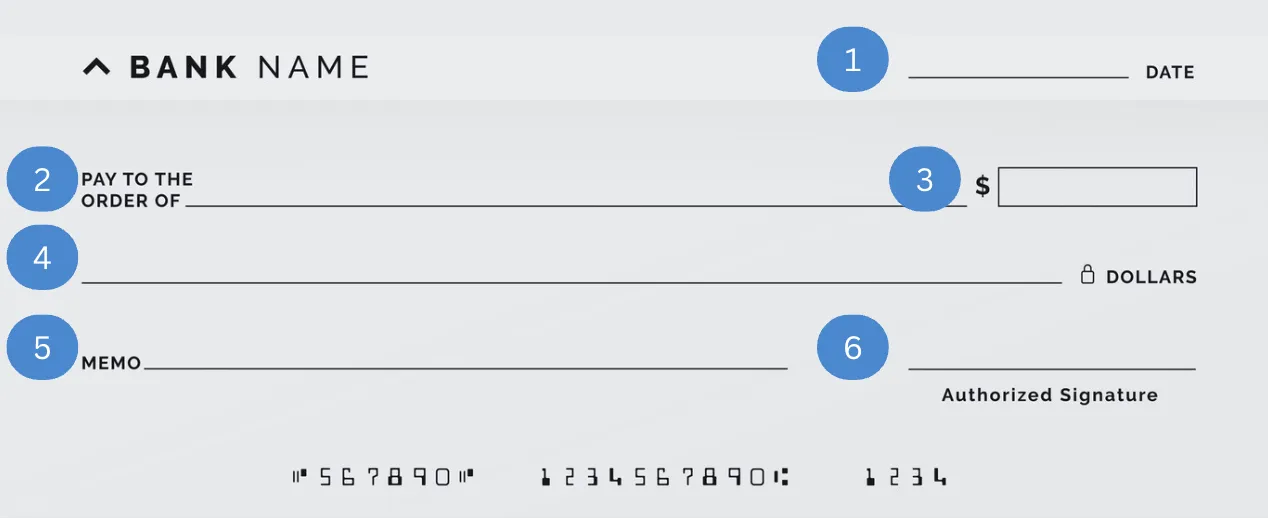
1. Write the Date
Remember that in the United States, the date format is mm/dd/yyyy.
2. Payee’s Name
Write the full name of the person to whom you are issuing the check, exactly as it appears on their official identification.
3. Amount in Numbers
Write the numerical amount clearly.
4. Amount in Words
Write the amount in words, including cents.
5. Add a Memo
You may include a note specifying the reason for the payment.
6. Sign the Check
Sign the check legibly in the space designated for the drawer.
7. Review the Information
Ensure that all information is accurate to avoid issues for the payee when cashing the check.
It is essential to complete checks legibly, without strike-throughs or corrections, as these may invalidate the document.
How to Correctly Write Numbers in Words on a Check
Writing amounts in words may be confusing when dealing with U.S. dollars. The following points should be kept in mind:
- Dollar amounts must be written in full words
- Cents must be written as fractions
- Avoid using dollar symbols or similar notations
- If there is leftover space at the end of the line, draw a line to prevent fraud
- For example, $1,000.75 is written as: One thousand and 75/100 dollars
Cash Checks and Manage Your Money Easily with Comun
As you can see, knowing how to fill out a check is useful for sending and receiving money in the United States. It is a reliable and accessible alternative if you do not have a banking account.
However, issuing and cashing a check can also require significant time and effort. That’s why you can skip the trip to the bank, avoid wasting time or money on gas, and cash your check directly from your phone using Comun—no lines, no questions, no complications.
Discover Comun, the only platform designed to serve the needs of immigrant communities in the United States, with support available in Spanish.
Why Choose Comun?
- Open your account with an official ID from your country
- Access a mobile app specifically designed for immigrants in the U.S.
- Make payments, receive your salary, and manage your finances
- Send money to your loved ones in LATAM for just a $2.99 transfer fee
Frequently Asked Questions
Still have questions about how to fill out a personal check? See our FAQ section.
What if I Make a Mistake Filling Out a Check?
If there are strike-throughs or inconsistencies in the amounts, the check must be voided and a new one used.
How Do I Void a Check?
Write the word VOID in large letters on the front of the check.
What Information Appears on the Back of a Check?
The back of the check contains the endorsement, meaning the payee’s signature for cashing the check.
International Money Transfers
Sending money to Latin America? What you need to know about the new 1% tax
8 min de lectura
Sending Money to Latin America? What You Need to Know About the New 1% Tax
If you send money home to Mexico, Guatemala, Colombia, El Salvador, Honduras, or anywhere else in Latin America, a new federal law may affect the fees you pay per money transfer, depending on how you send it.
On July 4, 2025, the United States enacted the One Big Beautiful Bill Act (OBBBA), Public Law 119-21, which introduced a new federal excise tax on certain international money transfers. The tax, set at 1% of the transfer amount, applies to remittances made on or after January 1, 2026. However, not all transfers are taxable.
If you send money from a US bank account or using a US-issued debit or credit card, your transfer is exempt from the tax by statute. The tax applies only when you pay with cash, a money order, a cashier's check, or a similar physical instrument.
Understanding whether this tax applies to you and how it may affect your transfers can help you send money home with fewer surprises.
What Is the New 1% Remittance Tax?
It imposes a 1% federal excise tax on certain outbound remittance transfers, meaning money sent from a sender in the United States to a recipient in a foreign country, through a remittance service provider.
The tax is codified under IRC Section 4475, added to the Internal Revenue Code by Section 70604 of the OBBBA. It applies to all senders, regardless of citizenship or immigration status.
The tax was effective for transfers made after December 31, 2025, with collection beginning January 1, 2026.
Who Pays the Tax? Who Doesn't?
The key factor is how you fund the transfer, not how much you send, not where it goes, and not your immigration or citizenship status.
| Subject to the 1% Tax | Exempt from the 1% Tax |
|---|---|
| Transfers funded with cash (e.g., paying cash at a remittance service provider) | Transfers funded from a US bank account at a BSA-compliant institution |
| Transfers funded with money orders | Transfers funded with a US-issued debit card |
| Transfers funded with cashier's checks | Transfers funded with a US-issued credit card |
| Transfers funded with similar physical instruments | Transfers of $15 or less (under EFTA threshold) |
Source: IRS.gov, RSM US. This information is for informational purposes only and does not constitute legal or tax advice.
This means that if you often send money back home with a remittance service provider with physical locations (for example Western Union or MoneyGram) and pay with cash, a 1% tax will be added to your total transfer amount.
However, if you send money through a digital app or bank account linked to your US checking or savings account, or pay with a US-issued debit or credit card, the transfer is exempt from the tax under Section 4475.
How Is the Tax Collected?
The tax is collected at the point of transfer. When a taxable transaction occurs, the remittance transfer provider is responsible for collecting the 1% from the sender at the time the transfer is made.
Providers must then deposit the collected taxes with the IRS on a semimonthly schedule and file quarterly returns.
The Remittance Landscape in 2026
For millions of families across Latin America, the money that arrives from a relative in the United States can pay the rent, cover school fees, or put food on the table. In 2024, Latin America and the Caribbean received an estimated $161 billion in remittances, the vast majority sent from the US. Mexico alone received over $63.3 billion. In countries like El Salvador, Guatemala, Nicaragua, and Honduras, remittances represent between 19% and 26% of GDP.
For people already stretching every dollar between their own expenses in the US and the needs of family back home, an additional cost on each transfer can have an impact. How much it affects you depends largely on the tools available to you.
Cash agent networks (Western Union, MoneyGram, Intermex):
These are the traditional in-person options, often used by senders who mostly manage cash. Transfers funded with cash at these locations are subject to the 1% tax.
Digital apps (Remitly, Wise, Xoom, Común, and others):
These platforms typically process transfers from a linked US bank account or US-issued debit or credit card. These payment methods are exempt from the tax under Section 4475. However, fees and exchange rate margins may vary by provider.
Bank wire transfers:
Transfers sent directly from a US bank account at a Bank Secrecy Act–compliant institution are exempt from the tax by statute. Bank wire fees can be higher than digital app fees.
What This Means for You
If you send money home regularly, you already know that there are costs involved: transfer fees, exchange rate margins, sometimes a fee on the receiving end. Now, depending on how you send money, there may also be a new 1% federal tax. That may not sound like much in isolation, but if you're someone already careful about managing what to keep and what to send, it can add up.
There is no single right answer for everyone. Some people that have a US bank account can shift to a digital transfer method. Others who don't have that option yet, or may have reasons for continuing to send through an agent location. Whatever your situation is, a few things may help:
Know what you're being charged:
Before confirming any transfer, you should be able to see the fee, the exchange rate, any applicable taxes, and the exact amount your family will receive. Review everything before you hit send. Some service providers, like Común, offer in-app tools to help you calculate the costs before sending anything.
Compare the total cost:
A provider that charges no transfer fee but offers a weaker exchange rate can potentially cost more than one with a modest flat fee and a fair rate. The number that matters is what arrives on the other end.
If you have a US bank account or debit card, ask your provider about your options:
Transfers funded from a US bank account or US-issued debit or credit card are exempt from the tax under the current statute.
Ask your provider directly how they handle the tax:
Some providers may have updated their apps, websites, or agent instructions. If you're sending via a digital channel linked to your US bank account or debit or credit card, ask whether that payment method qualifies for the statutory exemption.
Manage your remittances confidently with Común
Having an account to receive electronic payments, track your spending, and send money directly may help make managing your financial life in the U.S. more convenient. Común accepts more than 100 valid Latin American IDs to open a debit account. With Común you get:
- A $2.99 flat fee per remittance transfer, with no hidden charges
- A checking account held at Community Federal Savings Bank, Member FDIC. Deposits are FDIC insured up to the applicable limits
- Transparent, in-app pricing where you can see exactly what each transfer will cost, including fees and the exchange rate, before you confirm
- 24/7 customer support in Spanish
- Cash pickup options for your recipient
- The ability to send transfers from the comfort of your phone
To learn more about Común's remittance services, visit comun.app/remittances.
FAQ
What is the new 1% Remittance Tax?
It is a federal excise tax introduced by the One Big Beautiful Bill Act (OBBBA), Public Law 119-21, codified as IRC Section 4475. It imposes a 1% tax on certain outbound money transfers from the United States to recipients in foreign countries. It applies only to transfers funded with cash, money orders, cashier's checks, or similar physical instruments.
When does the new remittance tax take effect?
The tax applies to remittance transfers made on or after January 1, 2026. It was signed into law on July 4, 2025, as part of the OBBBA. The IRS granted penalty relief to providers for the first three quarters of 2026, with full enforcement expected beginning Q4 2026.
Who has to pay the 1% tax?
The tax is owed by the sender, but it is collected and remitted to the IRS by the remittance transfer provider at the time of the transfer. It applies to all senders, regardless of citizenship or immigration status.
Are all money transfers from the US subject to the new tax?
No. The tax applies only to transfers funded with cash or physical instruments. Transfers funded from a US bank account at a Bank Secrecy Act–compliant institution, or paid with a US-issued debit or credit card, are exempt from the tax by statute.
How is the tax collected?
The remittance transfer provider collects the 1% tax from the sender at the time of transfer. Providers must deposit collected taxes with the IRS on a semimonthly schedule and file quarterly returns using Form 720.
How can I tell if my transfer is taxable?
It depends on how you're funding the transfer. If you are paying with cash, a money order, or a cashier's check at a remittance agent, the 1% tax likely applies. If you are sending money through a digital app or bank account using your US checking account or a US-issued debit or credit card, the transfer may be exempt under the current statute. Ask your provider directly to confirm how your specific payment method is classified.
Immigration
Bank Fees for Immigrants: Common vs. Competitors
8 min de lectura
For immigrants in the U.S., bank fees can amount to hundreds of dollars a year. Común stands out by offering a monthly-fee-free account, no minimum balance, and no SSN requirement. Compared with competitors like Seis and Majority, Común eliminates fixed fees while still providing full services in Spanish.
Choosing the right bank account can save you hundreds of dollars a year. For the immigrant community in the U.S., comparing fees is especially important because many traditional accounts charge fees that directly affect the monthly budget. We analyzed the main options available.
Fees at Traditional Banks
Major U.S. banks such as Bank of America, Chase, and Wells Fargo charge between $6 and $25 per month to maintain a checking account, with minimum balance requirements of $1,500 to $25,000 to avoid those fees. They also charge overdraft fees ($35 per transaction), out-of-network ATM withdrawal fees ($2.50-$5 per withdrawal), and international transfer fees ($25-$45 per wire transfer). For a newly arrived immigrant without credit history or a high balance, these costs add up quickly.
Común: No-Fee Account for Immigrants
Común offers a checking account with no monthly fee, no minimum balance required, and no overdraft penalty in many cases. It does not require an SSN — it accepts a passport, consular ID, and more than 100 Latin American IDs. Customer service is completely in Spanish. Account opening takes minutes from a mobile phone. It allows instant domestic transfers at no cost between Común users. It is the option designed specifically for the Latino community in the U.S.
Majority: Monthly Membership with International Benefits
Majority charges $5.99 per month as a base membership (down from $14.99). In return, it offers unlimited international calls to selected countries, roaming mobile data in more than 50 countries, and discounts at participating merchants. If you actively use international calling and travel benefits, the membership may be worth it. However, if you only need a basic bank account, you are paying for services you may not use.
Seis: Account for Visa Workers
Seis is designed for expats and visa workers in the U.S. It offers an account without an SSN using a visa and passport. Fees vary by plan: the basic account has limits on the number of free transactions. It is more geared toward professionals with work visas (H-1B, L-1) than the immigrant community at large. Its interface is available in multiple languages, including Spanish.
Direct Fee Comparison
In terms of monthly fee, Común charges $0, Majority charges $5.99/month, and traditional banks charge between $6 and $25. The minimum balance requirement is $0 at Común, $0 at Majority, and between $1,500 and $25,000 at traditional banks. Regarding SSN requirement, Común does not require it, Majority does not either, while traditional banks generally do. All three have FDIC or equivalent deposit protection.
Which Option Is Best for You?
If you are looking for the account with the lowest total fees and do not need unlimited international calls, Común is the most economical option. If you travel frequently or call abroad often, Majority’s membership may be worth it. Traditional banks only make sense if you already have the required minimum balance or if you need specific services such as mortgages or investment accounts.
Frequently Asked Questions About Bank Fees
What bank fees are most common in the U.S.?
The most common are: monthly maintenance fee ($6-$25), overdraft fee ($35 per transaction), out-of-network ATM fee ($2.50-$5), and international wire transfer fees ($25-$45). Digital banks like Común eliminate most of these fees.
Can I avoid bank fees at a traditional bank?
Yes, usually by maintaining a monthly minimum balance (which varies by bank and account type), receiving direct payroll deposit, or being a student. However, for immigrants without credit history or with variable income, meeting these requirements can be difficult at first.
Are ATM fees unavoidable?
No. Multiple digital banks offer free access to ATM networks (Allpoint, MoneyPass) with thousands of fee-free locations across the U.S. Común provides access to fee-free ATMs within its network. Outside the network, typical charges are $2.50-$5 from the ATM plus whatever your bank charges.
What is an overdraft fee and how can I avoid it?
An overdraft fee occurs when you spend more money than you have in your account and the bank covers the difference by charging you a penalty (typically $35). You can avoid it by activating low-balance alerts, linking a savings account as backup, or choosing a bank that does not charge overdraft fees — some digital accounts decline the transaction instead of charging a penalty.
Is it worth paying a monthly membership for a bank account?
It depends on the included benefits. A $5.99-$14.99 monthly membership may be worth it if it includes services you actively use (international calling, travel insurance, cashback). If you only need an account for deposits, payments, and transfers, a free account like Común is more cost-effective.

Financial Education
What is cashback and how does it work? A 2026 Guide
8 min de lectura
What is cashback and how does it work? A 2026 Guide
Cashback is a rewards system that gives you back a percentage of the money you spend on eligible purchases. In simple terms, when you buy something using certain credit cards, debit cards, apps, or rewards programs, you may get a percentage of your money back on purchases, though it is usually credited to your account rather than handed over as physical cash.
If you recently moved to the United States or are learning how the financial system works, you may have heard the term 'cashback' while shopping at places like Walmart, Target, gas stations, supermarkets, or online stores.
For many people, cashback can become a practical tool to manage everyday expenses such as groceries, transportation, gas, and household purchases. While the amounts may seem small at first, they can add up over time when used consistently and responsibly.
What is cashback?
Cashback is a type of financial reward that returns a percentage of your purchase after you spend money with a participating payment method or rewards platform.
For example:
- If you spend $100 at the supermarket using a card that offers 2% cashback, you may receive $2 back
- If a cashback app offers 5% cashback at a participating gas station and you spend $60 on fuel, you may receive $3 back
Unlike traditional discounts, cashback usually happens after the purchase is completed. The Consumer Financial Protection Bureau (CFPB) explains that cashback rewards are commonly offered through credit cards and loyalty programs as an incentive for spending.
How does cashback work?
Cashback programs generally follow a simple process:
- You make an eligible cashback purchase using the participating card, app, or rewards account
- The transaction is recorded by the provider
- A percentage of that purchase is returned to you as cashback
The reward may appear as:
- Statement credit
- Bank deposit
- Gift card
- Rewards balance
- Redeemable points
- Store credit
Some cashback rewards appear within a few days, while others may take an entire billing cycle or longer to process. There are often minimum redemption thresholds before you can claim your cashback. Certain programs may include expiration dates. It is also important to understand that not every purchase qualifies for cashback.
Cashback vs. traditional discounts
While cashback and traditional discounts can both help consumers save money, they work in different ways. A traditional discount lowers the price immediately at checkout, while cashback returns part of the money after the purchase has already been completed.
| Cashback | Traditional Discount |
|---|---|
| Money is returned after the purchase | Price is reduced before purchase |
| Usually linked to cards, apps, or loyalty programs | Usually available directly in-store |
| Rewards may take days or weeks to process | Savings are immediate |
| May help track expenses digitally | Does not usually include tracking tools |
| Often limited to eligible categories or stores | Depends on store promotions |
Types of cashback in 2026
Not all cashback programs work the same way. Before signing up for a cashback program, it is important to review details such as annual fees, interest rates, minimum redemption, expiration policies, and spending categories.
Fixed-rate cashback
This type gives the same cashback percentage on all purchases. Example: 1.5% cashback on everything you buy. This structure is simple because you do not need to track categories or rotating offers.
Category-based cashback
Some cards or apps offer higher cashback percentages in specific categories such as supermarkets, restaurants, gas stations, or streaming subscriptions. For example: 3% on groceries, 2% on gas, 1% on all other purchases.
Rotating cashback categories
Some providers change cashback categories every few months. One quarter may focus on gas stations and grocery stores; another may include online shopping and travel purchases. These programs sometimes require manual activation each quarter.
Welcome bonuses
Certain credit cards offer introductory cashback bonuses if you spend a minimum amount during the first months after opening the account. For example: spend $500 in the first 3 months and receive $150 cashback bonus. The Federal Trade Commission recommends reviewing terms carefully before applying for financial products with promotional offers.
Where can you get cashback in the United States?
Credit cards:
Many credit cards in the U.S. include cashback rewards. Some examples include products from Discover, Chase, Capital One, and American Express. Some cards focus on categories like dining or travel, while others offer flat-rate cashback.
Debit cards:
Some financial institutions offer cashback debit cards, although rewards are usually smaller than those offered by credit cards. This may appeal to people who prefer avoiding debt or credit card interest.
Cashback apps:
Several mobile apps partner with retailers and offer cashback rewards for purchases. Examples include Rakuten, Ibotta, Upside, and Honey. These apps may provide cashback for grocery shopping, online purchases, gas stations, and restaurants.
Store loyalty programs:
Retailers sometimes offer cashback or store rewards through membership programs. For example, supermarkets, pharmacies, and warehouse stores may return store credit or savings points after purchases.
Cashback vs. points vs. miles: Which is better?
Although they are often grouped together under the category of 'rewards,' each one works differently and can be useful depending on a person's spending habits, financial goals, and lifestyle.
Cashback programs generally return a percentage of the money spent on eligible purchases. Points systems usually assign a numerical value to purchases that can later be redeemed for products, gift cards, discounts, or services. Travel miles are typically associated with airlines, hotels, or travel-focused credit cards.
| Cashback | Points | Miles |
|---|---|---|
| Returns money | Rewards system value | Travel-focused rewards |
| Flexible spending | Often redeemed in specific ecosystems | Usually tied to airlines or hotels |
| Reward after spending | Redemption values vary | Best for frequent travelers |
| Common for everyday purchases | May include gift cards or products | Often used for traveling |
For many people, especially those focused on getting some value on their everyday expenses such as groceries, transportation, gas, or household purchases, cashback can feel more useful as the reward is directly connected to money rather than conversion systems or travel programs.
3 practical tips for using cashback responsibly
1. Use cashback for purchases you already planned
Focus on recurring expenses such as groceries, gas, transportation, and utility bills. This helps you avoid overspending simply to earn rewards.
2. Don't buy things you don't need
A cashback offer does not automatically make a purchase worthwhile. For example, spending $200 to earn $4 cashback may not help your finances if the purchase was unnecessary.
3. Track your cashback earnings
Many apps and financial platforms allow you to monitor spending categories, cashback totals, and monthly rewards. Tracking your rewards can help you understand your spending patterns and maintain financial goals.
Does Común offer cashback?
No. Común does not currently offer cashback programs.
However, Común provides tools and resources that offer guidance for Latin American immigrants navigating the U.S. financial system.
While cashback might be useful for some people, it is important to pay attention to commissions, as savings when commissions are included might not be as strong as initially perceived. When comparing financial tools in the United States, cashback is only one factor to consider. Fees, commissions, account accessibility, and transparency can also affect your financial experience over time.
Común's cost for opening a debit account is $0, same as the $0 minimum balance and $0 monthly commission for the debit account.
FAQ
What is cashback and how does it work?
Cashback is a rewards system that returns a percentage of your purchases after you spend money using eligible cards, apps, or loyalty programs.
How is cashback calculated?
Cashback is usually calculated as a percentage of the purchase amount. For example, if you spend $100 and your cashback rate is 2%, you receive $2 back.
Where can I get cashback in the United States?
Cashback is commonly available through credit cards, debit cards, shopping apps, and retailer loyalty programs.
What is the difference between cashback and points?
Cashback returns money directly, while points are part of rewards systems that may only be redeemed for specific products, gift cards, or services.
Does Común offer cashback?
No. Común currently does not offer cashback.
Is cashback taxable?
In many cases, cashback earned through purchases is generally treated as a rebate rather than taxable income. However, tax treatment may vary depending on how rewards are earned. The IRS recommends consulting a tax professional for specific situations.
.avif)
Financial Education
Your essential guide to the bank routing number in the U.S.
8 min de lectura
The bank routing number, or ABA Routing Number, is essential information for making money transfers. It is a 9-digit code used to identify each financial institution in the United States.
This code is so important because it ensures that electronic transactions are carried out correctly and that funds reach the designated bank.
In this article, we offer a complete guide to help you understand what a bank routing number is, what it does, where to find it, and how it is used in everyday electronic financial transactions.
What is a bank routing number (ABA), and why is it essential in the U.S. banking system?
An ABA routing number, or transit routing number, is a unique 9-digit code that serves as an identifier for each financial institution in the United States.
It differs from a bank account number in that an account number is personal, valid for the use of a single user only. By contrast, the routing number is a unique identifier for banks, credit unions, and digital banks.
The primary function of the routing number is to allow financial institutions to precisely identify which bank to send to or receive from during routine operations such as direct deposit of payroll, automatic payments (ACH), and electronic transfers.
It is important to note that this code is different from a bank account number and is not equivalent to the IBAN (International Bank Account Number), which is a set of numbers used especially in Europe to identify international bank accounts and is composed of the country code, check digits (the checksum of the bank account number), and a bank account number.
In the United States, however, the SWIFT/BIC code is used for international money transfers, not the IBAN.
Here are some crucial functions of the bank routing number in digital transactions.
Unique bank identification
The bank routing number helps prevent errors when identifying a specific bank and processing a transfer from one institution to another, even when they have similar names or many branches across the country.
Facilitates electronic transfers
This code is also indispensable so that ACH systems and wire transfers can send funds to the correct destination, quickly and securely.
Key for direct deposits
The ABA number is also essential for employers to make direct deposits, using that code together with the checking account number, without the need for checks or cash.
Automated bill payments
To set up automated payments for services such as electricity, water, and online subscriptions, you must provide the bank routing number so the billing system can process the transaction automatically.
Handling funds between banks
This number is also indispensable for transactions involving multiple financial institutions, such as interbank transfers or check clearing.
How to find a bank routing code and your bank account number
By now, the importance of the ABA number is clear. But how do you find a bank routing code? Knowing this information is the first step to making transfers correctly.
Likewise, it is essential to understand how to find your bank account number and to tell one number from the other to avoid confusion.
The routing number consists of 9 digits and identifies the bank. The account number has usually 10 to 12 digits and identifies the individual account within the bank.
To find your account number, look at the bottom of a check; it is the series of numbers that follows the routing number. You can also find it at the top of a statement or directly in the mobile application.
It is essential to make sure you have the correct routing number before making a transfer. Therefore, it is advisable to confirm it directly with your financial institution to avoid errors.
Many users ask where to find the routing number on a physical debit card. However, the routing number is not printed on such instrument because it is intended for digital transfers, not for payments at physical merchants.
These are the most common places to find the routing number for your bank or financial institution.
On your checks
Check the lower left corner of your personal or business checks; the routing number is the 9 digits shown there.Another relevant detail is the check number, which is usually at the top.
Mobile application
Another way to find this code is to access your mobile application and go to the transfers or direct deposit information section.
Bank statements
Check your latest bank statement, whether physical or digital; the routing number may appear in a section of that document.
Direct contact with your bank
If you have any doubt about the routing number, you can contact your bank by phone or visit a branch so they can clarify any questions before you make a bank transfer.
Your routing number and account: Key tools for your finances in the U.S. with Comun
Throughout this article, we have learned the importance of both the bank routing number and the bank account number in the U.S. financial system. Both are indispensable for carrying out fast and secure digital transactions.
Being clear about what a bank’s ABA number is not only lets you carry out digital transactions with ease but also gives you financial autonomy to allocate your resources toward the services you need for your well-being.
The U.S. financial system can seem complicated, especially for immigrant communities. That is why Comun seeks to streamline processes and offer transactions without complications.
- Receive and send money easily from your mobile application
- Integrate other applications and enhance your experience
- Access support available in Spanish and English
- Send international remittances with fees starting at $2.99 USD, up to the applicable limits.
- Get started with official ID from your country
Open your account today and discover an ally to manage your finances in the United States.
Frequently Asked Questions
If you have more questions, check our frequently asked questions section.
Where can I find my routing number if I don’t have checks?
You can find it on your account statement or by calling the bank directly.
What is the routing number for ACH transfers?
It is the code that identifies each bank and consists of 9 digits.
Is the routing number the same for all banks?
No. Each bank has a different routing number.
What is the routing number on a card?
The routing number does not appear on physical cards.
What is the routing number on a check?
It is found at the bottom of a check and consists of 9 digits.

Immigration
O1 Visa Requirements in 2026: What You Need to Know
8 min de lectura
O1 Visa Requirements to Work in the United States
The United States offers a wide variety of visas to include as many profiles as possible that can contribute their knowledge to the country.
One example is the O1 visa, intended for foreign nationals who possess extraordinary abilities in fields such as science, sports, and the arts.
This visa has very specific criteria. Therefore, in this article, we explain the requirements established by the U.S. government to obtain it, the classification of O1 visa types, and the documents required during the application process.
If you are looking for an alternative to obtain a work visa in a highly competitive field, the O1 visa could open the door to a new life.
What Is the O1 Visa and Who Can Apply?
The O1 is a U.S. nonimmigrant visa aimed at foreign nationals with extraordinary abilities or outstanding achievements in specific areas.
The concept of “extraordinary ability” can seem a bit ambiguous, but in this context, USCIS refers to individuals who have reached such a level of excellence in their field that they have verifiable national or international recognition.
This visa is divided into two main categories:
O-1A Visa
For individuals with extraordinary achievements in science, education, business, or athletics.
O-1B Visa
For individuals with extraordinary ability in the arts, motion picture, or television industry.
As you can see, it is an immigration document that demands a high level of achievement from applicants in specific areas of work.
Main Requirements for the O1 Visa
To qualify for an O1 visa, applicants must meet a series of requirements established by USCIS.
Below are the main requirements for the two categories of this visa.
For the O-1A Visa
Applicants with outstanding achievements in science, education, business, or athletics must demonstrate they meet the following eligibility criteria:
- Having received significant recognition with national or international impact.
- Membership in prestigious associations that require outstanding achievements.
- Mentions or features in reputable media outlets.
- Having participated as a judge of the work of others in the same field.
- Being the author of published scientific articles.
- Having collaborated with distinguished organizations in the area of expertise.
- Evidence of a high salary or remuneration compared to others in the same field.
For the O-1B Visa
Applicants with outstanding achievements in the arts, film, or television industry can demonstrate eligibility if they meet the following requirements:
- Having received major awards, such as Grammy, Emmy, Oscar, or Nobel Prize.
- Participation in renowned productions.
- Being recognized by media and critics.
- Demonstrable commercial success or popularity.
- Having led prestigious projects.
It is important to note that it is not necessary to meet all these requirements, but the more criteria the applicant fulfills, the easier it will be to obtain the visa.
In both cases, applicants must have a job offer or a sponsor in the United States.
Documents and Evidence Commonly Submitted with the Application
In addition to meeting the criteria, the applicant must have the following documents to prepare a complete application.
Form I-129, Petition for a Nonimmigrant Worker
This form must be filed by the U.S. employer or agent and should include the following details:
- Full name of the beneficiary.
- Detailed description of the project.
- Expected duration and location of the project.
Letters of Recommendation
This letter is essential to support the applicant’s experience in their field. It must be issued by a group of peers, a union, or an expert entity.
Job Offer Letter or Employment Contract in the U.S.
It is a document signed by the applicant and the employer that sets out the terms and conditions of employment, responsibilities, and duration.
Additionally, the previously mentioned requirements can be supported with the following documentation:
- Copies of publications, articles, or press materials.
- Evidence of memberships, awards, or recognitions.
- Financial statements or evidence of high remuneration.
If you have any doubts about your application process, consult an immigration attorney who can help you determine whether your profile fits this type of visa, which is often considered an elite category. Keep in mind that there are other options such as the EB-1 and H-1B visas.
Find Opportunities in the U.S. with Support from Común
In this article, we explained that the O1 is the visa for individuals with extraordinary abilities, aimed at people with outstanding performance in science, sports, and the arts. We also covered the approval requirements and documentation needed to demonstrate that you belong to the groups covered by this work authorization.
Arriving in a new country to work involves many changes and learning to adapt to customs and regulations. When it comes to managing money effectively, it is essential that immigrants have access to quality financial services.
Discover Común, the financial platform that makes life easier for immigrants in the U.S.!
- Checking account with clear and competitive fees.
- International money transfers with affordable costs.
- Mobile app available in Spanish that accepts more than 100 official foreign identifications.
- Debit card for everyday purchases and payments.
Open your account with Común today and build your future in the U.S. with a financial platform designed for immigrants.
Frequently Asked Questions (FAQ)
Can You Obtain an O1 Visa Without a Sponsor?
No, the O1 visa always requires a sponsor to initiate the process. This sponsorship may be provided by a U.S. employer or an agency that acts as an intermediary between the applicant and contractors in the United States.
Although this visa cannot be self-petitioned, there is an option to hire an agent to submit the initial petition.
How Much Money Is Required for an Investor Visa in the United States?
The most common investor visa is the EB-5, which requires a minimum investment of $1,050,000 if the investment is made in a rural area or one with high unemployment.
A key requirement is that the project must create or maintain at least 10 full-time jobs in the United States.
Another investor visa option is the E-2, or treaty investment visa, which does not require a fixed amount but requires the applicant to prove that the investment is large enough to generate a positive impact.
Which Documents Carry the Most Weight for Approval?
The documents that usually carry the most weight for O1 visa approval are those that demonstrate sustained and verifiable recognition.
For example:
- Major awards.
- Publications in recognized media.
- Participation as a judge of others’ work.
- Membership in selective associations.
- Evidence of participation in well-known projects.
- Letters of recommendation from experts or field leaders.
Although it is not necessary to present all these documents, the more evidence there is, the greater the chances of approval.
How Long Does the O1 Visa Last and Can It Be Renewed?
The initial duration is 3 years, depending on the project. Extensions of 1 year can be requested as long as the requirements continue to be met.
Checking account
Open an Online Banking Account
8 min de lectura
Opening an online banking account is very easy these days. We’ll show you the key factors you should consider when choosing the digital bank that best fits your profile, since there are multiple options on the market. We’ll also explain how to open an online account effectively.
Opening an online banking account in the U.S. can be done in minutes from your cell phone. All you need is a valid ID, a U.S. phone number, and your address. Platforms like Común do not require an SSN and accept more than 100 Latin American IDs, making the process accessible for immigrants from day one.
What is online banking and what are its advantages?
Online banking consists of managing your money and carrying out financial transactions through the internet or a mobile app, without needing to visit a physical bank branch. This includes checking your balance, making transfers, paying bills, depositing checks, and more.
The main advantages are 24/7 availability, access from anywhere, no lines or office hours, and generally lower fees than traditional banks because they do not have physical infrastructure costs.
How to choose the best online bank for you
Not all online banks are the same, especially for immigrants. The most important factors to consider are:
- Opening requirements: do they ask for an SSN? Do they accept a passport or consular ID?
- Fees: monthly fee, minimum balance, ATM charges
- Language: do they offer support in Spanish?
- Security: is it backed by the FDIC?
- Features: Zelle, direct deposit, remittances, virtual card
Steps to open an online banking account
The general process for opening an online banking account in the U.S. is as follows:
- Download the chosen bank’s app
- Provide your full name, date of birth, and address
- Upload a photo of your ID (passport, national ID, consular ID)
- Verify your phone number with an SMS code
- Accept the terms and conditions
- Receive approval (usually instant or within minutes)
- Request your debit card and start using your account
Open an account without an SSN: options for immigrants
Many traditional banks require an SSN to open an account. However, Común allows you to open an account with a passport, consular ID, or other forms of Latin American identification. There is no minimum balance, no monthly fee, and the process is completely in Spanish. The account includes a VISA debit card, early direct deposit, and remittances starting at $2.99.
Frequently asked questions about opening an online banking account
Can I open an online bank account without going to a branch?
Yes. Digital banks like Común let you open an account 100% online from your phone, without visiting any branch. All you need is your ID and a U.S. phone number. The process takes about 3 minutes, and approval is instant in most cases.
What documents do I need to open an online bank account in the U.S.?
It depends on the bank. Traditional banks generally ask for an SSN or ITIN, photo ID, and proof of address. Común accepts more than 100 Latin American IDs — passport, consular ID, national ID — without needing an SSN or minimum balance. You only need a U.S. phone number and your current official identification.
Are online banking accounts safe?
Yes, if they are backed by the FDIC. Regulated digital banks in the U.S. offer the same level of protection as traditional banks: up to $250,000 per account holder insured federally. They also use SSL encryption, two-factor authentication, and anti-fraud systems. Común operates through Community Federal Savings Bank, an FDIC member.
Can I have more than one online bank account at the same time?
Yes, there is no legal limit. Many people have accounts at multiple banks: for example, one for everyday spending and another for savings. You can have a Común account for day-to-day use in the U.S. and keep your account in your home country to receive funds when you travel.
How long does it take for an online bank account to be activated?
Most digital banks approve the account within minutes. The physical card arrives by mail in 5-10 business days. However, the virtual card is available as soon as you are approved, allowing you to make online purchases or add the card to Apple Pay or Google Pay right away.
Can I receive my paycheck in an online banking account?
Yes. All online banking accounts that have a routing number and account number accept payroll direct deposit. Común has its own routing number and lets you generate a pre-filled form to give to your employer. Many digital accounts also advance the deposit up to 2 days before the official date.






Thousands of immigrants are already achieving more with their money. You can too.
Comun is a financial technology company and not a bank. Banking services are provided by Community Federal Savings Bank; Member FDIC. The Comun Visa® Debit Card is issued by Community Federal Savings Bank, pursuant to a license from Visa U.S.A Inc. and may be used everywhere Visa Cards are accepted.
Comun is a fintech company and not a bank or licensed money transmitter.
* Results may vary. For a complete list of eligible IDs and application requirements, follow this link.
^ No minimums, no maintenance fees. ATM or transfer fees may apply. See app for fee details.
‡ Direct deposit funds are typically available when we receive the payment file, up to two days before the scheduled payment date. This early availability is not guaranteed.
** A service provided by Service UniTeller, Inc. Service UniTeller, Inc. is licensed in all states that require a license. Remittance fees start at $2.99 but may vary. Please check the app for more details. Comun Inc. may earn revenue from the conversion of foreign currencies.
† Funds in your account are FDIC insured up to $250,000 by ownership category through Community Federal Savings Bank (CFSB), Member FDIC, in the event CFSB fails.