Checking account
Open an Online Banking Account
Opening an online banking account in the U.S. can be done in minutes from your cell phone. All you need is a valid ID.
8 min read

04 Oct 2022

Opening an online banking account is very easy these days. We’ll show you the key factors you should consider when choosing the digital bank that best fits your profile, since there are multiple options on the market. We’ll also explain how to open an online account effectively.
Opening an online banking account in the U.S. can be done in minutes from your cell phone. All you need is a valid ID, a U.S. phone number, and your address. Platforms like Común do not require an SSN and accept more than 100 Latin American IDs, making the process accessible for immigrants from day one.
What is online banking and what are its advantages?
Online banking consists of managing your money and carrying out financial transactions through the internet or a mobile app, without needing to visit a physical bank branch. This includes checking your balance, making transfers, paying bills, depositing checks, and more.
The main advantages are 24/7 availability, access from anywhere, no lines or office hours, and generally lower fees than traditional banks because they do not have physical infrastructure costs.
How to choose the best online bank for you
Not all online banks are the same, especially for immigrants. The most important factors to consider are:
- Opening requirements: do they ask for an SSN? Do they accept a passport or consular ID?
- Fees: monthly fee, minimum balance, ATM charges
- Language: do they offer support in Spanish?
- Security: is it backed by the FDIC?
- Features: Zelle, direct deposit, remittances, virtual card
Steps to open an online banking account
The general process for opening an online banking account in the U.S. is as follows:
- Download the chosen bank’s app
- Provide your full name, date of birth, and address
- Upload a photo of your ID (passport, national ID, consular ID)
- Verify your phone number with an SMS code
- Accept the terms and conditions
- Receive approval (usually instant or within minutes)
- Request your debit card and start using your account
Open an account without an SSN: options for immigrants
Many traditional banks require an SSN to open an account. However, Común allows you to open an account with a passport, consular ID, or other forms of Latin American identification. There is no minimum balance, no monthly fee, and the process is completely in Spanish. The account includes a VISA debit card, early direct deposit, and remittances starting at $2.99.
Frequently asked questions about opening an online banking account
Can I open an online bank account without going to a branch?
Yes. Digital banks like Común let you open an account 100% online from your phone, without visiting any branch. All you need is your ID and a U.S. phone number. The process takes about 3 minutes, and approval is instant in most cases.
What documents do I need to open an online bank account in the U.S.?
It depends on the bank. Traditional banks generally ask for an SSN or ITIN, photo ID, and proof of address. Común accepts more than 100 Latin American IDs — passport, consular ID, national ID — without needing an SSN or minimum balance. You only need a U.S. phone number and your current official identification.
Are online banking accounts safe?
Yes, if they are backed by the FDIC. Regulated digital banks in the U.S. offer the same level of protection as traditional banks: up to $250,000 per account holder insured federally. They also use SSL encryption, two-factor authentication, and anti-fraud systems. Común operates through Community Federal Savings Bank, an FDIC member.
Can I have more than one online bank account at the same time?
Yes, there is no legal limit. Many people have accounts at multiple banks: for example, one for everyday spending and another for savings. You can have a Común account for day-to-day use in the U.S. and keep your account in your home country to receive funds when you travel.
How long does it take for an online bank account to be activated?
Most digital banks approve the account within minutes. The physical card arrives by mail in 5-10 business days. However, the virtual card is available as soon as you are approved, allowing you to make online purchases or add the card to Apple Pay or Google Pay right away.
Can I receive my paycheck in an online banking account?
Yes. All online banking accounts that have a routing number and account number accept payroll direct deposit. Común has its own routing number and lets you generate a pre-filled form to give to your employer. Many digital accounts also advance the deposit up to 2 days before the official date.
About Común
Común aims to support the Latino community in the United States. It offers a debit account that can be opened with more than 100 valid Latin American IDs and an app available in Spanish.
Visit Común's website or download the app for free to learn more about the full offer and applicable terms.
Olivia Rhye
Community Partner

Checking account
Común Account Security: Empowering Your Financial Journey
8 min de lectura
In a world where financial stability is crucial, Común stands out as a beacon of innovation in the traditional banking industry. Partnered with trusted banks like Community Federal Savings Bank, both FDIC Members, Común offers a secure foundation¹ for managing your finances. Here's how Común is changing the game for its customers and anyone seeking financial freedom and inclusion.
Partnered With Trusted Banks for Maximum Security
Común isn't just a fintech company¹ — it's a mission-driven platform designed to enable upward mobility through financial services. When you deposit with Común, you're guaranteed the same security as a traditional bank account, with deposits insured up to $250,000¹, ensuring financial stability for you and your family.
Safe and Fast Remittances
For many immigrant families and others, sending money back home to loved ones is essential. Común makes this process safe and fast, letting you meet your financial obligations with confidence. Licensed through Service UniTeller, Inc.⁴, Común ensures your remittances reach their destination quickly, giving you a better shot at financial stability.
Real-Time Notifications and Early Access to Funds
Stay informed with instant notifications — every transaction, every sign of activity is reported to you, giving you peace of mind. Común's unique early-access-to-payroll-deposits³ feature lets you manage your cash flow effectively, turning hard work into visible results sooner.
Visa-Enabled Security Worldwide
Común's Visa® debit card¹, processed through Visa USA Inc., ensures global acceptance and trust. Whether you're shopping locally or internationally, Común's banking solutions go with you everywhere, keeping your funds safe wherever you go.
Designed for Members' Unique Needs
Común is deeply committed to financial inclusion, designing products that meet the unique needs of its members — especially those who are just starting out or who struggle to connect with traditional banking channels. From simple account setup to learning how to manage your finances, Común is with you every step of the way.
Building a Community of Trust and Mobility
Común's mission goes beyond simple banking services — it's about building a community and helping millions of people navigate the complexities of financial systems. By offering tools that help you learn and grow, Común supports your journey toward achieving financial freedom.
Conclusion: Común
Común customers aren't just opening a bank account — they're joining a community dedicated to building financial stability and shaping a future where every hardworking person deserves a shot at upward mobility. Download the Común app this week to start your journey toward financial freedom, equipped with the best tools to help you navigate, connect, and thrive.
Financial Education
What is a wire transfer? A complete guide for 2026
8 min de lectura
What is a wire transfer? A complete guide for 2026
A wire transfer remains one of the most widely used methods for moving large amounts of money quickly through financial institutions. It is commonly used for urgent transactions, high-value payments, or international bank transfers that often involve additional verification procedures and transaction monitoring.
According to Federal Reserve Fedwire statistics, around 209.9 million wire transfers were processed in 2024, an 8.6% increase compared to the previous year.
What is a wire transfer?
A wire transfer is an electronic transfer of funds between financial institutions through secure financial networks. Wire transfers are commonly used for: sending large amounts of money, urgent domestic payments, international bank transfers, real estate transactions, business payments, emergency family transfers.
How long does a wire transfer take?
| Transfer Type | Typical Delivery Time |
|---|---|
| Domestic wire transfer | Same day or within hours |
| International wire transfer | Typically 1–5 business days |
| ACH transfer | Typically 1–3 business days |
| Remittance app transfer | Typically in minutes to 2 days |
How much does a wire transfer cost in 2026?
| Transfer Type | Average Cost |
|---|---|
| Domestic outgoing wire | $15–$35 |
| International outgoing wire | $35–$75 |
| Incoming international wire | $10–$20 |
| Exchange rate markup | 1%–4% depending on the provider |
Fees and exchange rate markups vary by bank, destination country, transfer amount, intermediary institutions, and payment method. Always review the total transfer cost before sending money internationally.
Advantages and disadvantages of wire transfers
Advantages:
- Speed for time-sensitive payments
- Higher transfer limits
- Secured financial infrastructure
- Useful for international banking
Disadvantages:
- Higher costs
- Transfers are difficult to reverse
- More banking information is required
- Longer processing for international transfers
Wire transfer vs. money transfer apps
| Feature | Wire Transfer | Digital Remittance App |
|---|---|---|
| Typical use | Large or time-sensitive transfers | Regular family or friend remittances |
| Average cost | Typically $15–$75 transfer fees | Usually lower — flat fees or 0.48%–1% |
| Speed | Same day to several days | Typically in minutes to 2 days |
| Currency conversion | Bank-set rate, markup typically 1–4% | Near mid-market rate, markup 0–1.4%, shown upfront |
| Setup process | More banking details required (routing, SWIFT/IBAN) | Usually app-based, quick mobile signup |
| Best for | High-value or business payments | Frequent personal transfers |
FAQ
Can I make a wire transfer without a bank account?
In general, wire transfers require both parties to have bank accounts. For transfers without a bank account, consider alternatives like remittance apps.
Is a wire transfer safe?
Yes, wire transfers use regulated banking systems with transaction records and tracking. However, they are difficult to reverse if incorrect information is entered.
When should I use a wire transfer instead of an app?
Wire transfers make sense for high-value, urgent, or institution-required payments. For regular remittances to family, digital apps typically offer lower cost and more convenience.
Común is a financial technology company and not a bank. Banking services are provided by Community Federal Savings Bank, Member FDIC. Remittance service provided by Service UniTeller, Inc.
Immigration
EB-2 visa: requirements and how to apply in 2025
8 min de lectura
Obtaining permanent residence is the goal of millions of immigrants in the United States. The EB-2 visa is one of the most feasible paths to achieve it, since it not only grants the applicant the right to work legally, but to do so within their area of professional expertise.
This type of visa is intended to facilitate immigration for people with advanced university degrees or demonstrable exceptional ability.
If you have a professional career and several years of experience, you may qualify to obtain a Green Card through the EB-2 visa and gain strong job opportunities and stability in the U.S.
Below we explain the requirements to obtain the EB-2 visa, the differences between eligibility categories, and the step-by-step process to secure the pathway that could completely change your working life.
Learn more about the EB-2 visa and why it matters
There are several categories of work visas that can lead to a Green Card. One of them is the EB-2.
There are two routes to obtain this visa:
- With an employer sponsor:
Requires a U.S. employer to file through a process called PERM Labor Certification, which demonstrates the need for a foreign worker due to an insufficient number of qualified U.S. workers.
- With a National Interest Waiver (EB-2 NIW):
Employer involvement is not required; it can be filed as a self-petition showing the work has significant impact or is in the national interest of the United States.
This visa is aimed at professionals with advanced degrees in various fields or with exceptional ability.
The main advantages of the EB-2 over other visas are:
- It puts you on a path to permanent residence.
- It does not rely on capped lotteries.
- It allows you to advance professionally with greater freedom and financial stability.
Differences among the main U.S. employment visas
Understanding immigration procedures and visa application processes can be confusing because of the different categories and specific requirements for each.
Below is a comparison table of the EB-2, EB-3, and EB-5 visas.
EB-2 | EB-3 | EB-5
Approximate processing time with sponsor: at least 12–18 months. With NIW the time may be somewhat shorter. | About 1 to 3 years. | EB-5 processing times vary widely; consult USCIS directly.
Who can apply? Professionals with an advanced degree or exceptional ability. Applicants with skills of national interest. | Skilled workers Professionals with a bachelor’s degree Other workers | Foreign investors who make a minimum investment in a U.S. business and create at least 10 jobs.
Purpose of the visa Obtain permanent residence based on professional merit. NIW allows self-petition. | Obtain permanent residence for skilled workers or professionals. | Obtain permanent residence in exchange for a significant financial investment.
Approximate costs Form I-140: $715 Form I-485 (adjustment of status): $1,440 Consular processing: $325. | Same as EB-2 | $1.8 million standard investment. $900,000 reduced investment if the project is in a TEA area. Form I-526 / I-526E: $11,160 + $100 if investing via a Regional Center.
Main requirements With sponsor: employer files PERM and then Form I-140NIW: show work of national interest. | PERM approved by DOL Employer must file Form I-140Meet additional requirements for other workers. | Proof of lawful, traceable investment in at least the minimum amount. Evidence of creation or preservation of at least 10 jobs. Enter as a conditional resident. File Form I-829 to remove conditions.
| EB-2 | EB-3 | EB-5 | |
|---|---|---|---|
| Approximate processing time |
With sponsor: at least 12–18 months. With NIW the time may be somewhat shorter. |
About 1 to 3 years. | EB-5 processing times vary widely; consult USCIS directly. |
| Who can apply? |
Professionals with an advanced degree or exceptional ability. Applicants with skills of national interest. |
Skilled workers Professionals with a bachelor’s degree Other workers |
Foreign investors who make a minimum investment in a U.S. business and create at least 10 jobs. |
| Purpose of the visa |
Obtain permanent residence based on professional merit. NIW allows self-petition. |
Obtain permanent residence for skilled workers or professionals. | Obtain permanent residence in exchange for a significant financial investment. |
| Approximate costs |
Form I-140: $715 Form I-485 (adjustment of status): $1,440 Consular processing: $325. |
Same as EB-2 |
$1.8 million standard investment. $900,000 reduced investment (TEA area). Form I-526 / I-526E: $11,160 + $100 (Regional Center cases). |
| Main requirements |
With sponsor: employer files PERM and then Form I-140. NIW: show work of national interest. |
PERM approved by DOL. Employer must file Form I-140. Meet additional requirements for other workers. |
Proof of lawful, traceable investment of the minimum amount. Evidence of creation or preservation of at least 10 jobs. Enter as a conditional resident. File Form I-829 to remove conditions. |
What are the requirements to obtain the EB-2 visa?
It’s important to stress that applicants must meet specific requirements to obtain the EB-2 visa in any of its modalities.
These are requirements you cannot overlook:
Requirements via advanced academic degree
Holding an advanced degree is the most common way to obtain an EB-2 visa.
- An advanced degree is considered a master’s, doctorate, or post-doctoral degree.
- A person with a bachelor’s degree may apply, as long as they can show at least 5 years of experience.
Requirements via exceptional ability
Another alternative is to demonstrate exceptional ability in fields such as the arts, sciences, business, or others.
This means reaching a level of expertise significantly above ordinary. It must be shown with at least 3 types of documentary evidence:
- Recognitions: achievements, distinctions, and awards received.
- Work record: employer letters and proof of years of work experience.
- Memberships: belonging to associations that require meeting professional standards and merits.
National Interest Waiver (NIW)
Allows applying without a sponsor or labor certification.
These are the 3 criteria for the EB-2 NIW, according to USCIS:
- The endeavor has substantial merit.
- It has national importance for the United States.
- The applicant is well positioned to advance it.
This visa is widely used by researchers, physicians, businesspeople, and entrepreneurs who can contribute significantly to U.S. society.
How to apply for the EB-2 visa
Below are the key steps to obtain the EB-2 visa.
Determine eligibility
First, determine which subcategory fits your profile—advanced degree, exceptional ability, or NIW. Assess your background and each category’s characteristics to decide where to apply.
File the initial petition
Generally, you will file Form I-140, which the employer or the applicant (in the case of NIW) uses to start the visa process.
Adjustment of status or consular processing
For adjustment of status, file Form I-485 if the applicant is in the U.S. Otherwise, proceed via consular processing with the DS-260.
Interview and final decision
USCIS or the consulate will likely require an interview to verify your information and ask questions related to your profile. Once approved, the applicant ultimately obtains lawful permanent residence.
Once in the United States, open your account with Común
In this article, we reviewed what the EB-2 visa is, the requirements to apply, the sponsorship or NIW options, and the key steps in the process.
Although it may seem confusing or endless, it is also a step toward living and working legally in the U.S. and obtaining a residence card.
To start from scratch in a new country, you need allies who understand you.
Común is the financial platform built for immigrants newly arriving in the U.S. who want to manage their money safely. Send money from the United States to Latin America with clear, affordable fees. Your family can receive it directly in bank accounts or pick it up at selected physical locations.
Opening your account is very easy! The mobile app is available in Spanish and English. Comun accepts over 100 qualifying foreign government IDs, and was designed with you in mind.
Frequently Asked Questions (FAQ)
If you still have questions, see this section:
Can I include my family in the application?
If your petition is approved, you can include your spouse and unmarried children under 21.
How much does it cost to apply for the EB-2?
- I-140 (Immigrant Petition): $715.
- I-485: $1,440.
- USCIS Immigrant Fee (for Green Card issuance): $235.
What if my visa is denied?
You can file an appeal or start a new application.

Financial Education
How to Invest Money in the United States: A Beginner’s Guide
8 min de lectura
Ways to Invest Money and Secure Your Future in the United States
One of the constant concerns for people who leave their home country in search of better opportunities in the United States is financial uncertainty, often caused by poor management and a lack of knowledge about effective strategies to grow their money.
Saving products are an alternative that allows you to save money in the long term while earning interest—returns that depend on the term and the rate offered by the financial institution.
Knowing the different ways to save money is a way to ensure financial stability for you and your family. Below, we explain the types of investments and the safest ways to get started. Please note that investment products are NOT FDIC INSURED, NOT BANK GUARANTEED, and MAY LOSE VALUE.
What Does It Mean to Invest Money and Why Is It Important?
Investing means allocating money toward a goal with the aim of obtaining higher returns in the future. You can do it on your own, through a business, or with formal financial instruments that put the contributed money to work to pay interest over defined time frames.
Here are some benefits of using investment strategies:
- Financial security: gives you the confidence of having a savings fund for the future.
- Financial growth: puts your money to work to generate passive income and avoid losing value due to inflation.
- Family support: helps you plan long-term family projects, such as buying a home or paying for children’s higher education.
How to Define Your Goals and Risk Profile Before Investing
Before you begin, keep in mind that all investments involve some level of risk. If you’re a beginner, it’s essential to start at a level that matches your situation.
You should also be clear about your financial goals—the targets you want to reach in the short, medium, and long term.
Risk Profile
A risk profile is an investor’s ability to handle potential losses caused by market fluctuations.
These are the three main types.
Conservative
This profile is ideal for people not familiar with investing, as it involves low risk. Although returns are steady, they tend to be lower than other investment alternatives. Preferred options include savings accounts and short-term investment funds.
Moderate
This profile suits somewhat more experienced investors who are willing to take moderate risk by combining safer investments with slightly riskier ones to obtain better returns.
Aggressive
This profile is for those who have a strong command of investing. They have a high tolerance for losses and aim for high income through significant long-term investments, typically in the stock market, high-yield funds, and real estate.
Determine Your Risk Profile
Next, define the risk profile that aligns with your personal finances and your experience with these instruments.
Follow these tips to help you make a smart investment.
Step 1. Assess Your Current Financial Situation
Take stock of your finances—consider your income, monthly expenses, debts, and existing savings.
Step 2. Determine Your Investment Goals.
Set exactly what you want to achieve and in what timeframe—for example, buying a home, traveling abroad, paying for medical treatment, or simply building an emergency fund. Remember that long-term investments involve higher risk but can also offer higher returns.
Step 3. Decide How Much You Can Invest Initially.
Based on your budget, determine how much you can allocate to your initial investment and whether you can increase it later.
Step 4. Evaluate Your Risk Tolerance.
Analyze your willingness to accept potential losses and their impact on your personal finances.
Here is a comparative table for clarity.
Investment Profile
Risk Level
Time Horizon
Potential Return
Characteristics
Conservative
Low
Long – Medium
Low
Prioritizes safety over return.
Moderate
Medium
Medium – Long
Low – Medium
Balances safety and returns.
Aggressive
High
Long
High
Seeks to maximize long-term gains, with higher risk.
4 Accessible Investment Options for Beginners
A common misconception is that you need a significant amount of money to become an investor. In reality, there are accessible alternatives that let you start with small amounts, easily.
Here are four ideal options to start investing.
Index Funds
Index funds pool money from multiple investors to buy stocks or bonds.
Main Benefits:
- Automated operation.
- Easy diversification.
- Potential for good long-term returns with little effort.
Certificates of Deposit (CDs)
A certificate of deposit is an investment made directly with a financial institution for a fixed term, meaning you cannot withdraw the money during that period.
Main Benefits:
- A relatively secure way to start investing, as it’s offered by financial institutions.
- Generates steady, predictable returns.
Bonds
Bonds are loans to companies or governments that pay interest periodically and generally carry lower risk.
Main Benefits:
- Income is more predictable.
- A good option to diversify alongside slightly riskier investments.
Digital Investment Accounts
An accessible option that allows you to invest from a mobile application.
Main Benefits:
- Let you start with very small amounts of money.
- Very beginner-friendly for entering the world of investing.
Before choosing an investment vehicle, consider your risk profile. If you prefer stability over returns, CDs or bonds may be ideal.
Avoid “putting all your eggs in one basket.” The key to smart investing is diversifying across several instruments, even with small amounts.
Simple Habits to Invest and Review Your Strategy
When you start investing, it’s important to be realistic, stay patient, and remain consistent with your financial goals.
Here are some simple practices to keep your investments on track.
- Review your investments at least every 3 to 6 months.
- Adjust your strategy as your goals or financial situation change.
- Use digital tools to monitor your progress.
Use Común to Manage Your Money Easily as an Immigrant in the U.S.
Financial management is a responsibility you should entrust to an accessible platform.
Meet Común! The financial service that lets you send, receive, and withdraw money within and outside the United States, quickly, simply, and securely.
Común is a mobile app that allows you to open an account easily with a qualifying official identification from your home country, so it’s a great option for the immigrant community.
Open your account with Común and start sending, receiving, and withdrawing money. Enjoy Spanish and English language support, clear fees, and a digital platform ideal for the immigrant community in the United States.
Frequently Asked Questions (FAQ)
If you still have questions, see the section below. Please note that investment products are NOT FDIC INSURED, NOT BANK GUARANTEED, and MAY LOSE VALUE.
How much money do I need to start investing in the U.S.?
There are quite accessible investment options today, especially digital platforms. Some let you start with amounts as low as $1 or $5, which is ideal for learning to invest.
Is it safe to invest as an immigrant?
Yes—even if you are not a legal resident, you can invest money in the United States. Just make sure to use regulated institutions and platforms.
What if I want to change my investment strategy in the future?
It’s common to change your investment strategy to match your financial goals. Review your investments periodically and make the necessary adjustments according to the applicable timelines.

Financial Education
How to fill out a check in the United States in 5 simple steps (+ Example)
8 min de lectura
Have you ever filled out a check? Although most transactions today are digital, knowing how to fill out a check is essential—especially if you are just beginning your financial life.
According to recent data, one-third of Americans paid by check in 2024, demonstrating that checks still play an important role in the U.S. economy.
You might consider checks an outdated payment method; the reality is that they are useful in specific situations. For that reason, we will explain what a check is, the different types of checks, and how to complete them properly.
What Is a Check and What Is It Used For?
Despite the digital era, checks remain a relevant traditional payment method due to their formality and traceability. They are used for rent payments, purchases, and service payments.
Additionally, checks are a common payment method among the immigrant community, who often use them while adapting to the U.S. banking system.
But what exactly is a check and what are its characteristics? It is a physical document issued by an individual or business (the drawer) to order a bank to pay a specified amount to a third party. For the payment to be processed, the drawer must have sufficient funds in their checking account.
In general, a check contains the following information:
- Name of the drawer, whether an individual or a business
- Name of the payee
- Financial institution where the money will be drawn
- Amount to be paid, both in numbers and in words
- Signatures of the drawer
What Are the Different Types of Checks?
There are different types of checks in the United States. In this case, we will focus on the personal check, although you may choose the option that best suits your needs.
Personal Check
A personal check is a payment order issued by an individual to another individual using the funds in a checking account.
What Is a Personal Check Used For?
The most common uses for personal checks include:
- Rent and utility payments
- Purchase of everyday goods
- Legal agreements requiring documentary support
Certified Check
A certified check serves the same purpose as a personal check but is reviewed and guaranteed by the issuing bank, which verifies that the drawer has sufficient funds and holds them until the check is cashed.
A certified check provides certainty of available funds, making it a more secure method for making and receiving payments.
Cashier’s Check
Unlike a personal check, a cashier’s check is issued directly by the bank, offering greater security for the payee, as the bank is responsible for issuing and safeguarding the funds.
To obtain a cashier’s check, the drawer must visit a bank branch and pay the amount to be transferred. The bank then issues the check in the name of the payee, guaranteeing that it can be cashed using the institution’s own funds and not a personal account.
It is commonly used for high-value purchases such as homes and vehicles.
Money Order
While not strictly a check, it is a traditional payment method with similar functionality.
A money order is a financial instrument that allows funds to be sent via traditional mail using a certified check, which must be purchased and paid for by the drawer at an authorized location.
It allows secure money transfers without requiring a bank account.
How to Fill Out a Check in the U.S.
Before issuing this type of payment order, you must know how to do it properly. Below is an example of how to fill out a check easily, starting from step one:
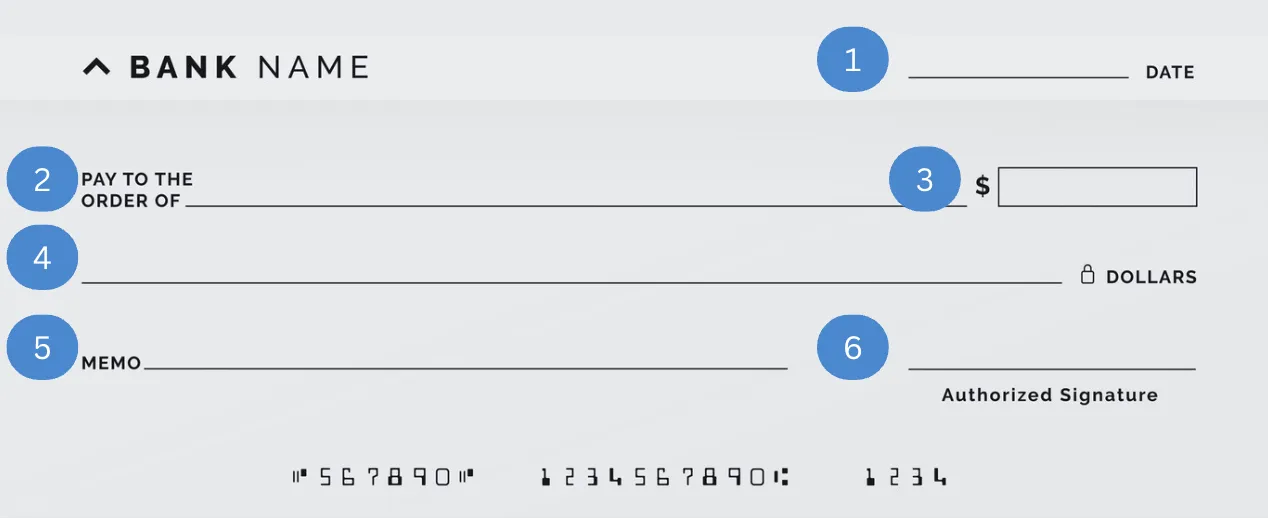
1. Write the Date
Remember that in the United States, the date format is mm/dd/yyyy.
2. Payee’s Name
Write the full name of the person to whom you are issuing the check, exactly as it appears on their official identification.
3. Amount in Numbers
Write the numerical amount clearly.
4. Amount in Words
Write the amount in words, including cents.
5. Add a Memo
You may include a note specifying the reason for the payment.
6. Sign the Check
Sign the check legibly in the space designated for the drawer.
7. Review the Information
Ensure that all information is accurate to avoid issues for the payee when cashing the check.
It is essential to complete checks legibly, without strike-throughs or corrections, as these may invalidate the document.
How to Correctly Write Numbers in Words on a Check
Writing amounts in words may be confusing when dealing with U.S. dollars. The following points should be kept in mind:
- Dollar amounts must be written in full words
- Cents must be written as fractions
- Avoid using dollar symbols or similar notations
- If there is leftover space at the end of the line, draw a line to prevent fraud
- For example, $1,000.75 is written as: One thousand and 75/100 dollars
Cash Checks and Manage Your Money Easily with Comun
As you can see, knowing how to fill out a check is useful for sending and receiving money in the United States. It is a reliable and accessible alternative if you do not have a banking account.
However, issuing and cashing a check can also require significant time and effort. That’s why you can skip the trip to the bank, avoid wasting time or money on gas, and cash your check directly from your phone using Comun—no lines, no questions, no complications.
Discover Comun, the only platform designed to serve the needs of immigrant communities in the United States, with support available in Spanish.
Why Choose Comun?
- Open your account with an official ID from your country
- Access a mobile app specifically designed for immigrants in the U.S.
- Make payments, receive your salary, and manage your finances
- Send money to your loved ones in LATAM for just a $2.99 transfer fee
Frequently Asked Questions
Still have questions about how to fill out a personal check? See our FAQ section.
What if I Make a Mistake Filling Out a Check?
If there are strike-throughs or inconsistencies in the amounts, the check must be voided and a new one used.
How Do I Void a Check?
Write the word VOID in large letters on the front of the check.
What Information Appears on the Back of a Check?
The back of the check contains the endorsement, meaning the payee’s signature for cashing the check.
Financial Education
Online Banking Security: Protect Your Account Information
8 min de lectura
Protecting your information in online banking starts with simple good habits: use unique passwords, turn on two-factor verification when available, and check your activity often. With Común you can lock your card instantly from the app if something looks suspicious.
The convenience of managing your financial transactions online through digital banking has become increasingly popular. However, with the rise of digital banking comes the need for greater security to protect personal and financial information. Here's how you can safeguard your bank account information while enjoying the benefits of online and mobile banking. Aiming for the most secure online banking possible is essential, since it involves implementing industry-standard security technology, multi-factor authentication, alert notifications, and encouraging people to take proactive security measures.
Understanding Online Banking
Online banking, offered by most traditional banks, credit unions, and online-only banks, lets customers pay bills, transfer funds, and manage their financial accounts over the internet. Whether you're dealing with a large bank or a local credit union, these institutions offer secure online banking services tailored to their customers' needs. This can be accessed through a bank's website or a mobile banking app, offering the convenience of banking anytime, anywhere. As banking has evolved, security measures to protect online bank account information must also advance.
Common Threats in Online Banking
Online banking security is paramount, since various threats could compromise your bank accounts. Common online threats include:
- Phishing Scams: Identity thieves send fraudulent communications, often by email, to access your online banking information.
- Malware: Malicious software designed to infiltrate your device and steal data related to your financial accounts.
- Identity Theft: Criminals can use personal information to open new accounts or access existing ones.
- Data Breach: A significant risk where sensitive information is accessed without authorization, potentially affecting numerous accounts.
Understanding these risks is crucial to maintaining online banking security. Banks and credit unions often update their security features to protect against such threats, making it important for users to follow recommended security measures. Keeping online banking secure is a collective effort involving secure banking technology, vigilant fraud monitoring, and informed users who are aware of risks like phishing scams and hacking attacks.
Regain Control and Peace of Mind With Común's Security Measures
- Log In Easily and Securely: Use Face ID or Touch ID for quick access to your Común account.
- Get Instant Notifications: Stay on top of your purchases with instant alerts from Común.
- Manage Your Card With Ease: Freeze and unfreeze your Común card whenever you need to.
Open your bank account¹ in 3 minutes with your country's ID²
Your Money Is in Good Hands With Común
- FDIC-Insured: Funds in your Común account are insured up to $250,000 by Community Federal Savings Bank, Member FDIC.
- VISA Protections: Your Común card is protected by VISA's guarantee against unauthorized charges.
Monitoring and Protecting Your Accounts
Regularly monitoring your account balances and transactions is vital. Set up banking alerts through your financial institution to notify you of any unauthorized transactions. When banking online, especially on public Wi-Fi networks, it's a good idea to use a Virtual Private Network (VPN) to secure the connection and protect your data from being intercepted. Also, make sure all devices used for online banking have secure software and are regularly updated.
Most banks, including credit unions and traditional banks, use robust banking security measures to protect online and mobile banking operations. However, responsibility also falls on the customer to use trusted mobile banking apps, available from sources like Google Play or the App Store, emphasizing the importance of security when choosing apps, and to contact the bank right away if any suspicious activity is detected. The Federal Deposit Insurance Corporation (FDIC) plays a crucial role in improving online banking security and protection by insuring money at online banks and protecting customer data security, thereby safeguarding customer funds and privacy.
The Importance of Strong Passwords
Online banking security starts with strong, unique passwords. Creating strong passwords means using a combination of at least 12 characters, including uppercase letters, lowercase letters, numbers, and symbols. Avoid using the same password across multiple online accounts, and update your passwords regularly to protect your bank account information. A password manager can help generate and securely store these passwords. It's crucial to apply this practice to all accounts, especially your savings account, to protect it from unauthorized access and potential hacking threats.
The Role of Encryption in More Secure Online Banking
Encryption serves as a critical layer of security to protect your account information while banking online. When you access your bank account through a bank's website or a mobile banking app, your personal and financial information is encrypted. This encryption makes it harder for hackers to intercept and decode data during transmission between your device and your bank's servers, keeping online banking secure.
Technologies like SSL (Secure Socket Layer) and HTTPS (Hyper Text Transfer Protocol Secure) are fundamental to ensuring a secure connection when banking online. These security measures are used by most banks and credit unions to protect financial transactions. To verify a secure connection, users can look for the lock symbol in their browser's address bar on banking websites, confirming the presence of HTTPS, which indicates web communication is protected by encryption.
Staying Educated on the Latest Security Trends
Staying informed about the latest security features and trends is crucial for anyone using online and mobile banking platforms. Traditional banks, online banks, and credit unions continually update their security protocols to counter emerging threats and ensure secure online banking. By regularly reading updates from your financial institution and taking advantage of resources like banking alerts and advice from bank representatives, you can improve your ability to protect your bank accounts from unauthorized transactions and identity theft.
Additionally, using a Virtual Private Network (VPN) can add an extra layer of security when accessing your financial information on public Wi-Fi networks. A VPN creates a secure, private connection over a less secure network, like public Wi-Fi, ensuring your online banking activities are protected from prying eyes.
Enrolling in two-factor authentication (2FA) or multi-factor authentication (MFA) is another strong security measure recommended by most banks. This approach requires more than one form of verification to access your online bank account, significantly reducing the risk of unauthorized access.
By understanding the importance of these security practices and adopting measures like using strong, unique passwords, regularly updating them through a password manager, and monitoring your account balances, you can safeguard your financial life and enjoy the benefits of digital banking with confidence. Whether you need to transfer money, pay bills, or simply check your savings or money market accounts, being proactive about online security can protect you from potential cyber threats and improve your overall online banking experience.
Protect Your Account
In conclusion, the growing popularity of online and mobile banking requires robust security practices to protect sensitive personal and financial information. By understanding various threats like phishing, malware, and data breaches, and using strong security measures like strong, unique passwords, encryption, and multi-factor authentication, people can significantly improve their online banking security.
It's also crucial for users to stay informed about the latest security trends and updates provided by their financial institutions. Taking proactive steps, like using a VPN on public networks and regularly monitoring account activity, helps ensure a secure, efficient digital banking experience. By adopting these practices, users can protect their financial transactions and personal details, maintaining peace of mind while enjoying the convenience of modern banking technology.
What are good security practices for online banking?
Use unique, hard-to-guess passwords, avoid accessing your account over public wifi, and review your activity regularly.
What security features does Común offer?
Instant card lock from the app, PIN or Face ID login, and 24/7 support through chat, email, phone, or WhatsApp.
How do I recognize a fraud or phishing attempt?
Be wary of urgent messages asking you to confirm information or click links. Común will never ask for your password or access codes by message or phone call.
Frequently asked questions
What is two-factor verification and why does it matter?
It's an extra layer of security that requires a second code beyond your password, making it harder for someone else to access your account even if they have your password.
Is it safe to use public wifi to check my bank account?
It's not recommended — use mobile data or a secure network when accessing financial information.
How do I lock my Común card if I suspect something's wrong?
Directly from the app, instantly, with no need to call support.
Will Común ask for my password by phone or message?
No, never. If someone asks for it claiming to be from Común, it's a fraud attempt.
How often should I check my bank activity?
Ideally every few days, to catch any activity you don't recognize as early as possible.
What do I do if I get a suspicious message asking for my information?
Don't reply or click any links — contact Común support directly through the app's official channels.

International Money Transfers
How long does an international money transfer take? Business days, time zones, and type of transfer
8 min de lectura
If you need to send money to your home country from the United States, it is important to consider how long an international money transfer takes. In general, the processing time for this type of operation is usually 1 to 5 business days.
However, this depends on several factors, such as the payment system, the banks involved, the currency conversion, and the holidays in between.
That is why it is important to know the different types of international money transfers available, the advantages and disadvantages of each one, and, of course, how long they take to deliver the money to its destination.
Below, we offer you a guide to answer those questions so you can send money home as quickly and safely as possible.
What is an international money transfer and how long does it usually take?
First of all, an international transfer is the sending of money to a bank entity located outside the country of the originating account. Unlike domestic transfers, international transfers involve additional banking systems, such as the SWIFT networks, which can increase costs and processing times in many cases.
There are several factors that influence the total time an international money transfer takes, but in general, it takes 1 to 5 business days.
For example, one relevant aspect that influences this is the system used, whether SWIFT or SEPA, which have different conditions and characteristics.
SWIFT Transfers
The SWIFT system is the largest network: it connects thousands of traditional banks worldwide to send money from one country to another through secure mechanisms.
Characteristics of the SWIFT system
- In general, it takes 3 to 5 days to complete money transfers.
- The involvement of intermediary banks is common, which can generate additional fees.
- It is useful for sending money in different currencies, although it implies disadvantages in time and costs.
- To use this system, check the SWIFT code of the receiving bank.
SEPA Transfer
On the other hand, the SEPA system is focused on international money transfers within the European Union.
Characteristics of the SEPA system
- International money transfers are usually completed in 1 business day.
- Fees are more affordable compared to the SWIFT system.
- This system works exclusively in the SEPA area, and for transactions in euros.
As you can see, both the SWIFT and SEPA systems are useful for making international money transfers safely. Although for those living in the United States, the latter is not recommended due to its geographic limitations.
Here is a comparison table:
| SWIFT | SEPA | |
|---|---|---|
| Time | 3 to 5 business days | 1 business day |
| Cost | Expensive, due to the involvement of intermediaries | Affordable |
| Geographic availability | Worldwide | Exclusively in Europe |
Factors that influence the time of an international money transfer
The time an international money transfer takes is not fixed. It varies according to the type of transfer and other elements involved in the operation.
Here is what you need to know to estimate how long it will take for your money to reach your loved ones.
Payment system
So far, we have presented the SWIFT system, which takes 3 to 5 business days, and SEPA, which is generally reflected the next business day.
In addition, there are ACH (Automated Clearing House) transfers, which are a more common system in the U.S., characterized by being a more economical option, although the process usually takes 2 to 3 business days.
Intermediary banks
There are cases in which the financial institutions participating in an international money transfer do not have a direct relationship with each other, so they need to involve intermediary banks. This, in addition to increasing costs, lengthens transfer times, because it makes the operation take longer than usual.
Cut-off times and business days
Another essential aspect is the cut-off time banks have for executing transactions. If you send money after this time, the operation is processed the next business day.
Also, do not forget to take into account the holidays of both the sending country and the receiving country, which also extend the waiting time.
Currency conversion and destination country
When sending money from the United States to your home country in Latin America, the bank will need to make the corresponding currency exchange and apply an exchange rate. This also usually adds time to the international money transfer process.
Security verifications and compliance controls
Banks often carry out security checks to prevent money laundering and fraud, especially when large amounts are involved.
What information do you need to make an international money transfer?
You are almost ready to start sending money abroad. But first, it is very important that you make sure you have the necessary information to process this type of transfer. Otherwise, the transfer could be rejected or take longer than usual.
Sender’s information
You will need to provide your basic personal information: full name, bank account, official address, and phone number.
Beneficiary’s information
It is also essential to provide the details of the person who will receive the money: full name, recipient’s account number, address, and country of origin.
Bank codes
- IBAN: for transfers within the European Union.
- SWIFT/BIC code: for transfers in most of the world, including the United States.
Amount and currency
Indicate the amount of the transfer and the currency in which it will be received.
Purpose or payment reference
Finally, indicate the purpose of the transfer. It may be: maintenance payment, family support, family savings, etc.
How can you speed up an international money transfer?
We know that sending money to your family and loved ones is very important, which is why it is vital that you avoid mistakes and bad practices that could delay your transfers even more.
- Verify that the beneficiary’s details are complete and correct: check that your recipient’s details are written as they appear on their official identification.
- Make the transfer before the bank’s cut-off time: remember that doing it after this time causes the transfer to be processed the next business day.
- Avoid sending money on weekends or holidays: try to send money on business days to avoid delays.
- Consider using specialized remittance services with faster processes: there are alternative services that offer better conditions than traditional banks.
Make your international money transfers quickly and safely with Común
This time, we learned that international transfers are money transfers made from one country to another, and there are several factors involved in the time they take to be completed.
Are you looking for a way to send money home without complications?
Discover Común, the digital platform that connects you with your family through a service that understands your needs.
Make your first international money transfer, forget about hidden fees, and get transparent rate so your loved ones receive more for less.
Frequently Asked Questions (FAQ)
If you still have questions, check our FAQ.
What is the average time of an international money transfer?
Approximately 1 to 5 business days.
Why do some transfers take longer than usual?
It depends on the system used, the involvement of intermediaries, the currency exchange, and other factors. That is why you should make sure to check the estimated time before sending your money, to see if it fits your timing and needs.
Can I send money on weekends?
Yes, but it will be processed the next business day in most cases.

Checking account
What’s the difference between a savings account and a checking account?
8 min de lectura
Difference Between a Savings Account and a Checking Account
Need a safe, simple way to manage your money? It’s important to understand the different bank account types offered by U.S. financial institutions and digital platforms.
Two primary examples are savings accounts and checking accounts. While common in the U.S., they differ in important ways especially relevant when you’re new to managing money in a new country.
It’s easy to assume both accounts do the same thing. Below, we detail what each account is, the main differences, comparisons, and examples.
What is a checking account?
A checking account is one of the most popular financial products. It’s designed for frequent transactions: receiving pay, sending transfers, and paying at physical and online merchants.
These are the main benefits of opening a checking account:
- Allows frequent deposits and withdrawals.
- Includes a debit card for purchases.
- Makes bill payments and transfers easy.
- Ideal for day-to-day income and expense management.
- Access to mobile/online banking.
- Some still offer paper checks for secure payments.
What is a checking account used for?
A checking account has multiple functions, for example:
- Receive your paycheck via direct deposit—securely and quickly.
- Pay utilities like electricity, water, or internet.
- Make purchases online or in stores.
- Withdraw cash at ATMs or participating retailers.
- Send money transfers to others easily.
- Track your money in real time.
In short, this account type covers everyday needs with simple, accessible tools.
Here’s where you can learn about different checking account types and their features.
What is a savings account?
Unlike checking, a savings account is for setting money aside longer term and growing it through interest.
Advantages of a savings account:
- Fewer routine transactions; focused on building funds.
- Can earn interest on your balance.
- Useful for mid- to long-term goals.
- Generally limits monthly withdrawals.
- Ideal for an emergency fund or setting aside money for unexpected expenses.
Key differences between checking and savings
Though different, both accounts complement each other to cover short-, mid-, and long-term financial needs.
These are the main differences between them.
Access and usage
- Checking: money is available anytime for daily transactions—transfers, cash withdrawals, and bill payments via cards and digital channels.
- Savings: access is more limited because the goal is saving and growth; transfers are still possible.
Interest earnings
- Checking: most don’t pay interest; those that do tend to offer very low rates.
- Savings: the core feature is interest over time—protecting and growing funds without high-risk investing.
Learn about joint bank accounts, an excellent way to manage finances as a team.
Primary purpose
- Checking: mainly for short-term holding to cover daily expenses, receive wages, and make purchases with a debit card.
- Savings: to keep money safe and earn interest so it doesn’t lose value to inflation; a reserve for emergencies or long-term plans like trips, celebrations, or moves.
Costs and requirements
- Checking: many have monthly maintenance fees, often waived with a minimum balance or regular direct deposits.
- Savings: typically fewer fees than checking, but may require a minimum balance to avoid charges; some require keeping funds for a set period before withdrawal.
As you can see, the decision to open a checking or savings account depends on your needs. However, combining both is a strategic decision for financial management. On the one hand, a checking account allows you to keep up with daily payments, while a savings account is designed to plan for the future and keep your money separate.
Manage your money in the U.S. with Común
In this article, you learned the difference between checking (for daily transactions) and savings (for growing money over time to meet future goals).
Immigrants arriving in the U.S. need bank accounts that offer security and trust, yet often face hurdles due to strict requirements that disadvantage many in the community.
Meet Común, the checking account that understands immigrants’ needs!
Here are some benefits that await you:
- Checking account with clear, competitive fees.
- International money transfers with affordable costs.
- Mobile app also available in Spanish and accepts 100+ qualifying official IDs for account opening.
- Debit card for everyday purchases and payments.
Open your Común account today and organize your money in the U.S.
Frequently Asked Questions (FAQ)
If you still have questions, check out our FAQ section.
Which is better, checking or savings?
It depends on your needs. If you're looking for an account for everyday transactions, such as transfers and deposits, receiving paychecks, and making utility payments, a checking account may be an option. If you want to save your money for the long term, consider a savings account.
Can I have both checking and savings?
Yes, you can separate your goals and organize your money. Use a checking account that supports domestic and international transfers with clear, affordable fees, and keep a savings account to plan long-term.
Which account suits newly arrived immigrants best?
Común is a financial platform with accessible onboarding requirements and fair, competitive pricing.

International Money Transfers
What banks does Zelle have in Mexico? A Complete Guide to Sending and Receiving Money from the U.S.
8 min de lectura
Have you heard of Zelle? It is a highly popular digital payments platform in the United States. It allows users with accounts at affiliated banks—whether traditional banks, digital banks, or credit unions to easily send and receive money.
In 2024 alone, Zelle reported 151 million enrolled accounts, including individuals and small businesses, reflecting its widespread adoption among U.S. users.
If you need to send money outside the United States easily, for example Mexico, you may be wondering which banks in Mexico support Zelle.
However, this platform does not have agreements with any banks in Mexico, and it is mandatory to have a U.S. banking account to access its services.
Nevertheless, there are other options as efficient as Zelle for sending money to Mexico, such as banking accounts with integrated remittance services and international money transfer applications.
Below, we explain how to receive money through Zelle, the benefits it offers for users in the United States, and the alternatives available for sending money to other countries.
What is Zelle and Is It Possible to Use It in Mexico?
Zelle is a digital payments service that facilitates P2P (peer-to-peer) transfers at certain partner banks within the United States.
It is known for being a fast service, with money transfers reflected within minutes, in addition to being free and having broad coverage throughout the U.S.
It operates through the mobile apps of participating banks, as it is directly integrated with them and only allows money transfers to other Zelle users.
But which bank in Mexico is compatible with Zelle? Unfortunately, it is not possible to send or receive money through this platform in Mexico, as it is not designed for international money transfers and only complies with the technological and regulatory standards of the U.S. financial system.
Which Banks in Mexico Use Zelle? Everything You Need to Know
No bank in Mexico is compatible with Zelle services, meaning that international money transfers cannot be made through this platform.
To use Zelle, you must have a U.S. banking account at one of the affiliated banks.
Here is a list of some of the major banks that support Zelle in the United States:
- Ally Bank
- Bank of America
- BMO Harris Bank
- Capital One
- Chase (JPMorgan Chase)
- Citibank
- Citizens Bank
- Discover Bank
- Fifth Third Bank
- FirstBank
- Frost Bank
- Huntington Bank
- PNC Bank
- Regions Bank
- TD Bank
- Truist Bank
- US Bank
- Wells Fargo
Although Comun is not integrated with Zelle, this does not limit its functionality, as it is a comprehensive personal finance solution that goes beyond just money transfers.
How to Send Money to Mexico with Zelle? Answers and Efficient Alternatives
If you need to send money to Mexico quickly, you will have to choose a different service than Zelle, as it only allows bank transfers between U.S. accounts.
The main reasons Zelle is not available in Mexico are:
- To register with Zelle, you must access the online banking platform of one of the affiliated U.S. banks.
- You also need a U.S. phone number or email address.
- Zelle is not a remittance or international payment platform, so it does not have the capacity to convert currencies or deposit funds in international banks.
- Zelle does not comply with the regulations of financial institutions in Mexico, such as Banxico and the CNBV.
If you have used Zelle to send money within the United States, you are likely looking for a similarly reliable system to make international money transfers.
U.S. Banking Accounts with Integrated Remittance Services
In addition to traditional banks, there are alternatives that offer integrated remittance services to facilitate money transfers to Mexico.
Comun is a platform that meets the needs of many people in the United States, especially the immigrant community, by allowing remittances to be sent to loved ones easily, at very low cost, and through a single mobile application.
International Money Transfer Platforms
Another alternative for making international money transfers is to use platforms specialized in this type of transaction.
Examples include:
- Wise: sends money between accounts using the real time exchange rate.
- Remitly: offers international money transfers with standard or instant delivery.
The advantage of these platforms is that a bank account is not required, and their operation is accessible. However, the money transfer fees vary depending on factors such as the amount to be sent and the exchange rate.
Traditional International Bank Transfers to Mexico
You can also opt to make money transfers through traditional banks, for which you will need the SWIFT code of the receiving institution in Mexico and the recipient’s banking details.
Although it is a secure option, it is also one of the most expensive, due to high fees and intermediaries that increase the cost.
For example, a U.S. bank like Bank of America charges a $45 USD fee plus an average of 1% to 3% exchange rate margin. Therefore, in a money transfer of $1000 USD, the recipient receives approximately 900 pesos MXN less than with specialized international money transfer platforms.
Cash Deposit/Withdrawal Services at Retail Networks
If the recipient does not have access to a banking account, you can choose a service for cash deposit and withdrawal at physical locations.
Some examples include:
- Western Union: global network for bank transfers and cash delivery
- MoneyGram: allows money transfers to banking accounts and in cash
- Comun: also allows quick cash transfers
Beyond Zelle: Comun Simplifies Your Financial Life in the U.S. and Your Money Transfers to Mexico
Although Zelle is a very effective service for sending and receiving money within the United States, it has limitations that prevent international money transfers, making it more suitable for citizens who need to make frequent payments within U.S. territory.
For the immigrant community in the United States, it is important to choose a solution that not only facilitates money transfers but also offers a complete, accessible, and easy-to-use finance platform.
Comun is the platform that will simplify your financial life in the United States, offering the following benefits:
- Open an account easily using your official ID from your country.
- Forget about traditional fees: no opening fee, no monthly maintenance fee, and no minimum balance required.
- No hidden charges for remittances: your first international money transfer is free, and afterward you pay a fee starting at $2.99 USD per transfer, up to the applicable limits.
- Customer support also available in Spanish.
- Integrate your finances and remittance service in a single mobile application, making Comun the most suitable option.
- Obtain a Visa debit card to make purchases in physical stores.
- Access an extensive cash management network and make deposits at thousands of locations near you.
Open your Comun account and access a financial service without complications.
Frequently Asked Questions
Do I need a U.S. account to use Zelle?
Yes, Zelle is only available through the online banking platforms of affiliated U.S. banks.
Can I send money to Mexico via Zelle if I have a U.S. account?
No, no bank in Mexico is compatible with Zelle.
What are the best alternatives to Zelle for sending money to Mexico?
Comun: a fintech platform that provides access to an account and remittance capabilities.
Does Comun offer Zelle for sending money to Mexico?
Comun is not connected to Zelle, but you can send money to Mexico for a fee starting at $2.99 USD per transfer up to the applicable limits.
How do I set Zelle to Spanish?
Since it is a service available through the affiliated bank apps, you must access their settings and select Spanish as the preferred language.
How do I download Zelle?
Go to the Play Store or App Store and search for Zelle. Remember, it is only available in the United States.

Financial Education
Practical guide to choosing the best savings account in the U.S. in 2025
8 min de lectura
Looking for an effective way to save money in the United States? For immigrants, opening a bank account is an essential step to adapt to the country’s pace of life and to access various everyday financial services, such as receiving payments, sending money, and saving.
For the latter, there are savings accounts which, unlike checking accounts, are a tool to safeguard money in a secure place and grow it through an interest rate or Annual Percentage Yield (“APY”).
More than a list of savings account options in the United States, below we present a practical, comprehensive guide so you can learn to compare key factors such as which banks pay higher interest in the USA, fees, and FDIC backing for greater security.
Best savings accounts in the United States in 2025
One of the qualities of the U.S. financial system is that it includes a large number of institutions offering savings accounts with different advantages and features.
Below, we list some of the high-yield savings accounts in 2025. Please check each bank for the most up-to-date information.
| Bank | Marcus by Goldman Sachs | SoFi Bank | Ally Bank | Capital One | Citi Bank |
|---|---|---|---|---|---|
| Estimated APY (September 2025) | 3.65% | Up to 4.50% under certain requirements | Up to 3.90% | Up to 3.50% | Up to 4.30% on High-Yield options |
| Minimum opening deposit | Not required | Not required | Not required | Not required | Not required |
| Main fees / charges | Clear and competitive fees | Some conditions are required to maintain the high APY | Limit of 10 withdrawals or early withdrawal penalty for the High-Yield CD | Meeting certain conditions is required to maintain the high APY | May require a minimum balance to avoid fees |
| FDIC insurance | FDIC member | FDIC member | FDIC member | FDIC member | FDIC member |
| Key benefit | Money transfers up to $100,000 USD to/from other banks | Use vaults to set money aside and enable round-ups | Access Allpoint or MoneyPass ATMs and up to $10 reimbursement for other ATMs | Digital access and branch access | Broad branch network |
| Suitable profile | People seeking simplicity and a good APY | Those looking to combine checking and savings | People seeking an easy-to-use digital platform | People seeking a hybrid experience with online and in-person service | People seeking a bank with global presence |
Key factors for choosing a savings account in the United States
Before choosing a savings account, it is very important to compare alternatives at traditional banks, such as Bank of America and Wells Fargo, and digital banks, such as Ally Bank and Capital One.
Annual Percentage Yield (APY)
APY (Annual Percentage Yield) indicates the annual return on your money. This percentage varies depending on the type of financial institution and the type of account.
For example, at traditional banks the APY may be under 1%, while on digital high-yield savings account options, you can obtain a return above 4%, under certain conditions.
Minimum deposits and balance requirements
Although many digital and hybrid banks do not require initial deposits, traditional banks often do. For example, U.S. Bank requires a minimum deposit of $25 USD to open an account.
Fees and hidden charges
Banks also frequently charge monthly maintenance fees, which can affect the return on your savings.
For example, Wells Fargo requires a minimum balance of $300 USD per month to avoid a $5 USD monthly fee.
Security: FDIC insurance
It is essential to verify that the bank you choose is a member of the FDIC (Federal Deposit Insurance Corporation), because this institution insures deposits up to $250,000 USD per depositor, per insured bank, for each account ownership category in the event of bank failure.
Access and ease of use
It is also very important to assess how easy it is to access the services of the institutions you consider. For example, whether they have mobile banking, access to ATM networks, the ability to make transfers and withdraw money, as well as the account-opening requirements requested for immigrants.
Types of savings accounts in the United States
In the United States there are several types of bank accounts to cover profiles with different expectations and lifestyles. It is essential to understand the particularities of each one so you can choose the most suitable option according to your needs.
These are the main bank account types in the U.S.
Traditional savings accounts
These are savings accounts offered by both traditional and digital banks to keep money with moderate interest rates.
Advantages
- It is possible to make direct deposits and withdraw money.
- Most do not require a minimum opening deposit.
Disadvantages
- Lower interest rates than high-yield options.
- Because of this, your money may lose value against inflation.
- Limited additional benefits compared with other options.
High-yield savings accounts (High-Yield Savings Account)
These are savings accounts distinguished by offering a considerably higher APY than traditional options.
Advantages
- Greater growth of your money, especially in the long term.
- Unlike Certificates of Deposit, these accounts allow you to withdraw money without penalties in most cases.
Disadvantages
- Sometimes it is necessary to maintain a minimum balance to access the highest APY.
- Rates vary over time.
- Not all institutions have physical branches.
Money Market Accounts
These are deposit accounts that combine some features of checking and savings accounts.
Advantages
- They provide greater flexibility and allow the use of checks and debit cards.
- They offer notable interest rates, especially for accounts with high balances.
Disadvantages
- They may require higher minimum balances to open an account or avoid monthly fees.
- Variable interest rates.
- Limits on withdrawals and money transfers at some banks.
Certificates of Deposit (CDs)
These are fixed-term investment instruments starting at 3 months, with a fixed interest rate.
Advantages
- Higher interest rates than regular savings accounts.
- Guaranteed return if you do not withdraw the money.
Disadvantages
- If you need to withdraw your money early, you will have to pay a penalty.
- Generally, you will need to invest a large amount of money to reach a good rate of return.
Tips to get the most out of your savings account
If you really want to see a positive impact on your personal finances, opening a bank account is not enough. You need to learn to use it strategically to see real results.
Follow these simple tips and maximize the potential of your savings account.
- Automate minimum monthly deposits to build discipline.
- Set clear savings goals to build an emergency fund.
- Do not use your savings account for daily expenses; try to have a separate account that allows you to carry out daily transactions easily.
- Look for banks that offer a debit card or integration with international transfers so you can send money to your country of origin without complications.
Manage and grow your money in the U.S. with Común
Throughout this article you learned what a savings account is, the key aspects for comparing and choosing your preferred option—APY, minimum deposit, fees, and FDIC protection—as well as tips to make the most of them and promote financial education.
Común is the financial option designed for immigrants who want to handle their money with clarity and confidence.
Discover why Común is an option designed for your needs:
- Open your checking account with qualifying official identification from your country of origin.
- Get a debit card for daily expenses.
- Send remittances easily to Mexico and other LATAM countries.
- Save and organize your money easily.
Open your account with Común today and start organizing your money safely and simply. Take the next step toward more stable finances in the United States!
Frequently Asked Questions (FAQ)
What is the minimum deposit to open a savings account?
It depends on the bank. Some do not require a minimum deposit, while traditional institutions usually request around $25 USD.
Do all savings accounts have FDIC insurance?
All accounts at FDIC-insured banks have insurance. Exceptions are fintechs that act as intermediaries.
Can a person without a Social Security Number open a savings account in the U.S.?
Many banks accept an ITIN instead of an SSN or, in some cases, a passport or official foreign ID. Please check with the corresponding bank for their identification requirements for opening an account.
Instant payments
Learn how to use Cash App for your finances in the U.S.
8 min de lectura
The popularity of digital personal finance applications continues to grow among users in the United States. According to recent data, 8 out of 10 Americans have embraced the digital economy by using financial applications for purchases, digital payments, online banking, and more.
Cash App is one effective alternative to facilitate personal finance management. In 2024, it recorded 57 million monthly active users and $16.2 billion in earnings.
If you're curious to know what Cash App is, how it works, all its benefits, and its associated fees, below we provide all the details so you can decide whether it is the best option to meet your needs.
What Is Cash App and What Is It Used For?
Cash App is an alternative to traditional banking that operates through a mobile financial services application. Its functionality is highly versatile, as it not only allows users to send and receive money but also to make purchases and receive direct deposits from payroll.
The application was developed by Block Inc. (formerly Square Inc.) and aims to offer a comprehensive and more accessible service through digital solutions.
To open an account on Cash App, you must meet certain requirements, such as having a Social Security Number (SSN) and a U.S. bank account.
Cash App: How It Works, What Features It Offers, and What Fees It Charges
Cash App is available through its official mobile application, in which you must complete the registration and verification process to access all available features. Once completed, you may link a bank account if needed.
You will also have a Cash Tag: a unique username that allows you to send and receive money easily.
The following are the main features offered by the Cash App application:
Sending and Receiving Money
Cash App allows instant transfers between users of the application free of charge (free instant transfers; standard network fees may still apply).
Cash Card
This is a free debit card linked to your balance. It allows you to make online and in-store purchases and withdraw cash from ATMs.
QR Code
Pay directly in physical stores using a QR code.
Cash App Pay
A payment method that allows users to complete transactions in online stores and directly through the application.
Cash Boosts
You can obtain discounts at selected physical and online establishments.
Fees for Using Cash App
Although many of Cash App’s features are free, such as account maintenance, use of the Cash Card, and transfers between Cash App accounts. Below is a table with some of the main fees and charges associated with the aforementioned features:
| Service | Cost |
|---|---|
| Instant transfer to bank card | 0.5 % to 1.75 % |
| Standard transfer (1 to 3 days) | Free |
| ATM withdrawals | 2.50 USD per withdrawal |
Cash App registration requirements
If you want to use Cash App to control your finances, make sure you meet the following requirements:
Have a U.S. phone number
You can also use an email to verify your identity.
Reside in the United States or England
Cash App is only available in the United States and the United Kingdom. The application and information are available in English only.
Have a bank account
It is recommended if you want to have access to all the functions of the application.
Do the identity verification
This will allow you to access features such as sending or receiving more than 1,000 USD over 30 calendar days and applying for the Cash Card.
But remember that to perform identity verification you need:
- Full name
- Birthdate
- Social Security Number (SSN)
How secure is Cash App? : 9 important considerations
The issue of security is one of the most relevant in relation to financial services applications. You should always verify that your provider has the necessary measures in place to keep your assets and personal data safe.
For its part, Cash App has the following security measures, among others:
Multifactor authentication
Cash App requests identity authentication via email or SMS. In addition, it allows you to activate a PIN or biometry to log in.
End-to-end encryption
Your personal data stored in Cash App is secure through TLS/E2E.
System for the detection and prevention of illegal activities
Cash App has implemented technologies trained to detect unusual behavior and prevent fraud, such as machine learning and algorithms.
Subsequent payment monitoring
The application has an additional monitoring system to do a double check and detect unusual activities.
Although the above features offer some certainty regarding the application's security measures, it's always important to take into account some considerations:
Turn off automatic login
To prevent an outsider from accessing your account without your authorization, avoid using automatic login. Instead, use strong, unique passwords and enable 2-step authentication.
Beware of fraud
Stay alert to scams, either by phone or email. Never give out personal information or passwords through these means. If you need to contact application support, do so through official means.
Keep active alerts
Cash App allows you to receive alerts for your transactions directly on your cell phone. Make sure to keep them active.
Verify data before making transfers
Send money only to people you know and verify their information before confirming the operation, since once the money has been sent, it is not possible to recover it.
Activate the PIN to carry out transactions
You have the option of activating the PIN or biometric data to confirm your transfers before doing them, and avoid the use of your application by third parties in case of theft or loss.
Are you looking for more than just a payment app? Comun is your financial ally in the U.S. UU.
There is no doubt that Cash App is a popular alternative among those looking for a fairly comprehensive and easy-to-use financial solution.
But if you are looking for a financial ally that offers a simple and secure experience, with customer service and a platform also available in Spanish, we present Comun.
Comun goes beyond traditional limitations, so that immigrant communities in the United States have access to quality financial services, without complications. With Comun you can:
- Receive and send money conveniently, without complications and without the need for a traditional bank account.
- Open your Comun account with the qualified Official Identification of your country of origin.
- Get a simple mobile application for hassle-free daily international money transfers.
Open your Comun account today and breaks down the barriers of traditional financial services, language and cultural ones.
FAQs
If you still have questions about what Cash App is for and its features, check out our frequently asked questions.
What are Cash Boosts in Cash App?
These are instant discounts available on the Cash Card. To activate them, enter the mobile application and select “Cash Card”, followed by “Add Boost” and “Save Boost”. Select the discount you are interested in and it will be applied when you pay with your debit card.
What happens if I receive a lot of money through Cash App?
Some necessary checks may be activated starting at $1000.
How much is the maximum that can be sent via Cash App?
1000 USD over 30 calendar days for unverified users; if you verify your user, you can increase this limit to 20,000 USD.
What is Cashtag in the Cash App?
This is a unique username that is used so that other users of the application can send you money. It starts with the $ symbol followed by an identifier.

Checking account
What Are the Benefits of a Común Account?
8 min de lectura
A Común account gives you a VISA debit card, zero maintenance fees, direct deposit up to 2 days early, and remittances from $2.99 — without needing an SSN. It is the bank account designed specifically for Latin American immigrants in the U.S.
What Is Común and Who Is It For?
Común is a digital financial platform designed specifically for the Latino community in the United States. Unlike traditional banks, Común lets you open a checking account without a Social Security Number (SSN), using Latin American identification documents such as a passport, consular ID, or national ID from more than 100 countries. The process is completely online, in Spanish, and takes approximately 3 minutes.
Main Benefits of a Común Account
No monthly fees
Común does not charge a monthly maintenance fee, does not require a minimum balance, and does not penalize low balances. This contrasts with banks like Chase or Bank of America that charge between $12 and $25 per month if you do not meet balance requirements.
VISA debit card
You receive a physical VISA debit card delivered to your home and access to a virtual card from day one for online purchases. It works at millions of merchants in the U.S. and abroad.
Instant transfers with Pay
With Pay you send and receive money within the U.S. instantly and at no cost. Ideal for paying rent, splitting expenses with friends, or receiving work payments.
Early direct deposit
Set up your payroll to receive your paycheck up to 2 days before the official payday, depending on when your employer sends the funds.
Remittances from $2.99
Send money to Mexico and other Latin American countries starting at $2.99 per transaction, with same-day delivery in many cases. Bank deposit options, cash pickup at stores like Oxxo or Walmart, and more.
Access to more than 55,000 fee-free ATMs
Through the Allpoint network, Común gives you access to more than 55,000 ATMs in the U.S. without charging you a fee. Avoid out-of-network ATM charges.
Customer service in Spanish
Común support is available 100% in Spanish, through the app, chat, and phone — no need to communicate in English to resolve questions about your account.
Frequently Asked Questions About Común Benefits
Do I need an SSN to open a Común account?
No. Común accepts more than 100 Latin American IDs — passport, consular ID, national ID, voter ID — without requiring an SSN or ITIN. The process is completely digital and in Spanish. You only need a U.S. phone number and your ID document.
Is the Común account FDIC insured?
Yes. Común operates through Community Federal Savings Bank (CFSB), an FDIC member. Your deposits are insured up to $250,000 by the federal government, just like at any traditional bank.
Can I receive my payroll check with Común?
Yes. Común has its own account number and routing number, which lets you set up direct deposit with your employer. You can even generate a pre-filled direct deposit form from the app to hand to human resources.
Does Común charge for sending remittances?
Yes, but starting at $2.99 per transaction — significantly less than the $5-$15 charged by Western Union or MoneyGram. The exact fee depends on the destination country, amount, and delivery method chosen. Many transfers to Mexico are delivered the same day.
Can I use Común if I have an irregular immigration status?
Yes. Común does not require a specific immigration status. You only need a valid government-issued ID from your home country. The account is the same for all customers regardless of status. There are no immigration checks in the account-opening process.
How do I download the Común app?
The Común app is available on Google Play Store (Android) and Apple App Store (iOS). Search for "Común" or "Comun App." The account-opening process is completed directly in the app in approximately 3 minutes, with government-issued ID and a U.S. phone number.





Thousands of immigrants are already achieving more with their money. You can too.
Comun is a financial technology company and not a bank. Banking services are provided by Community Federal Savings Bank; Member FDIC. The Comun Visa® Debit Card is issued by Community Federal Savings Bank, pursuant to a license from Visa U.S.A Inc. and may be used everywhere Visa Cards are accepted.
Comun is a fintech company and not a bank or licensed money transmitter.
* Results may vary. For a complete list of eligible IDs and application requirements, follow this link.
^ No minimums, no maintenance fees. ATM or transfer fees may apply. See app for fee details.
‡ Direct deposit funds are typically available when we receive the payment file, up to two days before the scheduled payment date. This early availability is not guaranteed.
** A service provided by Service UniTeller, Inc. Service UniTeller, Inc. is licensed in all states that require a license. Remittance fees start at $2.99 but may vary. Please check the app for more details. Comun Inc. may earn revenue from the conversion of foreign currencies.
† Funds in your account are FDIC insured up to $250,000 by ownership category through Community Federal Savings Bank (CFSB), Member FDIC, in the event CFSB fails.