International Money Transfers
Money Transfers: From Traditional Methods to Digital Innovations
The financial evolution of money transfer methods from traditional practices to digital innovations marks a crucial shift, revolutionizing how we think about and manage our finances in our bank accounts and beyond. This transition isn't just about technological advancement — it reflects a fundamental shift in user expectations, security standards, and global connectivity, especially in international money transfers and seamless bank account integration.
8 min read

04 May 2024
Money transfers have evolved from traditional methods like checks and money orders to instant digital solutions. With Común, most international remittances arrive within minutes, with no need to visit a branch.
The financial evolution of money transfer methods from traditional practices to digital innovations marks a crucial shift, revolutionizing how we think about and manage our finances in our bank accounts and beyond. This transition isn't just about technological advancement — it reflects a fundamental shift in user expectations, security standards, and global connectivity, especially in international money transfers and seamless bank account integration.
Accelerating Transactions: The Digital Revolution in Money Transfers
The rise of digital platforms and money transfer apps has transformed the speed and accessibility of transactions. Where bank transfers between financial institutions once took days to complete, digital innovations now enable instant money transfers, letting users transfer money around the world in just a few business days or even instantly. This monumental shift in convenience lets users send money or transfer funds from one bank account to another 24/7, without the traditional visit to a bank or credit union.
These changes encapsulate the journey from traditional methods like bank transfers and bank-to-bank transfers to the digital innovations now dominating our financial ecosystem. As we continue exploring these developments, it's clear that ways of transferring money — from using a debit card for instant transfers to leveraging payment app capabilities like Google Pay and Apple Pay — aren't just evolving, they're being redefined for a new era of global connectivity and digital empowerment, making money transfer apps an indispensable tool in our daily lives.
Navigating International Money Transfers: Considerations
Additionally, the rise of mobile apps, from money transfer services like Cash App to full banking apps, has democratized access to financial services. These platforms offer user-friendly interfaces that simplify the money transfer process, whether sending money abroad through international transfers or managing domestic transfers between checking and savings accounts within the same bank. This broadens financial inclusion, letting even those with a basic savings account or checking account participate easily in bank transfers and person-to-person payments.
It's equally important to have a solid understanding of the regulatory framework surrounding international money transfers. This includes being aware of anti-money laundering (AML) laws and the various transfer limits imposed by different countries. These regulations are designed to prevent financial crimes and ensure the security of cross-border transactions. Following these laws not only helps avoid legal complications, but also ensures your transactions process without unnecessary delays.
In addition to choosing the right service and understanding regulations, it's also helpful to be aware of the exchange rates offered by different services. Exchange rates can significantly affect the final amount received on the other end, especially for large transactions. It's also crucial to consider delivery times, especially if the transfer is time-sensitive. While some services can transfer funds almost instantly, others may take several business days. This can be particularly important in emergency situations or when making payments with strict deadlines.
Exploring Different Money Transfer Options: Wire, ACH, and Beyond
Digital advances have also introduced a new level of security and transparency to money transfers. With modern encryption and authentication technologies, including features like fraud detection, financial transactions — whether internal transfers, external transfers, or even online payments for online purchases — are safer than ever.
Money transfer apps have become a safe haven for personal finances, offering real-time transaction tracking and ensuring that transferring money — from a linked bank account via Automated Clearing House (ACH) transfers or direct deposit — stays secure and straightforward. ACH transfers stand out for domestic efficiency and cost-effectiveness, ideal for regular payments like salaries and bills. Additionally, traditional methods like checks, cash deposits, and money orders retain their usefulness for specific scenarios, offering tangible options in a predominantly digital world.
The Rise of Person-to-Person (P2P) Money Transfer Apps
P2P transfer apps have fundamentally transformed how we exchange money, making transactions as simple as sending a message. These apps let users send funds directly to others, using just an email address or phone number, eliminating the need for intermediaries. Among the many options available, several apps have gained prominence, each standing out for its distinctive features.
For example, some apps are celebrated for their integration with social networks, enhancing the social aspect of money transfers. Others prioritize security, offering advanced encryption and authentication methods to protect transactions. There are also apps designed to facilitate cross-border payments by simplifying the process of sending money internationally, offering competitive exchange rates and low fees. This diversity ensures there's a P2P transfer app suited to practically every need and preference, reflecting the dynamic, user-centered evolution of financial technology.
Decoding the Costs: Fees in Money Transfers
The rise of mobile apps, from money transfer services like Cash App to full banking apps, has democratized access to financial services. These platforms offer user-friendly interfaces that simplify the money transfer process, whether sending money abroad through international transfers or managing domestic transfers between checking and savings accounts within the same bank. This broadens financial inclusion, letting even those with a basic savings account or checking account participate easily in bank transfers and person-to-person payments.
Understanding the fees associated with money transfers is pivotal for managing your finances effectively and avoiding unexpected costs. The fee landscape for transfers can vary significantly, spanning service charges, transaction fees, and currency conversion fees, among others. Transparency around these fees is crucial — so it's essential to choose services that offer clear, straightforward information about all the costs involved.
Service charges and transaction fees are often the most visible costs associated with transferring money. These can vary widely depending on the provider and transfer method chosen. For example, traditional bank transfers might carry higher fees compared to online platforms or mobile apps. Currency conversion fees also play a significant role, especially for international transfers, where money needs to be exchanged from one currency to another. Some services build their profit into the exchange rate offered, making it less favorable than the market rate. This practice underscores the importance of scrutinizing the exchange rates provided, not just the explicit fees.
This approach not only helps you make informed decisions, but also helps avoid hidden charges that can add up. To minimize these costs, adopting strategies like selecting the transfer method best suited to your needs — considering factors like speed, destination, and amount — and diligently comparing providers to find the best rates and lowest fees can lead to significant savings. By prioritizing transparency and using cost-minimizing strategies, users can navigate the complexities of money transfers more confidently and economically.
Send abroad with peace of mind with your Común account¹
Open your account in 3 minutes!
Conclusion
In conclusion, the shift from traditional methods to digital innovations in money transfers represents a significant advancement in financial management. Digital platforms and money transfer apps have revolutionized how we send money, providing unprecedented convenience, speed, and security. From seamless bank account transfers to the global reach of international money transfers, these digital solutions offer a full range of services that meet our diverse financial needs.
By emphasizing transparency, these platforms minimize hidden fees, making it easier than ever to manage our savings and checking accounts. Additionally, innovations like instant transfers and robust fraud detection technology have made money transfer apps a reliable option for consumers. As we continue embracing these digital advances, the essence of mastering money transfers lies in leveraging technology to enhance our personal finance capabilities, ensuring we can navigate the complexities of modern financial transactions with confidence and cost-effectively.
How have money transfers changed over time?
From checks, money orders, and bank transfers that took days, to mobile apps that process payments and remittances in minutes.
What advantages do digital transfers have over traditional methods?
Greater speed, real-time tracking, and the ability to send money without leaving home. With Común, you can send a remittance from the app anytime.
Are traditional methods still useful?
Yes, checks and cash are still relevant in certain cases, such as when the recipient doesn't have a digital bank account.
Frequently asked questions
Why are digital transfers faster than traditional ones?
Because they use real-time processing networks, instead of the multi-day cycles of traditional banking methods.
Do I need to visit a branch to send money with Común?
No, the entire process happens through the app, with no need to visit any physical location.
Are traditional methods like checks still valid?
Yes, they're still useful in certain cases, though digital apps tend to be faster and more convenient.
How fast does a remittance sent through Común arrive?
Most arrive within minutes, depending on the country and delivery method.
Can I track my transfer in real time?
Yes, the app shows you your transfer's status while it's being processed.
Is sending money digitally safer than by check?
Both methods have different protections; digital apps usually offer additional verification and encryption.
About Común
Común aims to support the Latino community in the United States. It offers a debit account that can be opened with more than 100 valid Latin American IDs and an app available in Spanish.
Visit Común's website or download the app for free to learn more about the full offer and applicable terms.
Olivia Rhye
Community Partner


Financial Education
How to fill out a check in the United States in 5 simple steps (+ Example)
8 min de lectura
Have you ever filled out a check? Although most transactions today are digital, knowing how to fill out a check is essential—especially if you are just beginning your financial life.
According to recent data, one-third of Americans paid by check in 2024, demonstrating that checks still play an important role in the U.S. economy.
You might consider checks an outdated payment method; the reality is that they are useful in specific situations. For that reason, we will explain what a check is, the different types of checks, and how to complete them properly.
What Is a Check and What Is It Used For?
Despite the digital era, checks remain a relevant traditional payment method due to their formality and traceability. They are used for rent payments, purchases, and service payments.
Additionally, checks are a common payment method among the immigrant community, who often use them while adapting to the U.S. banking system.
But what exactly is a check and what are its characteristics? It is a physical document issued by an individual or business (the drawer) to order a bank to pay a specified amount to a third party. For the payment to be processed, the drawer must have sufficient funds in their checking account.
In general, a check contains the following information:
- Name of the drawer, whether an individual or a business
- Name of the payee
- Financial institution where the money will be drawn
- Amount to be paid, both in numbers and in words
- Signatures of the drawer
What Are the Different Types of Checks?
There are different types of checks in the United States. In this case, we will focus on the personal check, although you may choose the option that best suits your needs.
Personal Check
A personal check is a payment order issued by an individual to another individual using the funds in a checking account.
What Is a Personal Check Used For?
The most common uses for personal checks include:
- Rent and utility payments
- Purchase of everyday goods
- Legal agreements requiring documentary support
Certified Check
A certified check serves the same purpose as a personal check but is reviewed and guaranteed by the issuing bank, which verifies that the drawer has sufficient funds and holds them until the check is cashed.
A certified check provides certainty of available funds, making it a more secure method for making and receiving payments.
Cashier’s Check
Unlike a personal check, a cashier’s check is issued directly by the bank, offering greater security for the payee, as the bank is responsible for issuing and safeguarding the funds.
To obtain a cashier’s check, the drawer must visit a bank branch and pay the amount to be transferred. The bank then issues the check in the name of the payee, guaranteeing that it can be cashed using the institution’s own funds and not a personal account.
It is commonly used for high-value purchases such as homes and vehicles.
Money Order
While not strictly a check, it is a traditional payment method with similar functionality.
A money order is a financial instrument that allows funds to be sent via traditional mail using a certified check, which must be purchased and paid for by the drawer at an authorized location.
It allows secure money transfers without requiring a bank account.
How to Fill Out a Check in the U.S.
Before issuing this type of payment order, you must know how to do it properly. Below is an example of how to fill out a check easily, starting from step one:
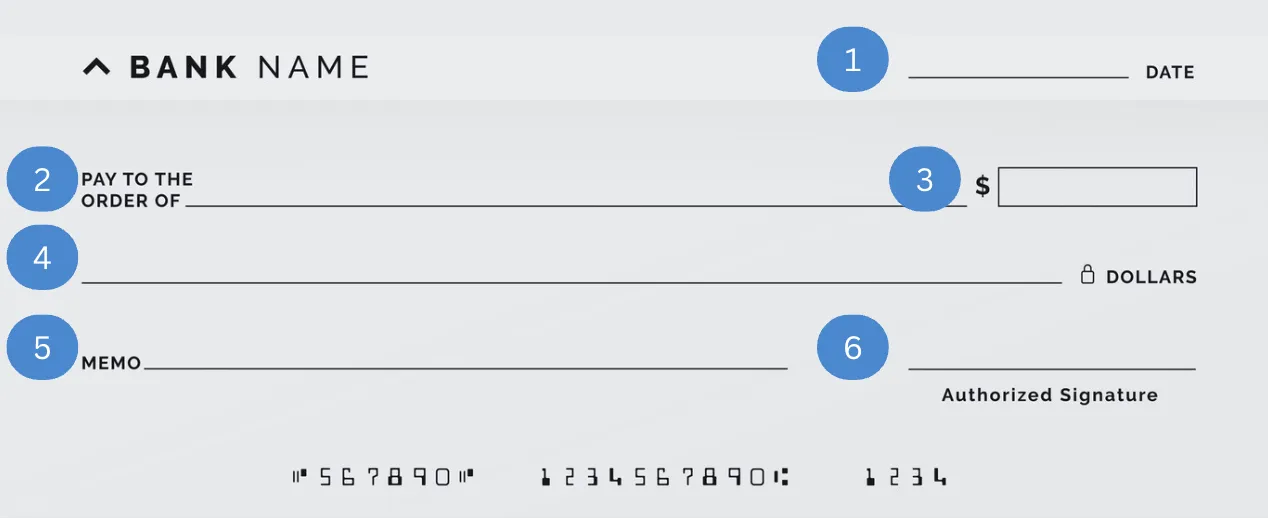
1. Write the Date
Remember that in the United States, the date format is mm/dd/yyyy.
2. Payee’s Name
Write the full name of the person to whom you are issuing the check, exactly as it appears on their official identification.
3. Amount in Numbers
Write the numerical amount clearly.
4. Amount in Words
Write the amount in words, including cents.
5. Add a Memo
You may include a note specifying the reason for the payment.
6. Sign the Check
Sign the check legibly in the space designated for the drawer.
7. Review the Information
Ensure that all information is accurate to avoid issues for the payee when cashing the check.
It is essential to complete checks legibly, without strike-throughs or corrections, as these may invalidate the document.
How to Correctly Write Numbers in Words on a Check
Writing amounts in words may be confusing when dealing with U.S. dollars. The following points should be kept in mind:
- Dollar amounts must be written in full words
- Cents must be written as fractions
- Avoid using dollar symbols or similar notations
- If there is leftover space at the end of the line, draw a line to prevent fraud
- For example, $1,000.75 is written as: One thousand and 75/100 dollars
Cash Checks and Manage Your Money Easily with Comun
As you can see, knowing how to fill out a check is useful for sending and receiving money in the United States. It is a reliable and accessible alternative if you do not have a banking account.
However, issuing and cashing a check can also require significant time and effort. That’s why you can skip the trip to the bank, avoid wasting time or money on gas, and cash your check directly from your phone using Comun—no lines, no questions, no complications.
Discover Comun, the only platform designed to serve the needs of immigrant communities in the United States, with support available in Spanish.
Why Choose Comun?
- Open your account with an official ID from your country
- Access a mobile app specifically designed for immigrants in the U.S.
- Make payments, receive your salary, and manage your finances
- Send money to your loved ones in LATAM for just a $2.99 transfer fee
Frequently Asked Questions
Still have questions about how to fill out a personal check? See our FAQ section.
What if I Make a Mistake Filling Out a Check?
If there are strike-throughs or inconsistencies in the amounts, the check must be voided and a new one used.
How Do I Void a Check?
Write the word VOID in large letters on the front of the check.
What Information Appears on the Back of a Check?
The back of the check contains the endorsement, meaning the payee’s signature for cashing the check.

Living in the United States
Minimum wage in the United States in 2026: Complete guide by state
8 min de lectura
Minimum wage in the United States in 2026
The federal minimum wage remains $7.25 per hour, unchanged since 2009 under the Fair Labor Standards Act.
However, that number does not reflect what all workers earn. Many states, some cities and counties have set higher minimum wages, which means that your legal minimum pay depends on where you work.
Understanding the minimum hourly wage in the USA is not just about knowing the federal number. It's about knowing whether you are being paid what you are legally owed.
Why has it stayed the same for so long?
Changes to the federal minimum wage require approval from Congress. While there have been multiple proposals to increase it, none have passed into law. As a result, the federal rate has not kept up with inflation or the rising cost of living.
In practice, this means the federal minimum wage acts as a baseline, not the standard in many parts of the country.
Minimum wage by state in 2026
Workers must be paid the highest applicable minimum wage, whether it comes from federal, state, or local law.
Below is a representative minimum wage by state table for 2026. It is important to always verify your local rate, as some cities have higher minimums.
| Rate | State(s) | Notes |
|---|---|---|
| $17.95 | Washington, D.C. | Highest in U.S. Adjusted annually on July 1 via CPI formula |
| $17.13 | Washington State | Highest state, CPI-indexed; first state to exceed $17 statewide |
| $16.94 | Connecticut | — |
| $16.90 | California | Fast food workers at chains with 60+ locations: $20.00/hr. No tip credit permitted. |
| $16.00 | New York (rest of state) · Hawaii · Rhode Island | New York City, Long Island & Westchester: $17.00/hr · Hawaii from $14.00 in 2025 |
| $15.92 | New Jersey | Lower rate applies for small employers (≤5 employees) |
| $15.74 | Oregon | Portland metro area: $17.00/hr · Non-urban areas: $14.20/hr · CPI-indexed annually |
| $15.16 | Colorado | Denver: $19.29/hr · CPI-indexed annually |
| $15.15 | Arizona | CPI-indexed annually |
| $15.10 | Maine | — |
| $15.00 | Delaware · Illinois · Maryland · Massachusetts · Missouri · Nebraska | Local rules may apply |
| $14.42 | Vermont | CPI-indexed annually |
| $14.00 | Alaska · Florida | Alaska increase effective July 1, 2026; Florida effective September 30, 2026 |
| $13.73 | Michigan | Scheduled to reach $15.00 on Jan 1, 2027 |
| $12.77 | Virginia | Legislation passed to reach $15.00 by 2028 |
| $12.00 | Nevada · New Mexico | State rate applies where higher than federal |
| $11.85 | South Dakota | CPI-indexed annually |
| $11.41 | Minnesota | CPI-indexed |
| $11.00 | Ohio | CPI-indexed · Businesses with gross receipts under $394,000: $7.25/hr |
| $10.85 | Montana | CPI-indexed annually |
| $10.55 | Arkansas | State rate applies where higher than federal |
| $7.25 | Texas · Idaho · Indiana · Iowa · Kansas · Kentucky · New Hampshire · North Carolina · North Dakota · Oklahoma · Pennsylvania · Utah · Wisconsin | Federal FLSA minimum generally applies to covered employers |
| $5.15* | Georgia · Wyoming | *State law is lower, but FLSA-covered employers must pay the federal $7.25 |
| No state minimum wage law | Alabama · Louisiana · Mississippi · South Carolina · Tennessee | No state minimum wage statute; federal $7.25/hr applies under the FLSA for covered employers |
Source: https://www.dol.gov/agencies/whd/minimum-wage/state
A few things worth noting: The states in the $7.25 group include states that adopted that rate under state law, while Georgia and Wyoming technically maintain a lower state minimum wage of $5.15 per hour. However, for most employees covered by the Fair Labor Standards Act (FLSA), the federal minimum wage of $7.25 per hour generally applies instead.
Three states have mid-year increases scheduled for 2026: Alaska jumps to $14.00 on July 1, Florida rises to $15.00 on September 30, and Oregon adjusts as well.
States with the highest minimum wage
Some states and cities have set wages far above the federal level to match actual local living costs. The highest minimum wages in 2026 are found in:
- Washington, D.C. at $17.95
- Washington State at $17.13
- Connecticut at $16.94
- California at $16.90
If you are working in one of these places, your pay should reflect at least those standards and not the federal minimum.
States with the lowest minimum wage
Several states' laws set their minimum wage below what the federal minimum wage indicates; in this case the federal standard of $7.25 per hour takes precedence. Some of them are:
- Georgia at $5.15
- Wyoming at $5.15
- Alabama and Louisiana — no separate state minimum wage law
If you live and work in these states and work minimum wage, your salary should reflect the federal minimum hourly wage in the USA.
Minimum wage for tipped workers
For tipped workers, it's important to understand that federal law permits a lower base wage. Under the Fair Labor Standards Act, employers can pay as little as $2.13 per hour as long as tips bring total earnings to at least the applicable minimum wage.
If tips do not cover the difference, the employer must make up the gap. However, some states, like California, do not allow this lower rate and require full minimum wage regardless of tips. It is important to check with your official local authorities the specific laws in your state for tipped workers.
Minimum wage for young workers
Workers under 20 years old can be paid a youth minimum wage of $4.25 per hour during their first 90 consecutive calendar days of employment. After that period, or once the worker turns 20, employers must pay the standard minimum wage.
What if your employer pays you less than minimum wage?
If you are being paid less than the legal minimum wage, your employer may be violating federal, state, or local labor laws.
Workers generally have the right to:
- Be paid at least the applicable minimum wage
- Receive overtime pay where required by law
- Keep records of hours worked and wages received
Employees can report potential violations to the U.S. Department of Labor's Wage and Hour Division. In general, labor law protections relating to minimum wage and overtime apply regardless of immigration status.
How much do you earn on minimum wage?
Assuming full-time work at 40 hours per week, your monthly and annual income could look like this (before taxes):
| Hourly Wage | Monthly Income (approx.) | Annual Income (approx.) |
|---|---|---|
| $7.25 | ~$1,256 | ~$15,080 |
| $13.00 | ~$2,253 | ~$27,040 |
| $16.50 | ~$2,860 | ~$34,320 |
These figures are estimates before taxes and depend on consistent full-time hours.
Is minimum wage enough to live in the U.S.?
In many parts of the country, the minimum wage does not fully cover the cost of living. Expenses such as housing, transportation, food, and healthcare vary widely by location. In states like California or New York, where the cost of living is high, even with better rates for minimum wages it may not be enough to support a family without an additional income.
It is important to consider the minimum wage and costs of living by state when choosing where to live and work.
How you get paid matters
Once you are earning, how you receive and manage your money can make a real difference. Some workers are paid by check or even in cash, which can make it harder to track income, build financial history, or send money to family.
Having a bank account or financial services platform may help:
- Receive direct deposits
- Track your income and expenses
- Send money securely to family members abroad
- Start building a financial roadmap to eventually access credit and build a credit history
For those who may not have access to traditional banking, there are a wide range of financial service providers and platforms including Común, which offer the ability to open a debit account with a passport or Matrícula Consular while you wait for your ITIN. You can manage your money through a mobile app which is also available in Spanish. Visit comun.app to learn more.
FAQ
Does the minimum wage increase in 2026?
The federal minimum wage remains $7.25, but many states continue to raise their rates annually.
What is the minimum wage in my state?
It depends on where you live. Always check your state and city laws, as local rates may be higher.
Can I be paid less if I am an immigrant?
No. Labor laws apply regardless of immigration status. You are still entitled to minimum wage and overtime protections.
Understanding your pay and what comes next
The minimum wage in the United States is not a single nationwide standard for all workers. It is a system shaped by federal law with state adjustments. Knowing the correct rate for your location is the first step. Making sure you are actually being compensated fairly is just as important.
Once you are earning, setting up a secure way to receive and manage your money can help you stay in control. With options like Común's debit account, you can receive direct deposits, track your income, and plan your finances in an app that is also available in Spanish. Visit comun.app to learn more.

Community
Community Banking: Supporting Local Economies
8 min de lectura
Community banking focuses on meeting the financial needs of specific communities, often underserved by large traditional banks. Digital platforms like Común extend that approach to the immigrant community, with documentation requirements adapted to their reality.
Community Banks: Local Investment, Knowledge, and Education
Community banks are known for their personalized approach to banking. With a deep understanding of the local economy, these banks can offer financial products and services tailored to the specific needs of their customers. This localized knowledge allows them to provide better advice and more flexible solutions for individuals and businesses within the community.
In addition, they invest significantly in their local areas. They reinvest deposits back into the community through loans to local residents, small businesses, and organizations. This cycle of local investment promotes economic development and helps create jobs, contributing to the overall prosperity of the community. The relationships built between community banks and their customers go beyond simple transactions. These banks often participate in local events, support community projects, and contribute to charitable causes.
Their active involvement in the community strengthens trust and creates a sense of shared purpose and commitment to local well-being. In addition, community banks play a crucial role in providing financial education. By offering workshops, seminars, and one-on-one consultations, they help community members improve their financial literacy. This education empowers individuals to make informed decisions, manage their finances effectively, and plan for their future.
Común - Banking designed for your life in the USA
Open your bank account¹ in 3 minutes with your country ID²
Stability and Trust: Aspects of Community Banking
Stability and trust are the pillars of community banking, forming the foundation of the relationship between banks and their customers. These attributes are particularly crucial for ensuring economic resilience and fostering customer confidence, which together create a stable financial environment for both individuals and businesses.
Community banks tend to take a conservative approach to lending and investing, focusing on sustainable growth and prudent risk management. This strategy often makes them more resilient during economic downturns, allowing them to continue supporting their customers even in difficult times. The emphasis on building long-term relationships means that community banks are more likely to provide ongoing support during periods of financial instability, further fostering a stable financial environment.
Customer trust is significantly enhanced through the personalized service offered by community banks. Customers appreciate the ability to speak directly with bank representatives who understand their unique circumstances and needs, fostering a sense of reliability and security. In addition, community banks often prioritize transparency in their operations, from clear communication about fees and services to straightforward loan terms. This transparency builds customer trust and confidence in the bank’s integrity.
Active involvement in local communities also reinforces the trust customers place in community banks. By supporting local initiatives, sponsoring events, and participating in community activities, these banks demonstrate their commitment to the well-being of their customers and the broader community. This involvement not only strengthens the relationship between the bank and its customers, but also contributes to the overall prosperity of the community.
Financial security is another critical aspect of stability and trust in community banking. Deposits at community banks are typically insured by the Federal Deposit Insurance Corporation (FDIC), providing an additional layer of security for customers’ funds and assuring them that their money is protected. In addition, community banks often have robust fraud protection measures in place. Their local presence allows them to monitor and quickly address suspicious activity, further enhancing customers’ sense of security.
In short, the stability and trust that define community banking are essential to economic resilience, customer confidence, and financial security. These qualities enable community banks to effectively support their customers, even in difficult times, and maintain strong, lasting relationships within their communities.
How Integrating Común.app Improves Stability and Trust:
Stability and trust are fundamental to the success of community banking, fostering long-term relationships and financial security for customers. By integrating Común.app into their banking experience, users can enjoy the benefits of personalized service, financial security, and community support in a modern and convenient format. Here’s how integrating Común.app improves stability and trust in the community:
- Instant Access to Information: Común.app gives users instant access to account information, transaction history, and real-time notifications. This transparency helps customers stay informed and confident about their financial status, increasing trust in the platform.
- FDIC Insurance and Fraud Protection: Just like traditional community banks, Común.app accounts are FDIC insured, and the app includes robust security measures to protect against unauthorized transactions. This combination of security features ensures that customers’ funds are safe, reinforcing their trust in the digital banking service.
- User-Friendly Experience: Común.app provides a user-friendly experience with intuitive navigation and easy access to essential banking services. This accessibility builds customer trust, as users can manage their finances conveniently and efficiently.
- Personalized Customer Support: Común.app offers top-quality customer service available seven days a week via chat, email, or phone. This commitment to customer support reflects the personalized service of traditional community banks, fostering a sense of reliability and trust.
- Financial Inclusion and Community Focus: Común.app emphasizes financial inclusion, serving Latin American immigrants and other underserved communities. By offering services without the need for a Social Security Number and focusing on customer protection regardless of immigration status, Comun.app builds trust among its users and aligns with the community-centered values of traditional banks.
- Educational Resources: Común.app also provides educational resources to help users improve their financial literacy. By offering guidance on how to manage finances, understand banking services, and make informed decisions, Común.app empowers its users, increasing their confidence in the platform.
Choosing Común means choosing a trusted partner dedicated to supporting the financial well-being of its customers, just like a traditional community bank.
Banking designed for your life in the USA
Open your bank account¹ in 3 minutes with your country ID²
Technology and Innovation in Community Banking
Community banks are increasingly embracing digital transformation to improve the customer experience and stay competitive. By adopting online and mobile banking platforms, they provide customers with convenient access to their accounts, the ability to transfer funds, pay bills, and monitor transactions from anywhere at any time. These digital services offer a level of convenience that meets the expectations of modern tech-savvy customers.
The importance of keeping up with technological advances cannot be overstated. As customer needs evolve, community banks must continuously update their digital offerings to provide seamless and user-friendly experiences. This includes integrating features such as instant notifications, secure login options, and personalized financial tools. By doing so, they ensure they remain relevant and appealing to both existing and potential customers.
Cybersecurity
Alongside digital transformation, community banks are prioritizing cybersecurity to protect customer data and ensure secure transactions. Advanced encryption techniques protect sensitive information from unauthorized access. Multi-factor authentication adds an additional layer of security, requiring customers to verify their identities through multiple methods before accessing their accounts.
Security audits are carried out regularly to identify and address potential vulnerabilities. These audits help ensure that cybersecurity measures are up to date and effective against emerging threats. By implementing these robust security measures, community banks not only protect their customers, but also build and maintain trust, reinforcing their reputation as secure and reliable financial institutions.
Overall, technology and innovation in community banking are essential for improving customer satisfaction, increasing operational efficiency, and maintaining security in an increasingly digital world.
Conclusion
Community banks are indispensable to the health and vitality of local economies. Through personalized service, support for small businesses, investment in the community, relationship-building, financial education, and stability, these institutions create a strong economic foundation. By choosing a community bank, individuals and businesses can contribute to the growth and success of their local area, fostering a prosperous and interconnected community.
Key Benefits of Community Banks:
- Personalized Service: Tailored financial products and services.
- Support for Small Businesses: Loans and credit for local businesses.
- Community Investment: Reinvests deposits in the local economy.
- Relationship Building: Active participation in community events and causes.
- Financial Education: Workshops and consultations to improve financial literacy.
- Stability and Trust: Resilience during economic downturns.
By supporting community banks, you are supporting the growth and prosperity of your local economy.
What is community banking?
It's a financial services model focused on serving specific communities — geographic, cultural, or need-based — that often have less access to traditional banking.
How does community banking benefit local economies?
By making bank accounts, remittances, and savings more accessible, it helps more people participate in the formal economy instead of relying on informal services with higher fees.
How does this approach apply to the immigrant community in the U.S.?
Platforms like Común accept Latin American IDs instead of requiring an SSN, specifically addressing the documentation barriers this community faces.
Frequently asked questions
What sets community banking apart from a large traditional bank?
It focuses on the specific needs of a particular community, with adapted requirements and products, instead of a generic model.
Does community banking only exist for geographic communities?
No, it can also focus on cultural or need-based communities, like the immigrant community.
How does this help the local economy?
More people with formal banking access means less reliance on costly informal services, like check-cashing stores.
Is Común an example of community banking?
Común is a digital financial platform designed for the immigrant community, with documentation requirements adapted to that community.
What documentation requirements does Común adapt?
It accepts over 100 Latin American IDs instead of requiring a Social Security Number.
Does community banking have the same costs as traditional banking?
It varies by provider; many digital community banking platforms, including Común, don't charge a monthly fee or require a minimum balance.

Living in the United States
Cashier’s Checks in the U.S.: Costs, Impact on Latinos, and Free Alternatives
8 min de lectura
Why is it so expensive to cash checks in the United States?
Without a bank account, people must turn to check-cashing stores that charge between 1% and 3% of the check amount. For a $1,000 check, that means $10-30 lost on each cash-out. Banks may also charge fees for depositing checks from other banks.
Why do Latinos disproportionately bear these costs?
Latino communities have less access to banking services because of barriers such as SSN requirements, language, and unfamiliarity with the system. Without a bank account, they are more likely to use check-cashing stores located in low-income areas that charge high fees.
Solutions for cashing checks at no cost
The best solution is to open a bank account. Común is a Spanish-language digital bank that allows you to open an account without an SSN using a passport or consular ID card. Once opened, you can deposit checks for free from the app using mobile deposit. There are also nonprofit organizations such as UnidosUS that offer free financial services to Latino communities.
Frequently asked questions about cashing checks in the U.S.
How much does it cost to cash a check in the U.S. without a bank account?
Check cashing stores typically charge between 1% and 3% of the check amount, with a minimum of $3-5. For a $1,000 payroll check, that means losing between $10 and $30 on each cash-out. Walmart Money Center charges lower fees ($4 for checks up to $1,000), but the cost is still higher than having a bank account.
Can I cash a check for free in the U.S.?
Yes, with a bank account. If you deposit the check at your own bank, there is no charge. With Común you can deposit checks by photographing them from the app, completely free. Some banks also allow you to deposit checks from other banks at no additional cost using mobile deposit.
Why do Latino immigrants pay more to cash checks?
The main reason is less access to bank accounts. Barriers include SSN requirements, language, unfamiliarity with the system, and fear of formal procedures. Without a bank account, they turn to check-cashing services that charge high fees. Platforms like Común remove these barriers by accepting Latin American IDs without an SSN.
What do I need to deposit a check in Común?
You only need the Común app and the physical check. Open the app, select “Deposit check,” take a photo of the front and back of the check (with your signature on the back), and the money is generally credited in 1-2 business days. There are no additional charges for the mobile deposit service.
What happens if someone pays me with a personal check from someone without a bank account?
Personal checks from people without sufficient funds or without an active account bounce (bounced check). If you deposit that check, the bank may temporarily hold the funds and then debit you the amount plus an NSF fee ($25-35). To receive payments more safely, prefer Zelle, Venmo, or direct transfers instead of personal checks from people you do not know well.
Is it better to receive payroll by check or by direct deposit?
Direct deposit is better in virtually all cases: the money arrives automatically on payday (or earlier with Común), there is no risk of the check being lost or stolen, there are no cashing fees, and you can access the funds immediately. With Común you can set up direct deposit from the app in minutes using your routing number and account number.

Living in the United States
Discover how much it costs to live in the United States
8 min de lectura
Knowing the cost of living in the United States is essential if you plan to build a life in this country. It includes the amount of money needed to cover basic expenses such as housing, food, health, public transportation, etc.
You’ve surely asked yourself before how much money you need to live well in the U.S. The reality is that this figure is relative, since costs vary considerably from one State to another.
However, in general terms, it is possible to state that the main expense is housing, followed by food and health services.
This time, we will explain how much it costs per month to live in the United States, which is the cheapest State to live in the USA, and the approximate costs you will have to cover so you can consider your monthly budget.
What does the cost of living in the United States mean?
Cost of living refers to the amount of money required to cover the necessary expenses to subsist, which are divided as follows:
- Housing: monthly rent or mortgage.
- Food: purchasing groceries and prepared food.
- Transportation: public transit or your own car.
- Health: health insurance, medical care, medications, treatments, etc.
- Education: tuition, school supplies.
- Basic services: electricity, water, internet.
The average cost of living varies in each State, because each one has a particular lifestyle that may be more or less affluent, depending on the type of services available and the area’s infrastructure.
Knowing which States are the cheapest in the United States is essential to adjust your monthly expenses in a competitive way.
Main expenses in the United States
Starting a new life in the United States entails covering a series of monthly expenses that could affect your finances if they are not planned correctly.
Below, we show you the national average of basic necessities in this country.
Housing: the largest monthly expense
Housing is the largest expense you will have once you arrive in the United States, especially if you plan to live in a city like New York, known for its high costs.
Housing costs also depend on whether it is a mortgage or rent.
In March 2025, the average rent was $1.575 USD for a one-bedroom apartment and $1.835 USD for a two-bedroom apartment.
On the other hand, in the same month, the average mortgage rose to $2.807 USD, which represents an increase of 5.3%.
Food and basic services
According to the Thrifty Food Plan from the United States Department of Agriculture (USDA), an adult between 20 and 50 years old requires approximately $309.20 USD per month, while a child between 9 and 11 years old spends around $234.20 USD.
Health and health insurance
As for health insurance, the cost depends on several factors, such as the beneficiary’s age, place of residence, and level of coverage.
This is the national average cost by level of coverage for people over 40 years old.
- Bronze: $488 USD
- Silver: $621 USD
- Gold: $676 USD
- Platinum: $913 USD
Transportation: public vs. own car
For its part, the national average cost of public transportation in the United States reaches $975 USD annually or $81 USD monthly, while the cost of maintaining a car exceeds a thousand dollars per month.
Cost of living in the United States by State and city
Remember that the previous figures are a nationwide average, so prices may be lower or higher depending on the city and State where you intend to live.
| City / State | Cost of living index1 | Average monthly salary2 | Income needed for a single person3 | Income needed for a family of 4 (2 adults and 2 children)4 |
|---|---|---|---|---|
| San Francisco, California | 67% higher than the national average | $7,938 | $9,993.16 | $28,260 |
| New York | 74% higher than the national average | $4,331.58 | $11,547 | $26,533 |
| Washington, D.C. | 42% higher than the national average | $6,658 | $9,138 | $23,157 |
| Miami, Florida | 21% higher than the national average | $5,153 | $9,083.45 | $22,707 |
| Boston, Massachusetts | 46% higher than the national average | $6,750 | $10,413 | $26,663 |
| Austin, Texas | 3% lower than the national average | $5,419 | $8,313 | $19,1665 |
¹ RentCafe, 2025
² ZipRecruiter, 2025
³ Smart Assets, 2024
⁴ Smart Assets, 2025
⁵ Click2Houston, 2025
As you can see, the cities of New York and San Francisco are among the most expensive nationwide, so it is advisable to choose a more accessible place to live, such as Texas.
Remember that these data are an estimate and your salary could be higher or lower, as could your monthly expenses and the money needed to live.
What is the average salary in the United States?
Another important aspect in determining the cost of living in the United States is the average salary and the minimum wage—concepts that could be confused but are actually very different.
On the one hand, the minimum wage is the amount from which an employer must start to set employees’ pay. It is established by law.
This varies in each State. According to the U.S. government, at the federal level this figure reaches $7.25 USD per hour, although several States set a higher minimum. For example, in California and New York it is $16.50 USD.
The average salary is the average income a worker receives per month. This amount is obtained by adding total wages and dividing by the number of workers.
By contrast, the real amount needed to live comfortably is the sum of the average costs of essential services such as housing, utilities, and food, in addition to other types of expenses such as leisure.
It is very important to be clear about the difference between the average salary and the real cost of living, since it is likely that your salary will not match your needs, especially if you are the head of a large family.
For example, while the average salary in San Francisco, California, is $7,938 USD, the amount needed to live is $9,993. In contrast, it is worth highlighting States such as West Virginia, where the average salary is $5,405 per month and the income needed to live is $6,735 USD. As you can see, the gap is much smaller, which places this State as the most accessible to live in the United States.
Manage your money better in the U.S. with Comun
Having a checking account will make financial control easier so you can stay on top of all your monthly expenses, organize income, and send money home.
That’s what Comun is for! A financial platform designed for day-to-day needs in the United States through an easy-to-use mobile app that is available in English and Spanish. Opening an account is very easy and fast; you can do it with qualifying official identification from your country of origin.
In addition, it makes it easier to send remittances to several countries, up to the applicable limits, without complications, so that your family receives more money for less.
Why choose Comun?
- Get a Visa debit card.
- Send money home with accessible, transparent fees.
- Save money and pay your bills easily.
- Anti-fraud security
And much more!
Open your account with Comun today and manage your financial life in the United States with security and confidence.
Frequently Asked Questions (FAQ)
Which city in the United States is the cheapest?
Within West Virginia, cities such as Huntington, Charleston, or Parkersburg are often among the most affordable in the country.
Which state in the USA is more affordable to live in, according to the cost of living?
West Virginia is considered an affordable State in the country.
How can I calculate the monthly cost according to my lifestyle?
Add up your necessary monthly living expenses, for example:
Monthly cost: Housing+Utilities+Food+Transportation+Other
International Money Transfers
Remittance services: how to send money to Latin America
8 min de lectura
Remittance services: sending money to Latin America
For millions of Latin Americans living in the United States, sending money back home is part of everyday life. For many, their families and friends back home often depend on fast and reliable remittances from the United States. Today, there are many service providers for sending money to Latin America available in the market, each offering different advantages and disadvantages and choosing the right one is key to make the most out of your hard-earned money. A useful approach is to understand how remittance pricing works, what factors affect the total cost, and how to compare the services based on your specific needs.
How to measure the real cost of a remittance?
The real cost of a remittance is determined by different elements:
- The transfer commission.
- The exchange rate being offered at the moment.
- Additional service fees.
- Delivery method.
- Transfer speed.
- Promotional pricing conditions.
In practice, the exchange rate often has the biggest impact on how much money the recipient actually receives. For example, two providers may advertise similar fees while delivering noticeably different final amounts because of the FX spread built into the exchange rate.
What is the FX spread?
The FX spread is the difference between:
- The real market exchange rate (this is also called the mid-market or interbank rate)
- The exchange rate the service provider gives you
This difference is where some remittance service providers generate revenue. The same reason why two services with the same "$0 fee" can have very different final costs.
The most popular remittance services used by Latin Americans in the U.S.
Different services work better for different types of users. Here you can find a general overview of the providers most commonly used by the Latino communities in the United States.
Western Union
Western Union is one of the largest remittance companies in the world, with an extensive cash pickup network across thousands of locations in Latin America.
Strengths:
- Large global network
- Cash pickup availability
- Multiple delivery methods
Limitations:
- Exchange rates may vary significantly
- Fees depend on payment method and destination
Ria Money Transfer
Ria Money Transfer offers payments from the US to more than 165 countries across the world, with delivery options including cash collection and delivery to either a mobile money wallet or bank account.
Strengths:
- Wide coverage
- Competitive options in some corridors
- Cash pickup availability
Limitations:
- Pricing varies depending on country and delivery method
- Exchange rate competitiveness changes daily
MoneyGram
MoneyGram is a service provider of international remittances that enables individuals to send and receive money internationally and domestically.
Strengths:
- Extensive cash pickup network
- Fast transfers in some cases
- Availability in multiple countries
Limitations:
- Fees and FX spreads can vary widely
- Final cost depends heavily on transfer method
Félix Pago
Félix Pago is a WhatsApp-based platform focused on servicing the Latino community in the U.S. to send money throughout Latin America.
Strengths:
- Mobile-first experience
- Speed and convenience
Limitations:
- Coverage and features may vary by destination
- Transfer economics depend on corridor and timing
- Not every user prefers chat-based transfers
Común
Común offers the possibility to open a debit account in the USA and send money home from Común's app or WhatsApp.
Strengths:
- Spanish-first app and customer support
- Convenient with a mobile-focused experience
- Promotional FX rate available on the first transfer
- Accepts more than 100 Latin American IDs to open a debit account
- Transparent fees
Limitations:
- Exchange rates and transfer costs vary daily
- The final recipient amount depends on the destination country, transfer method, and market conditions
Remittance services: a general comparison
Today, the remittance service provider market in the U.S. can be divided into two major categories:
Traditional remittance agencies
Companies that offer physical networks and cash pickup infrastructure. For example: Western Union, Ria Money Transfer or MoneyGram.
Fintech alternatives
These platforms focus on mobile experience, transparent pricing, digital account management, accessibility for immigrants in the U.S. and some offer Spanish-first experiences. Examples: Común and Félix Pago.
Why do comparisons matter?
Exchange rates change every day and promotional offers can also change. This is why it's important to compare what's the best service provider for your current situation. If possible, it is recommended to use a tool to have a better perspective on your remittance costs. For example Común has a live calculator at comun.app/compara designed to help you understand the exact conditions of your transfer.
Beyond the exchange rate
For many immigrants in the United States, choosing the best remittance services is not just based on who offers the best exchange rate. The accessibility to the services can shape the entire experience of sending money. Some people may not have a Social Security Number, a traditional U.S. bank account, or an easy way to verify their identity through conventional financial systems. Language can also play an important role for navigating financial apps especially with customer support and understanding the specific transfer policies. Being able to do financial transactions in a native language can make transactions feel less stressful.
The competitive market landscape in the U.S. makes it possible for Latin American immigrants to compare options for their remittances. Today, you can look beyond the exchange rate and consider factors like Spanish-language support, flexible identification requirements, mobile accessibility and transparency around fees and/or transfer conditions. The best remittance service provider is the one that offers pricing, services and access that fit your needs. Común's app is available in Spanish, accepts more than 100 Latin American IDs and offers transparent fees.
How to choose the right remittance service for your situation?
There is no universal "best" remittance provider. The right option depends on how often you send money, where you are sending it, how your recipient receives the funds, and what kind of financial access you have in the United States. Choosing based on your own priorities is often the best path.
If this is your first transfer
Many remittance services offer promotional pricing or preferred exchange rates for first-time users. These promotions can temporarily improve the amount received by your family, but they do not always reflect the long-term cost of using the platform.
For example, some digital services may offer stronger FX rates on the first transfer, while traditional providers occasionally waive transfer fees for new customers. However, the total value still depends on the exchange rate, transfer speed, and delivery method.
Before sending your first remittance, it is important to consider:
- The final amount your recipient will receive
- If the promotion applies to your destination country
- Delivery times
- Bank deposit vs cash pickup options
To compare exchange rates you can always use a tool, for example, comun.app/compara is designed to help people understand the cost of their transfer.
If you do not have an SSN
Access to financial services can vary significantly for immigrants in the United States, especially for people who do not have a Social Security Number. This can make onboarding slower or more complicated for recent immigrants, ITIN holders, or people primarily using foreign identification documents.
Some remittance service providers have adopted more flexible verification models. Común, for example, accepts more than 100 Latin American IDs. It is recommended to check with every institution their specific verification requirements.
If you send money regularly
People who send remittances every month can benefit more from consistency than from temporary promotions. For frequent senders, it can be useful to review:
- Ongoing exchange rates
- Fee transparency
- Recurring transfer options
- Convenience: for example mobile app or WhatsApp transfers
- Customer service availability
If your family depends on cash pickup
Cash pick-up continues to play a major role across many parts of Latin America, especially in smaller cities or rural communities where bank access may be limited.
Traditional remittance companies like Western Union, Ria Money Transfer, and MoneyGram offer large physical networks that allow recipients to collect money in person at supermarkets, convenience stores, banks, and local partner locations.
Before choosing a provider, it is helpful to verify:
- Whether cash pickup is available in the destination city
- Pickup hours and accessibility
- Transfer speed
- Identification requirements for recipients
- Maximum transfer limits
In some cases, the best service is simply the one your recipient can access easily. Común offers cash pick ups with options in some stores and banks.
If you prefer convenience: mobile-first experiences
Over the past years, mobile-first experiences have become popular given the convenience of being able to send remittances from one's mobile phone.
Digital-first services can offer:
- Faster onboarding
- Mobile transfers
- Real-time notifications
- Simpler account management
Platforms like Común and Félix Pago are examples of services designed around mobile experiences for Latino immigrants. For people who feel more comfortable managing their transfers from their phones, these platforms can feel faster and more convenient.
FAQ
What is the cheapest service to send remittances to Latin America?
There is no single service that is always the cheapest. Costs depend on exchange rates, transfer fees, destination country, payment method, and whether you qualify for a first-transfer promotion. The best way to verify your exact case is to compare providers.
What is the FX spread and why does it matter when sending remittances?
The FX spread is the difference between the real market exchange rate and the exchange rate offered by the remittance provider. A weaker exchange rate can reduce the amount your recipient receives.
How can I verify the real cost before sending a remittance?
The best way is to compare the total recipient amount, exchange rate, fees, and promotional conditions before sending money. Some service providers offer tools that calculate the costs before sending the remittance. Común's live comparison calculator is designed to help users verify this information in real time.
Do all remittance services offer cash pickup options?
No. Some remittance providers specialize in bank deposits or digital wallet transfers, while others maintain extensive cash pickup networks across Latin America. Before sending money, it is important to confirm how your recipient prefers to receive funds and whether pickup locations are accessible in their area.
Why do exchange rates change between remittance providers?
Each provider sets its own exchange rates based on market conditions, operating costs, transfer corridors, and promotional strategies. Because rates can change daily, comparing providers before each transfer can help users better understand the total cost of sending money.
Final thoughts
The remittance industry has changed significantly over the past decade, today sending money to Latin America is no longer limited to one type of service or provider. Immigrants in the United States can choose between traditional cash pickup networks, digital-first platforms, and hybrid financial services depending on what works best for their families.
For many people, the real value comes from the full experience from the convenience of usage, accessibility to the services and knowing exactly how much money will arrive can matter just as much as costs. Común offers transparent pricing, an app available in Spanish and a comparison tool that helps users review transfer costs before sending money.

Financial Education
How to Endorse a Check: Your Safe and Detailed Step-by-Step Guide
8 min de lectura
Despite the fact that digital payment methods have gained significant relevance practically worldwide, checks remain essential for carrying out certain transactions, especially for people without a banking account.
According to recent data, 61% of Americans still use checks. However, 17% have been victims of check fraud.
Knowing how to endorse a check in the United States is a necessary security measure to prevent fraud. While it can be a confusing procedure, it is crucial to understand it in order to avoid issues.
In this article, we will explain step-by-step how to correctly endorse checks, as well as the information you need to write on the back in order to cash the stated amount.
What Is a Check Endorsement and Why Is It So Important in the U.S.?
A check endorsement is a signature on the back of the check that serves as authorization for it to be cashed at a financial institution.
Its main function is to validate the cashing of the check, as well as authorize the transfer of funds, or to transfer the right to another person.
Knowing how to endorse a check is essential because it is a primary security requirement in the U.S. financial system, serving as a protection measure for the holder and the deposited funds.
What Is the Correct Way to Endorse a Check, and Where Should You Sign?
Below, we show you how to complete the endorsement before cashing checks at the bank.
Step 1: Verify the Check Details
Make sure the details on the front of the check are correct, such as the payee’s name, the amount in numbers and words, and the banking institution.
Step 2: Locate the Endorsement Area
Turn the check over and locate the statement “Endorse Here” or “Do not write below this line.” Avoid writing below the marked area.
Step 3: Sign the Check Precisely
Sign the check in the designated box, according to the type of endorsement you require. Next, we will explain everything about the different types.
But what should you do if the payee’s name is incorrect?
Example of How to Endorse a Check if the Name Is Misspelled
If the payee’s name is incorrect, you should first sign as it appears and then sign again with the corrected name.
James Smit — James Smith
Step 4: Consider a Restrictive Endorsement (Highly Recommended!)
A restrictive endorsement is a security measure to prevent an unauthorized third party from cashing the check, as it limits the form of payment to a registered banking account. It is linked to the information provided on the back of the check.
Step 5: Multiple-Payee Endorsements
If the check is made out to more than one payee, one or all may need to sign the endorsement, depending on how it is written.
- Katy Adams and Mark Palmer: Signatures from both are required
- Katy Adams or Mark Palmer: One signature is sufficient
- Katy Adams and/or Mark Palmer: Depending on the intermediary bank, one or two signatures may be required
- Katy Adams, Mark Palmer, etc.: The bank determines whether one or all signatures are necessary
Types of Endorsements: Know the Options for Your Checks
Before endorsing your check, verify which type is most suitable depending on the transaction you need to perform. For example, a restrictive endorsement is a way to secure your money, just like using modern financial alternatives such as Común, a comprehensive service that gives you access to unified and efficient financial tools.
Blank Endorsement
A blank endorsement is carried out when the same payee cashes the check in cash. In this case, only the signature in the designated area is needed.
Restrictive Endorsement
A restrictive endorsement is a security measure to ensure that the funds are deposited into a specific banking account.
To do this, you must include the statement “for deposit only to” + bank name, account number, and signature.
This is the most recommended method for Común users who make deposits via mobile, as it provides protection for the check in case of loss and ensures that the money is deposited into the designated account.
Third-Party Endorsement
If the check will be cashed by a third party, it must be endorsed as follows.
Pay to the order of: (name of another person) + signature
It is important to exercise extreme caution with this type of endorsement. Use it only with trusted individuals, and in case of theft or loss of a check, report it to the financial institution immediately.
Business Endorsement
A business endorsement is made when a check is cashed in the name of a company. This requires including the full name of the company, followed by the signature of the authorized legal representative.
Mobile Deposit Endorsement
To deposit check funds through a mobile application or mobile banking, it must be endorsed as follows:
For mobile deposit only + your signature.
Deposit your endorsed check easily and securely using Común
Cashing checks is a process that requires special care and attention in order to avoid mistakes and setbacks that could affect the transaction.
This time, we learned the importance of correctly endorsing a check in the United States, as well as the different types that exist, according to the available cashing methods.
Now that you know how to fill out a check on the back, you can rely on Común to deposit the funds through the mobile app.
Skip the lines: Deposit your check from the app; availability of funds may vary.
Común offers you the necessary security to protect your money and personal data
It is an accessible platform for immigrants in the United States; request to open your account with documentation from your country
Get customer support in English and Spanish, available 24/7
Access a comprehensive mobile app to manage your personal finances in the simplest way
Común will not only make the check deposit process easier, but it will also transform your financial life in the United States. Open your account today and find out.
Frequently Asked Questions
Is it mandatory to endorse a check in the United States?
In most cases, yes, it is necessary. If you request a deposit through an ATM or application, the bank may not require an endorsement.
What happens if I sign the check incorrectly when endorsing it?
Avoid cross-outs or scratches and endorse the check again. If the bank rejects it, ask the issuer to issue a new one.
Can I endorse a check to another person?
You can endorse a check so that it can be cashed by another person with the statement “pay to order of” along with the payee’s name. However, this process is restricted according to each bank’s specific policies.
Is it safe to deposit a check with the mobile app?
It is safe to deposit a check through the Común mobile app, as your data is encrypted and it includes other security measures such as two-step verification.
International Money Transfers
How much does it cost to send money to Mexico from the United States? A 2026 guide
8 min de lectura
Sending money to Mexico with Común costs as little as $2.99 per transfer, and your first transfer is at no cost. The exchange rate is shown in full before you confirm, with no hidden charges, and most transfers arrive within minutes.
How much does it cost to send money to Mexico from the United States? A 2026 guide
In most cases, the total cost depends on three factors: the transfer fee, the exchange rate, and any charges applied to the recipient of the money. The truth is that the final cost can range from a few dollars to something more significant as it is impacted by the service fee, delivery method, and speed.
Remittances have become so important to the Mexican economy that Mexico remains the world's second-largest recipient of remittances, behind only India. According to BBVA Research, Mexico received $61.8 billion USD in remittances in 2025, representing 3.4% of the country's GDP. Today, there are dozens of apps and money transfer services available for sending money from the United States to Mexico. Some focus on speed, others on cash pickup access, and some prioritize lower overall costs.
In this guide, we'll break down what actually affects the cost of a transfer, compare popular services, and explain how to find the option that works best for you and your family.
How much money can I send to Mexico?
One very important aspect to consider is the amount allowed by money transfer apps, as well as any restrictions included in their terms and conditions.
In general, there is no legal limit imposed by the United States government, but each platform has its own standards and regulations that determine transfer limits and guidelines for international money transfers.
For example, these are some of well known providers that offer money transfers to Mexico and their respective limits:
- Western Union: up to 5,000 USD per transaction.
- MoneyGram: up to 10,000 USD per transaction.
- Xoom: Level 1 is limited to $2,999 per day while the third level allows up to $50,000 per day.
If you are looking for a straightforward way to send money to Mexico, Común can be an excellent alternative. New users can enjoy the first money transfer free and then pay a fee starting at 2.99 USD per transfer, up to applicable limits.
What is the best way to send money from the United States to Mexico?
There are several ways to send money from the United States to Mexico, whether through traditional banks or specialized international money transfer services. These are the main options to do it:
Bank-to-Bank transfers
One of the most common ways to send money is through wire transfers from one traditional bank to another. The advantage of this method is that it can be secure because it is backed by official financial institutions. However, transfers can take longer and involve higher fees.
To send funds this way, you must have a U.S. bank account and use the recipient's SWIFT code.
The transfer cost depends on the receiving bank in Mexico. For example:
- BBVA charges approximately $30 USD + VAT to receive an incoming international transfer.
- Citibanamex estimates suggest around $15–20 USD + VAT for incoming transfers, but confirming directly with the bank is recommended.
These fees apply regardless of the amount sent, therefore it is important to confirm the fees with each bank.
Cash transfers
Another option, which may be more accessible for people without a bank account, is sending cash that can be picked up at different locations across Mexico.
To send cash, it is common to visit a physical location of the provider that offers this service, such as a Western Union office. Once there, you pay the amount you want to send plus the assigned fee. To collect the funds, your family members must present a valid government ID at one of the participating locations, such as Oxxo, Banco Azteca, Walmart, or others. However, many service providers such as Western Union also have digital offers.
Although this can be a convenient alternative for people who mainly manage cash, it may also come with potential drawbacks, such as fees that vary depending on the amount sent and exchange rates that might be less competitive compared to some digital transfer services.
Apps and digital platforms
Another option for sending money to Mexico is through apps and digital platforms that specialize in international money transfers, such as Wise, Félix Pago, Ria Money Transfer, and Común. Many of these services are available on both iOS and Android and may offer lower costs compared to some cash transfers or traditional bank wires, depending on the provider and delivery method. Some platforms focus mainly on money transfers, while others may also include additional financial features, such as a debit card or access to a U.S. bank account.
To access these services, you must create an account on the provider's website or app. In addition, some apps require identity verification using personal information such as your SSN (Social Security Number) or ITIN.
You can send money directly through the provider's app or, in some cases, even through WhatsApp, and choose the preferred delivery method. Some services also offer cash pickup options for recipients. For example, Común accepts more than 100 Latin American IDs for account verification, it allows you to send money through the app or via WhatsApp, and offers cash pickup options across Mexico.
Before choosing an app to send money to Mexico, we recommend comparing the most popular options and evaluating which one best fits your needs and those of your family.
Five popular mobile apps for sending money to Mexico from the United States
There are many apps available for sending money from the United States to Mexico, but costs, delivery speeds, and exchange rates can vary depending on the provider and transfer method. Comparing multiple options can help you find the service that best fits your needs.
| Service | Payment Options | Fee | Delivery Options | Exchange Rate | MXN per 1,000 USD | Speed |
|---|---|---|---|---|---|---|
| Común | Bank account, debit card, cash | Starting at 2.99 USD | Bank account or cash pickup | Competitive | ~17,000 MXN | Minutes to hours |
| Western Union | Bank, cash, card | Varies depending on amount | Bank, cash, wallet | Exchange rate with spread applied | ~16,920 MXN | Minutes to days |
| Félix Pago | WhatsApp, cash, card | $2.99 USD for bank account and $4.98 USD for cash pickup transfers | Bank account and cash | Competitive | ~17,000 MXN | Instant |
| Ria Money Transfer | Bank account (ACH), debit card, credit card, cash | Starting at $0.99; free for bank transfers up to $15,000 | Bank account, cash pickup, mobile wallet | Exchange rate with spread applied | ~16,900–17,000 MXN | Minutes to days |
| MoneyGram | Bank account, debit card, credit card, cash (at agent) | Free for bank transfers up to $10,000; $49.99 for $10,001–$15,000; $5+ for cash sends | Bank account, debit card, mobile wallet, cash pickup | Exchange rate with spread applied | ~16,800–16,950 MXN | Minutes to hours |
The amount received in MXN for every 1,000 USD can change throughout the day due to fluctuations in exchange rates, provider fees, and delivery methods. The rates shown here are for illustrative purposes only and may not reflect the exact amount available at the time of your transfer. Before sending money, it may be helpful to compare the current exchange rate and total transfer cost across providers. Común's comparison tool can help you check and compare available rates in real time.
What determines the real cost of sending money to Mexico?
When comparing money transfer services, many people focus only on the advertised transfer fee. But the real cost of sending money to Mexico usually depends on three different factors:
- The transfer fee.
- The exchange rate spread.
- Charges applied to the recipient.
Understanding these costs can help you compare services more accurately and avoid situations where your family receives less money than expected.
Transfer Fee
The transfer fee is the most visible cost. This is the amount the provider charges to process the transaction.
Some services charge a flat fee per transfer, while others adjust the fee depending on the amount sent, the payment method, or how quickly you want the money delivered. In some cases, companies may offer promotional pricing or even a free first transfer for eligible users.
Although low fees can help reduce costs, they may not always result in the lowest overall transfer cost once exchange rates and other charges are taken into account.
Exchange rate spread
The exchange rate spread is one of the most important and often least visible parts of the total cost.
Some service providers do not use the exact market exchange rate you find on Google or financial websites. Instead, they add a margin, also known as a "spread," when converting USD to MXN.
This means that even a small difference in the exchange rate can significantly reduce the amount your recipient receives in pesos, especially on larger transfers.
A service with a slightly higher transfer fee but a more competitive exchange rate may actually deliver more money to your family in Mexico.
Recipient charges or withdrawal costs
In some cases, additional costs may appear after the transfer is sent. Depending on the provider and delivery method, the recipient could face charges for cash pickup, ATM withdrawals, bank processing, or currency conversion. Some banks and pickup locations may also apply their own service fees.
These extra costs are important because they directly affect the final amount your recipient can actually use.
Compare the full cost
The best way to compare money transfer services is to look at the total outcome: how much you pay, how much your recipient receives, and how long the transfer takes.
If possible, it is recommended that before sending money, you review the transfer fee, compare the exchange rate, and check whether there are any recipient-side charges. Small differences across these three factors can add up quickly over time.
To compare real-time transfer costs, exchange rates, and delivery options, you can use tools like Común's compara before making your transfer.
How can I send money to Mexico with Común?
With Común you can send money to your family and friends in Mexico directly from Común's mobile app without leaving your home.
You can follow these steps:
- Open your Común mobile app.
- On the main page, select "Send a Remittance."
- Select the recipient you want to send the international transfer to.
- You can register a recipient using their banking details, including full name, bank name, and phone number.
- After registering the recipient, enter the amount you want to send and review the transaction costs.
- Confirm the details and select "Confirm International Transfer."
- The recipient should receive the money within minutes. If you select a store pickup, the person can collect the money about 30 minutes after confirming the transaction.
- You can check the transfer status in your Común mobile app by clicking on the transaction.
Transfer fees start at 2.99 USD per transaction, up to applicable limits.
Send money to Mexico easily and securely
Today, there are more options than ever for sending money from the United States to Mexico. Whether you prefer the familiarity of a traditional bank, the convenience of cash pickup, or the flexibility of a digital platform, the right choice will depend on your own situation.
Comparing fees, exchange rates, delivery methods, and transfer times may help you find an option that better fits your needs and the way your family prefers to receive money.
With Común you can open an account using more than 100 Latin American IDs, send money from the comfort of your phone and access multiple delivery methods across Mexico.
How much does it cost to send money to Mexico with Común?
Fees start at $2.99 per transfer. Your first transfer is at no cost. Común shows the exchange rate and the exact amount your family will receive before you confirm — nothing changes afterward.
How long does it take for the money to arrive?
Most transfers arrive within minutes. The exact time depends on the delivery method your family chooses (bank deposit or cash pickup).
Where can my family pick up the money in Mexico?
Común offers cash pickup at locations like Elektra and Oxxo, plus direct deposit to a Mexican bank account.
Frequently asked questions
What's the minimum fee to send money to Mexico with Común?
Starting at $2.99 per transfer. Your first transfer is at no cost. The final amount your family receives is shown in full before you confirm, with no hidden charges.
Is Común's exchange rate competitive?
Yes, Común offers a competitive exchange rate and shows you the exact amount in pesos before sending, so you know exactly how much your family will receive.
Can I send money to Mexico even if my family doesn't have a bank account?
Yes, your family can pick up the cash at locations like Elektra or Oxxo without needing a bank account.
How long does a transfer to Mexico take?
Most transfers arrive within minutes, depending on the delivery method chosen.
Do I need a Común account to send money to Mexico?
Yes, remittances are sent from your Común account inside the app by selecting "Send a remittance."
Is there a limit on how much I can send to Mexico?
Transfer limits vary by account; you can check them directly in the app before confirming your transfer.

Financial Education
How to Create a Strict Household Budget
8 min de lectura
Creating a strict household budget starts with tracking all income and fixed expenses, then setting limits on variable spending. An account with no monthly fee or minimum balance, like Común's, makes it easier to track your money without losing part of your budget to fees.
Why Are Family Budgets Essential?
Creating a strict household budget is essential for achieving financial stability and discipline. A well-planned family budget helps families manage their income, control their spending, and save for future goals. This article provides a comprehensive guide to setting up a rigorous budget, ensuring that every dollar is accounted for and used effectively.
Introduction: The Importance of a Strict Household Budget
In today’s fast-paced world, managing household finances can be challenging. Creating a budget is a fundamental step in managing personal finances. With the rising cost of living and various financial obligations, it is easy to lose control of spending. A strict household budget is crucial for maintaining financial discipline, reducing debt, and reaching long-term financial goals. By creating and sticking to a detailed budget, families can ensure that their financial resources are used wisely, leading to greater financial security and peace of mind.
Assessing Your Current Financial Situation
The first step in creating a strict household budget is to assess your current financial situation. This involves taking a detailed look at your income, expenses, debts, and savings. Calculating your net income is crucial for effective financial planning, as it represents your salary after tax and benefit deductions. Start by listing all sources of income, including salaries, bonuses, freelance work, and any other income sources. Next, categorize and list all expenses, including fixed expenses such as housing, utilities, and insurance, as well as variable expenses such as groceries, transportation, healthcare, entertainment, and miscellaneous costs.
It is important to be thorough and honest during this assessment. To begin, try tracking your spending for a month and identify patterns or areas where you may be overspending. This big-picture view will serve as the foundation for your budget, helping you identify where adjustments are needed to align your spending with your financial goals. Use tools like Google Sheets or a budgeting app to make this process easier and more organized.
Setting Clear Financial Goals, Including an Emergency Fund
Once you have a clear understanding of your financial situation, the next step is to set clear financial goals. These goals will improve your budgeting decisions and serve as a guide to keep you motivated. Financial goals can be short-term, such as saving for a vacation or paying off a credit card, or long-term, such as buying a home, funding your children’s education, or saving for retirement. A well-structured budget not only covers necessary expenses, but also allocates funds to build savings and discretionary spending, highlighting the role of savings in achieving financial stability.
When setting your financial goals, make sure they are SMART goals. SMART stands for specific, measurable, achievable, relevant, and time-bound. So instead of setting a general goal like “save money,” give yourself a clear objective such as “save $5,000 for an emergency fund in 9 months.” Setting SMART goals provides clarity and direction, making it easier to stay focused and committed to your budget. In addition, incorporating retirement accounts as part of your financial strategy is crucial for long-term financial security.
Creating Your Budget Plan
With your financial assessment and goals in place, it is time to create your budget plan. Start by prioritizing your spending, focusing on essentials like housing, utilities, food, transportation, and healthcare. Allocate a portion of your income to cover these essential costs first. Then, list your monthly expenses, categorizing them into fixed and variable types. Tracking household expenses is crucial; consider using online banking tools and personal finance apps to manage and categorize these expenses efficiently. Allocate funds for savings and debt repayment, ensuring that you are working toward your financial goals.
Consider using guidelines such as the 50-30-20 rule, where 50% of your income may go to needs, 30% to discretionary spending, and 20% to savings or even debt payments. Adjust these percentages based on your financial situation and specific goals. Use budgeting tools or apps to help you track your income and expenses, ensuring that you stay within your budget limits. Review and adjust your budget regularly as needed to accommodate changes in income or expenses. Before the start of each month, prepare a new budget to account for seasonal variations and upcoming specific expenses.
Implementing and Sticking to Your Budget
Creating a budget is just the beginning; the real challenge lies in sticking to it. To successfully implement your budget, develop habits that promote financial discipline. Start by automating your savings and bill payments. This ensures that you meet your financial obligations and savings goals without the temptation to spend the money elsewhere.
Understanding your net pay is crucial for effective financial planning. Track your expenses regularly to make sure you are sticking to your budget, especially when it comes to variable expenses. Use budgeting apps or spreadsheets to monitor your spending and make adjustments as needed. Avoid impulse purchases by making a shopping list and sticking to it. In addition, set aside a budget for unexpected expenses to ensure long-term financial stability. Look for ways to reduce expenses, such as cooking at home instead of eating out, canceling unused subscriptions, and looking for discounts when shopping.
Communicate openly with your family about your budget and financial goals. Encourage everyone to take part in the budgeting process and make it a team effort. Having a collective commitment to financial discipline will make it easier to stay on track and achieve your goals.
Here are five popular apps for tracking expenses and budgets:
- Mint: Mint is a budgeting app that allows users to track expenses, create budgets, and set financial goals. It categorizes transactions and provides insight into spending patterns. Using personal finance apps like Mint can efficiently track household expenses.
- YNAB (You Need A Budget): YNAB helps users create detailed budgets based on their income and expenses. It emphasizes giving every dollar a job and helps users plan for future expenses, encouraging proactive financial management.
- Personal Capital: Personal Capital is a wealth management tool that tracks expenses, budgets, and investments. It provides a comprehensive view of your financial health and offers tools for retirement planning.
- PocketGuard: PocketGuard improves your budgeting by showing how much discretionary income you have after accounting for bills, goals, and necessities. It categorizes expenses to help users identify areas where they can save money.
- Goodbudget: Goodbudget is a digital envelope budgeting app that allows users to divide their funds into different categories or "envelopes." This system helps users monitor their spending and ensure they stick to their budget limits for each category.
How Común Can Help With Budget Tracking
Comun offers several features that can complement these budgeting apps and improve your overall financial management:
- Instant notifications: Comun provides instant notifications for all transactions, helping users stay aware of their spending in real time.
- Detailed transaction history: Users can easily access their transaction history, making it easier to categorize expenses and monitor spending patterns.
- Expense categorization: The Comun app automatically categorizes expenses, which can be synced with budgeting apps like Mint for a complete view of your financial activity.
- Savings goals: Comun allows users to set and track savings goals, helping you stay motivated and on track to meet your financial objectives.
- Customer support: Comun offers top-tier customer service available 7 days a week by chat, email, or phone, providing users with support for any financial questions or issues.
By using Comun alongside these budgeting apps, users can achieve better financial discipline and stay on top of their budgeting and spending goals.
Conclusion: Achieving Financial Discipline and Security
Creating and maintaining a strict household budget takes effort and commitment, but the rewards are worth it. Saving money for various purposes, such as emergencies, major purchases, or enjoyable experiences, is crucial for financial stability. By assessing your financial situation, setting clear goals, creating a detailed budget plan, and sticking to it, you can achieve financial discipline and security. Understanding net income, including deductions such as health insurance from gross pay, is essential for creating an effective budget. A well-managed budget helps you control spending, reduce debt, and save for future goals, ultimately leading to a more secure and prosperous financial future for your family. Embrace the process, stay committed, and watch your financial health improve as you work toward your dreams.
By following these steps and maintaining financial discipline, you can take control of your household finances, reduce financial stress, and build a strong foundation for a secure future. A strict budget is not just about restricting spending; it is about making informed decisions that align with your financial goals and values. With dedication and perseverance, you can achieve financial stability and enjoy the peace of mind that comes with knowing your finances are under control.
Quick List: Measuring Your Budget Success
- Assess your financial situation:
- List all sources of income
- Categorize and list all expenses
- Track spending for a month
- Set clear financial goals:
- Define specific, measurable, achievable, relevant, and time-bound (SMART) goals
- Prioritize short-term and long-term goals
- Create your budget plan:
- Prioritize essential expenses (housing, utilities, food, transportation, healthcare)
- Allocate funds for savings and debt repayment
- Use the 50/30/20 rule as a guide
- Use budgeting tools or apps
- Implement and stick to your budget:
- Automate savings and bill payments
- Track expenses regularly
- Avoid impulse purchases
- Cut unnecessary expenses
- Communicate openly with your family about the budget
- Review and adjust regularly:
- Monitor income and expenses
- Make necessary adjustments to the budget
- Stay committed to your financial goals
By following this checklist, you can manage your budgeting efforts efficiently and get closer to achieving your financial goals.
How do I start creating a budget for my household?
Track all your income and fixed expenses (rent, utilities, debt), then set realistic limits on variable spending (food, entertainment) based on what's left.
How do I keep bank fees from eating into my budget?
Choose an account with no monthly fee or minimum balance — every avoidable fee is money that stays in your budget instead of going to the bank.
What tools help maintain a strict budget?
Real-time activity notifications, reviewing your transactions often, and separating money by spending category are practices that make it easier to stay in control.
Frequently asked questions
Where do I start making a budget?
Track all your income and fixed expenses first, then set limits on variable spending with what's left.
What percentage of my income should I save?
It varies by situation; many people start with the 50/30/20 rule (needs/wants/savings) as a baseline.
How do I avoid overspending each month?
Review your activity often and use notifications to catch unnecessary spending early.
Do bank fees really affect my budget?
Yes — a $12-25 monthly fee plus occasional overdraft charges can add up to hundreds of dollars a year.
Does Común help me stick to a budget?
It doesn't charge a monthly fee or require a minimum balance, and real-time activity notifications help you track your spending.
Should I have a savings account separate from my checking account?
It can help separate money meant for savings from day-to-day spending money, reducing the temptation to use it.

Living in the United States
Requirements to rent a house in the United States if you are an immigrant
8 min de lectura
One of the main challenges immigrants face in the U.S. is formalizing a lease, since property owners often require a series of documents that can turn the search process into a maze.
Examples might include credit scores, proof of income, background checks, and references that many immigrants do not yet have. However, there are proven strategies that make it easier for newcomers to obtain a lease in the United States.
If this sounds familiar, keep reading—we’ll explain in detail how to prepare to rent safely and avoid the typical obstacles immigrants encounter when establishing themselves in the U.S.
What do you need to rent in the United States?
Before you start searching for your next home, you should keep in mind the key requirements for renting an apartment in the U.S. These help the landlord confirm that the tenant is reliable and has sufficient financial solvency to pay rent on time and in full.
Below are the most requested items to sign a lease:
Personal identification
It’s very important to verify your legal identity. Landlords or real estate agents may ask for one or more of the following documents:
- Valid passport.
- Visa or resident card.
- Driver’s license.
- Social Security Number (SSN) or ITIN.
Financial solvency
To demonstrate you have sufficient solvency to cover the monthly rent, you can provide several documents, such as:
- Proof of income, such as pay stubs, tax returns, or bank statements.
- Employer letter or employment contract.
- It is also common to be asked for a security deposit equal to one month’s rent, which serves as a guarantee in case of damage to the property.
Credit history
Reviewing credit history is a crucial step for landlords and agents because it provides reliable evidence of the applicant’s financial behavior.
If you’ve been in the United States for a short time, you may not have a credit history. This article explains simple ways to start building one.
In that case, you may be asked for a credit report from an official agency or a signed authorization to check your credit score.
Local guarantors
If you lack sufficient evidence of solvency, you may be asked for a guarantor, who serves as a backstop if you cannot meet the lease terms.
Such a guarantor must reside in the United States and provide the following documents:
- Government-issued ID.
- Proof of income.
- Good credit history.
Renting in the United States: Process and leasing options for immigrants
Housing options in the U.S. are broad and adapt to all lifestyles, budgets, and immigration statuses.
Rental options you can find in the United States include:
- Furnished houses or apartments.
- Unfurnished houses or apartments.
- Individual rental.
- Shared rental.
Regardless of the type of property you’re looking for, we recommend following these steps to rent a house or apartment.
1. Explore and select the property
Take the time to review all property details and alternatives in different neighborhoods and cities. We recommend searching trusted sites such as Zillow, Realtor, or Apartments.com. Also ask friends or acquaintances who have gone through the process for referrals.
2. Evaluate the offer conditions
Carefully analyze the lease terms, such as price, property description, requirements, and restrictions.
3. Submit your rental application
When you find a home that meets your expectations, submit a rental application with your personal information, references, and authorization to check your credit history.
4. Visit the property
Before signing any contract or paying a deposit, it is essential to visit the property to ensure it matches the listing and is free from maintenance-related deterioration.
5. Submit the required documentation
If after the visit you are still interested in renting the property, the next step is to provide the previously mentioned documents, such as proof of income and government ID.
6. Review and sign the lease
The landlord will review your application and verify your documents. If approved, the final step is agreeing to and signing the lease terms, which set the rental conditions such as duration, cost, rules, and conditions for refunding the security deposit, among others.
Three key tips for a safe, hassle-free first rental
Finding your first rental in the U.S. can be a major challenge due to the number of requirements involved.
Below are some useful tips to help your search pay off as soon as possible.
Research the housing market
Use rental websites to research which areas are more affordable or best fit your lifestyle, ensuring you can cover not only rent but also day-to-day expenses.
Use multiple search methods
Don’t limit yourself to a single method. Alternate among websites, mobile applications, classifieds, and even the help of a real estate agent.
Avoid scams
It’s essential to stay alert to potential scams. Apply these tips and stay safe:
- Make sure the agent or brokerage is registered and has reliable references.
- Do not make any payment before personally visiting the property and having a contract formalized before a notary.
- Use only recognized platforms and portals.
- Be wary of last-minute offers or listings that seem “too good to be true.”
- Avoid using cash when finalizing the rental.
- Review each clause of the contract in detail before signing.
Considerations before choosing a home
Before choosing a house or apartment to rent, it’s important to consider several factors, for example:
- Location:
Location is one of the most relevant aspects when choosing a home. Beyond the city, consider the distance to your workplace and other frequent destinations.
- Neighborhood:
Research the type of neighborhood, safety, infrastructure, recreational areas, community profile, and any other information you consider significant for making a decision.
- Rental cost:
Make sure the rent fits within your means. Create a budget that includes your monthly income and expenses.
Below are tenants’ rights and obligations in the United States.
Payments and deposits
The tenant must pay the monthly rent and the agreed deposit on time. Both payments can be made by bank transfer, bank deposit, or check.
Maintenance and repairs
The landlord must ensure the property is in optimal condition and has all utilities. In turn, the tenant agrees to take care of the premises, keep them clean, and report any defects requiring maintenance.
Tenant legal protections
Tenants are protected by U.S. law against unfair practices, such as:
Refund of the security deposit if conditions are met.
Protection against unjustified or no-notice eviction.
Make your rent payments online safely and conveniently with Común
Renting your first home in the United States doesn’t have to be overwhelming. Take time to learn the most common requirements and consider alternative solutions like those in this article. This way, you’ll see it is possible to open the door to decent housing.
With the right preparation and tools, the rental process becomes much simpler and more accessible.
Rely on Común, a financial platform that addresses day-to-day needs in the United States, with an intuitive mobile app, so opening an account is quick and easy using qualifying official identification from your country of origin. It also makes it simple to send remittances up to the applicable limits to LATAM countries, so your family receives more, with competitive fees.
Discover Común, an excellent option dedicated to serving immigrant communities in the United States, with support available in Spanish.
Open your checking account today with a partner that understands your needs as an immigrant!
Frequently Asked Questions
If you still have questions, check our FAQs.
How much does rent cost in the United States?
The national average for rental housing is around $2,100 USD.
Where is it cheaper to live in the United States?
Cities such as Laredo, Texas, and Toledo, Ohio report the most affordable living costs.
Financial Education
How to Cash a Check: A Step-by-Step Process
8 min de lectura
With Común you can cash a check without going to a bank: take a photo of it in the app and the money is deposited into your account at no cost. You can also use the network of over 88,000 cash-deposit locations if you prefer to cash it in person.
In the world of finance, the ability to cash a check efficiently and securely is a fundamental necessity. From payroll checks to tax refund checks, the mechanism of turning these paper promises into real purchasing power is a critical aspect of financial management. This article provides a guide on what a check is, how to cash it, and where to do so, ensuring you are well equipped to navigate this process.
What Is a Check?
A check is a written, dated, and signed instrument that orders a bank to pay a specific amount of money from the issuer’s account to the person or entity whose name is written on the check. The recipient (payee) then deposits or cashes the check to access the funds.
Checks are a traditional form of payment that allow individuals and businesses to make transactions without the need for immediate cash exchange. They can be used for a wide range of payments, from personal gifts to payroll and business transactions.
Checks offer a traceable payment method, providing a paper trail that can be useful for accounting and tax purposes. They remain a fundamental component of financial transactions, offering a combination of security, convenience, and versatility. Despite the rise of digital payments, the relevance of various types of checks persists, serving diverse needs from everyday payments to significant financial dealings. Here are the different types of checks:
- Personal Checks: These are the most common type, issued by individuals and generally drawn from a checking account. They are used to pay bills, rent, or transfer money to family and friends.
- Cashier’s Checks: These are issued by banks themselves, guaranteeing funds are available because the bank holds the amount until the check is cashed. They are often used in major transactions, such as down payments on a house.
- Certified Checks: These are personal checks verified by a bank. The bank certifies that the signature is genuine and that the issuer has sufficient funds in their account to cover the check amount at the time of issuance.
- Money Orders: These are a prepaid payment method, similar to checks but generally considered safer because they require upfront payment. Money orders are widely accepted and can be purchased at banks, post offices, and even some retail stores.
- Traveler’s Checks: These are preprinted fixed-amount checks designed to allow travelers to carry money without cash. They can be exchanged for local currency at banks, exchange offices, or some retailers and are protected against loss or theft.
- Government Checks: These include tax refunds, Social Security benefits, and other payments issued by the government. These are considered very secure, as they are backed by the government.
From personal to certified checks, each type plays a specific role, ensuring that individuals and businesses have the flexibility to manage their money securely and efficiently. Despite the growing prevalence of digital finance, checks continue to hold their place, offering an indispensable option for a wide variety of financial dealings. Understanding the functionality and usefulness of different types of checks remains key to optimizing financial transactions and strategies.
How to Cash Your Check
The journey from receiving a check to turning it into cash or depositing it into your bank account is simplified by understanding a few key steps. Using advances in banking technology and the expertise of bank tellers, let us dive into the methodical approach to accessing your funds.
Step 1: Endorse Your Check
Start by endorsing your check, a necessary step that indicates your intent to cash or deposit it. Turn the check over and sign your name in the specified area on the back.
Step 2: Prepare Your Identification
Having a valid form of identification is crucial. This could be a driver’s license, a government-issued ID, or any other official identification, ensuring that the check is cashed or deposited by its legitimate owner.
Step 3: Choose Where to Cash the Check
Your options include a local bank or credit union, where checking accounts often provide lower fees for account holders, or a check-cashing service for those without a bank account. In addition, certain retailers and grocery stores with a customer service desk may offer check-cashing services, usually for a small fee.
Step 4: Present Your Check and Identification
At your chosen location, present the endorsed check and your ID. The teller or service representative will verify your identity and the check’s authenticity.
Step 5: Decide Between Cash or Deposit
Choose whether you want to cash the check or deposit it into your account. This decision may affect whether you opt for a direct deposit into a linked bank account, use mobile deposit options, or even load funds onto a prepaid debit card.
Step 6: Complete the Transaction
The teller processes your check based on your decision. Deposits may require a short wait for funds to become available, while cashing it provides immediate access to your money.
Step 7: Obtain a Receipt
Always make sure to get a receipt after the transaction. This serves as a record of your action, important for personal financial tracking and potential inquiries.
Cashing your check is a straightforward process when you follow these essential steps, from endorsement to choosing your cashing location. Each stage is designed to ensure access to your funds is secure, convenient, and tailored to your financial needs, highlighting the importance of understanding your banking options.
Where to Cash Your Check and the Associated Fees
Identifying a reliable and efficient place to cash your check, whether it involves government checks, insurance settlement checks, or two-party personal checks, is paramount. The landscape offers several avenues, each with its own set of benefits and considerations.
Banks and Credit Unions
Traditional and secure, if the check is drawn against an account at the same institution, cashing it is typically free. These places are ideal for those with their own bank accounts, offering services such as cashing cashier’s checks and government and payroll checks. Associated Fees: If you have an account at the bank or credit union where the check was drawn, cashing a check is generally free. Some banks may still charge a fee if the check comes from a different bank, but this is increasingly uncommon.
Check-Cashing Services
A viable option for immediate needs or for individuals without bank accounts, though often accompanied by fees. Check-cashing stores and services such as Ingo Money provide versatility but may involve check-cashing limits or higher fees. Associated Fees: These services are convenient but often come with higher fees. They may charge a flat fee plus a percentage of the check amount, which can range from 1% to 4% or more. For example, cashing a $1,000 check at a service that charges 2% would cost $20.
Retail Stores
A very convenient option, many stores and gas stations now offer check cashing for a flat fee or a percentage of the check amount. This can be particularly helpful for cashing checks such as payroll or government checks on the go. Associated Fees: Some supermarkets and convenience stores cash checks for a fee, which may be lower than check-cashing services. Fees at retailers are often a flat fee (for example, $3 to $6 for checks up to a certain dollar amount) plus an additional fee for larger amounts.
Digital Options
Mobile deposits and services linked to PayPal accounts or prepaid cards allow you to deposit checks without visiting a bank. This method suits those comfortable with digital banking, offering a way to deposit checks directly into a linked account or prepaid card. Associated Fees: If there are fees, they are often structured similarly to Ingo Money or PayPal services for immediate access, but they are usually waived if you are willing to wait for the standard clearing time.
The decision spans traditional banking institutions, check-cashing services, retail points of sale, and innovative digital platforms, each catering to different needs and preferences. Whether you prioritize convenience, low fees, or immediate access to cash, there is a tailored option for your situation. As we move toward an increasingly digital world, the value of the physical check remains undeniable in its usefulness and necessity.
Conclusion
Cashing a check efficiently depends on understanding your options and the associated fees. Whether you prefer the traditional security of a bank or credit union, the convenience of a check-cashing service, or the modern approach of mobile deposits, the key is to weigh these options against your immediate financial needs and the costs involved. By integrating money-saving strategies, such as avoiding high fees and opting for direct deposit, you can ensure a smooth and stress-free process while making the most of your financial resources.
How do I cash a check with the Común app?
Open the app, go to the check deposit section, take a photo of the front and back (make sure it's signed in the endorsement area), and confirm the amount. Mobile check deposit is at no cost.
How long does it take for the check funds to show up?
Timing varies depending on the amount and your account history; the app shows you an estimate before you confirm the deposit.
What are my options if I don't want to use mobile deposit?
Común has a network of over 88,000 cash-deposit locations, and you can withdraw at AllPoint+ ATMs at no cost (3 free withdrawals a month, then $2.50 per withdrawal).
Frequently asked questions
Does cashing a check through the Común app cost anything?
No, mobile check deposit through the app is at no cost.
What do I need to deposit a check through the app?
Just your phone with the Común app, the physical check signed in the endorsement area, and good lighting for the photo.
Can I cash any type of check with Común?
The app guides you through the process; make sure the check is current, properly signed, and has complete information before photographing it.
What happens if my check deposit is rejected?
The app will notify you if there's an issue with the deposit; check that the check's details are legible and complete.
Can I withdraw the cash from a deposited check at an ATM?
Yes, once the deposit shows in your account, you can withdraw at any AllPoint+ ATM at no cost (up to 3 times a month).
Does Común charge for each check I deposit?
No, mobile check deposit has no fee.
Immigration
Benefits of Having an ITIN in the U.S. for Non-Citizens
8 min de lectura
How to get an ITIN
The ITIN is obtained through IRS Form W-7 along with identity and foreign status documentation. A passport is the only document that satisfies both requirements on its own. The process takes between 7 and 11 weeks.
1. It allows federal tax filing
The ITIN allows you to file tax returns with the IRS, including claiming credits such as the Child Tax Credit and the Earned Income Tax Credit.
2. Access to credit and financial services
Some banks and credit unions accept an ITIN as an alternative ID to an SSN for opening accounts. Platforms like Común do not require either an SSN or an ITIN.
3. It facilitates business operations
For entrepreneurs, the ITIN is vital for filing business taxes and applying for an Employer Identification Number (EIN).
4. It supports residence and immigration processes
Consistently filing taxes with an ITIN can demonstrate good moral character, a factor considered in some immigration cases.
5. It helps establish identity and secure income
In the absence of an SSN, the ITIN is recognized by financial institutions and government agencies as a valid identification number.
6. Access to state services and benefits
In some states, the ITIN allows access to a driver’s license, health insurance, or in-state college tuition rates.
7. It protects against tax identity theft
Using the ITIN consistently links your tax data to your identification number, reducing the risk that someone files a return in your name.
Frequently asked questions about ITIN benefits
What is the ITIN used for in daily life?
The ITIN allows you to file tax returns with the IRS, claim tax credits such as the Child Tax Credit, open bank accounts at institutions that accept it, and in some states access services such as driver’s licenses or in-state tuition. It is the tax identification number for those who do not qualify for an SSN.
Does the ITIN give me the same rights as an SSN?
No. The ITIN is exclusively for tax purposes. It does not authorize you to work legally in the U.S., does not generate Social Security credits, does not provide automatic access to federal benefits such as Medicare or unemployment, and is not equivalent to an SSN for most government procedures. It is a tool for tax inclusion, not immigration status.
Does filing taxes with an ITIN affect me in an immigration process?
In general, filing taxes with an ITIN can be beneficial in immigration processes because it demonstrates a history of tax compliance and “good moral character,” one of the criteria evaluated in some adjustment-of-status cases. However, the impact varies by case — consult an immigration attorney before using it as an immigration strategy.
Can I open a bank account with an ITIN?
Some banks do accept an ITIN. Bank of America and certain local banks have specific programs for ITIN holders. However, many large banks require an SSN. Alternatives like Común do not require either an SSN or an ITIN — they accept a passport, consular ID, or other Latin American IDs for immediate account opening.
Does the ITIN help me access credit in the U.S.?
Yes, partially. Some credit card issuers and lenders accept an ITIN. Certain mortgage programs (ITIN loans) allow you to buy a home without an SSN. Building credit history with an ITIN is possible, although more limited than with an SSN. Credit built with an ITIN generally does not automatically transfer if you later obtain an SSN.
How do I apply for an ITIN if I have never had one?
You submit IRS Form W-7 along with identity and foreign-status documentation — a passport is the only document that satisfies both requirements on its own. You can mail it with your tax return, go in person to an IRS Taxpayer Assistance Center, or apply through an authorized Certifying Acceptance Agent (CAA), which is the fastest and safest method.






Thousands of immigrants are already achieving more with their money. You can too.
Comun is a financial technology company and not a bank. Banking services are provided by Community Federal Savings Bank; Member FDIC. The Comun Visa® Debit Card is issued by Community Federal Savings Bank, pursuant to a license from Visa U.S.A Inc. and may be used everywhere Visa Cards are accepted.
Comun is a fintech company and not a bank or licensed money transmitter.
* Results may vary. For a complete list of eligible IDs and application requirements, follow this link.
^ No minimums, no maintenance fees. ATM or transfer fees may apply. See app for fee details.
‡ Direct deposit funds are typically available when we receive the payment file, up to two days before the scheduled payment date. This early availability is not guaranteed.
** A service provided by Service UniTeller, Inc. Service UniTeller, Inc. is licensed in all states that require a license. Remittance fees start at $2.99 but may vary. Please check the app for more details. Comun Inc. may earn revenue from the conversion of foreign currencies.
† Funds in your account are FDIC insured up to $250,000 by ownership category through Community Federal Savings Bank (CFSB), Member FDIC, in the event CFSB fails.