Financial Education
What to Do if Your Bank Account Is Compromised: Immediate Actions
In today's digital age, keeping your bank account secure is essential. Unfortunately, the rise of online banking has also brought an increase in bank account hacking. Knowing what to do if your bank account gets hacked can save you from potential financial loss and stress.
8 min read

27 Jun 2024

If you suspect your account was compromised, act immediately: lock your card from the app, review your recent activity, and contact support. With Común, locking your card is instant and support is available 24/7.
Recognizing the Signs of Identity Theft and a Compromised Account
The first step is recognizing the signs that your bank account may have been compromised. Unusual or suspicious transactions, unexpected changes to your account details, and alerts or notifications from your bank that you didn't trigger are clear indicators. Getting text or email alerts about activity you didn't do can also mean your account has been hacked. Staying alert and regularly reviewing your account activity can help you catch these signs early if your bank account is hacked.
Immediate Actions to Take When You Notice Suspicious Activity
1. Contact Your Bank Immediately. If you suspect your account has been compromised, call your financial institution directly. Most banks have a dedicated fraud department that can freeze your account to prevent further unauthorized transactions. Acting quickly is crucial to protecting your hard-earned money.
2. Change Your Account Passwords. Immediately change your online account passwords and any other online accounts linked to your financial information. Make sure your new passwords are strong, unique, and different from passwords you've used before.
3. Monitor Your Account for Further Activity. Keep a close eye on your account for any additional suspicious activity. Regularly review your bank statement and account activity, and report any discrepancies to your bank. Setting up text and email alerts for transactions can help you stay on top of your account status.
Learn how to monitor your accounts here
4. Report the Fraud. File a report with your bank's fraud department. Also report the incident to the Federal Trade Commission (FTC) and consider filing a police report. This can help protect your credit report and prevent further identity theft.
Additional Precautions: Enable Two-Factor Authentication
[Image: homepage of bank app — keep image as-is]
To Prevent Future Incidents, Take These Additional Security Measures:
1. Secure Your Devices. Make sure your devices are protected with the latest antivirus protection and security updates. Avoid using public Wi-Fi for online banking.
2. Enable Two-Factor Authentication. Turn on two-factor authentication (2FA) for an extra layer of security on your bank accounts and other online accounts. This makes it harder for unauthorized users to access your accounts.
3. Be Careful What You Share. Be careful about the information you share online, and avoid providing sensitive information like your Social Security number through unsecured channels. Watch out for phishing emails and malicious links that can lead to a compromised account.
4. Use Strong, Unique Passwords. Make sure to use strong, unique passwords for all your other accounts. Avoid reusing the same password across multiple accounts, and change your passwords regularly.
5. Set Up Fraud Alerts. Consider setting up fraud alerts with your bank and credit bureaus. This can help you stay informed about any suspicious activity on your accounts.
We'll show you how to open a bank account in the United States
Común's Security Features
At Común, we prioritize the security of our customers' accounts, just like leading financial institutions. Our platform includes advanced security measures like encryption and real-time monitoring to protect your financial information. If you ever suspect fraudulent activity, our customer service team is available to help you right away. Just send us a message through the Común app, and we'll walk you through the steps needed to secure your account.
Open your bank account¹ in 3 minutes with your country's ID²
- No minimum balance fees
- Get paid up to 2 days early³
- Send money to your home country safely
- And much more!
Conclusion
Quick action is crucial when it comes to a compromised bank account. By recognizing the signs, taking immediate action, and using strong security features, you can protect your finances and regain control of your accounts. Stay alert and proactive to keep your bank account secure. Remember, responding quickly can prevent further losses and ensure your money stays in your hands.
What are the signs my account was compromised?
Transactions you don't recognize, unexpected changes to your account details, or alerts about activity you didn't start.
What should I do right away if my account was compromised?
Lock your card instantly from the app, review your recent activity, and contact support to report the suspicious activity.
How do I contact Común support in an emergency?
Through in-app chat, email, phone, or WhatsApp, available 24/7.
Frequently asked questions
How do I know if my account was hacked?
Common signs include transactions you don't recognize, changes to your contact details, or alerts about activity you didn't start.
Can I lock my Común card myself if I suspect fraud?
Yes, you can lock it instantly from the app without needing to call support first.
What should I check first if I think my account was compromised?
Review your recent activity in the app to identify any transaction you don't recognize.
How do I report suspicious activity on my Común account?
Contact support through chat, email, phone, or WhatsApp, available 24/7.
Am I responsible for fraudulent transactions if I report them quickly?
Reporting right away reduces your liability; exact protections depend on the circumstances.
How do I protect my account going forward?
Turn on app notifications, review your activity regularly, and never share your access codes, even with someone claiming to represent Común.
About Común
Común aims to support the Latino community in the United States. It offers a debit account that can be opened with more than 100 valid Latin American IDs and an app available in Spanish.
Visit Común's website or download the app for free to learn more about the full offer and applicable terms.
Olivia Rhye
Community Partner

Living in the United States
5 Apps to Earn Money Fast in the United States
8 min de lectura
Are you looking for ways to make extra money from the comfort of your home or during your free time? Thanks to technology, it is now possible with just a mobile phone and an internet connection. In this article, we present five apps that will let you earn money quickly and easily.
You can earn money from your phone in the U.S. with paid surveys (Eureka Surveys, Google Opinion Rewards), freelance work (Fiverr), selling used items (Mercari), or driving for Uber or Lyft. With Común, you can receive all of those payments in an account without SSN, without monthly fees, and in Spanish.
Eureka Surveys or Survey Pop:
1. Eureka Surveys is a platform that lets you earn money by answering surveys in minutes on your own schedule. You will accumulate points that you can redeem for gift cards or cash through PayPal.
Google Opinion Rewards:
2. Google Opinion Rewards is an app created by Google that lets you earn money by answering short surveys. For each completed survey, you will receive a reward redeemable in Google Play.
Fiverr:
3. Fiverr is a freelance services platform where you can offer your skills and knowledge in exchange for money. You can find jobs in design, writing, digital marketing, programming, and more. Remember to connect your Común account to Fiverr.
Mercari:
4. Mercari is a buying and selling app where you can sell new or used items. The app keeps a small commission for each sale made.
Uber or Lyft:
5. If you have a car and free time, you can take advantage of transportation apps like Uber or Lyft to earn extra money as a driver.
Making money quickly is easier than it seems thanks to these apps. Remember that with Común you get a free checking account and a VISA debit card with access to more than 57,000 ATMs.
International Money Transfers
Money Transfers: From Traditional Methods to Digital Innovations
8 min de lectura
Money transfers have evolved from traditional methods like checks and money orders to instant digital solutions. With Común, most international remittances arrive within minutes, with no need to visit a branch.
The financial evolution of money transfer methods from traditional practices to digital innovations marks a crucial shift, revolutionizing how we think about and manage our finances in our bank accounts and beyond. This transition isn't just about technological advancement — it reflects a fundamental shift in user expectations, security standards, and global connectivity, especially in international money transfers and seamless bank account integration.
Accelerating Transactions: The Digital Revolution in Money Transfers
The rise of digital platforms and money transfer apps has transformed the speed and accessibility of transactions. Where bank transfers between financial institutions once took days to complete, digital innovations now enable instant money transfers, letting users transfer money around the world in just a few business days or even instantly. This monumental shift in convenience lets users send money or transfer funds from one bank account to another 24/7, without the traditional visit to a bank or credit union.
These changes encapsulate the journey from traditional methods like bank transfers and bank-to-bank transfers to the digital innovations now dominating our financial ecosystem. As we continue exploring these developments, it's clear that ways of transferring money — from using a debit card for instant transfers to leveraging payment app capabilities like Google Pay and Apple Pay — aren't just evolving, they're being redefined for a new era of global connectivity and digital empowerment, making money transfer apps an indispensable tool in our daily lives.
Navigating International Money Transfers: Considerations
Additionally, the rise of mobile apps, from money transfer services like Cash App to full banking apps, has democratized access to financial services. These platforms offer user-friendly interfaces that simplify the money transfer process, whether sending money abroad through international transfers or managing domestic transfers between checking and savings accounts within the same bank. This broadens financial inclusion, letting even those with a basic savings account or checking account participate easily in bank transfers and person-to-person payments.
It's equally important to have a solid understanding of the regulatory framework surrounding international money transfers. This includes being aware of anti-money laundering (AML) laws and the various transfer limits imposed by different countries. These regulations are designed to prevent financial crimes and ensure the security of cross-border transactions. Following these laws not only helps avoid legal complications, but also ensures your transactions process without unnecessary delays.
In addition to choosing the right service and understanding regulations, it's also helpful to be aware of the exchange rates offered by different services. Exchange rates can significantly affect the final amount received on the other end, especially for large transactions. It's also crucial to consider delivery times, especially if the transfer is time-sensitive. While some services can transfer funds almost instantly, others may take several business days. This can be particularly important in emergency situations or when making payments with strict deadlines.
Exploring Different Money Transfer Options: Wire, ACH, and Beyond
Digital advances have also introduced a new level of security and transparency to money transfers. With modern encryption and authentication technologies, including features like fraud detection, financial transactions — whether internal transfers, external transfers, or even online payments for online purchases — are safer than ever.
Money transfer apps have become a safe haven for personal finances, offering real-time transaction tracking and ensuring that transferring money — from a linked bank account via Automated Clearing House (ACH) transfers or direct deposit — stays secure and straightforward. ACH transfers stand out for domestic efficiency and cost-effectiveness, ideal for regular payments like salaries and bills. Additionally, traditional methods like checks, cash deposits, and money orders retain their usefulness for specific scenarios, offering tangible options in a predominantly digital world.
The Rise of Person-to-Person (P2P) Money Transfer Apps
P2P transfer apps have fundamentally transformed how we exchange money, making transactions as simple as sending a message. These apps let users send funds directly to others, using just an email address or phone number, eliminating the need for intermediaries. Among the many options available, several apps have gained prominence, each standing out for its distinctive features.
For example, some apps are celebrated for their integration with social networks, enhancing the social aspect of money transfers. Others prioritize security, offering advanced encryption and authentication methods to protect transactions. There are also apps designed to facilitate cross-border payments by simplifying the process of sending money internationally, offering competitive exchange rates and low fees. This diversity ensures there's a P2P transfer app suited to practically every need and preference, reflecting the dynamic, user-centered evolution of financial technology.
Decoding the Costs: Fees in Money Transfers
The rise of mobile apps, from money transfer services like Cash App to full banking apps, has democratized access to financial services. These platforms offer user-friendly interfaces that simplify the money transfer process, whether sending money abroad through international transfers or managing domestic transfers between checking and savings accounts within the same bank. This broadens financial inclusion, letting even those with a basic savings account or checking account participate easily in bank transfers and person-to-person payments.
Understanding the fees associated with money transfers is pivotal for managing your finances effectively and avoiding unexpected costs. The fee landscape for transfers can vary significantly, spanning service charges, transaction fees, and currency conversion fees, among others. Transparency around these fees is crucial — so it's essential to choose services that offer clear, straightforward information about all the costs involved.
Service charges and transaction fees are often the most visible costs associated with transferring money. These can vary widely depending on the provider and transfer method chosen. For example, traditional bank transfers might carry higher fees compared to online platforms or mobile apps. Currency conversion fees also play a significant role, especially for international transfers, where money needs to be exchanged from one currency to another. Some services build their profit into the exchange rate offered, making it less favorable than the market rate. This practice underscores the importance of scrutinizing the exchange rates provided, not just the explicit fees.
This approach not only helps you make informed decisions, but also helps avoid hidden charges that can add up. To minimize these costs, adopting strategies like selecting the transfer method best suited to your needs — considering factors like speed, destination, and amount — and diligently comparing providers to find the best rates and lowest fees can lead to significant savings. By prioritizing transparency and using cost-minimizing strategies, users can navigate the complexities of money transfers more confidently and economically.
Send abroad with peace of mind with your Común account¹
Open your account in 3 minutes!
Conclusion
In conclusion, the shift from traditional methods to digital innovations in money transfers represents a significant advancement in financial management. Digital platforms and money transfer apps have revolutionized how we send money, providing unprecedented convenience, speed, and security. From seamless bank account transfers to the global reach of international money transfers, these digital solutions offer a full range of services that meet our diverse financial needs.
By emphasizing transparency, these platforms minimize hidden fees, making it easier than ever to manage our savings and checking accounts. Additionally, innovations like instant transfers and robust fraud detection technology have made money transfer apps a reliable option for consumers. As we continue embracing these digital advances, the essence of mastering money transfers lies in leveraging technology to enhance our personal finance capabilities, ensuring we can navigate the complexities of modern financial transactions with confidence and cost-effectively.
How have money transfers changed over time?
From checks, money orders, and bank transfers that took days, to mobile apps that process payments and remittances in minutes.
What advantages do digital transfers have over traditional methods?
Greater speed, real-time tracking, and the ability to send money without leaving home. With Común, you can send a remittance from the app anytime.
Are traditional methods still useful?
Yes, checks and cash are still relevant in certain cases, such as when the recipient doesn't have a digital bank account.
Frequently asked questions
Why are digital transfers faster than traditional ones?
Because they use real-time processing networks, instead of the multi-day cycles of traditional banking methods.
Do I need to visit a branch to send money with Común?
No, the entire process happens through the app, with no need to visit any physical location.
Are traditional methods like checks still valid?
Yes, they're still useful in certain cases, though digital apps tend to be faster and more convenient.
How fast does a remittance sent through Común arrive?
Most arrive within minutes, depending on the country and delivery method.
Can I track my transfer in real time?
Yes, the app shows you your transfer's status while it's being processed.
Is sending money digitally safer than by check?
Both methods have different protections; digital apps usually offer additional verification and encryption.
Living in the United States
Cheapest cities to live in the United States in 2026
8 min de lectura
Cheapest Cities to Live in the United States (2026)
Living in large metropolitan areas such as New York City, Los Angeles, or Miami can be expensive, especially when it comes to housing, transportation, and everyday expenses. For many people, including recent immigrants, young professionals, and families trying to build financial stability, the affordability of a place may play an important role when deciding where to live in the United States.
There are cities across the country where the overall cost of living can be lower while still offering access to jobs, public services, universities, and established communities. Cities such as Cleveland, Detroit, Toledo, Wichita, and Memphis are often recognized among the more affordable cities to live in the United States due to their relatively lower housing costs and cost-of-living indexes.
This guide explores some of the more affordable cities to live in the U.S., the factors that influence affordability, and considerations that may help when choosing a city that fits your budget, lifestyle, and long-term goals.
Factors that influence the cost of living in cities in the U.S.
Housing and rent
Housing is usually one of the largest expenses for households in the U.S. The national median home price ranges from approximately $408,800 to $437,000. In major metropolitan areas, average rents can exceed $2,000/month. In the most affordable cities, median home prices can be as low as $75,000–$150,000, and one-bedroom apartments often rent for $600–$900/month.
Utilities and groceries
Utility costs such as electricity, water, internet, and heating can vary depending on the region and climate. Grocery prices can also differ between cities depending on transportation costs, local agriculture, and overall demand.
Transportation and mobility
In some larger cities, public transportation may reduce the need for a car. In smaller or more spread-out cities, owning a vehicle may be more needed, which can add costs such as gas, insurance, parking, and maintenance.
Job Opportunities and Salaries
A lower cost of living may not always translate into greater affordability if local salaries are significantly lower. According to the U.S. Census Bureau, the national median household income was approximately $83,730 in 2024.
The 10 most affordable cities to live in the United States
1. Cleveland, OH
Cleveland consistently ranks among the most affordable large cities in the United States. Its overall cost of living runs approximately 7–17% below the national average, with housing costs particularly low. Median home prices range from roughly $105,000 to $150,000, a fraction of the national median. The city's economy is anchored in healthcare and advanced manufacturing, with the Cleveland Clinic and University Hospitals serving as two of the region's largest employers. Cleveland is also home to approximately 49,500 Hispanic residents, making it the second-largest Latino community of any city in Ohio, with established Puerto Rican, Mexican, and Central American communities.
2. Detroit, MI
Detroit stands out for its exceptionally low housing purchase prices. Houzeo reports a median sale price of $82,000, while Redfin records a higher median of $104,000 as of March 2026. Significant investment in downtown revitalization, automotive industry jobs, and a growing startup scene have improved its economic outlook.
3. Toledo, OH
Toledo is one of the lower-cost cities in the Midwest. Redfin puts Toledo's median sale price at $111,000 as of February 2026, noting that Toledo's median is 68% lower than the national average. Manufacturing, healthcare, and logistics remain important parts of the local economy, and the city has an established Latino community with access to Spanish-speaking services.
4. Wichita, KS
Wichita's cost of living is 12% lower than the national average, with housing 35% cheaper than the U.S. average. The median household income is $63,072. Redfin reports a median sale price of $235,000 in March 2026. The aerospace and manufacturing industries are major employers.
5. Memphis, TN
Memphis's overall cost of living is 11% lower than the national average. Redfin reports a median sale price of $170,000 in February 2026, noting Memphis's median is 51% lower than the national average. Average rents for a one-bedroom are typically in the $800–$950 range. Memphis is a logistics and distribution hub — FedEx is headquartered there.
6. Tulsa, OK
Tulsa is often viewed as one of the more affordable cities in the South-Central United States, with housing costs remaining below those in many larger U.S. metros. The city gained national attention through the Tulsa Remote program. Energy, healthcare, and finance continue to be important industries in the local economy.
7. Knoxville, TN
Knoxville's cost of living is 14% lower than the national average. The city combines lower overall costs with access to universities, healthcare systems, and outdoor recreation in the Appalachian region. Redfin reports a median sale price of $307,000 in March 2026.
8. Birmingham, AL
Birmingham is frequently recognized as one of the more affordable cities in the Southeast. Healthcare remains one of the city's largest industries, particularly because of the University of Alabama at Birmingham and its medical network. Housing prices and rental costs may remain lower than those found in many larger Southern metropolitan areas.
9. Indianapolis, IN
Indianapolis is often categorized as a lower-cost mid-sized city. The city has continued expanding in sectors such as logistics, healthcare, and technology, while maintaining housing prices that are often lower than those in coastal metropolitan areas. Indianapolis also has a growing Latino community and multiple immigrant support organizations.
10. Brownsville, TX
Brownsville is often highlighted for its affordability and strong connection to Latin American culture. Located within the U.S.-Mexico border, the city has one of the largest Spanish-speaking populations in the country (94% Hispanic), which may make everyday life more accessible for recent immigrants and bilingual families.
Comparison Table: Cost of Living by City (2026)
| State | 1BR FMR / Avg. Rent | vs. National 1BR FMR (~$1,393) | Cost of Living Index |
|---|---|---|---|
| West Virginia | $801 (FMR) | ~42% less | 83.2–86.6 |
| Arkansas | $811 (FMR) | ~42% less | 87.6 |
| Mississippi | $910 (FMR) | ~35% less | 83.3 |
| Oklahoma | ~$850–$875 (market) | ~37–39% less | 85.5–88.8 |
| Kansas | $885 (FMR) | ~36% less | 89.0 |
| Iowa | $839 (FMR) | ~40% less | 90.4 |
| Wyoming | $836 (FMR) | ~40% less | 92.3 |
| Alabama | $905 (FMR) | ~35% less | 89.3 |
| Indiana | ~$900–$950 (market) | ~32–35% less | 90.1 |
| Ohio | ~$950–$1,000 (market) | ~28–32% less | 91.2 |
1BR FMR = HUD Fair Market Rent FY2025. National 1BR FMR baseline: $1,393. Market-rate averages from PropertyCEO. Cost of Living Index from costoflivingbystate.com (C2ER Q1 2026). All figures are estimates and may vary by city, unit type, and data provider.
How to choose the ideal city?
An affordable city may look attractive on paper, but the best option can still vary depending on your personal situation, work opportunities, and long-term goals.
Family budget:
For most households, housing remains the largest monthly expense. Neighborhood-level costs may vary significantly within the same city.
Community and support networks:
For many immigrants, having access to a strong community network can make the transition to a new city easier. Cities with established Latino communities may offer more Spanish-speaking services, cultural organizations, churches, restaurants, and local businesses.
Job availability:
A lower cost of living may not always translate into greater financial stability if local salaries and job opportunities are limited. For remote workers, choosing a lower-cost city may also provide more flexibility.
Access to services and education:
Before moving, it may help to consider commute times, fuel costs, access to public transit, and proximity to schools, grocery stores, and healthcare services.
Manage your finances in the US with Común
Choosing an affordable city is only one part of building a stable life in the United States. Común offers a debit account that can be opened with more than 100 valid Latin American IDs. The app and services are available in Spanish and users can conveniently send money from their phone to 10+ countries in Latin America. Visit comun.app to learn more.
FAQs
What is the cheapest city to live in the US?
Based on 2026 cost-of-living data, Cleveland, OH and Detroit, MI rank among the cheapest large cities in the United States, with cost-of-living indexes well below the national average.
Where can you find the most affordable housing in the US?
The most affordable housing markets in 2026 tend to be in the Midwest and South, particularly in Ohio, Michigan, Tennessee, Alabama, and Oklahoma.
Which cities offer a balance between employment and affordability?
Indianapolis, IN and Knoxville, TN are frequently cited for combining affordability with strong job markets.
How do I calculate the cost of living before moving to a new city?
Start with the three largest expenses: housing, transportation, and food. Use tools like the C2ER Cost of Living Index or Numbeo's city comparison tool to compare cities side by side.
Which cities have the largest Latino communities and affordable cost of living?
Brownsville, TX has a 94% Hispanic population and a cost of living approximately 12–16% below the national average. Toledo, OH, Cleveland, and Indianapolis also have established Latino communities and Spanish-language services.

Financial Education
How to Use ATMs Safely in the U.S.
8 min de lectura
To use ATMs safely in the U.S.: choose ATMs in well-lit locations and at reputable banks, cover the keypad when entering your PIN, inspect the card reader for unusual devices (skimmers), and use ATMs within your bank's network to avoid fees. Acting with caution can protect you from the most common ATM fraud.
ATMs are an essential financial tool in the United States. However, they are also a frequent target for fraud and theft. Knowing the best safety practices can make the difference between a secure experience and a financial nightmare.
Choose the ATM Carefully
Choosing the right ATM is the first step toward a secure transaction. Prioritize ATMs located inside banks or large supermarkets, in well-lit areas, and with visible cameras. Avoid ATMs in isolated or poorly lit areas, or those that appear to be in bad condition. ATMs from recognized networks such as Allpoint, MoneyPass, or your own bank offer greater security and generally no additional fees. Común gives you access to more than 55,000 fee-free ATMs in the U.S. through the Allpoint network.
Visual Inspection: Spot Skimmers
Skimming is one of the most common forms of ATM fraud. Skimmers are illegal devices placed over the card reader to copy your card information. Before inserting your card: gently pull on the card reader — if it moves or seems loose, do not use that ATM. Check that the keypad is not raised or has unusual components. Look for small cameras or strange objects near the keypad. If anything looks out of the ordinary, use another ATM and report the suspicious one to the bank.
Always Protect Your PIN
Your PIN is the key to your account. When entering it: cover the keypad with your free hand even if no one is nearby — there may be hidden cameras. Never share your PIN with anyone, including bank employees. Memorize it and do not keep it written down near your card. If you forget your PIN, call the bank; never use the first number that comes to mind because you could lock your card. Change your PIN periodically, especially if you suspect it has been compromised.
During the Transaction
While using the ATM: keep your distance from strangers — no one needs to be close to you while you are completing your transaction. Do not accept help from strangers, even if they seem friendly. Know the amount you need to withdraw before you arrive at the ATM. Put away your cash and card before walking away. Make sure the ATM returns your card before you leave. If the ATM "swallows" your card, contact the bank immediately (there is a number on the ATM or on your card).
How to Avoid ATM Fees
ATM fees can add up quickly. To avoid them: use ATMs within your bank's or financial institution's network. Común offers access to the Allpoint network with more than 55,000 free ATMs in the U.S. If you use an out-of-network ATM, expect to pay between $2.50 and $5 per transaction, plus whatever your bank charges. Plan your withdrawals — taking out a larger amount less often reduces the number of fees. Consider paying with a debit card at stores that offer fee-free cash back.
What to Do If You Have an ATM Problem
If the ATM does not give you the money but deducted it from your account: keep the receipt or take a photo of the screen. Contact your bank immediately (the number is on your card). The bank will investigate and generally resolves the issue within 10 business days. If your card is retained by the ATM: do not leave until bank assistance arrives (they have rapid-response technicians). If you must leave, call the bank immediately to report it and block your card.
Frequently Asked Questions About Safe ATM Use
How do I know if an ATM has a skimmer installed?
Skimmers usually protrude slightly from the original card reader, have a different color or texture, or move when pressed. On the keypad, look for an extra layer placed over the original keypad. They may also install small cameras disguised as decorations. If you have doubts, do not use that ATM and report it by calling the number on the ATM.
Is it safe to use ATMs at night?
It depends on the location. An ATM inside a 24-hour store or in a well-lit bank lobby is safe at night. Avoid outdoor ATMs in isolated areas or on lightly traveled streets at night. If you urgently need cash at night, prefer 24-hour stores that offer cash back when you pay with debit.
What should I do if I am robbed while using the ATM?
Your safety comes first: do not resist and hand over the cash if you are threatened. As soon as you are safe: call 911, contact your bank to block the card immediately, and file a police report. With the police report, you can start a dispute process with your bank to recover stolen funds in some cases.
Do I have a daily ATM withdrawal limit?
Yes, all banks have daily ATM withdrawal limits. The standard limit at most banks in the U.S. is $300 to $1,000 per day. Común has set limits that you can check in the app. If you need to withdraw more, you can do so at multiple ATMs or contact the bank to request a temporary limit increase.
Can I use my Latin American debit card at ATMs in the U.S.?
Yes, if it has the Visa, Mastercard, or Maestro logo, it will work at most ATMs in the U.S. However, the fees can be high: international fee from the issuing bank (1-3%), U.S. ATM fee ($3-$5), and a currency conversion rate. For regular use in the U.S., it is more convenient to open a local account like Común to eliminate these costs.

Living in the United States
Minimum wage in the United States in 2026: Complete guide by state
8 min de lectura
Minimum wage in the United States in 2026
The federal minimum wage remains $7.25 per hour, unchanged since 2009 under the Fair Labor Standards Act.
However, that number does not reflect what all workers earn. Many states, some cities and counties have set higher minimum wages, which means that your legal minimum pay depends on where you work.
Understanding the minimum hourly wage in the USA is not just about knowing the federal number. It's about knowing whether you are being paid what you are legally owed.
Why has it stayed the same for so long?
Changes to the federal minimum wage require approval from Congress. While there have been multiple proposals to increase it, none have passed into law. As a result, the federal rate has not kept up with inflation or the rising cost of living.
In practice, this means the federal minimum wage acts as a baseline, not the standard in many parts of the country.
Minimum wage by state in 2026
Workers must be paid the highest applicable minimum wage, whether it comes from federal, state, or local law.
Below is a representative minimum wage by state table for 2026. It is important to always verify your local rate, as some cities have higher minimums.
| Rate | State(s) | Notes |
|---|---|---|
| $17.95 | Washington, D.C. | Highest in U.S. Adjusted annually on July 1 via CPI formula |
| $17.13 | Washington State | Highest state, CPI-indexed; first state to exceed $17 statewide |
| $16.94 | Connecticut | — |
| $16.90 | California | Fast food workers at chains with 60+ locations: $20.00/hr. No tip credit permitted. |
| $16.00 | New York (rest of state) · Hawaii · Rhode Island | New York City, Long Island & Westchester: $17.00/hr · Hawaii from $14.00 in 2025 |
| $15.92 | New Jersey | Lower rate applies for small employers (≤5 employees) |
| $15.74 | Oregon | Portland metro area: $17.00/hr · Non-urban areas: $14.20/hr · CPI-indexed annually |
| $15.16 | Colorado | Denver: $19.29/hr · CPI-indexed annually |
| $15.15 | Arizona | CPI-indexed annually |
| $15.10 | Maine | — |
| $15.00 | Delaware · Illinois · Maryland · Massachusetts · Missouri · Nebraska | Local rules may apply |
| $14.42 | Vermont | CPI-indexed annually |
| $14.00 | Alaska · Florida | Alaska increase effective July 1, 2026; Florida effective September 30, 2026 |
| $13.73 | Michigan | Scheduled to reach $15.00 on Jan 1, 2027 |
| $12.77 | Virginia | Legislation passed to reach $15.00 by 2028 |
| $12.00 | Nevada · New Mexico | State rate applies where higher than federal |
| $11.85 | South Dakota | CPI-indexed annually |
| $11.41 | Minnesota | CPI-indexed |
| $11.00 | Ohio | CPI-indexed · Businesses with gross receipts under $394,000: $7.25/hr |
| $10.85 | Montana | CPI-indexed annually |
| $10.55 | Arkansas | State rate applies where higher than federal |
| $7.25 | Texas · Idaho · Indiana · Iowa · Kansas · Kentucky · New Hampshire · North Carolina · North Dakota · Oklahoma · Pennsylvania · Utah · Wisconsin | Federal FLSA minimum generally applies to covered employers |
| $5.15* | Georgia · Wyoming | *State law is lower, but FLSA-covered employers must pay the federal $7.25 |
| No state minimum wage law | Alabama · Louisiana · Mississippi · South Carolina · Tennessee | No state minimum wage statute; federal $7.25/hr applies under the FLSA for covered employers |
Source: https://www.dol.gov/agencies/whd/minimum-wage/state
A few things worth noting: The states in the $7.25 group include states that adopted that rate under state law, while Georgia and Wyoming technically maintain a lower state minimum wage of $5.15 per hour. However, for most employees covered by the Fair Labor Standards Act (FLSA), the federal minimum wage of $7.25 per hour generally applies instead.
Three states have mid-year increases scheduled for 2026: Alaska jumps to $14.00 on July 1, Florida rises to $15.00 on September 30, and Oregon adjusts as well.
States with the highest minimum wage
Some states and cities have set wages far above the federal level to match actual local living costs. The highest minimum wages in 2026 are found in:
- Washington, D.C. at $17.95
- Washington State at $17.13
- Connecticut at $16.94
- California at $16.90
If you are working in one of these places, your pay should reflect at least those standards and not the federal minimum.
States with the lowest minimum wage
Several states' laws set their minimum wage below what the federal minimum wage indicates; in this case the federal standard of $7.25 per hour takes precedence. Some of them are:
- Georgia at $5.15
- Wyoming at $5.15
- Alabama and Louisiana — no separate state minimum wage law
If you live and work in these states and work minimum wage, your salary should reflect the federal minimum hourly wage in the USA.
Minimum wage for tipped workers
For tipped workers, it's important to understand that federal law permits a lower base wage. Under the Fair Labor Standards Act, employers can pay as little as $2.13 per hour as long as tips bring total earnings to at least the applicable minimum wage.
If tips do not cover the difference, the employer must make up the gap. However, some states, like California, do not allow this lower rate and require full minimum wage regardless of tips. It is important to check with your official local authorities the specific laws in your state for tipped workers.
Minimum wage for young workers
Workers under 20 years old can be paid a youth minimum wage of $4.25 per hour during their first 90 consecutive calendar days of employment. After that period, or once the worker turns 20, employers must pay the standard minimum wage.
What if your employer pays you less than minimum wage?
If you are being paid less than the legal minimum wage, your employer may be violating federal, state, or local labor laws.
Workers generally have the right to:
- Be paid at least the applicable minimum wage
- Receive overtime pay where required by law
- Keep records of hours worked and wages received
Employees can report potential violations to the U.S. Department of Labor's Wage and Hour Division. In general, labor law protections relating to minimum wage and overtime apply regardless of immigration status.
How much do you earn on minimum wage?
Assuming full-time work at 40 hours per week, your monthly and annual income could look like this (before taxes):
| Hourly Wage | Monthly Income (approx.) | Annual Income (approx.) |
|---|---|---|
| $7.25 | ~$1,256 | ~$15,080 |
| $13.00 | ~$2,253 | ~$27,040 |
| $16.50 | ~$2,860 | ~$34,320 |
These figures are estimates before taxes and depend on consistent full-time hours.
Is minimum wage enough to live in the U.S.?
In many parts of the country, the minimum wage does not fully cover the cost of living. Expenses such as housing, transportation, food, and healthcare vary widely by location. In states like California or New York, where the cost of living is high, even with better rates for minimum wages it may not be enough to support a family without an additional income.
It is important to consider the minimum wage and costs of living by state when choosing where to live and work.
How you get paid matters
Once you are earning, how you receive and manage your money can make a real difference. Some workers are paid by check or even in cash, which can make it harder to track income, build financial history, or send money to family.
Having a bank account or financial services platform may help:
- Receive direct deposits
- Track your income and expenses
- Send money securely to family members abroad
- Start building a financial roadmap to eventually access credit and build a credit history
For those who may not have access to traditional banking, there are a wide range of financial service providers and platforms including Común, which offer the ability to open a debit account with a passport or Matrícula Consular while you wait for your ITIN. You can manage your money through a mobile app which is also available in Spanish. Visit comun.app to learn more.
FAQ
Does the minimum wage increase in 2026?
The federal minimum wage remains $7.25, but many states continue to raise their rates annually.
What is the minimum wage in my state?
It depends on where you live. Always check your state and city laws, as local rates may be higher.
Can I be paid less if I am an immigrant?
No. Labor laws apply regardless of immigration status. You are still entitled to minimum wage and overtime protections.
Understanding your pay and what comes next
The minimum wage in the United States is not a single nationwide standard for all workers. It is a system shaped by federal law with state adjustments. Knowing the correct rate for your location is the first step. Making sure you are actually being compensated fairly is just as important.
Once you are earning, setting up a secure way to receive and manage your money can help you stay in control. With options like Común's debit account, you can receive direct deposits, track your income, and plan your finances in an app that is also available in Spanish. Visit comun.app to learn more.
International Money Transfers
How to send money to Honduras from the U.S.
8 min de lectura
How to send money to Honduras from the U.S.
Sending money to Honduras from the U.S. usually takes minutes when using digital remittance services. Fees typically range from about $2.99 to $8 depending on the provider, payment method, and delivery option. Most transfers arrive the same day when sent to cash pickup or mobile wallets, depending on verification and processing conditions from each provider.
Hondurans in the U.S. sent over $9.74 billion home in 2024, according to Honduras's central bank. The World Bank estimates remittances represent roughly 26% of Honduras's GDP, making them one of the country's most important sources of household income. For many families, this money is part of monthly budgets that helps cover essential needs such as food, housing, healthcare, and education.
What is the cheapest way to send money to Honduras from the U.S.?
The answer depends on a few factors, including the fee charged to send, the exchange rate markup applied to the conversion, and how your recipient wants to receive the money. All three affect how many lempiras actually arrive on the other end.
Exchange rates vary by provider and are adjusted compared to the mid-market rate. This difference is called the exchange rate margin and can affect how much the recipient receives even when fees look low.
Exchange rate markups can quietly reduce what your family receives. Some providers advertise a $0 fee but apply a less competitive USD-to-lempira conversion rate, and that difference doesn't always show up clearly. Before confirming any transfer, it is recommended to check how many lempiras your recipient will actually get.
The delivery method also affects cost. Cash pickup options can have different pricing compared to bank deposits or mobile wallet transfers. Payment method also influences cost, since debit card, credit card, and bank transfer funding options are priced differently across providers.
Overall, the lowest-cost option depends on urgency, payout method in Honduras, funding method, and exchange rate conditions at the time of transfer.
When using Común remesas, you will be able to see and confirm exchange rate and fees before sending a transfer.
How long does it take to send money to Honduras?
Transfer times to Honduras vary depending on provider and payout method. Many digital transfers can arrive within minutes.
Cash pickup can be a fast delivery option across most providers because funds are made available for collection as soon as the transfer is processed and approved. Bank deposits may take longer, usually within the same day or up to one business day depending on processing times.
Timing can also change based on verification checks. First-time transfers or higher amounts often require identity verification under U.S. financial regulations, which can add extra processing time before the money is released.
Delivery speed is also affected by timing factors outside the provider's control. Weekends and public holidays in either the U.S. or Honduras can delay processing because some banking and payout networks operate only during business days.
Faster delivery options are often available, but they may be priced differently from standard transfers. In many services, selecting instant or expedited delivery can increase the total cost compared to slower options.
Best apps to send money to Honduras: comparison
Different apps and services offer different combinations of fees, speed, and convenience. The table below provides a quick comparison of common providers that are used for sending money from the U.S. to Honduras.
| Provider | Cost behavior | Delivery speed behavior | ID requirements |
|---|---|---|---|
| Común | Shows total cost before sending, including fee and exchange rate | Often supports near-instant delivery depending on payout method | Can accept alternative IDs depending on verification |
| Remitly | Cost varies by speed option and funding method, including economy vs express pricing | Offers both near-instant and next-day delivery depending on selection | Identity verification required, SSN not always required |
| Western Union | Pricing varies by funding method and payout option such as cash pickup or bank deposit | Delivery can range from minutes to next business day depending on method | ID verification required, SSN not always required |
| MoneyGram | Cost depends on how money is sent and received, including cash pickup vs bank transfer | Delivery ranges from minutes to next business day depending on corridor and method | ID verification required, SSN not always required |
| Xoom (PayPal) | Pricing depends on PayPal funding method and destination payout option | Delivery can range from minutes to 1 day depending on method | PayPal account required, verification may vary |
Fees and exchange rates change depending on payment method and transfer amount. It is important to verify with your selected provider the current fees and requirements.
How to send money to Honduras with Común: step by step
Sending money to Honduras with Común is done through a mobile app available in the United States. Inside the app, users can enter recipient information, choose an amount to send, and complete a transfer digitally step by step. The process is handled within the app and does not require visiting a physical location or using paper forms.
1. Create a Común account
You will need a valid ID for which you can use a passport or more than 100 valid Latin American IDs, a residential address in the US (you can use your phone's location for proof) and an active email address and phone number capable of receiving SMS. The first step is to download the Común App (available on iOS and Android), the next step is to open the app and select Sign Up / Solicitar Ahora. Enter your personal details and US residential address. Then, take a photo of your official ID and a quick selfie to verify your identity. Finally, submit your application for approval.
2. Add your recipient in Honduras
Once you have your Común account, from the main dashboard, tap on "Envía una Remesa". Select a saved recipient or add a new one by entering their required details (full name, ID type, ID number, and bank account/delivery method).
3. Enter the transfer amount
Type in the amount you want to send and confirm the currency. The app will show the exchange rate and total cost before confirming the transfer.
4. Pay and confirm
Complete payment using your selected funding method and review transfer details before sending. Transparency in fees and exchange rates is shown before final confirmation.
You can send money to Honduras from your Común app starting at $2.99, in minutes, with transparent fees and visible exchange rates before you confirm a transaction.
How much does Western Union charge to send money to Honduras?
Western Union fees for sending money to Honduras vary based on transfer amount, payment method, and delivery option. Typical fees for mid-size transfers may range from about 5 to 8 USD equivalent, with additional costs coming from exchange rate margins.
Costs can increase when using credit cards or selecting instant cash pickup options. Final pricing is shown during checkout and depends on the specific transaction setup.
Western Union offers both in-store and digital options, but pricing differences may apply depending on where the transfer is initiated.
Can I send money to Honduras without a Social Security Number?
Yes, some remittance providers allow sending money without a Social Security Number.
Requirements vary depending on provider policies and transaction amounts. Some services may request additional verification for higher transfer limits or first-time users.
Identity verification is still required to comply with financial regulations, even if an SSN is not needed. Some service providers like Común accept alternative forms of identification such as a passport or Latin American ID for account creation.
What do I need to send money to Honduras for the first time?
First-time transfers usually require basic personal and recipient information. This includes a valid government-issued identification, the full name of the recipient in Honduras, and the method they will use to receive the money, such as cash pickup, bank deposit, or mobile wallet depending on availability.
When sending cash in person or loading cash into a transfer service, you also need the physical money in U.S. dollars and a valid ID. The agent or service provider will use this information to create and process the transfer.
Most digital services accessed through apps also require account verification before the first transfer is completed. This step is required under financial regulations in the United States and is used to confirm identity and reduce fraud risk.
Once the account is set up and verified, future transfers usually take less time because sender details and recipient information are already saved in the system.
FAQ
What is the cheapest app to send money to Honduras?
The lowest cost depends on exchange rates and fees combined. Some apps like Común start from $2.99 per transfer, while others vary based on payment method and transfer size.
How long does a transfer to Honduras take?
Most transfers arrive within minutes when using cash pickup or mobile delivery options. Bank deposits may take up to one business day depending on processing times.
Can I send money to Honduras without a bank account?
Yes, some providers allow cash-based funding methods such as debit cards or cash top-ups at partner locations. A bank account is not always required depending on the service.
What is the maximum amount I can send to Honduras?
Transfer limits depend on the provider and verification level. Most services allow higher limits after identity verification is completed.
Is it safe to send money to Honduras online?
Digital remittance services use encrypted systems and identity verification to protect transactions. Safety also depends on using regulated providers and secure login practices.
What do I need to send money to Honduras for the first time?
You need valid identification, recipient information, and a payment method. Most platforms also require account verification before the first transfer can be completed.
Común is a financial technology company and not a bank. Banking services are provided by Community Federal Savings Bank, Member FDIC. The Común Visa® Debit Card is issued by Community Federal Savings Bank. Remittance service provided by Service UniTeller, Inc. Remittance fees start at $2.99 but may vary. Común Inc. may earn revenue from the conversion of foreign currencies.

Instant payments
What is Cash App and how does it work?
8 min de lectura
What is Cash App and how does it work?
Cash App is a peer-to-peer (P2P) payment app that allows users in the United States and the United Kingdom to send and receive money digitally. Over time, Cash App has expanded beyond transfers and now also offers features such as debit cards, direct deposits, savings tools, and investing options.
If you recently moved to the United States or are exploring digital financial tools, you have probably heard of Cash App. The app is widely used for sending money between friends, paying for purchases, and managing certain financial activities directly from a smartphone.
For many immigrants in the United States, understanding how Cash App works is important because it may appear similar to a traditional bank account, but it is not exactly the same thing.
What is Cash App?
Cash App is a mobile financial app that allows users to send, receive, store, and spend money digitally through their phones. The app is commonly used for:
- Sending money to friends or family
- Receiving payments
- Paying for purchases
- Using a debit card linked to your balance
- Receiving direct deposits
- Buying stocks or Bitcoin
Unlike traditional banks, Cash App primarily operates through its mobile app rather than physical branches.
How does Cash App work?
To start using Cash App, you need to download the app, create an account with a U.S. phone number or email, and link a bank account or debit card. Once the account is set up, you can send or request money by searching for another person by their $Cashtag, phone number, email, or QR code.
Standard transfers typically arrive in 1 to 3 business days to a linked bank account. Instant transfers to a debit card usually carry a percentage-based fee.
How much does Cash App charge? — Fee table
| Service | Typical Cost |
|---|---|
| Standard bank transfer (1–3 business days) | No additional fee |
| Instant transfer to debit card | Percentage-based fee |
| Sending money using linked credit card | Additional fee may apply |
| ATM withdrawals | Fee may apply depending on conditions |
| Account opening | No monthly fee |
Fees and terms may change over time. Always review the official Cash App website before using financial services.
Is Cash App safe?
Cash App uses encryption and security features like Face ID and Touch ID. However, like any P2P payment platform, it is important to use it only with people you know. Once sent, money generally cannot be recovered if the transaction went to the wrong person.
Is Cash App available in Spanish?
Spanish-language support availability on Cash App may vary. The app's primary experience is mainly in English, which can be a limitation for users who prefer to operate in Spanish.
Can an immigrant open a Cash App account?
Cash App has its own eligibility requirements for account opening. Requirements may include a U.S. phone number or email address, and additional verification information may be required. It is recommended to review Cash App's current terms directly.
Limitations of Cash App for Latino immigrants
- Does not support international remittances to Latin America
- Spanish-language experience may be limited
- May not accept Latin American IDs for account opening
- No dedicated 24/7 Spanish-language support
Cash App vs. Común — Quick comparison
| Feature | Cash App | Común |
|---|---|---|
| P2P payments in the U.S. | Yes | Yes |
| Debit card | Yes | Yes |
| Stock and Bitcoin investing | Yes | No |
| Remittances to Latin America | No | Yes |
| Spanish-language experience | Spanish-language support availability varies | Yes |
| Payroll direct deposit | Yes | Yes |
| Open account with Latin American IDs | Eligibility requirements apply | Yes |
| Monthly maintenance fee | Varies by service usage | No monthly maintenance commission |
| Minimum balance requirement | Not always required | $0 |
FAQ
Is Cash App available in Spanish?
The app primarily operates in English. Spanish-language support availability may vary.
Can I send money to Mexico with Cash App?
No. Cash App does not support international money transfers to Mexico or other Latin American countries.
How much does Cash App charge for instant transfers?
Cash App charges a percentage-based fee for instant transfers to a debit card. Verify current fees on the official Cash App website.
Is Cash App safe?
Cash App uses encryption and identity verification. However, P2P transfers are difficult to reverse. Use it only with people you know and trust.
What is the difference between Cash App and Común?
Cash App focuses on domestic payments in the U.S. Común also offers domestic payments but additionally includes remittances to Latin America, full Spanish-language support, and the ability to open an account with more than 100 Latin American IDs.
Común is a financial technology company and not a bank. Banking services are provided by Community Federal Savings Bank, Member FDIC. Peer-to-peer payments services are provided by Cross River Bank. No minimums, no monthly maintenance commission.

Financial Education
Money transfer scams in 2026: how to identify and avoid them
8 min de lectura
Money transfer scams in 2026: how to identify and avoid them
Money transfer scams continue to affect thousands of families across the United States, especially immigrant communities that regularly send money to loved ones abroad. In recent years, scammers have become more sophisticated, using fake banking apps, social media impersonation, AI-generated voices, and emotional manipulation to steal money and personal information.
According to recent data from the Federal Trade Commission (FTC), consumers reported losing $15.9 billion to fraud in 2025, with impersonation scams remaining the most commonly reported types of fraud.
For Latino immigrants in the U.S., these scams can feel especially stressful because they often involve urgent family situations, language barriers, or financial pressure.
What are money transfer scams?
Money transfer scams are fraudulent schemes designed to convince someone to send money or share sensitive financial information. These scams may happen through phone calls, text messages, WhatsApp, social media, fake banking apps, email phishing, or online marketplaces.
Most common scams in 2026
Bank impersonation scams:
Scammers pretend to be your bank, sending messages that look official asking if you authorized a transaction. They then call claiming to represent the bank and instruct you to transfer funds to 'reverse' fraud.
Government impersonation scams:
Someone claims to be from the IRS, Social Security, or immigration and threatens consequences if you don't pay immediately.
Marketplace scams:
Scammers on platforms like Facebook Marketplace request payment through transfers. After funds are sent, the item may never arrive.
Overpayment scams:
A scammer claims to have 'accidentally' sent money and asks for it back. Their original payment may later be reversed or prove fraudulent.
Romance/friendship scams:
Someone develops an online relationship and then asks for money for an 'emergency'.
AI-generated voice scams:
In 2026, scammers use AI to clone family members' voices and create false urgency by claiming to be in an emergency.
Red flags: how to recognize a scam
- They ask you to send money immediately or you'll 'lose' something
- They pressure you to keep the transaction secret
- The offer seems too good to be true
- They ask you to pay with hard-to-trace methods (gift cards, wire transfers, crypto)
- The phone number or email doesn't match the official one
- They unexpectedly ask you to confirm personal information
What to do if you were scammed
- Contact your financial institution immediately
- Report to the FTC at reportfraud.ftc.gov
- Save all evidence: screenshots, messages, phone numbers
- Change passwords and enable two-factor authentication
How Común protects your money
Común uses encryption and identity verification to protect transactions. If you receive a suspicious message claiming to be from Común, contact official support directly through the app or at ayuda@comun.app. Común will never ask for your password or verification code via text message.
FAQ
How do I know if a call is really from my bank?
Hang up and call the official number on the back of your card or the bank's official website. Legitimate banks will never ask you to transfer money to 'protect it'.
Can I get my money back if I was scammed?
It depends on the transfer method and how quickly you report. P2P transfers and wire transfers are difficult to reverse. Report immediately to your financial institution.
Común is a financial technology company and not a bank. Banking services are provided by Community Federal Savings Bank, Member FDIC.
Financial Education
The Future of Banking Services: Trends to Watch
8 min de lectura
What Today's Banking Customers Want
Today's banking consumers are no longer satisfied with just basic financial transactions. They want seamless digital experiences, personalized services, and round-the-clock accessibility. With the spread of smartphones and internet connectivity, customers expect banking services to be available at their fingertips, anytime and anywhere. They also demand transparency, security, and efficiency in every interaction with their financial institutions.
Understanding and meeting these changing needs is crucial for banks to attract and retain new customers in an increasingly competitive landscape.
Better Experiences Are Essential for Deposit Growth and Customer Loyalty
In an era where switching banks is easier than ever, delivering a superior customer experience has become essential for deposit growth and maintaining customer loyalty. Banks that prioritize user-friendly interfaces, intuitive mobile apps, and responsive customer support are more likely to succeed in building solutions integrated with customer data. Beyond the transactional aspect, customers value proactive financial advice, personalized product recommendations, and tailored communication.
By investing in emerging technologies that improve customer experiences, many banks can build stronger relationships with their customers and position themselves as trusted financial organizations for the long term.
Technological and Industry Shifts
In banking, the traditional advantages that once set institutions apart are gradually eroding. With the rise of fintech startups and tech giants entering the financial services space, banks face unprecedented competition. Legacy systems and processes that used to be barriers to entry are now being disrupted by innovative technologies and agile business models.
Banking Designed for Your Life in the USA
Open your bank account¹ in 3 minutes with your country's ID²
Banking Is Losing Its Traditional Advantages
Historically, banks held monopolies on financial services due to their physical presence, regulatory barriers, and established customer trust. However, the arrival of digital banking and the spread of online-only banks have challenged this status quo. Traditional advantages like branch networks and long-standing reputations are no longer as significant in a digital era where convenience and efficiency come first.
Technological Advances Shaping the Banking Industry
Technological advances are driving profound change in the banking industry, redefining how financial services are delivered and consumed. From artificial intelligence (AI) and machine learning to blockchain and cloud computing, banks are leveraging cutting-edge technologies to streamline operations, improve security, and improve customer experiences.
AI and Data Advances Accelerating Transformation Possibilities
AI and data analytics are revolutionizing banking by letting institutions gain deeper insight into customer behavior, automate repetitive tasks, and personalize offers at scale. Chatbots powered by natural language processing (NLP) provide instant customer support, while predictive analytics algorithms help identify trends and proactively mitigate risk.
Seamless Technology and Platform Integration Is a Top Priority
Seamless technology and platform integration is essential for banks to deliver cohesive, omnichannel experiences to their customers. Whether through mobile banking apps, online banking portals, or in-branch interactions, customers expect consistent, intuitive interfaces that smoothly meet their financial needs across various touchpoints.
[Video embed — keep as-is: https://www.youtube.com/watch?v=V4FKKe5Zs2A]
Embracing Responsible AI (GenAI)
As banks adopt AI and automation, it's crucial to do so responsibly, considering ethical implications and potential biases. Responsible AI, often called GenAI, involves ensuring fairness, transparency, and accountability in AI-driven decision-making processes. By adopting ethical AI frameworks and governance principles, banks can build trust with customers and mitigate risks associated with AI deployment.
Innovations in AI and data analysis are driving transformative possibilities, while seamless technology and platform integration is now a top priority. Banks must also embrace responsible Generative AI (GenAI) to stay ahead.
Banking as a Service (BaaS)
As traditional banking models evolve, Banking as a Service (BaaS) is emerging as a key trend reshaping the financial landscape. This section explores the key aspects of BaaS, from emerging industry trends to competitive arenas and business models, offering insight into the future of banking.
Emerging Trends in the BaaS Banking Industry
- Collaboration Over Competition: Traditional banks are increasingly partnering with fintech startups and third-party providers to offer specialized financial services. This collaborative approach lets banks leverage innovative technologies and expand their service offerings without needing extensive infrastructure investment.
- API-Driven Ecosystems: Application Programming Interfaces (APIs) play a central role in BaaS, enabling seamless integration of banking services into third-party apps and platforms. Open banking initiatives around the world are driving the adoption of standardized APIs, fostering a more interconnected financial ecosystem.
- Platformization of Banking: Banking services are shifting from product-centric models to platform-centric models, where banks act as enablers of financial transactions rather than just service providers. Platforms offer a diverse range of financial products and services curated from multiple providers, giving customers greater choice and flexibility.
Competitive Arenas and Emerging Business Models in Banking
- Digital Challenger Banks: Digital-only banks, or challenger banks, are disrupting the traditional banking landscape with their agile operations, innovative products, and customer-first approach. These agile startups leverage technology to deliver superior user experiences and challenge incumbents in key market segments. Such is the case with the Común app, which offers financial services for immigrants living in the U.S.
- Embedded Finance: Embedded finance refers to integrating financial services into non-financial apps, like e-commerce platforms, ride-share apps, and social networks. By embedding banking functionality directly into everyday activities, financial transactions become seamless and frictionless for users.
Banking Designed for Your Life in the USA
Open your bank account¹ in 3 minutes with your country's ID²
A Look at the Bigger Picture: Everyday Banking
- Mobile-First Solutions: Everyday banking is increasingly mobile-centric, with customers preferring the convenience of managing their finances on the go. Mobile banking apps offer a wide range of features, including account management, bill payments, peer-to-peer transfers, and financial insights, meeting customers' diverse needs.
- Personalization and Predictive Analytics: Banks are leveraging data analytics and AI algorithms to personalize their offerings and anticipate customer needs. By analyzing transactional data and behavioral patterns, banks can deliver personalized product recommendations, tailored financial advice, and proactive alerts, improving customer engagement and satisfaction.
Discover the Future of Banking: Embrace BaaS Innovations Today for Financial Evolution and Empowerment
- Enhanced Customer Experiences: BaaS lets banks deliver enhanced customer experiences by leveraging innovative technologies and partnerships. From frictionless onboarding experiences to personalized financial solutions, BaaS empowers customers to reach their financial goals more effectively.
- Financial Inclusion and Accessibility: BaaS has the potential to drive financial inclusion by extending banking services to underserved and unbanked populations. Through partnerships with fintechs and leveraging digital channels, banks can reach previously inaccessible markets and provide essential financial services to those who need them.
- Agility and Innovation: Embracing BaaS lets banks innovate quickly and adapt to changing market dynamics. By leveraging outside expertise and resources, banks can accelerate the development and rollout of new products and services, stay ahead of the competition, and meet changing customer expectations.
Everyday banking remains the biggest arena, and the future of banking will see financial evolution and empowerment through BaaS innovations.
Regulatory and Compliance Considerations
This section explores the imperative nature of investing in regulatory compliance, the importance of anticipating regulatory action, and the impact of regulatory developments on BaaS. It also discusses predictions for the future of BaaS in light of these regulatory considerations.
Investing in Regulatory Compliance Is Imperative
- Compliance Frameworks: Banks and BaaS providers must establish robust compliance frameworks to adhere to regulatory requirements and industry standards. This includes implementing Know Your Customer (KYC) procedures, anti-money laundering (AML) measures, and data protection protocols to safeguard customer information and mitigate financial risks.
- Risk Management: Investing in risk management practices is essential to navigate regulatory complexities and protect against potential threats. By conducting regular risk assessments and implementing risk mitigation strategies, banks can ensure regulatory compliance while maintaining operational resilience.
Anticipating Regulatory Action
- Proactive Compliance Measures: Anticipating regulatory action lets banks stay ahead of compliance requirements and mitigate regulatory risks effectively. By closely monitoring regulatory developments, engaging with regulatory authorities, and participating in industry forums, banks can proactively address emerging regulatory challenges and adapt their compliance strategies accordingly.
- Regulatory Engagement: Establishing open communication channels with regulatory authorities fosters collaboration and transparency, letting banks address regulatory concerns and seek guidance on compliance matters. By actively engaging with regulators, banks can demonstrate their commitment to regulatory compliance and build trust within the regulatory community.
Regulatory Developments Impacting BaaS
- Global Regulatory Landscape: Regulatory developments, like open banking initiatives and data protection regulations, have a significant impact on the BaaS ecosystem. Financial service providers must stay on top of regulatory changes across different jurisdictions and adapt their operations accordingly to ensure compliance with local laws and regulations.
- Compliance Challenges: Regulatory requirements related to data privacy, cybersecurity, and consumer protection pose significant challenges for BaaS providers. Meeting complex regulatory frameworks requires substantial investment in resources and expertise, demanding a proactive approach to effectively address regulatory concerns.
Banking Designed for Your Life in the USA
Open your bank account¹ in 3 minutes with your country's ID²
Predictions for the Future of BaaS
- Regulatory Evolution: The future of BaaS is expected to be shaped by ongoing regulatory evolution, with regulators adapting existing frameworks to address emerging risks and challenges. Predictions suggest regulators will focus on improving consumer protection, promoting market competition, and fostering innovation within the BaaS ecosystem.
- Regulatory Harmonization: As the BaaS landscape continues to evolve, there's a growing need for regulatory harmonization across different jurisdictions to facilitate cross-border operations and ensure a level playing field for market participants. Predictions indicate regulators will collaborate to standardize regulatory requirements and promote interoperability within the BaaS ecosystem.
- Compliance Innovation: Innovations in regulatory technology (RegTech) are expected to play a significant role in driving compliance innovation within the BaaS industry. Predictions suggest BaaS providers will leverage RegTech solutions to automate compliance processes, improve regulatory reporting capabilities, and enhance overall regulatory efficiency.
Investing in regulatory compliance is crucial, since regulatory actions and developments significantly impact BaaS. Predicting future regulatory landscapes helps institutions stay prepared and compliant.
Conclusion
The future of banking services is marked by technological innovation, shifting customer preferences, and evolving regulations. Banking as a Service (BaaS) is reshaping the industry, offering new avenues for collaboration and innovation. Embracing BaaS today unlocks new opportunities to improve customer experiences and drive economic growth.
Regulatory compliance is crucial. Banks must invest in compliance frameworks and anticipate regulatory changes to mitigate risks effectively. Looking ahead, success in banking will depend on agility, innovation, and customer focus. By staying on top of trends, leveraging technology, and prioritizing compliance, banks can thrive in the digital era.

International Money Transfers
How can I receive money from the United States? 3 reliable and fast methods
8 min de lectura
Knowing how to receive money from the United States is essential, as remittances have become a key part of the economy for thousands of immigrant households. According to estimates, by 2030, migrant workers will send a total of $5 billion to their country of origin.
The growing need to send and receive money from abroad has encouraged the creation of new methods specifically designed for countries like Latin America. Below, we present the fastest, easiest, and safest options for receiving your money without complications.
You will learn everything about receiving money from the United States and Latin America: key aspects such as costs and security, requirements to open an account, and different applications for sending money from the United States. By the end of this article, you will know exactly which option is best suited to your needs.
5 Key Aspects to Consider When Receiving Money from the United States
Thanks to technological advances and financial openness, sending and receiving money through digital means is increasingly simple and accessible.
However, immigrant families still face various obstacles, such as high transfer fees, bank-imposed restrictions, and weak security measures.
Undoubtedly, this is not a decision to be taken lightly. Before accepting the terms and conditions of any provider, pay attention to the following key aspects:
Transfer Speed
Access to cash quickly is a fundamental need for users receiving money from the United States. The reception time varies depending on the sender and other important factors:
- Type of bank: If the transaction is carried out through a traditional bank, it may take up to 5 business days. It is therefore advisable to opt for a company specialized in international transfers.
- Holidays or non-business days: These can also affect the speed of money reception.
- Receiving bank conditions: Each financial institution sets its own rules for receiving remittances, so it is advisable to consult your bank's specific conditions.
Cost/Fees
A fundamental aspect to consider when receiving money from the United States is the fees, which can exceed 10% of the total amount and significantly reduce household support.
Consider an option that offers affordable costs and a favorable exchange rate.
Security and Reliability
The theft of personal data, commonly known as phishing, is the primary risk in international money transfers. To avoid becoming a victim of such fraud, make sure to use a reliable service through an official website or mobile app. Additionally, do not share passwords or sensitive information with third parties.
Ease of Use
According to the study Remittances to Latin America and the Caribbean 2024, 60% of migrant workers in the United States send money to their mothers. It is important to choose a provider that understands your needs and offers reliable, secure, and easy-to-use platforms.
Receiving Options
If for any reason you cannot receive money through bank transfers, look for an option that offers cash pickup locations near you, such as Oxxo or Walmart.
What Do You Need to Receive Money from the United States?
Regardless of the bank you choose the requirements for receiving money can be summarized as your basic personal information:
- Full name of the beneficiary
- Account number
- Name and address of the receiving bank
- SWIFT/BIC code of the receiving bank
- Address of the beneficiary
- Name of the intermediary bank
The requested data may vary depending on the receiving country, so you may be asked for more or less information. Remember, no reputable institution will ask for passwords or access information to complete transfers or send money.
3 Methods to Receive Money from the United States Without Complications
If you need to send and receive money from the United States to Mexico, you can choose from the following options:
1. Receiving Money into Your Account
This is a simple way to receive money from the United States, as it allows you to do so from the comfort of your home via a mobile application.
In the case of Mexico, most traditional banks tend to receive transfers from the United States under their own terms and conditions. This means that fees and exchange rates vary by financial institution.
For Banorte and BBVA, the cost for international transfers is $30 plus VAT, regardless of the amount sent.
Receiving money through traditional financial institutions can be expensive; fortunately, there are more affordable alternatives.
2. Receiving Money Through Comun
Comun allows you to send money from the United States to Latin America with no charge on your first transfer and accessible fees thereafter. It is the preferred option among the immigrant community, offering shared language, interests, and goals: bringing families closer together through secure and affordable financial solutions.
Open your account with Comun and start sending money from the United States to your home without complications. Your family can receive it in local bank accounts or collect it physically at partner locations.
3. Receiving Money on Other Platforms
Wise
Wise is another platform that offers international money transfers. It is geared toward independent workers around the world who earn income from the United States.
Although it is a common alternative for receiving money digitally from abroad, it does not offer physical pickup options, which may be a drawback for migrant families.
Western Union
Western Union is one of the most popular options among migrant workers in the United States, as it allows for cash transfers without the need for a bank account, including to rural or hard-to-reach areas.
It is a suitable option in certain circumstances, but be aware that Western Union’s commission fees are typically high, and it uses a lower exchange rate than the market.
The cost of sending money depends on several factors, such as the method used and the destination country. However, the fee can reach up to 6%, not including the exchange rate difference.
MoneyGram
Finally, MoneyGram is an international money transfer service operating in over 200 countries, including Mexico.
Your Family Gets More for Less: Send Money with Comun from the United States.
As you can see, sending and receiving money from the United States does not have to be complicated. Today, there are financial services that aim to bridge the gaps that hinder communication between businesses and individuals.
Comun is an accessible option for all, offering the best benefits for immigrant families:
- Access to a debit card and mobile app
- Account opening with official ID from your country
- Competitive fees for International money transfers, starting at $2.99 transfer fee
- No opening fees or monthly charges
Compare and choose the option that best fits your needs. Remember that you have an ally in Comun to receive money from the United States without complications.
Frequently Asked Questions
How long does it take for money to arrive from the U.S. to Mexico?
With Comun, your money arrives in minutes via bank transfers. Cash pickups at partner locations take as little as 1 hour.
What are the typical fees for receiving money?
Fees usually depend on the amount and destination country. Comun offers a transfer fee starting at $2.99, regardless of the amount sent up to the applicable limits.
Do I need a checking account to receive money?
Comun provides a checking account that includes a debit card and mobile application. However, it is not required, since you can receive money at physical locations.
Is it safe to receive money through digital platforms?
Absolutely. Comun is backed by major financial institutions. Your Comun account funds are insured by the FDIC up to $250,000 per ownership category through Community Federal Savings Bank (CFSB), member of the FDIC, in the event of CFSB’s failure.

Community
Community Banking: Supporting Local Economies
8 min de lectura
Community banking focuses on meeting the financial needs of specific communities, often underserved by large traditional banks. Digital platforms like Común extend that approach to the immigrant community, with documentation requirements adapted to their reality.
Community Banks: Local Investment, Knowledge, and Education
Community banks are known for their personalized approach to banking. With a deep understanding of the local economy, these banks can offer financial products and services tailored to the specific needs of their customers. This localized knowledge allows them to provide better advice and more flexible solutions for individuals and businesses within the community.
In addition, they invest significantly in their local areas. They reinvest deposits back into the community through loans to local residents, small businesses, and organizations. This cycle of local investment promotes economic development and helps create jobs, contributing to the overall prosperity of the community. The relationships built between community banks and their customers go beyond simple transactions. These banks often participate in local events, support community projects, and contribute to charitable causes.
Their active involvement in the community strengthens trust and creates a sense of shared purpose and commitment to local well-being. In addition, community banks play a crucial role in providing financial education. By offering workshops, seminars, and one-on-one consultations, they help community members improve their financial literacy. This education empowers individuals to make informed decisions, manage their finances effectively, and plan for their future.
Común - Banking designed for your life in the USA
Open your bank account¹ in 3 minutes with your country ID²
Stability and Trust: Aspects of Community Banking
Stability and trust are the pillars of community banking, forming the foundation of the relationship between banks and their customers. These attributes are particularly crucial for ensuring economic resilience and fostering customer confidence, which together create a stable financial environment for both individuals and businesses.
Community banks tend to take a conservative approach to lending and investing, focusing on sustainable growth and prudent risk management. This strategy often makes them more resilient during economic downturns, allowing them to continue supporting their customers even in difficult times. The emphasis on building long-term relationships means that community banks are more likely to provide ongoing support during periods of financial instability, further fostering a stable financial environment.
Customer trust is significantly enhanced through the personalized service offered by community banks. Customers appreciate the ability to speak directly with bank representatives who understand their unique circumstances and needs, fostering a sense of reliability and security. In addition, community banks often prioritize transparency in their operations, from clear communication about fees and services to straightforward loan terms. This transparency builds customer trust and confidence in the bank’s integrity.
Active involvement in local communities also reinforces the trust customers place in community banks. By supporting local initiatives, sponsoring events, and participating in community activities, these banks demonstrate their commitment to the well-being of their customers and the broader community. This involvement not only strengthens the relationship between the bank and its customers, but also contributes to the overall prosperity of the community.
Financial security is another critical aspect of stability and trust in community banking. Deposits at community banks are typically insured by the Federal Deposit Insurance Corporation (FDIC), providing an additional layer of security for customers’ funds and assuring them that their money is protected. In addition, community banks often have robust fraud protection measures in place. Their local presence allows them to monitor and quickly address suspicious activity, further enhancing customers’ sense of security.
In short, the stability and trust that define community banking are essential to economic resilience, customer confidence, and financial security. These qualities enable community banks to effectively support their customers, even in difficult times, and maintain strong, lasting relationships within their communities.
How Integrating Común.app Improves Stability and Trust:
Stability and trust are fundamental to the success of community banking, fostering long-term relationships and financial security for customers. By integrating Común.app into their banking experience, users can enjoy the benefits of personalized service, financial security, and community support in a modern and convenient format. Here’s how integrating Común.app improves stability and trust in the community:
- Instant Access to Information: Común.app gives users instant access to account information, transaction history, and real-time notifications. This transparency helps customers stay informed and confident about their financial status, increasing trust in the platform.
- FDIC Insurance and Fraud Protection: Just like traditional community banks, Común.app accounts are FDIC insured, and the app includes robust security measures to protect against unauthorized transactions. This combination of security features ensures that customers’ funds are safe, reinforcing their trust in the digital banking service.
- User-Friendly Experience: Común.app provides a user-friendly experience with intuitive navigation and easy access to essential banking services. This accessibility builds customer trust, as users can manage their finances conveniently and efficiently.
- Personalized Customer Support: Común.app offers top-quality customer service available seven days a week via chat, email, or phone. This commitment to customer support reflects the personalized service of traditional community banks, fostering a sense of reliability and trust.
- Financial Inclusion and Community Focus: Común.app emphasizes financial inclusion, serving Latin American immigrants and other underserved communities. By offering services without the need for a Social Security Number and focusing on customer protection regardless of immigration status, Comun.app builds trust among its users and aligns with the community-centered values of traditional banks.
- Educational Resources: Común.app also provides educational resources to help users improve their financial literacy. By offering guidance on how to manage finances, understand banking services, and make informed decisions, Común.app empowers its users, increasing their confidence in the platform.
Choosing Común means choosing a trusted partner dedicated to supporting the financial well-being of its customers, just like a traditional community bank.
Banking designed for your life in the USA
Open your bank account¹ in 3 minutes with your country ID²
Technology and Innovation in Community Banking
Community banks are increasingly embracing digital transformation to improve the customer experience and stay competitive. By adopting online and mobile banking platforms, they provide customers with convenient access to their accounts, the ability to transfer funds, pay bills, and monitor transactions from anywhere at any time. These digital services offer a level of convenience that meets the expectations of modern tech-savvy customers.
The importance of keeping up with technological advances cannot be overstated. As customer needs evolve, community banks must continuously update their digital offerings to provide seamless and user-friendly experiences. This includes integrating features such as instant notifications, secure login options, and personalized financial tools. By doing so, they ensure they remain relevant and appealing to both existing and potential customers.
Cybersecurity
Alongside digital transformation, community banks are prioritizing cybersecurity to protect customer data and ensure secure transactions. Advanced encryption techniques protect sensitive information from unauthorized access. Multi-factor authentication adds an additional layer of security, requiring customers to verify their identities through multiple methods before accessing their accounts.
Security audits are carried out regularly to identify and address potential vulnerabilities. These audits help ensure that cybersecurity measures are up to date and effective against emerging threats. By implementing these robust security measures, community banks not only protect their customers, but also build and maintain trust, reinforcing their reputation as secure and reliable financial institutions.
Overall, technology and innovation in community banking are essential for improving customer satisfaction, increasing operational efficiency, and maintaining security in an increasingly digital world.
Conclusion
Community banks are indispensable to the health and vitality of local economies. Through personalized service, support for small businesses, investment in the community, relationship-building, financial education, and stability, these institutions create a strong economic foundation. By choosing a community bank, individuals and businesses can contribute to the growth and success of their local area, fostering a prosperous and interconnected community.
Key Benefits of Community Banks:
- Personalized Service: Tailored financial products and services.
- Support for Small Businesses: Loans and credit for local businesses.
- Community Investment: Reinvests deposits in the local economy.
- Relationship Building: Active participation in community events and causes.
- Financial Education: Workshops and consultations to improve financial literacy.
- Stability and Trust: Resilience during economic downturns.
By supporting community banks, you are supporting the growth and prosperity of your local economy.
What is community banking?
It's a financial services model focused on serving specific communities — geographic, cultural, or need-based — that often have less access to traditional banking.
How does community banking benefit local economies?
By making bank accounts, remittances, and savings more accessible, it helps more people participate in the formal economy instead of relying on informal services with higher fees.
How does this approach apply to the immigrant community in the U.S.?
Platforms like Común accept Latin American IDs instead of requiring an SSN, specifically addressing the documentation barriers this community faces.
Frequently asked questions
What sets community banking apart from a large traditional bank?
It focuses on the specific needs of a particular community, with adapted requirements and products, instead of a generic model.
Does community banking only exist for geographic communities?
No, it can also focus on cultural or need-based communities, like the immigrant community.
How does this help the local economy?
More people with formal banking access means less reliance on costly informal services, like check-cashing stores.
Is Común an example of community banking?
Común is a digital financial platform designed for the immigrant community, with documentation requirements adapted to that community.
What documentation requirements does Común adapt?
It accepts over 100 Latin American IDs instead of requiring a Social Security Number.
Does community banking have the same costs as traditional banking?
It varies by provider; many digital community banking platforms, including Común, don't charge a monthly fee or require a minimum balance.

Financial Education
How to fill out a check in the United States in 5 simple steps (+ Example)
8 min de lectura
Have you ever filled out a check? Although most transactions today are digital, knowing how to fill out a check is essential—especially if you are just beginning your financial life.
According to recent data, one-third of Americans paid by check in 2024, demonstrating that checks still play an important role in the U.S. economy.
You might consider checks an outdated payment method; the reality is that they are useful in specific situations. For that reason, we will explain what a check is, the different types of checks, and how to complete them properly.
What Is a Check and What Is It Used For?
Despite the digital era, checks remain a relevant traditional payment method due to their formality and traceability. They are used for rent payments, purchases, and service payments.
Additionally, checks are a common payment method among the immigrant community, who often use them while adapting to the U.S. banking system.
But what exactly is a check and what are its characteristics? It is a physical document issued by an individual or business (the drawer) to order a bank to pay a specified amount to a third party. For the payment to be processed, the drawer must have sufficient funds in their checking account.
In general, a check contains the following information:
- Name of the drawer, whether an individual or a business
- Name of the payee
- Financial institution where the money will be drawn
- Amount to be paid, both in numbers and in words
- Signatures of the drawer
What Are the Different Types of Checks?
There are different types of checks in the United States. In this case, we will focus on the personal check, although you may choose the option that best suits your needs.
Personal Check
A personal check is a payment order issued by an individual to another individual using the funds in a checking account.
What Is a Personal Check Used For?
The most common uses for personal checks include:
- Rent and utility payments
- Purchase of everyday goods
- Legal agreements requiring documentary support
Certified Check
A certified check serves the same purpose as a personal check but is reviewed and guaranteed by the issuing bank, which verifies that the drawer has sufficient funds and holds them until the check is cashed.
A certified check provides certainty of available funds, making it a more secure method for making and receiving payments.
Cashier’s Check
Unlike a personal check, a cashier’s check is issued directly by the bank, offering greater security for the payee, as the bank is responsible for issuing and safeguarding the funds.
To obtain a cashier’s check, the drawer must visit a bank branch and pay the amount to be transferred. The bank then issues the check in the name of the payee, guaranteeing that it can be cashed using the institution’s own funds and not a personal account.
It is commonly used for high-value purchases such as homes and vehicles.
Money Order
While not strictly a check, it is a traditional payment method with similar functionality.
A money order is a financial instrument that allows funds to be sent via traditional mail using a certified check, which must be purchased and paid for by the drawer at an authorized location.
It allows secure money transfers without requiring a bank account.
How to Fill Out a Check in the U.S.
Before issuing this type of payment order, you must know how to do it properly. Below is an example of how to fill out a check easily, starting from step one:
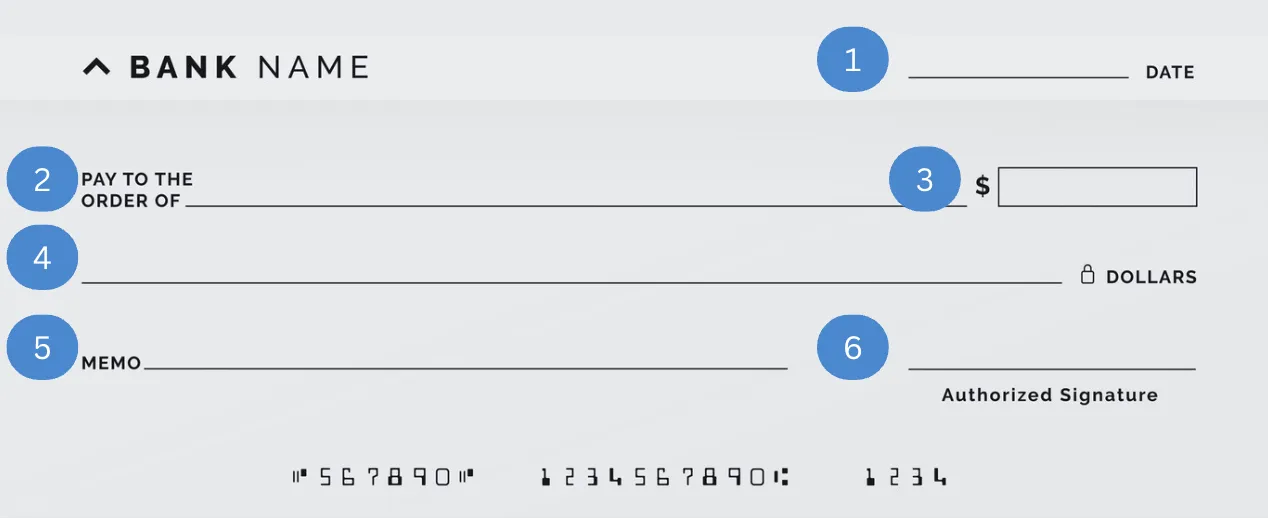
1. Write the Date
Remember that in the United States, the date format is mm/dd/yyyy.
2. Payee’s Name
Write the full name of the person to whom you are issuing the check, exactly as it appears on their official identification.
3. Amount in Numbers
Write the numerical amount clearly.
4. Amount in Words
Write the amount in words, including cents.
5. Add a Memo
You may include a note specifying the reason for the payment.
6. Sign the Check
Sign the check legibly in the space designated for the drawer.
7. Review the Information
Ensure that all information is accurate to avoid issues for the payee when cashing the check.
It is essential to complete checks legibly, without strike-throughs or corrections, as these may invalidate the document.
How to Correctly Write Numbers in Words on a Check
Writing amounts in words may be confusing when dealing with U.S. dollars. The following points should be kept in mind:
- Dollar amounts must be written in full words
- Cents must be written as fractions
- Avoid using dollar symbols or similar notations
- If there is leftover space at the end of the line, draw a line to prevent fraud
- For example, $1,000.75 is written as: One thousand and 75/100 dollars
Cash Checks and Manage Your Money Easily with Comun
As you can see, knowing how to fill out a check is useful for sending and receiving money in the United States. It is a reliable and accessible alternative if you do not have a banking account.
However, issuing and cashing a check can also require significant time and effort. That’s why you can skip the trip to the bank, avoid wasting time or money on gas, and cash your check directly from your phone using Comun—no lines, no questions, no complications.
Discover Comun, the only platform designed to serve the needs of immigrant communities in the United States, with support available in Spanish.
Why Choose Comun?
- Open your account with an official ID from your country
- Access a mobile app specifically designed for immigrants in the U.S.
- Make payments, receive your salary, and manage your finances
- Send money to your loved ones in LATAM for just a $2.99 transfer fee
Frequently Asked Questions
Still have questions about how to fill out a personal check? See our FAQ section.
What if I Make a Mistake Filling Out a Check?
If there are strike-throughs or inconsistencies in the amounts, the check must be voided and a new one used.
How Do I Void a Check?
Write the word VOID in large letters on the front of the check.
What Information Appears on the Back of a Check?
The back of the check contains the endorsement, meaning the payee’s signature for cashing the check.





Thousands of immigrants are already achieving more with their money. You can too.
Comun is a financial technology company and not a bank. Banking services are provided by Community Federal Savings Bank; Member FDIC. The Comun Visa® Debit Card is issued by Community Federal Savings Bank, pursuant to a license from Visa U.S.A Inc. and may be used everywhere Visa Cards are accepted.
Comun is a fintech company and not a bank or licensed money transmitter.
* Results may vary. For a complete list of eligible IDs and application requirements, follow this link.
^ No minimums, no maintenance fees. ATM or transfer fees may apply. See app for fee details.
‡ Direct deposit funds are typically available when we receive the payment file, up to two days before the scheduled payment date. This early availability is not guaranteed.
** A service provided by Service UniTeller, Inc. Service UniTeller, Inc. is licensed in all states that require a license. Remittance fees start at $2.99 but may vary. Please check the app for more details. Comun Inc. may earn revenue from the conversion of foreign currencies.
† Funds in your account are FDIC insured up to $250,000 by ownership category through Community Federal Savings Bank (CFSB), Member FDIC, in the event CFSB fails.