International Money Transfers
Alternatives for Sending Packages to Mexico from the United States
Discover how to send packages from the United States to Mexico — main shipping companies, rates, delivery times and key features.
8 min read

18 Dec 2025

How to Send Packages from the United States to Mexico Without Complications
Being far from family and friends is one of the main challenges faced by immigrants living in the United States. Fortunately, sending mail is a way to maintain the bond with loved ones across borders.
In the United States there are several options for sending packages to Mexico. Below we explain the features of each service so you can choose the one that best fits your budget and needs.
Main Package Delivery Services from the United States to Mexico
There are two shipping options from the United States to Mexico: through USPS or private courier companies.
United States Postal Service (USPS)
These are the main United States Postal Service (USPS) shipping services and their characteristics. Please refer to their website for the most up-to-date information.
Priority Mail Express
- Delivery prices: starting at approximately $59.50 for standard international services.
- Time: 3–5 business days.
- Main features: offers express international delivery service, full tracking and limited insurance for certain types of packages.
Priority Mail
- Delivery prices: starting at $30.90 for standard international shipments.
- Time: 6–10 business days.
- Main features: offers full tracking and moderate prices. Ideal for medium-sized packages that need to be delivered quickly.
First-Class Mail
- Delivery prices: starting at $14.05 for envelopes.
- Time: varies between 7 and 20 business days depending on customs processing.
- Main features: an economical service ideal for sending documents and envelopes. In many cases tracking is only available until the package leaves the United States.
Private Courier Companies
There are also private courier company alternatives that offer excellent service and additional shipping options. Please refer to each courier’s website for most up-to-date information.
FedEx
- Delivery prices: rates vary by package size, but they offer flat rates for packages up to 15 kilograms and an additional charge for extra weight.
- Time: 3–5 days for express service.
- Main features: international coverage with home delivery and includes customs paperwork.
UPS
- Delivery prices: variable rates depending on package size and weight.
- Time: 2–5 business days.
- Main features: online tools for quoting and tracking packages plus strong presence in the United States.
DHL
- Delivery prices: international shipments starting at $50.
- Time: 2–5 business days with express service.
- Main features: international presence, fast home-delivery service and online rate calculator.
Below is a comparison table to help you view the information more clearly.
Company
Type of Service
Estimated Cost
Average Time
USPS
Priority Mail Express
From $59.50
3–5 business days
USPS
Priority Mail
From $30.90
6–10 business days
USPS
First-Class Mail
From $14.05 for envelopes
7–20 business days
FedEx
International Express Service
Prices vary depending on size and weight
3–5 business days
UPS
International Express Service
Prices vary depending on size and weight
2–5 business days
DHL
International Express Service
Prices vary depending on size and weight
2–5 business days
Factors That Affect the Price and Delivery Time of Your Package
As seen in the previous section, it is impossible to precisely estimate the shipping cost and time for each courier service from the U.S. to Mexico. Several factors influence the final result, explained below.
Package Weight and Size
This is the main factor that affects the final cost of an international shipment — the heavier and bulkier the package, the higher the rate. Also check whether the company has a maximum shipping weight.
ZIP Code and Destination Location
The final destination also matters. Sending a package to Mexico City is usually cheaper than to a rural area.
Type of Service Selected
Express or priority shipping services are faster and therefore more expensive.
Peak Seasons and Holidays
If you ship during Christmas, New Year or high-demand dates, expect possible delays or extra costs.
What Do You Need to Send Packages from the United States to Mexico?
Before going to your preferred shipping carrier’s office, make sure all information is ready to avoid delays and ensure your package reaches your loved ones without issues.
Step 1. Check Customs Restrictions
Make sure your package does not contain restricted items for entry into Mexico, such as perishable food, flammable liquids or counterfeit goods. If unsure, check customs rules.
Step 2. Pack and Label Your Package Properly
Use a proper box or purchase one at the post office. If the contents are fragile, protect them well and place the label correctly when closing the box.
Step 3. Verify the Recipient’s Information and ZIP Code
Double-check as many times as needed that recipient details (name, ZIP code, neighborhood) are accurate. Even small errors can send a package to the wrong place.
Step 4. Keep Your Tracking Number and Shipping Receipt
Finally, keep the tracking number and receipt; they let you track the package and clarify any issues if needed.
Tips to Save Money and Time on Your International Shipments
We understand how important it is for immigrants to send packages to Mexico from the United States. More than a packaged product, it represents birthday gifts, greetings from afar, and fulfilled dreams for the people you love most.
That’s why it’s important to follow these tips when sending a package to Mexico.
- Compare prices before shipping: remember that some services offer a flat rate, but the final cost depends on weight and size.
- Avoid weekends or holidays: in addition to being more expensive, shipping may face delays.
- Take advantage of promotions or loyalty programs: stay attentive to promotions offered by postal companies.
- Group shipments whenever possible: try sending several items in the same shipment instead of one by one.
Send Packages to Mexico and Manage Your Finances with Común
Sending packages to your loved ones in Mexico is a way to show them they’re still important to you. That’s why planning your shipments—and your finances—is essential.
Get to know Común, the digital platform that helps immigrants manage their money in the most accessible way, as you can open an account using a qualifying official identification from your home country.
Just as your packages travel with care, Común supports your financial well-being.
Open your account with Común and stay connected with your loved ones through remittances.
Frequently Asked Questions (FAQ)
If you still have questions, check the following section.
How long does a shipment from the United States to Mexico take?
It depends on the courier company, but in general, an express service takes 3 to 5 business days.
How do I track my package?
When you send your package, you’ll receive a tracking number so you can follow it until it reaches its destination. Some courier options only provide tracking until it leaves the United States.
What is the most economical way to send a package to Mexico?
The USPS First-Class Package International Service is ideal for economical shipments, though the delivery time is usually longer.
About Común
Común aims to support the Latino community in the United States. It offers a debit account that can be opened with more than 100 valid Latin American IDs and an app available in Spanish.
Visit Común's website or download the app for free to learn more about the full offer and applicable terms.
Olivia Rhye
Community Partner

Financial Education
What is a wire transfer? A complete guide for 2026
8 min de lectura
What is a wire transfer? A complete guide for 2026
A wire transfer remains one of the most widely used methods for moving large amounts of money quickly through financial institutions. It is commonly used for urgent transactions, high-value payments, or international bank transfers that often involve additional verification procedures and transaction monitoring.
According to Federal Reserve Fedwire statistics, around 209.9 million wire transfers were processed in 2024, an 8.6% increase compared to the previous year.
What is a wire transfer?
A wire transfer is an electronic transfer of funds between financial institutions through secure financial networks. Wire transfers are commonly used for: sending large amounts of money, urgent domestic payments, international bank transfers, real estate transactions, business payments, emergency family transfers.
How long does a wire transfer take?
| Transfer Type | Typical Delivery Time |
|---|---|
| Domestic wire transfer | Same day or within hours |
| International wire transfer | Typically 1–5 business days |
| ACH transfer | Typically 1–3 business days |
| Remittance app transfer | Typically in minutes to 2 days |
How much does a wire transfer cost in 2026?
| Transfer Type | Average Cost |
|---|---|
| Domestic outgoing wire | $15–$35 |
| International outgoing wire | $35–$75 |
| Incoming international wire | $10–$20 |
| Exchange rate markup | 1%–4% depending on the provider |
Fees and exchange rate markups vary by bank, destination country, transfer amount, intermediary institutions, and payment method. Always review the total transfer cost before sending money internationally.
Advantages and disadvantages of wire transfers
Advantages:
- Speed for time-sensitive payments
- Higher transfer limits
- Secured financial infrastructure
- Useful for international banking
Disadvantages:
- Higher costs
- Transfers are difficult to reverse
- More banking information is required
- Longer processing for international transfers
Wire transfer vs. money transfer apps
| Feature | Wire Transfer | Digital Remittance App |
|---|---|---|
| Typical use | Large or time-sensitive transfers | Regular family or friend remittances |
| Average cost | Typically $15–$75 transfer fees | Usually lower — flat fees or 0.48%–1% |
| Speed | Same day to several days | Typically in minutes to 2 days |
| Currency conversion | Bank-set rate, markup typically 1–4% | Near mid-market rate, markup 0–1.4%, shown upfront |
| Setup process | More banking details required (routing, SWIFT/IBAN) | Usually app-based, quick mobile signup |
| Best for | High-value or business payments | Frequent personal transfers |
FAQ
Can I make a wire transfer without a bank account?
In general, wire transfers require both parties to have bank accounts. For transfers without a bank account, consider alternatives like remittance apps.
Is a wire transfer safe?
Yes, wire transfers use regulated banking systems with transaction records and tracking. However, they are difficult to reverse if incorrect information is entered.
When should I use a wire transfer instead of an app?
Wire transfers make sense for high-value, urgent, or institution-required payments. For regular remittances to family, digital apps typically offer lower cost and more convenience.
Común is a financial technology company and not a bank. Banking services are provided by Community Federal Savings Bank, Member FDIC. Remittance service provided by Service UniTeller, Inc.
.avif)
Financial Education
The Definitive Guide to Managing Checks in the Digital Age
8 min de lectura
The shift from physical to digital checks marks a significant transformation in financial services, driven largely by technological advances and the widespread adoption of mobile devices and online banking platforms. This shift reflects a broader trend in the digital era, where convenience and efficiency come first. The importance and benefits of having a checking account in this context can't be overstated, since it enables direct deposit and check deposit through ATMs, saving users significant time and money.
How Banks and Financial Institutions Are Adapting
Banks and financial institutions have been at the forefront of this digital shift. Recognizing their customers' needs and preferences, these institutions have invested heavily in developing secure, user-friendly online banking services and mobile apps. These platforms let users complete a wide range of transactions that traditionally required a visit to a bank branch. Now, customers can access their bank accounts and manage payroll checks through direct deposit — a feature that improves the efficiency of receiving paychecks and issuing personal checks directly from their smartphones or computers. This functionality doesn't just simplify the process — it also makes it accessible anytime, anywhere, removing the physical limitations of traditional banking.
Convenience and Accessibility
The integration of online and mobile banking solutions has made financial services more accessible, letting users complete transactions remotely. One example is the PayPal app, which lets users deposit checks into their PayPal account using a photo, accessing their money for free within 10 days or instantly for a fee. This is particularly beneficial for users who need to deposit payroll checks without the delay of mail services or the inconvenience of visiting a physical bank or check-cashing store. For people living in areas without easy access to traditional banking facilities, or those with mobility issues, these digital options provide essential financial access, improving their ability to manage personal finances efficiently.
Enhanced Security Features
Along with convenience, security is a priority in the evolution of digital check processing. Financial institutions have implemented sophisticated security measures to protect users and their transactions. These include encryption, two-factor authentication, and secure sockets layer (SSL) technology, which protect data transmitted during online and mobile banking sessions. Additionally, features like automated fraud detection systems monitor unusual activity, helping prevent unauthorized access and transactions.
Verification processes for digital check transactions have also become more robust. Digital checks often require multi-factor authentication, which can include biometrics (like fingerprint or facial recognition), security questions, or mobile code confirmation. These layers of security help ensure only authorized users can issue, cash, or deposit checks, significantly reducing the risk of fraud.
The shift to digital check processing through online banking and mobile devices illustrates a broader trend in financial transactions toward greater technology integration, prioritizing user convenience and security. As this trend continues, we can expect these platforms to evolve even further, offering more features and efficiencies for managing financial transactions in the digital age.

Navigating Check-Cashing Services and Fees in the Digital Age
Traditional banks continue to offer check-cashing services at their branches, but the rise of digital platforms has diversified how consumers can cash a check and access their money. For those without a bank account, a check-cashing service provides a vital option for turning checks into cash, often at physical locations. Digital services like PayPal let users deposit checks directly into their PayPal accounts just by taking a photo of the check, making a PayPal account an essential tool for digital check deposits. Mobile apps like Ingo Money offer similar services, allowing check deposits directly to prepaid cards, PayPal accounts, or even as Amazon credit. These tools offer a level of convenience and speed traditional banks often can't match, since they skip the need to visit a physical location.
Understanding Check-Cashing Fees
Each check-cashing option has its own set of fees. Traditional banks may charge non-customers a fee to cash checks, and these fees can be particularly high for personal or third-party checks. Grocery stores and check-cashing stores typically charge a percentage of the check amount, which can vary widely depending on the type and amount of the check. Services like Western Union also facilitate check cashing, but often with higher fees, especially for instant-cash services.
Digital platforms vary in their fee structures. PayPal, for example, offers free check deposit if the user is willing to wait a few days for funds to settle, but a faster-access option is available for a small fee. Ingo Money also charges fees for instant access but offers a fee-free option if the user is willing to wait for funds.
Reducing Costs and Increasing Convenience With Digital Solutions
Digital solutions offer significant advantages in terms of reducing check-cashing costs and increasing convenience. By enabling direct deposits into checking accounts or onto prepaid cards like the Walmart MoneyCard, these digital platforms eliminate the need for physical check-cashing locations. This not only saves on the cost associated with cashing checks at physical locations, but also reduces the time spent processing transactions.
Additionally, the ability to deposit checks anytime, anywhere via a mobile device or computer means funds are available faster and without the inconvenience or expense of traveling to a bank or check-cashing store. This accessibility is particularly beneficial for people in remote areas or those with mobility issues, for whom visiting a physical location is a challenge.
In summary, the digital transformation of check-cashing services has given consumers a wider range of options for accessing their money quickly and securely, often at lower costs than traditional methods. The convenience of digital platforms extends to the ability to send money quickly and securely, further improving the user experience in managing financial transactions. As technology continues to advance, we can expect further innovations that will improve the efficiency and convenience of these financial transactions.
The Role of Third-Party Checks in Modern Financial Transactions
Handling third-party checks and pre-printed checks is critical within the digital banking framework. These checks, essential for numerous transactions like payroll payments and government payments, must be managed with strict security measures to ensure the integrity of financial processes.
Handling Third-Party Checks
Third-party checks involve transferring funds from the payer to an intermediary recipient, who then endorses the check to another party, known as third-party check endorsement. This process is particularly useful when the original recipient needs to endorse a third-party check to someone else, either because they lack valid ID or face limitations that prevent them from cashing the check themselves. The complex nature of these transactions requires rigorous verification processes. Financial institutions require valid ID from anyone attempting to cash or deposit third-party checks to verify their legitimacy. Both the original recipient and the endorser must sign, explicitly authorizing the transfer of funds. This verification helps mitigate risks like fraud, which are higher with third-party checks due to the multiple parties involved.
Managing Pre-Printed Checks
Pre-printed checks are commonly used for direct deposit of payroll and government benefits. They include fixed details like the issuing bank's name, the amount, and the recipient's account information, which are printed by the financial institution or company issuing the check. These checks are usually processed through specialized check-cashing services, which use advanced digital scanning technology to validate the check's details against secure databases, ensuring the payment comes from a legitimate source and is deposited into the correct bank account.
Modern Solutions in Check Cashing
Digital solutions have revolutionized how checks are processed, improving convenience and reducing check-cashing fees. Online banking platforms and mobile devices enable check deposits through mobile check deposit services. These platforms, like those offered by banks and financial services like PayPal and Ingo Money, let users cash checks by taking a photo and uploading it through an app. This method not only streamlines the processing of two-party personal checks and government checks, but also speeds up the availability of funds in checking accounts or on prepaid cards like the Walmart MoneyCard.
In conclusion, the digital transformation in handling third-party and pre-printed checks is improving security, reducing fees, and increasing convenience across the board. This shift doesn't just respond to growing demand for more efficient financial services — it also reflects broader trends toward digitization across every aspect of banking and financial transactions.
Embracing Digital Change in Check Management
The transformation of check management in the digital age is a clear reflection of the broader trend toward technology-driven financial services. This evolution presents a unique mix of challenges and opportunities. As we've explored, the shift from physical to digital checks brings improved security, greater convenience, and significant cost savings, making it an essential trend for both consumers and financial institutions.
The future of check management depends on deeper integration of innovative technologies. Banks and financial institutions are continually improving their digital services to offer users smoother experiences. Innovations like blockchain and artificial intelligence are poised to redefine security and efficiency in financial transactions, offering even more robust protections against fraud and errors.
For individuals, the ability to manage checks through mobile devices and online platforms means easier access to their finances, less time spent on manual processes, and reduced fees associated with traditional check-cashing services. For businesses and financial institutions, digital check processing reduces administrative burden and speeds up capital flow, improving economic efficiency.
In summary, managing checks in the digital age involves a dynamic mix of adapting to current technologies and anticipating the future needs of the financial market. This ongoing evolution promises to make financial management more accessible, secure, and efficient for everyone involved.

Financial Education
The Future of Banking Services: Trends to Watch
8 min de lectura
What Today's Banking Customers Want
Today's banking consumers are no longer satisfied with just basic financial transactions. They want seamless digital experiences, personalized services, and round-the-clock accessibility. With the spread of smartphones and internet connectivity, customers expect banking services to be available at their fingertips, anytime and anywhere. They also demand transparency, security, and efficiency in every interaction with their financial institutions.
Understanding and meeting these changing needs is crucial for banks to attract and retain new customers in an increasingly competitive landscape.
Better Experiences Are Essential for Deposit Growth and Customer Loyalty
In an era where switching banks is easier than ever, delivering a superior customer experience has become essential for deposit growth and maintaining customer loyalty. Banks that prioritize user-friendly interfaces, intuitive mobile apps, and responsive customer support are more likely to succeed in building solutions integrated with customer data. Beyond the transactional aspect, customers value proactive financial advice, personalized product recommendations, and tailored communication.
By investing in emerging technologies that improve customer experiences, many banks can build stronger relationships with their customers and position themselves as trusted financial organizations for the long term.
Technological and Industry Shifts
In banking, the traditional advantages that once set institutions apart are gradually eroding. With the rise of fintech startups and tech giants entering the financial services space, banks face unprecedented competition. Legacy systems and processes that used to be barriers to entry are now being disrupted by innovative technologies and agile business models.
Banking Designed for Your Life in the USA
Open your bank account¹ in 3 minutes with your country's ID²
Banking Is Losing Its Traditional Advantages
Historically, banks held monopolies on financial services due to their physical presence, regulatory barriers, and established customer trust. However, the arrival of digital banking and the spread of online-only banks have challenged this status quo. Traditional advantages like branch networks and long-standing reputations are no longer as significant in a digital era where convenience and efficiency come first.
Technological Advances Shaping the Banking Industry
Technological advances are driving profound change in the banking industry, redefining how financial services are delivered and consumed. From artificial intelligence (AI) and machine learning to blockchain and cloud computing, banks are leveraging cutting-edge technologies to streamline operations, improve security, and improve customer experiences.
AI and Data Advances Accelerating Transformation Possibilities
AI and data analytics are revolutionizing banking by letting institutions gain deeper insight into customer behavior, automate repetitive tasks, and personalize offers at scale. Chatbots powered by natural language processing (NLP) provide instant customer support, while predictive analytics algorithms help identify trends and proactively mitigate risk.
Seamless Technology and Platform Integration Is a Top Priority
Seamless technology and platform integration is essential for banks to deliver cohesive, omnichannel experiences to their customers. Whether through mobile banking apps, online banking portals, or in-branch interactions, customers expect consistent, intuitive interfaces that smoothly meet their financial needs across various touchpoints.
[Video embed — keep as-is: https://www.youtube.com/watch?v=V4FKKe5Zs2A]
Embracing Responsible AI (GenAI)
As banks adopt AI and automation, it's crucial to do so responsibly, considering ethical implications and potential biases. Responsible AI, often called GenAI, involves ensuring fairness, transparency, and accountability in AI-driven decision-making processes. By adopting ethical AI frameworks and governance principles, banks can build trust with customers and mitigate risks associated with AI deployment.
Innovations in AI and data analysis are driving transformative possibilities, while seamless technology and platform integration is now a top priority. Banks must also embrace responsible Generative AI (GenAI) to stay ahead.
Banking as a Service (BaaS)
As traditional banking models evolve, Banking as a Service (BaaS) is emerging as a key trend reshaping the financial landscape. This section explores the key aspects of BaaS, from emerging industry trends to competitive arenas and business models, offering insight into the future of banking.
Emerging Trends in the BaaS Banking Industry
- Collaboration Over Competition: Traditional banks are increasingly partnering with fintech startups and third-party providers to offer specialized financial services. This collaborative approach lets banks leverage innovative technologies and expand their service offerings without needing extensive infrastructure investment.
- API-Driven Ecosystems: Application Programming Interfaces (APIs) play a central role in BaaS, enabling seamless integration of banking services into third-party apps and platforms. Open banking initiatives around the world are driving the adoption of standardized APIs, fostering a more interconnected financial ecosystem.
- Platformization of Banking: Banking services are shifting from product-centric models to platform-centric models, where banks act as enablers of financial transactions rather than just service providers. Platforms offer a diverse range of financial products and services curated from multiple providers, giving customers greater choice and flexibility.
Competitive Arenas and Emerging Business Models in Banking
- Digital Challenger Banks: Digital-only banks, or challenger banks, are disrupting the traditional banking landscape with their agile operations, innovative products, and customer-first approach. These agile startups leverage technology to deliver superior user experiences and challenge incumbents in key market segments. Such is the case with the Común app, which offers financial services for immigrants living in the U.S.
- Embedded Finance: Embedded finance refers to integrating financial services into non-financial apps, like e-commerce platforms, ride-share apps, and social networks. By embedding banking functionality directly into everyday activities, financial transactions become seamless and frictionless for users.
Banking Designed for Your Life in the USA
Open your bank account¹ in 3 minutes with your country's ID²
A Look at the Bigger Picture: Everyday Banking
- Mobile-First Solutions: Everyday banking is increasingly mobile-centric, with customers preferring the convenience of managing their finances on the go. Mobile banking apps offer a wide range of features, including account management, bill payments, peer-to-peer transfers, and financial insights, meeting customers' diverse needs.
- Personalization and Predictive Analytics: Banks are leveraging data analytics and AI algorithms to personalize their offerings and anticipate customer needs. By analyzing transactional data and behavioral patterns, banks can deliver personalized product recommendations, tailored financial advice, and proactive alerts, improving customer engagement and satisfaction.
Discover the Future of Banking: Embrace BaaS Innovations Today for Financial Evolution and Empowerment
- Enhanced Customer Experiences: BaaS lets banks deliver enhanced customer experiences by leveraging innovative technologies and partnerships. From frictionless onboarding experiences to personalized financial solutions, BaaS empowers customers to reach their financial goals more effectively.
- Financial Inclusion and Accessibility: BaaS has the potential to drive financial inclusion by extending banking services to underserved and unbanked populations. Through partnerships with fintechs and leveraging digital channels, banks can reach previously inaccessible markets and provide essential financial services to those who need them.
- Agility and Innovation: Embracing BaaS lets banks innovate quickly and adapt to changing market dynamics. By leveraging outside expertise and resources, banks can accelerate the development and rollout of new products and services, stay ahead of the competition, and meet changing customer expectations.
Everyday banking remains the biggest arena, and the future of banking will see financial evolution and empowerment through BaaS innovations.
Regulatory and Compliance Considerations
This section explores the imperative nature of investing in regulatory compliance, the importance of anticipating regulatory action, and the impact of regulatory developments on BaaS. It also discusses predictions for the future of BaaS in light of these regulatory considerations.
Investing in Regulatory Compliance Is Imperative
- Compliance Frameworks: Banks and BaaS providers must establish robust compliance frameworks to adhere to regulatory requirements and industry standards. This includes implementing Know Your Customer (KYC) procedures, anti-money laundering (AML) measures, and data protection protocols to safeguard customer information and mitigate financial risks.
- Risk Management: Investing in risk management practices is essential to navigate regulatory complexities and protect against potential threats. By conducting regular risk assessments and implementing risk mitigation strategies, banks can ensure regulatory compliance while maintaining operational resilience.
Anticipating Regulatory Action
- Proactive Compliance Measures: Anticipating regulatory action lets banks stay ahead of compliance requirements and mitigate regulatory risks effectively. By closely monitoring regulatory developments, engaging with regulatory authorities, and participating in industry forums, banks can proactively address emerging regulatory challenges and adapt their compliance strategies accordingly.
- Regulatory Engagement: Establishing open communication channels with regulatory authorities fosters collaboration and transparency, letting banks address regulatory concerns and seek guidance on compliance matters. By actively engaging with regulators, banks can demonstrate their commitment to regulatory compliance and build trust within the regulatory community.
Regulatory Developments Impacting BaaS
- Global Regulatory Landscape: Regulatory developments, like open banking initiatives and data protection regulations, have a significant impact on the BaaS ecosystem. Financial service providers must stay on top of regulatory changes across different jurisdictions and adapt their operations accordingly to ensure compliance with local laws and regulations.
- Compliance Challenges: Regulatory requirements related to data privacy, cybersecurity, and consumer protection pose significant challenges for BaaS providers. Meeting complex regulatory frameworks requires substantial investment in resources and expertise, demanding a proactive approach to effectively address regulatory concerns.
Banking Designed for Your Life in the USA
Open your bank account¹ in 3 minutes with your country's ID²
Predictions for the Future of BaaS
- Regulatory Evolution: The future of BaaS is expected to be shaped by ongoing regulatory evolution, with regulators adapting existing frameworks to address emerging risks and challenges. Predictions suggest regulators will focus on improving consumer protection, promoting market competition, and fostering innovation within the BaaS ecosystem.
- Regulatory Harmonization: As the BaaS landscape continues to evolve, there's a growing need for regulatory harmonization across different jurisdictions to facilitate cross-border operations and ensure a level playing field for market participants. Predictions indicate regulators will collaborate to standardize regulatory requirements and promote interoperability within the BaaS ecosystem.
- Compliance Innovation: Innovations in regulatory technology (RegTech) are expected to play a significant role in driving compliance innovation within the BaaS industry. Predictions suggest BaaS providers will leverage RegTech solutions to automate compliance processes, improve regulatory reporting capabilities, and enhance overall regulatory efficiency.
Investing in regulatory compliance is crucial, since regulatory actions and developments significantly impact BaaS. Predicting future regulatory landscapes helps institutions stay prepared and compliant.
Conclusion
The future of banking services is marked by technological innovation, shifting customer preferences, and evolving regulations. Banking as a Service (BaaS) is reshaping the industry, offering new avenues for collaboration and innovation. Embracing BaaS today unlocks new opportunities to improve customer experiences and drive economic growth.
Regulatory compliance is crucial. Banks must invest in compliance frameworks and anticipate regulatory changes to mitigate risks effectively. Looking ahead, success in banking will depend on agility, innovation, and customer focus. By staying on top of trends, leveraging technology, and prioritizing compliance, banks can thrive in the digital era.
Financial Education
How to fill out a check in the United States in 5 simple steps (+ Example)
8 min de lectura
Have you ever filled out a check? Although most transactions today are digital, knowing how to fill out a check is essential—especially if you are just beginning your financial life.
According to recent data, one-third of Americans paid by check in 2024, demonstrating that checks still play an important role in the U.S. economy.
You might consider checks an outdated payment method; the reality is that they are useful in specific situations. For that reason, we will explain what a check is, the different types of checks, and how to complete them properly.
What Is a Check and What Is It Used For?
Despite the digital era, checks remain a relevant traditional payment method due to their formality and traceability. They are used for rent payments, purchases, and service payments.
Additionally, checks are a common payment method among the immigrant community, who often use them while adapting to the U.S. banking system.
But what exactly is a check and what are its characteristics? It is a physical document issued by an individual or business (the drawer) to order a bank to pay a specified amount to a third party. For the payment to be processed, the drawer must have sufficient funds in their checking account.
In general, a check contains the following information:
- Name of the drawer, whether an individual or a business
- Name of the payee
- Financial institution where the money will be drawn
- Amount to be paid, both in numbers and in words
- Signatures of the drawer
What Are the Different Types of Checks?
There are different types of checks in the United States. In this case, we will focus on the personal check, although you may choose the option that best suits your needs.
Personal Check
A personal check is a payment order issued by an individual to another individual using the funds in a checking account.
What Is a Personal Check Used For?
The most common uses for personal checks include:
- Rent and utility payments
- Purchase of everyday goods
- Legal agreements requiring documentary support
Certified Check
A certified check serves the same purpose as a personal check but is reviewed and guaranteed by the issuing bank, which verifies that the drawer has sufficient funds and holds them until the check is cashed.
A certified check provides certainty of available funds, making it a more secure method for making and receiving payments.
Cashier’s Check
Unlike a personal check, a cashier’s check is issued directly by the bank, offering greater security for the payee, as the bank is responsible for issuing and safeguarding the funds.
To obtain a cashier’s check, the drawer must visit a bank branch and pay the amount to be transferred. The bank then issues the check in the name of the payee, guaranteeing that it can be cashed using the institution’s own funds and not a personal account.
It is commonly used for high-value purchases such as homes and vehicles.
Money Order
While not strictly a check, it is a traditional payment method with similar functionality.
A money order is a financial instrument that allows funds to be sent via traditional mail using a certified check, which must be purchased and paid for by the drawer at an authorized location.
It allows secure money transfers without requiring a bank account.
How to Fill Out a Check in the U.S.
Before issuing this type of payment order, you must know how to do it properly. Below is an example of how to fill out a check easily, starting from step one:
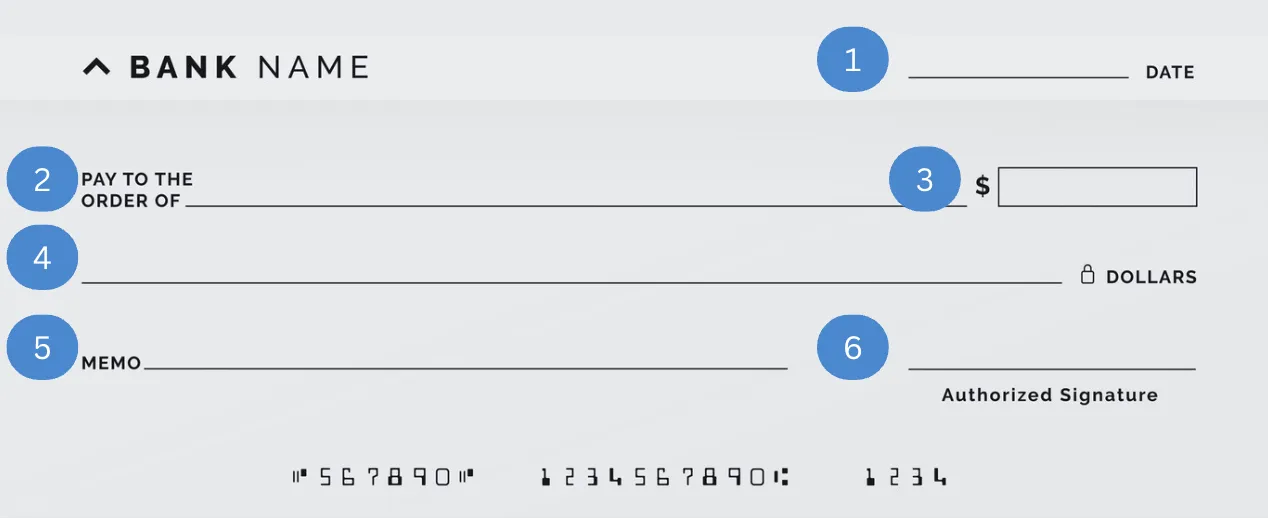
1. Write the Date
Remember that in the United States, the date format is mm/dd/yyyy.
2. Payee’s Name
Write the full name of the person to whom you are issuing the check, exactly as it appears on their official identification.
3. Amount in Numbers
Write the numerical amount clearly.
4. Amount in Words
Write the amount in words, including cents.
5. Add a Memo
You may include a note specifying the reason for the payment.
6. Sign the Check
Sign the check legibly in the space designated for the drawer.
7. Review the Information
Ensure that all information is accurate to avoid issues for the payee when cashing the check.
It is essential to complete checks legibly, without strike-throughs or corrections, as these may invalidate the document.
How to Correctly Write Numbers in Words on a Check
Writing amounts in words may be confusing when dealing with U.S. dollars. The following points should be kept in mind:
- Dollar amounts must be written in full words
- Cents must be written as fractions
- Avoid using dollar symbols or similar notations
- If there is leftover space at the end of the line, draw a line to prevent fraud
- For example, $1,000.75 is written as: One thousand and 75/100 dollars
Cash Checks and Manage Your Money Easily with Comun
As you can see, knowing how to fill out a check is useful for sending and receiving money in the United States. It is a reliable and accessible alternative if you do not have a banking account.
However, issuing and cashing a check can also require significant time and effort. That’s why you can skip the trip to the bank, avoid wasting time or money on gas, and cash your check directly from your phone using Comun—no lines, no questions, no complications.
Discover Comun, the only platform designed to serve the needs of immigrant communities in the United States, with support available in Spanish.
Why Choose Comun?
- Open your account with an official ID from your country
- Access a mobile app specifically designed for immigrants in the U.S.
- Make payments, receive your salary, and manage your finances
- Send money to your loved ones in LATAM for just a $2.99 transfer fee
Frequently Asked Questions
Still have questions about how to fill out a personal check? See our FAQ section.
What if I Make a Mistake Filling Out a Check?
If there are strike-throughs or inconsistencies in the amounts, the check must be voided and a new one used.
How Do I Void a Check?
Write the word VOID in large letters on the front of the check.
What Information Appears on the Back of a Check?
The back of the check contains the endorsement, meaning the payee’s signature for cashing the check.
Community
What You Need to Open a Común¹ Account
8 min de lectura
Común: Revolutionizing Financial Access for the Immigrant Community
Discover Común, a pioneering financial technology platform designed specifically to meet the needs of the immigrant community in the United States. Unlike traditional banking, Común offers a friendly digital banking experience focused on financial inclusion, low fees, and bilingual support, making financial services more inclusive and empowering.
Unmatched Ease When Opening an Account
Opening a checking account with Común is simple and hassle-free, addressing the barriers to financial exclusion the immigrant community typically faces. Accepting more than 100 forms of ID², including Social Security equivalents from Latin American countries, Común ensures immigrants have access to essential banking services. The application process is fast, taking under 5 minutes, and is free of additional or hidden fees, minimum balance requirements, or monthly charges. This inclusivity is central to Común's mission of fostering financial stability and growth.
Mobile Deposit Options
Común: Común offers a very convenient mobile deposit feature that lets users deposit cash at more than 88,000 locations across the United States, including major retailers like Walgreens, Dollar General, and Walmart. This extensive network ensures users can easily find a nearby deposit location, making the process of adding money to their accounts simple and hassle-free.
Traditional Banking: While many traditional banks offer mobile deposit options, they often restrict these to check deposits through a mobile app. Cash deposits typically require a visit to an ATM or bank branch, which can be less convenient and more time-consuming than Común's extensive cash deposit network.
Usefulness in Today's World: In today's fast-paced environment, the flexibility to deposit cash at a wide range of accessible locations is invaluable, especially for people who may not have easy access to traditional banking services or who work non-traditional hours when banks are closed.
International Remittances
Común: Común stands out in facilitating international remittances⁴, letting users send money abroad quickly and at lower fees compared to many traditional banks and remittance services. The process is enhanced with real-time notifications, keeping the sender informed from the moment the money is sent until it's received.
Traditional Banking: Traditional banks generally offer international transfer services, but these can be expensive and slow, with transfers sometimes taking several days to complete. Additionally, fees associated with traditional bank remittances can be significantly higher.
Usefulness in Today's World: In a globalized economy, the ability to send money across borders quickly and affordably is crucial. Many families rely on remittances for financial support, and businesses need efficient ways to handle international transactions. Común's streamlined, cost-effective service effectively meets these modern demands.
Early Access to Pay
Común: Común offers the ability to connect your paycheck to the app and get paid up to two days early³. This feature doesn't carry additional fees, providing significant relief during financial emergencies or when planning ahead.
Traditional Banking: Some traditional banks have started offering similar features, but they're often tied to specific account types or require a minimum balance. The accessibility and ease of use of Común's early pay access isn't always matched in traditional settings.
Usefulness in Today's World: With the rise of gig economy jobs and irregular pay schedules, having early access to wages can provide a buffer against financial instability. This feature is particularly valuable for those living paycheck to paycheck, offering a cushion that can help avoid overdraft fees and late payments.
Unlike traditional banking institutions, Común's innovative features are designed to meet the needs of today's diverse, mobile population, particularly benefiting the immigrant community in the U.S. By providing services that offer greater convenience, lower costs, and increased accessibility, Común doesn't just address the common challenges its users face — it also empowers them toward greater financial freedom and stability. As we move toward a more interconnected, fast-paced world, the importance of responsive, inclusive financial services keeps growing, something Común is uniquely positioned to deliver.

Robust Security and Customer Support
Security and customer support are paramount at Común. With FDIC-insured accounts and Visa protection on virtual Visa debit card transactions, Común customers can manage their funds with confidence. Innovative security features like biometric logins and instant transaction notifications keep your money safe. Plus, Común offers 24/7 customer support in English and Spanish, ensuring help is always available in your preferred language.
Commitment to Zero Fees and Upward Mobility
Común stands out not just for offering zero fees for opening an account, monthly maintenance, or minimum balances, but also for its commitment to helping its users achieve economic advancement. Común acts as a financial partner, supporting financial transactions without the burden of excessive fees. This commitment aligns with the goal of enabling upward mobility for immigrants, who contribute significantly to the U.S. economy.
Personalized Features and Benefits
Común goes beyond traditional financial services by offering features designed to meet the immigrant community's unique needs. Users can send money abroad at low or no cost, deposit cash at more than 88,000 locations nationwide, including free ATM withdrawals, and connect their accounts to popular payment apps like Cash App and Venmo. Común's platform also lets customers get paid up to two days early through direct deposit, further enhancing their flexibility and financial stability.
Conclusion
Común isn't just a financial services provider — it's a platform dedicated to transforming the banking experience for immigrants in the U.S. With its user-focused design, commitment to financial freedom, and robust features, Común is set to become a vital tool for its users' financial stability and growth. Whether you're looking to manage your day-to-day finances or send money to loved ones abroad quickly and safely, Común offers a reliable, inclusive, and efficient banking solution.
Founding Moment: Did You Know?
Founded by entrepreneurs Abiel Gutierrez and Andres Santos in New York, Común was built to empower families and enable upward mobility, particularly for immigrant families. The company has raised significant investment from notable firms like Costanoa Ventures, FJ Labs, and South Park Commons, underscoring the tremendous opportunity to serve immigrant families' financial needs and improve every person's life.
.avif)
International Money Transfers
How to Send Money to Mexico? Everything You Need to Know
8 min de lectura
For immigrants living in the United States, having accessible financial services that allow them to send money to Mexico and other countries in the region is of utmost importance; this is to financially support family and friends or achieve a better standard of living. Remittances have acquired such importance in the Mexican economy that, according to Reuters data, Mexico is the second-largest recipient of remittances worldwide, only after India, with more than 64.7 billion USD during 2024. It is fundamental for immigrants to know how to send money to Mexico from the United States securely, quickly, and at a low cost.
On this occasion, we will show you the best applications for transferring money to your loved ones, how they work, and all the benefits of each of them so you can choose the option that best suits your needs.
How much money can I send to Mexico?
A very important aspect you should consider is the amount allowed by applications for sending money to Mexico, as well as the restrictions in their terms and conditions.
In general, there is no legal limit imposed by the United States government, but each platform has its own standards and regulations on which they base certain limits and guidelines necessary for international money transfers.
For example, these are some of the best-known providers that offer money transfers to Mexico, with their respective limits:
- Western Union: up to 5,000 USD per transaction via the website
- MoneyGram: up to 10,000 USD per transaction
- Xoom: up to 10,000 USD per transaction
If you are looking for an easy way to send money to Mexico, Comun is an excellent alternative for you. You can enjoy your first money transfer for free, and then for a fee starting at 2.99 USD per transfer up to the applicable limits.
Additionally, your recipient can receive more for less due to highly competitive exchange rates compared to other similar applications.
Compare and choose the most convenient option to send money.
What's the best way to send money from the United States to Mexico?
There are several ways to send money from the United States to Mexico, either through traditional banks or specialized international money transfer services.
These are the simplest ways to do it:
Through bank-to-bank money transfers
One of the most common ways to send money is through bank transfers from one traditional bank to another. The advantage of this method is that it is safe, as it has the backing of official financial institutions. However, they also tend to take longer and generate more fees.
To send funds through this method, it is essential to have a U.S. bank account and use the recipient's SWIFT code. The cost of the money transfer depends on the receiving bank, in this case, located in Mexico.
For example, BBVA charges 30 USD plus VAT per transfer, Santander between 15 and 20 USD plus VAT, and Citi Banamex 20 USD plus VAT, all regardless of the amount sent.
Through cash remittances
Another option, which might be more accessible for users without a bank account, is cash remittances that can be collected at different points in Mexico. To send money in cash, it is necessary to go to a provider that offers this type of service, for example, a Western Union office. Once there, you must pay the amount to be sent, plus the fee assigned to the amount.
For your relatives to collect the funds from this transaction, they must present an official identification at one of the selected branches, which can be Oxxo, Banco Azteca, Walmart, or others. Although it is an excellent alternative for people who base their finances on cash handling, it may have certain disadvantages, such as high fees that depend on the amount sent, as well as a less competitive exchange rate.
Through mobile application
The third option for sending money to Mexico is through a mobile application specialized in international money transfers. There are many alternatives compatible with iOS and Android, and, in general, they are more economical than cash remittances or bank transfers.
To access these types of transfers, it is necessary to create an account on the provider's website or application. Additionally, some require identity verification through personal data such as the SSN (Social Security Number) or ITIN.
Before choosing an application to send money to Mexico, we recommend comparing the best-known options and evaluating which one best suits your needs and those of your family members.
The 6 best mobile applications for sending money to Mexico from the United States
| Name | Cost per transfer | Speed | Transfer limits | Additional features | Coverage |
|---|---|---|---|---|---|
| Venmo | Free or 3% if using credit card | Up to 1 day | Up to $299.99/week (unverified) Up to $60,000/week (verified with SSN or ITIN) |
Works as a social payment network. Online and in-store purchases. | U.S. |
| Zelle | Free (some banks may apply fees) | Minutes | Approx. $500/day (varies by bank) | Integrated into most U.S. banks | U.S. |
| Cash App | Free or up to 1.75% for instant transfers | Up to 2 days | Up to $7,500/week (verified) | Free debit card (Cash Card) | U.S. |
| Comun | Free in the U.S. or starting at $2.99 for international transfers | Instant or within minutes (average 8) | Up to $9,999/month* | Allows account opening with official ID, no SSN/ITIN required | U.S. and Latin America |
| Western Union | Between $3 and $30 (depending on amount, country, and method) | Immediate to several days | Up to $5,000 online | Cash transfers and withdrawals with broad coverage | 200+ countries |
| Remitly | Up to $10 (depending on speed) | Up to 5 days | From $3,000/month (depending on verification) | Home delivery option | 100+ countries |
| Wise | Variable fee (exchange rate and amount) | Up to 2 days | Up to $5,000/month | Multi-currency account | 70+ countries |
| Revolut | Free between Revolut users or ~5% for international transfers | Up to 2 days | Depends on country and currency | Automatic savings and financial analytics | U.S., Europe, LATAM, Asia |
| PayPal | Free local / ~3.95% + fixed fee for international transfers | Up to 1 day | Up to $10,000 per transfer (verified accounts) | Allows linking multiple payment methods and receiving money | 200+ countries |
Comun
Comun is a convenient option for immigrant workers in the United States, as it is specially designed to understand their needs. Comun offers a promotional fee-free first transfer and then a fee starting at 2.99 USD per transfer up to the applicable limits.
Additionally, you can access different payment methods and a very competitive exchange rate, so your family receives more for less at over 100,000 pickup locations.
Your Comun account gives you access to a mobile application and a debit card. Furthermore, your money transfers are applied in a matter of minutes.
Remitly
Remitly is an app that allows international money transfers. It is easy to use and offers various payment methods, such as debit or credit card or bank account. The sending time depends on the type of fee selected, either express, which is instant, or standard, which takes up to 5 business days.
It also offers a competitive exchange rate.
BOSS Revolution
BOSS Revolution is an easy and accessible money sending alternative. It has a limit of 2,999 USD, so it is geared towards small transactions. It accepts bank card and cash as payment methods, and money transfers are completed in minutes.
WorldRemit
WorldRemit is another alternative for easily sending money to Mexico. It offers a wide variety of payment methods, such as bank account transfers, cash pickup, and recharges. It has fees starting from 1.99 USD, but the exchange rate includes a margin of 1% to 2%, which affects the total amount to be received.
Western Union
Western Union is one of the most popular services for international money transfers. It has wide coverage, which facilitates access for people living in rural or remote areas. It allows sending money from banks, application, and website, and the money can be received in cash or in a bank account. The disadvantage is that fees are usually higher than other alternatives, and the exchange rate is less competitive with respect to the market, which affects the total amount to be received.
Félix Pago
Félix Pago is an innovative option that allows low-cost money transfers vía WhatsApp. It is a good option for small money deposits, although it does not offer functionalities such as account opening and a debit card, which could represent an obstacle for users seeking more complete alternatives.
How to send money to Mexico with Comun?
With Comun's international transfers, also known as Remittances, you can send money abroad to your family and friends from your Comun mobile application at a low cost and without leaving your home.
To make a transfer to Mexico, follow these steps:
- Enter your Comun mobile application.
- On the main page, select "Send a Remittance."
- Select the recipient to whom you wish to send the international transfer.
- You can register a recipient with their bank details, such as their full name, bank name, and cell phone number.
- After registering the recipient, enter the amount you wish to send and review the transaction costs.
- Confirm the data and select "confirm international transfer."
- The recipient should receive the international money within minutes.
- If you selected in-store pickup, the person can go to the store to pick up the money 30 minutes after confirming the transaction.
- You can check the status of the international transfer in your Comun mobile app by clicking on the movement.
You can send money to Mexico for a fee starting at $2.99 per transaction, up to the applicable limits.
Send money to Mexico easily and securely with a reliable mobile app
As you can see, sending money to Mexico has never been easier or more accessible. There are several remittance services that offer different competitive advantages, so it is convenient to compare fees, exchange rates, sending limits, among other features. The option indicated for you is a safe and fast alternative that speaks your language.
Comun allows you to open an account with your country's official documentation and send money home. Open your account today, send money to Latin American countries, and discover the most accessible side of finances.
Disclosures (in footer)
“Comun is a financial technology company and not a bank. Banking services are provided by Community Federal Savings Bank; Member FDIC. The Comun Visa® Debit Card is issued by Community Federal Savings Bank, pursuant to a license from Visa U.S.A Inc. and may be used everywhere Visa Cards are accepted.”
“Funds in your account are FDIC insured up to $250,000 by ownership category through Community Federal Savings Bank (CFSB), Member FDIC, in the event CFSB fails.”
“A service provided by Service UniTeller, Inc. Service UniTeller, Inc. is licensed in all states that require a license.”
“Remittance fees start at $2.99 but may vary. Please check the app for more details.”
“Comun Inc. may earn revenue from the conversion of foreign currencies.”
Checking account
Común Account Security: Empowering Your Financial Journey
8 min de lectura
In a world where financial stability is crucial, Común stands out as a beacon of innovation in the traditional banking industry. Partnered with trusted banks like Community Federal Savings Bank, both FDIC Members, Común offers a secure foundation¹ for managing your finances. Here's how Común is changing the game for its customers and anyone seeking financial freedom and inclusion.
Partnered With Trusted Banks for Maximum Security
Común isn't just a fintech company¹ — it's a mission-driven platform designed to enable upward mobility through financial services. When you deposit with Común, you're guaranteed the same security as a traditional bank account, with deposits insured up to $250,000¹, ensuring financial stability for you and your family.
Safe and Fast Remittances
For many immigrant families and others, sending money back home to loved ones is essential. Común makes this process safe and fast, letting you meet your financial obligations with confidence. Licensed through Service UniTeller, Inc.⁴, Común ensures your remittances reach their destination quickly, giving you a better shot at financial stability.
Real-Time Notifications and Early Access to Funds
Stay informed with instant notifications — every transaction, every sign of activity is reported to you, giving you peace of mind. Común's unique early-access-to-payroll-deposits³ feature lets you manage your cash flow effectively, turning hard work into visible results sooner.
Visa-Enabled Security Worldwide
Común's Visa® debit card¹, processed through Visa USA Inc., ensures global acceptance and trust. Whether you're shopping locally or internationally, Común's banking solutions go with you everywhere, keeping your funds safe wherever you go.
Designed for Members' Unique Needs
Común is deeply committed to financial inclusion, designing products that meet the unique needs of its members — especially those who are just starting out or who struggle to connect with traditional banking channels. From simple account setup to learning how to manage your finances, Común is with you every step of the way.
Building a Community of Trust and Mobility
Común's mission goes beyond simple banking services — it's about building a community and helping millions of people navigate the complexities of financial systems. By offering tools that help you learn and grow, Común supports your journey toward achieving financial freedom.
Conclusion: Común
Común customers aren't just opening a bank account — they're joining a community dedicated to building financial stability and shaping a future where every hardworking person deserves a shot at upward mobility. Download the Común app this week to start your journey toward financial freedom, equipped with the best tools to help you navigate, connect, and thrive.

International Money Transfers
How to Make International Money Transfers: Options and Costs
8 min de lectura
As the reasons for transferring money internationally increase, so do the available methods. Whether you are sending remittances to your family, paying suppliers, or receiving payments from abroad, understanding how international transfers work will help you save time and money.
What is an international money transfer?
An international money transfer is the movement of funds from a bank account in one country to another account in a different country. It can be done through bank wire transfers, specialized remittance services (Western Union, Remitly, Wise), or platforms like Común that allow you to send money to Mexico directly from the app.
How to choose the best international transfer service?
To choose the best service, consider: the total cost (visible fee + exchange rate margin), delivery speed, available delivery methods (bank deposit, cash pickup), and whether they accept your documentation. Use comparison tools like Monito to see real-time options for your specific corridor.
Main options for sending money internationally from the U.S.
Bank wire transfer
Traditional, expensive method ($25-45 per transfer), takes 1-5 business days, requires the recipient’s full bank details: account number, SWIFT/BIC, IBAN, or CLABE (Mexico).
Specialized remittance services
Wise, Remitly, and Xoom offer fees lower than 3-5%, delivery from minutes to 3 days, and multiple delivery options. Wise uses the real market exchange rate. They require an SSN or ITIN in the U.S.
Común
Común allows you to send remittances to Mexico and Latin America starting at $2.99 without requiring an SSN. Ideal for newly arrived immigrants. Options for bank deposit, cash pickup at Oxxo or Walmart.
Frequently asked questions about international transfers
What is the cheapest way to make an international transfer?
Specialized remittance apps (Wise, Remitly, Xoom) are generally cheaper than traditional banks for international transfers. Wise is known for using the real market exchange rate with transparent fees. For specific destinations such as Mexico, platforms like Común offer transfers starting at $2.99. Use comparison tools like Monito to see the best real-time options for your specific corridor.
How long does an international transfer take?
It depends on the method and destination country. International bank wire transfers take 1-5 business days. Remittance apps can be almost instant for cash pickup, or 1-3 business days for bank deposit. Factors such as time zones, bank cutoff times, and the destination country’s compliance requirements affect arrival time.
What information do I need to make an international transfer?
For an international bank wire transfer, you need: the beneficiary’s full name, the receiving bank’s name and address, the receiving bank’s SWIFT/BIC code, and the beneficiary’s account number or IBAN. For Mexico, the interbank CLABE (18 digits) is used. For remittance apps like Común, sometimes the recipient’s phone number or bank name is enough.
Are there amount limits for international transfers?
Yes. Limits vary by service and user verification level. Remittance apps typically allow between $2,999 and $10,000 per day for verified users. Bank wire transfers can be larger but cost more ($25-45 per transaction). Anti-money-laundering regulations require reporting transfers over $10,000 to the IRS (CTR form).
Do I need an SSN to send money abroad from the U.S.?
It depends on the service. Wise, Remitly, and traditional banks require an SSN or ITIN for regulatory compliance. Platforms like Común do not require an SSN — they accept a passport or consular ID — and allow you to send remittances to Mexico and Latin America starting at $2.99. This is especially useful for newly arrived immigrants who do not yet have an SSN.
Are international transfers taxable?
Sending money abroad itself does not generate taxes in the U.S. However, if the money comes from undeclared income, that is the tax obligation to address. The IRS may require reporting foreign accounts (FBAR/FATCA) if you have more than $10,000 in foreign accounts at any point during the year.

Living in the United States
Websites for finding jobs in the USA: 2026 guide for immigrant workers
8 min de lectura
Websites for finding jobs in the USA (2026 guide for immigrant workers)
An essential guide for finding a job in the USA. The search for a job in a new country can be a challenge, many processes may feel new or unfamiliar. However, in 2026 there are plenty of online resources to help with the process, one of the most commonly used resources is online job platforms. For many Spanish-speaking employment seekers in the USA whether recently arrived or supporting a family, there are employment opportunities available, the key is to know where to find them.
To help with the search, we have created a guide designed as a practical, curated overview of the most relevant websites for finding jobs in the United States. We hope to provide useful context on which platform works best depending on your situation.
The 10 best websites for finding jobs in the USA
1. Indeed
A practical starting point
Among all job platforms in the United States, Indeed continues to be the most widely used, especially for people looking for entry level or widely available opportunities. Its main advantage is volume. It gathers thousands of listings across industries from restaurants, warehouses, cleaning services, retail, to customer service. The platform allows users to apply for many positions directly through the app or website.
However, this same ease of use means competition is high. Users of the platform have reported that, for better chances of success, it is important to apply early and consistently.
Available in Spanish?
Indeed is fully available in Spanish, it is one of the most complete Spanish experiences among all websites for finding jobs in the USA.
2. LinkedIn
For professional and office roles
LinkedIn is more about building a professional presence. Therefore it is very important to have a well structured profile with recommendations and references to all previous experiences to attract potential opportunities.
This platform is commonly used for roles in administration, marketing, finance, and technology. The platform is generally more focused on professional and corporate roles than hourly positions. It is also important to consider that finding a job through it tends to take some time.
Available in Spanish?
LinkedIn is partially available in Spanish. It allows you to change the interface to Spanish, including menus and profile sections. However, most job postings in the USA and recruiter interactions are still primarily in English.
3. Glassdoor
For researching companies
Glassdoor is not just a job board; it is a decision-making tool. While it does include job listings, its real value lies in the information it provides about companies. Users can see salary ranges, employee reviews, and even details about the interview process.
For someone unfamiliar with the U.S. labor market, this can be helpful when evaluating workplace conditions and company culture and help identify companies with better working conditions. Many job seekers use Glassdoor alongside other job search websites in English and Spanish to confirm whether a job is worth pursuing before applying.
Available in Spanish?
Glassdoor is partially available in Spanish. It offers some Spanish interface options and content, but the experience is mixed. The reviews and salary data are often in English, depending on the company. It is still useful, but not fully localized.
4. ZipRecruiter
Faster matching with less effort
ZipRecruiter focuses on simplifying the job search by using technology to match candidates with relevant opportunities. Instead of spending hours browsing, users receive recommendations based on their profile, and in some cases, some employers may contact candidates directly.
This approach is particularly helpful for candidates with some work experience who want to save time and avoid repetitive applications. It reflects how job platforms in the United States are evolving toward more automated and personalized systems.
Available in Spanish?
ZipRecruiter is mostly in English. It is primarily an English-language platform.
5. SimplyHired
Useful for understanding salaries
SimplyHired plays a valuable supporting role. It aggregates listings from multiple sources and provides salary estimates that help job seekers understand what a position typically pays.
For newcomers trying to navigate where to find work in the USA, this information is especially useful. It helps with comparing offers and may help job seekers better understand local ranges.
Available in Spanish?
SimplyHired is partially available in Spanish. It has some Spanish interface support and localized search options. However, like other platforms, many listings remain in English.
6. USAJobs
The official path to government work
USAJobs is the official federal employment portal. It offers access to government positions, which are known for stability, structured hiring processes, and strong benefits.
However, it is important to be realistic about accessibility. Most roles require legal residency or U.S. citizenship, which may limit eligibility for some applicants.
Available in Spanish?
USAJobs offers limited Spanish support. It is mainly in English, as it is the official government portal.
7. FlexJobs
A path to find remote work
As remote work continues to grow, FlexJobs has become one of the most reliable platforms in this space. Unlike larger job boards, it focuses on curated listings, which may help reduce exposure to fraudulent or low-quality listings.
This makes it particularly useful for people looking for flexibility, whether they are freelancers, parents, or simply prefer not to work in a traditional office setting. In the context of websites for finding jobs in the USA, it stands out for prioritizing quality over quantity.
Available in Spanish?
FlexJobs operates almost entirely in English.
8. Upwork
A practical option for remote income
Upwork allows users to work as independent contractors, offering services in areas such as writing, programming, design, and digital marketing. It has become one of the most relevant platforms for remote work, especially as companies increasingly hire global talent.
While it requires time to build a profile and reputation, some users use it to generate freelance or supplemental income and open doors to long-term clients. It is particularly useful for people with digital skills who are looking for flexibility.
Available in Spanish?
Upwork offers a Spanish interface, which makes it more accessible than many remote platforms. However, most clients post jobs in English.
9. Fiverr
For turning skills into income
Fiverr offers a slightly different model from Upwork. Instead of applying to jobs, users create service listings and set their own prices, allowing clients to find them directly.
It is commonly used for creative work and as a source of side income, but it can also grow into a full-time opportunity. Within the broader landscape of job search websites in English and Spanish, Fiverr stands out for its flexibility and accessibility.
Available in Spanish?
Fiverr also supports Spanish in its interface. Since you create your own service listings, you can write them in Spanish, English, or both, which gives you flexibility depending on your target clients.
10. The Muse
A more curated, culture-focused option
The Muse is smaller than other platforms but offers a more curated experience. It focuses on companies that prioritize workplace culture and transparency, giving candidates a clearer idea of what to expect.
This makes it particularly appealing for younger professionals or those looking for a better long-term fit rather than just immediate employment. While it may not be the first stop for most job seekers, it can be a valuable complement to larger platforms.
Available in Spanish?
The Muse is primarily an English-language platform with no full Spanish interface.
Choosing the right platform for your situation
These platforms are useful within their unique context, the key to making the most out of them is understanding what they offer and how they fit in your situation. Someone looking for quick, entry-level work will likely benefit most from Indeed, while a candidate pursuing a long-term professional career should prioritize LinkedIn. Those interested in flexibility or remote income may find better results through FlexJobs, Upwork, or Fiverr, while individuals seeking long-term stability may consider USAJobs if they meet the requirements.
In practice, the most effective strategy is not to rely on a single platform. Combining two or three of these tools creates a more balanced approach and may improve job search efficiency.
How to apply without an SSN or with an ITIN
When exploring websites for finding jobs in the USA, one practical question often comes up early in the process: what happens if you don't yet have a Social Security Number (SSN)? In most formal employment situations, an SSN is required because employers use it for payroll and tax reporting. However, during the application stage, many platforms still allow you to apply without entering one.
If you already have legal work authorization but are waiting for your SSN, you can:
- Typically move forward in the hiring process, if the employer allows, and provide the number later
- In some cases, employers may accept an Individual Taxpayer Identification Number (ITIN) for tax purposes (although it does not replace work authorization)
The key distinction is that an ITIN allows you to comply with tax obligations, but it does not grant permission to work.
Requirements can vary depending on the employer and the type of role, therefore it is important to confirm what documentation will be needed once you move forward in the hiring process.
Tips for preparing your application
Using the right job platforms in the United States is the first part of the process. How you present yourself still plays a major role in whether you get a response.
- A strong resume should be clear, concise, and tailored to the type of job you are applying for
- In the U.S., resumes are typically one page and focus on skills and results rather than long descriptions
- Adjusting your resume to include keywords from the job description may help resumes align with automated application systems used by some employers
When it comes to interviews, preparation is just as important:
- Employers often expect candidates to explain their experience clearly and give examples of past work
- If you are not fluent in English, practicing common questions in advance can help you feel more confident
Applying regularly, following up when appropriate, and staying organized throughout the process may help improve consistency throughout the job search.
After you get the job: getting paid
Once you are successful and you find work in the United States, it is important to know how and where you are getting paid. Most employers rely on direct deposits, which requires access to a U.S. bank account. For many immigrants, this can be a challenge. Some financial institutions and fintech platforms offer products designed for individuals who may have limited access to traditional banking services. From traditional banks to digital platforms it's important to learn about their requirements and their offers. For example, with Común you can open a debit account using a passport or more than 100 valid Latin American IDs and Común's app is available in Spanish.
Frequently Asked Questions
Do I need a work permit to work in the United States?
Yes. To work legally in the U.S., you must have valid work authorization. This typically comes in the form of a work permit (Employment Authorization Document, or EAD) or a visa that allows employment.
What types of work permits are available for immigrants?
There are several common pathways depending on your situation. Temporary work visas like the H-2A (agricultural work) and H-2B (seasonal non-agricultural work) are frequently used. Professional visas such as the H-1B apply to specialized roles, while other options like TPS (Temporary Protected Status) or asylum-based work permits may apply depending on your country of origin and circumstances.
Each option has specific requirements, so it is important to verify eligibility with the official authorities.
Can I work in the United States if I don't speak English?
Yes, it is possible. Many jobs, especially in construction, cleaning, manufacturing, agriculture, and restaurants do not require advanced English. In cities with large Latino populations, it is common to find Spanish-speaking work environments.
However, improving your English can significantly expand your opportunities and increase your earning potential over time.
What are employment agencies?
Employment agencies, also known as staffing agencies, act as intermediaries between companies and job seekers. They help match candidates with available positions, often for temporary, seasonal, or entry-level roles.
For many newly arrived immigrants, these agencies may help some job seekers connect with available opportunities, especially if someone does not yet have a strong professional network in the United States.
Final thoughts
The key to navigating the U.S. job market in 2026 is not just knowing the websites for finding jobs in the USA, but understanding how to use them strategically. Each platform serves a different purpose, and choosing the right one may help better organize search and identify opportunities aligned with goals and experience. We wish you the best of luck in your job seeking process!
Financial Education
We Explain Your Bank Account Number: What It Means and Why It Matters
8 min de lectura
When you open a bank account, you receive a unique identifier known as a bank account number. This number is crucial for ensuring financial transactions like deposits, withdrawals, or transfers are routed to the correct account within the banking system. This article will dig into what your bank account number represents, how it's structured, and its importance in your financial activities.
What Is a Bank Account Number?
A bank account number is a unique sequence of digits assigned to an account holder by a financial institution. It works much like a physical address for your account within the broader network of financial institutions, distinguishing your account from others and ensuring transactions are recorded accurately.
Structure of a Bank Account Number
The structure of a bank account number varies by financial institution and country, but generally includes several key components:
- Bank Code/Institution Number: Identifies the specific financial institution. This code is nationally recognized and crucial for routing related banking transactions.
- Branch Code/Sort Code: This digit sequence identifies the exact bank branch where your account was established, essential for internal fund routing and operational clarity.
- Account Number: This is the unique identifier for your personal account within the bank. It's critical for distinguishing your account among millions of others within the same bank.
- Check Digits: Often included in account numbers to provide error-checking capabilities, these help ensure numbers are entered correctly and transactions are routed accurately.
Importance of Your Bank Account Number
- Transaction Accuracy: Your account number is vital for accuracy in financial transactions, ensuring money is sent or received correctly, whether you're setting up direct deposits, managing bill payments, or executing other bank-related financial transactions.
- Security: The uniqueness of your account number adds a significant layer of security, protecting against fraud and ensuring funds aren't misdirected.
- Financial Management: Understanding and managing your bank account numbers, whether for checking, savings, or other account types, helps with efficient financial management and security measures like preventing identity theft.
- International Transactions: For transactions beyond domestic borders, the international bank account number (IBAN) and bank identification code (BIC) are used alongside your account number to facilitate international payments and identify relevant financial institutions globally.
Managing Your Bank Account Number
While a bank account number is a powerful tool for managing financial transactions, it also requires careful handling:
- Keep It Confidential: Treat your bank account number with the same level of security as sensitive data like your Social Security number. Avoid sharing it publicly or through unsecured channels.
- Monitor Your Accounts: Regularly review your bank statement and transaction history through online banking platforms to catch any unauthorized activity early.
- Use Secure Networks: Make sure any online banking is done over secure, encrypted connections. Public Wi-Fi is vulnerable and can expose your banking information to theft.
- Familiarize Yourself With Your Bank's Protocols: Knowing your financial institution's security protocols is crucial. This includes everything from routing numbers for paper checks to using multi-factor ID to grant access to online accounts.
Your bank account number is more than just a sequence of digits — it's a crucial part of your financial identity, essential for directing and protecting the flow of your money. By understanding how your account number works and implementing robust security measures, you can secure your financial health and keep your funds safe. Whether you're receiving a paper check, setting up a direct deposit, or making online transactions, the integrity of your bank account number is paramount.
Things to Know: Bank Account Number vs. Routing Number
Bank account numbers and routing numbers are both critical components of the banking system, but they serve different purposes and have distinct characteristics. Understanding the difference between these two numbers is important for handling financial transactions effectively. Here's how they differ:
A bank account number uniquely identifies an individual's personal account within a bank. It specifies where funds should be deposited or withdrawn.
- Every Number Is Different: Each bank account number is unique to the account holder within a particular bank. No two accounts at the same bank share the same account number.
- Length and Structure: The length and structure can vary by bank and country, typically ranging from 8 to 12 digits in most countries. Some countries may use longer formats.
A routing number (also known as a sort code in some countries) identifies the bank itself, and sometimes the branch where the account is held. It's used to route money transfers like direct deposits and bill payments to the correct bank.
- Consistency: A routing number is consistent across all customers of a bank branch, or even the entire bank, depending on the institution's size and the country's banking system.
- Length and Structure: In the United States, for example, routing numbers are 9-digit codes established by the American Bankers Association. In the UK, similar numbers called sort codes are 6 digits long and formatted in three pairs.
Additionally, the geographic validity of these numbers varies. A bank account number is valid across the entire bank and doesn't change even if the account holder moves to another branch, unless the banking system specifies otherwise. A routing number, on the other hand, is often specific to a region or branch, particularly in larger banking systems like those in the United States. This specificity helps manage and route payments accurately within the complex network of branches and banks.
When setting up processes like automatic bill payments or direct deposits, both numbers are generally required. The routing number first guides the payment to the correct bank or branch, ensuring the institution is properly identified. The bank account number is then used to route the funds to the individual's specific account. Together, these numbers work to streamline financial transactions, making them secure and efficient across the banking network.
Conclusion
In conclusion, understanding the purpose of your bank account number is crucial. This also comes with understanding its distinction from a routing number to effectively manage your finances and ensure the security and accuracy of your transactions. A bank account number serves as a unique identifier for your specific account within a financial institution, playing a vital role in correctly directing funds, whether for deposits, withdrawals, or automatic bill payments. A routing number, on the other hand, identifies the financial institution and sometimes the specific branch, essential for routing transactions to the correct bank.
The geographic validity of these numbers — where the bank account number stays constant across branches while the routing number can vary by region or branch — highlights the complexity and structured approach banks use to manage and route payments. Both numbers are indispensable in modern banking, from setting up direct deposits to processing paper checks and making secure online transactions.
By maintaining a solid understanding of how these numbers work and applying rigorous security measures, like keeping your information confidential and monitoring account activity, you can protect your financial health and ensure your banking interactions are both smooth and secure. This knowledge not only empowers you to manage your accounts more effectively, but also protects you from potential fraud and errors in an increasingly digital world.
International Money Transfers
How to send money via Western Union? Complete guide and key tips
8 min de lectura
Western Union is one of the most recognized remittance services worldwide due to its extensive experience, coverage, and accessibility. Many immigrants choose it to send money to their families from the United States.
If you want to optimize the amount your family receives, it is very important to understand the different sending methods available with Western Union, as well as the fees each method generates.
For this reason, we will explain step by step how to send money through Western Union, including the requirements, different modalities, and the advantages and disadvantages of using this international agency.
What is Western Union and How Does It Work to Send Money?
Western Union is a network specialized in international money transfers, available through a large number of physical locations and online methods. It is an accessible method for sending remittances, as it is not necessary to have a banking account to use its services.
It offers two primary methods for international money transfers: online and in-person at a physical agency.
These are the requirements to send money through Western Union from the United States:
What Is Required to Make a Western Union Money Transfer?
- Be at least 18 years old
- Valid photo identification
- If visiting a Western Union agency in person, you may present your passport and, in some cases, your driver's license.
- If using the westernunion.com process, you must upload a photo of your ID and possibly a selfie or other identity verification requirements.
- Recipient’s information
- Ensure that you have the complete and correct details of the person receiving the money:
- Full name (as it appears on their identification)
- Recipient’s country and city
- Delivery method (cash pickup, bank deposit, or other)
- Payment method (card, bank account, or cash)
- Ensure that you have the complete and correct details of the person receiving the money:
Comparison Between Western Union and Comun
| Platform | Fee | Exchange rate (USD - MXN) | You Pay | Estimated Amount Received |
|---|---|---|---|---|
| Western Union | $4.99 - 15 USD | 1 USD = 16.70 MXN* | 300 USD + fee | 4,900 - 5,010 MXN |
| Comun | From 2.99 USD, up to applicable limits | 1 USD = 17 MXN* | 300 USD + fee | 5,100 MXN |
*please note the exchane rate is subject to change at anytime.
In addition to offering more favorable fees and exchange rates for international money transfers, Comun lets you send money 365 days a year digitally from your home, including holidays, which can be affected by longer wait times due to increased customer volume.
Steps to Send Money Through Western Union: Online and In Person
Currently, Western Union allows you to make international money transfers from the U.S. through its website, mobile app, or in person.
Sending Money Online with Western Union
If you prefer to send money online through Western Union, simply follow these steps:
Log in or register on their platform
To open an account with Western Union, you must have the previously mentioned documents and complete the identity verification process.
Then, log in to the Western Union app or website.
Select destination country and amount
With Western Union, you can choose from a wide variety of destinations in Latin America and worldwide, including Mexico, the Dominican Republic, Colombia, Argentina, and others.
Choose payment method
Western Union offers various payment methods such as credit card, debit card, bank deposit, and cash payment.
Enter recipient information
Make sure to enter the recipient’s details correctly.
Confirm and obtain the tracking number (MTCN)
Once all information is entered, verify its accuracy and confirm the transaction. You will then receive a tracking number to monitor the transfer.
Sending Money to a Western Union Agency
If you prefer to send money in person, follow these steps:
Locate a nearby agency
To find the agency closest to your home, visit the website and select the “Find Location” option. Enter your ZIP code and review the available locations.
You may also call Western Union customer service at 1-800-325-6000 for more information.
Fill out the sending form
Go to the service counter and request the sending form, which you must fill out using the same details required for the online form.
Submit payment and fees to the agent
Once the form is filled out correctly, pay the agent the total amount plus the applicable fee.
Receive the tracking number (MTCN)
Finally, receive the tracking number and share it with the recipient so they can collect the money correctly.
Advantages and Disadvantages of Using Western Union for Remittances
Western Union is a popular option for sending remittances securely and quickly, used by thousands of immigrants in the United States every month.
Below are the main advantages and disadvantages of sending money with Western Union.
Advantages
Extensive global coverage and physical presence
Western Union allows you to send money to almost any part of the world, with approximately 500,000 agencies across more than 200 countries. It even offers transfers to rural and hard-to-reach areas.
Fast cash transfers
If you need to send money urgently, Western Union offers a cash pickup option, available within minutes.
Brand recognition and established history
With over a century of experience, Western Union has a strong reputation and proven security in money transfers through its global network.
Disadvantages
High fees
Generally, the smaller the amount sent, the higher the fee. Fees vary depending on the payment and delivery method and typically range between $4.99 and $15 USD, excluding currency conversion.
Uncompetitive exchange rate
In addition to the initial fee, you must account for the loss due to currency exchange, which is calculated using a less competitive margin than the market rate. As a result, your family receives less money compared to other options.
Sending limits
For unverified users, the sending limit is $3,000 USD per transaction. For verified accounts, the limit is $50,000 USD.
Lack of transparency in fee structure
Western Union’s fees are variable and depend on multiple factors such as the destination country, payment method, delivery method, and transfer amount.
Comun: A Fast, Transparent, and Affordable Alternative to Send Money to Your Family
There is no doubt that Western Union is one of the most well-established remittance services due to its long history and ease of access. However, it is important for users to choose the option that best fits their needs.
Before making a money transfer, it is essential to clearly understand all fees and additional costs; otherwise, your family may receive less money without prior notice.
Comun is the comprehensive solution that makes sending remittances easier and more affordable.
Additionally, it offers:
- A mobile app also available in Spanish that allows you to send money easily to more than 17 countries in Latin America.
- Your first money transfer is free, and afterward, you pay a fee starting at $2.99 USD per transfer, up to the applicable limits.
- You need a mobile device to open your account, an official identification from your country (passport, consular ID, driver’s license, among others), and a US residential address.
- 24/7 customer support available in Spanish.
- High security standards that help your money arrive safely and track your transfer in real time.
- Transparent remittance fees.
Open your Comun account today.
Frequently Asked Questions
If you still have questions about how Western Union works, review our FAQ section:
Can I send money to myself through Western Union?
Yes, if you are traveling to another country and do not have a banking account, you can send money to yourself.
Why can’t I send money through Western Union?
There may be several reasons, such as exceeding the sending limit, rejected payment method, or incorrect recipient information.
How much does Western Union charge to send money?
Transfer fees depend on the recipient country, the amount, payment method, and delivery method.
Financial Education
What is cashback and how does it work? A 2026 Guide
8 min de lectura
What is cashback and how does it work? A 2026 Guide
Cashback is a rewards system that gives you back a percentage of the money you spend on eligible purchases. In simple terms, when you buy something using certain credit cards, debit cards, apps, or rewards programs, you may get a percentage of your money back on purchases, though it is usually credited to your account rather than handed over as physical cash.
If you recently moved to the United States or are learning how the financial system works, you may have heard the term 'cashback' while shopping at places like Walmart, Target, gas stations, supermarkets, or online stores.
For many people, cashback can become a practical tool to manage everyday expenses such as groceries, transportation, gas, and household purchases. While the amounts may seem small at first, they can add up over time when used consistently and responsibly.
What is cashback?
Cashback is a type of financial reward that returns a percentage of your purchase after you spend money with a participating payment method or rewards platform.
For example:
- If you spend $100 at the supermarket using a card that offers 2% cashback, you may receive $2 back
- If a cashback app offers 5% cashback at a participating gas station and you spend $60 on fuel, you may receive $3 back
Unlike traditional discounts, cashback usually happens after the purchase is completed. The Consumer Financial Protection Bureau (CFPB) explains that cashback rewards are commonly offered through credit cards and loyalty programs as an incentive for spending.
How does cashback work?
Cashback programs generally follow a simple process:
- You make an eligible cashback purchase using the participating card, app, or rewards account
- The transaction is recorded by the provider
- A percentage of that purchase is returned to you as cashback
The reward may appear as:
- Statement credit
- Bank deposit
- Gift card
- Rewards balance
- Redeemable points
- Store credit
Some cashback rewards appear within a few days, while others may take an entire billing cycle or longer to process. There are often minimum redemption thresholds before you can claim your cashback. Certain programs may include expiration dates. It is also important to understand that not every purchase qualifies for cashback.
Cashback vs. traditional discounts
While cashback and traditional discounts can both help consumers save money, they work in different ways. A traditional discount lowers the price immediately at checkout, while cashback returns part of the money after the purchase has already been completed.
| Cashback | Traditional Discount |
|---|---|
| Money is returned after the purchase | Price is reduced before purchase |
| Usually linked to cards, apps, or loyalty programs | Usually available directly in-store |
| Rewards may take days or weeks to process | Savings are immediate |
| May help track expenses digitally | Does not usually include tracking tools |
| Often limited to eligible categories or stores | Depends on store promotions |
Types of cashback in 2026
Not all cashback programs work the same way. Before signing up for a cashback program, it is important to review details such as annual fees, interest rates, minimum redemption, expiration policies, and spending categories.
Fixed-rate cashback
This type gives the same cashback percentage on all purchases. Example: 1.5% cashback on everything you buy. This structure is simple because you do not need to track categories or rotating offers.
Category-based cashback
Some cards or apps offer higher cashback percentages in specific categories such as supermarkets, restaurants, gas stations, or streaming subscriptions. For example: 3% on groceries, 2% on gas, 1% on all other purchases.
Rotating cashback categories
Some providers change cashback categories every few months. One quarter may focus on gas stations and grocery stores; another may include online shopping and travel purchases. These programs sometimes require manual activation each quarter.
Welcome bonuses
Certain credit cards offer introductory cashback bonuses if you spend a minimum amount during the first months after opening the account. For example: spend $500 in the first 3 months and receive $150 cashback bonus. The Federal Trade Commission recommends reviewing terms carefully before applying for financial products with promotional offers.
Where can you get cashback in the United States?
Credit cards:
Many credit cards in the U.S. include cashback rewards. Some examples include products from Discover, Chase, Capital One, and American Express. Some cards focus on categories like dining or travel, while others offer flat-rate cashback.
Debit cards:
Some financial institutions offer cashback debit cards, although rewards are usually smaller than those offered by credit cards. This may appeal to people who prefer avoiding debt or credit card interest.
Cashback apps:
Several mobile apps partner with retailers and offer cashback rewards for purchases. Examples include Rakuten, Ibotta, Upside, and Honey. These apps may provide cashback for grocery shopping, online purchases, gas stations, and restaurants.
Store loyalty programs:
Retailers sometimes offer cashback or store rewards through membership programs. For example, supermarkets, pharmacies, and warehouse stores may return store credit or savings points after purchases.
Cashback vs. points vs. miles: Which is better?
Although they are often grouped together under the category of 'rewards,' each one works differently and can be useful depending on a person's spending habits, financial goals, and lifestyle.
Cashback programs generally return a percentage of the money spent on eligible purchases. Points systems usually assign a numerical value to purchases that can later be redeemed for products, gift cards, discounts, or services. Travel miles are typically associated with airlines, hotels, or travel-focused credit cards.
| Cashback | Points | Miles |
|---|---|---|
| Returns money | Rewards system value | Travel-focused rewards |
| Flexible spending | Often redeemed in specific ecosystems | Usually tied to airlines or hotels |
| Reward after spending | Redemption values vary | Best for frequent travelers |
| Common for everyday purchases | May include gift cards or products | Often used for traveling |
For many people, especially those focused on getting some value on their everyday expenses such as groceries, transportation, gas, or household purchases, cashback can feel more useful as the reward is directly connected to money rather than conversion systems or travel programs.
3 practical tips for using cashback responsibly
1. Use cashback for purchases you already planned
Focus on recurring expenses such as groceries, gas, transportation, and utility bills. This helps you avoid overspending simply to earn rewards.
2. Don't buy things you don't need
A cashback offer does not automatically make a purchase worthwhile. For example, spending $200 to earn $4 cashback may not help your finances if the purchase was unnecessary.
3. Track your cashback earnings
Many apps and financial platforms allow you to monitor spending categories, cashback totals, and monthly rewards. Tracking your rewards can help you understand your spending patterns and maintain financial goals.
Does Común offer cashback?
No. Común does not currently offer cashback programs.
However, Común provides tools and resources that offer guidance for Latin American immigrants navigating the U.S. financial system.
While cashback might be useful for some people, it is important to pay attention to commissions, as savings when commissions are included might not be as strong as initially perceived. When comparing financial tools in the United States, cashback is only one factor to consider. Fees, commissions, account accessibility, and transparency can also affect your financial experience over time.
Común's cost for opening a debit account is $0, same as the $0 minimum balance and $0 monthly commission for the debit account.
FAQ
What is cashback and how does it work?
Cashback is a rewards system that returns a percentage of your purchases after you spend money using eligible cards, apps, or loyalty programs.
How is cashback calculated?
Cashback is usually calculated as a percentage of the purchase amount. For example, if you spend $100 and your cashback rate is 2%, you receive $2 back.
Where can I get cashback in the United States?
Cashback is commonly available through credit cards, debit cards, shopping apps, and retailer loyalty programs.
What is the difference between cashback and points?
Cashback returns money directly, while points are part of rewards systems that may only be redeemed for specific products, gift cards, or services.
Does Común offer cashback?
No. Común currently does not offer cashback.
Is cashback taxable?
In many cases, cashback earned through purchases is generally treated as a rebate rather than taxable income. However, tax treatment may vary depending on how rewards are earned. The IRS recommends consulting a tax professional for specific situations.






Thousands of immigrants are already achieving more with their money. You can too.
Comun is a financial technology company and not a bank. Banking services are provided by Community Federal Savings Bank; Member FDIC. The Comun Visa® Debit Card is issued by Community Federal Savings Bank, pursuant to a license from Visa U.S.A Inc. and may be used everywhere Visa Cards are accepted.
Comun is a fintech company and not a bank or licensed money transmitter.
* Results may vary. For a complete list of eligible IDs and application requirements, follow this link.
^ No minimums, no maintenance fees. ATM or transfer fees may apply. See app for fee details.
‡ Direct deposit funds are typically available when we receive the payment file, up to two days before the scheduled payment date. This early availability is not guaranteed.
** A service provided by Service UniTeller, Inc. Service UniTeller, Inc. is licensed in all states that require a license. Remittance fees start at $2.99 but may vary. Please check the app for more details. Comun Inc. may earn revenue from the conversion of foreign currencies.
† Funds in your account are FDIC insured up to $250,000 by ownership category through Community Federal Savings Bank (CFSB), Member FDIC, in the event CFSB fails.