International Money Transfers
Remittance services: how to send money to Latin America
Compare the most popular remittance services used by Latin Americans in the U.S. Learn how to measure the real cost of a transfer, what the FX spread is, and how to choose the right provider for your situation.
8 min read

15 May 2026
Remittance services: sending money to Latin America
For millions of Latin Americans living in the United States, sending money back home is part of everyday life. For many, their families and friends back home often depend on fast and reliable remittances from the United States. Today, there are many service providers for sending money to Latin America available in the market, each offering different advantages and disadvantages and choosing the right one is key to make the most out of your hard-earned money. A useful approach is to understand how remittance pricing works, what factors affect the total cost, and how to compare the services based on your specific needs.
How to measure the real cost of a remittance?
The real cost of a remittance is determined by different elements:
- The transfer commission.
- The exchange rate being offered at the moment.
- Additional service fees.
- Delivery method.
- Transfer speed.
- Promotional pricing conditions.
In practice, the exchange rate often has the biggest impact on how much money the recipient actually receives. For example, two providers may advertise similar fees while delivering noticeably different final amounts because of the FX spread built into the exchange rate.
What is the FX spread?
The FX spread is the difference between:
- The real market exchange rate (this is also called the mid-market or interbank rate)
- The exchange rate the service provider gives you
This difference is where some remittance service providers generate revenue. The same reason why two services with the same "$0 fee" can have very different final costs.
The most popular remittance services used by Latin Americans in the U.S.
Different services work better for different types of users. Here you can find a general overview of the providers most commonly used by the Latino communities in the United States.
Western Union
Western Union is one of the largest remittance companies in the world, with an extensive cash pickup network across thousands of locations in Latin America.
Strengths:
- Large global network
- Cash pickup availability
- Multiple delivery methods
Limitations:
- Exchange rates may vary significantly
- Fees depend on payment method and destination
Ria Money Transfer
Ria Money Transfer offers payments from the US to more than 165 countries across the world, with delivery options including cash collection and delivery to either a mobile money wallet or bank account.
Strengths:
- Wide coverage
- Competitive options in some corridors
- Cash pickup availability
Limitations:
- Pricing varies depending on country and delivery method
- Exchange rate competitiveness changes daily
MoneyGram
MoneyGram is a service provider of international remittances that enables individuals to send and receive money internationally and domestically.
Strengths:
- Extensive cash pickup network
- Fast transfers in some cases
- Availability in multiple countries
Limitations:
- Fees and FX spreads can vary widely
- Final cost depends heavily on transfer method
Félix Pago
Félix Pago is a WhatsApp-based platform focused on servicing the Latino community in the U.S. to send money throughout Latin America.
Strengths:
- Mobile-first experience
- Speed and convenience
Limitations:
- Coverage and features may vary by destination
- Transfer economics depend on corridor and timing
- Not every user prefers chat-based transfers
Común
Común offers the possibility to open a debit account in the USA and send money home from Común's app or WhatsApp.
Strengths:
- Spanish-first app and customer support
- Convenient with a mobile-focused experience
- Promotional FX rate available on the first transfer
- Accepts more than 100 Latin American IDs to open a debit account
- Transparent fees
Limitations:
- Exchange rates and transfer costs vary daily
- The final recipient amount depends on the destination country, transfer method, and market conditions
Remittance services: a general comparison
Today, the remittance service provider market in the U.S. can be divided into two major categories:
Traditional remittance agencies
Companies that offer physical networks and cash pickup infrastructure. For example: Western Union, Ria Money Transfer or MoneyGram.
Fintech alternatives
These platforms focus on mobile experience, transparent pricing, digital account management, accessibility for immigrants in the U.S. and some offer Spanish-first experiences. Examples: Común and Félix Pago.
Why do comparisons matter?
Exchange rates change every day and promotional offers can also change. This is why it's important to compare what's the best service provider for your current situation. If possible, it is recommended to use a tool to have a better perspective on your remittance costs. For example Común has a live calculator at comun.app/compara designed to help you understand the exact conditions of your transfer.
Beyond the exchange rate
For many immigrants in the United States, choosing the best remittance services is not just based on who offers the best exchange rate. The accessibility to the services can shape the entire experience of sending money. Some people may not have a Social Security Number, a traditional U.S. bank account, or an easy way to verify their identity through conventional financial systems. Language can also play an important role for navigating financial apps especially with customer support and understanding the specific transfer policies. Being able to do financial transactions in a native language can make transactions feel less stressful.
The competitive market landscape in the U.S. makes it possible for Latin American immigrants to compare options for their remittances. Today, you can look beyond the exchange rate and consider factors like Spanish-language support, flexible identification requirements, mobile accessibility and transparency around fees and/or transfer conditions. The best remittance service provider is the one that offers pricing, services and access that fit your needs. Común's app is available in Spanish, accepts more than 100 Latin American IDs and offers transparent fees.
How to choose the right remittance service for your situation?
There is no universal "best" remittance provider. The right option depends on how often you send money, where you are sending it, how your recipient receives the funds, and what kind of financial access you have in the United States. Choosing based on your own priorities is often the best path.
If this is your first transfer
Many remittance services offer promotional pricing or preferred exchange rates for first-time users. These promotions can temporarily improve the amount received by your family, but they do not always reflect the long-term cost of using the platform.
For example, some digital services may offer stronger FX rates on the first transfer, while traditional providers occasionally waive transfer fees for new customers. However, the total value still depends on the exchange rate, transfer speed, and delivery method.
Before sending your first remittance, it is important to consider:
- The final amount your recipient will receive
- If the promotion applies to your destination country
- Delivery times
- Bank deposit vs cash pickup options
To compare exchange rates you can always use a tool, for example, comun.app/compara is designed to help people understand the cost of their transfer.
If you do not have an SSN
Access to financial services can vary significantly for immigrants in the United States, especially for people who do not have a Social Security Number. This can make onboarding slower or more complicated for recent immigrants, ITIN holders, or people primarily using foreign identification documents.
Some remittance service providers have adopted more flexible verification models. Común, for example, accepts more than 100 Latin American IDs. It is recommended to check with every institution their specific verification requirements.
If you send money regularly
People who send remittances every month can benefit more from consistency than from temporary promotions. For frequent senders, it can be useful to review:
- Ongoing exchange rates
- Fee transparency
- Recurring transfer options
- Convenience: for example mobile app or WhatsApp transfers
- Customer service availability
If your family depends on cash pickup
Cash pick-up continues to play a major role across many parts of Latin America, especially in smaller cities or rural communities where bank access may be limited.
Traditional remittance companies like Western Union, Ria Money Transfer, and MoneyGram offer large physical networks that allow recipients to collect money in person at supermarkets, convenience stores, banks, and local partner locations.
Before choosing a provider, it is helpful to verify:
- Whether cash pickup is available in the destination city
- Pickup hours and accessibility
- Transfer speed
- Identification requirements for recipients
- Maximum transfer limits
In some cases, the best service is simply the one your recipient can access easily. Común offers cash pick ups with options in some stores and banks.
If you prefer convenience: mobile-first experiences
Over the past years, mobile-first experiences have become popular given the convenience of being able to send remittances from one's mobile phone.
Digital-first services can offer:
- Faster onboarding
- Mobile transfers
- Real-time notifications
- Simpler account management
Platforms like Común and Félix Pago are examples of services designed around mobile experiences for Latino immigrants. For people who feel more comfortable managing their transfers from their phones, these platforms can feel faster and more convenient.
FAQ
What is the cheapest service to send remittances to Latin America?
There is no single service that is always the cheapest. Costs depend on exchange rates, transfer fees, destination country, payment method, and whether you qualify for a first-transfer promotion. The best way to verify your exact case is to compare providers.
What is the FX spread and why does it matter when sending remittances?
The FX spread is the difference between the real market exchange rate and the exchange rate offered by the remittance provider. A weaker exchange rate can reduce the amount your recipient receives.
How can I verify the real cost before sending a remittance?
The best way is to compare the total recipient amount, exchange rate, fees, and promotional conditions before sending money. Some service providers offer tools that calculate the costs before sending the remittance. Común's live comparison calculator is designed to help users verify this information in real time.
Do all remittance services offer cash pickup options?
No. Some remittance providers specialize in bank deposits or digital wallet transfers, while others maintain extensive cash pickup networks across Latin America. Before sending money, it is important to confirm how your recipient prefers to receive funds and whether pickup locations are accessible in their area.
Why do exchange rates change between remittance providers?
Each provider sets its own exchange rates based on market conditions, operating costs, transfer corridors, and promotional strategies. Because rates can change daily, comparing providers before each transfer can help users better understand the total cost of sending money.
Final thoughts
The remittance industry has changed significantly over the past decade, today sending money to Latin America is no longer limited to one type of service or provider. Immigrants in the United States can choose between traditional cash pickup networks, digital-first platforms, and hybrid financial services depending on what works best for their families.
For many people, the real value comes from the full experience from the convenience of usage, accessibility to the services and knowing exactly how much money will arrive can matter just as much as costs. Común offers transparent pricing, an app available in Spanish and a comparison tool that helps users review transfer costs before sending money.
About Común
Común aims to support the Latino community in the United States. It offers a debit account that can be opened with more than 100 valid Latin American IDs and an app available in Spanish.
Visit Común's website or download the app for free to learn more about the full offer and applicable terms.
Olivia Rhye
Community Partner


International Money Transfers
What are remittances?
8 min de lectura
Remittances are money transfers an immigrant sends to family back home. With Común, sending a remittance to Latin America costs as little as $2.99, with a competitive exchange rate and delivery within minutes in most cases.
Living and working abroad? Remittances might be for you if you want to send money to family members, friends, or other beneficiaries in another country.
Remittance is money transfers from one person to another, usually across borders. They are most commonly sent by immigrants who send a portion of their income to support their families back home. However, remittances can also be personal gifts, financial support, or payments between relatives or friends who maintain social or economic ties despite the distance.
Do you know the difference between a remittance and a bank transfer payment?
Remittances can be money transfers, however what is commonly understood as remittances are voluntary person-to-person transfers, usually between family members. For example: a worker in Texas sending money to their parents in Mexico, a nurse in Florida sending money to her siblings in Honduras, or a student helping their grandparents in Guatemala. Bank transfers on the other hand, can include payments between companies, international trade payments, foreign direct investment, loans between corporations, or government aid.
In summary, remittances are personal, cross-border, person-to-person transfers.
How can you send remittances from the United States to Latin American countries?
Today there are more options than ever to send money to Latin America from the U.S. The process is usually very simple:
#1 Choose a remittance provider
Your remittance service provider can be a financial mobile application, a traditional bank like Wells Fargo, a specialized money transfer service like Western Union or MoneyGram, or a fintech company like Remitly.
#2 Select the destination country and delivery method
Each company offers different delivery options depending on their services and local partnerships. Delivery options vary in cost depending on the provider and the urgency.
#3 Enter the amount and confirm the exchange rate and fee
The amount received by the recipient varies by the exchange rate used by the provider and the service fee they charge. Some companies might charge no fees, but their business model relies on the exchange rate markup.
#4 Pay for the remittance
With so many options available, remittances can be paid with various methods including:
- Bank account (ACH).
- Debit card.
- Credit card (often the most expensive).
- Cash
#5 The recipient receives the money
It can take minutes to days for the recipient to receive the funds, depending on how the funds are received or by the type of remittance provider used to send the remittance.
How much does it cost to send remittances from the United States?
The total cost depends on two main factors:
1. Service fees
This is the fee the provider charges to send the remittance. It can range from $0 to over $20 USD per transaction depending on the provider and payment method used.
- Bank account: typically the cheapest.
- Debit card: mid-range cost.
- Credit card: most expensive (fees + potential interest)
2. Exchange rate costs
Some companies have different exchange rates, making the remittance more expensive even if the service fee is advertised as “$0.” Sometimes the fee for the service provider is included within the added margins in exchange rates.
3. Other possible additional costs
These may include cash pickup fees, limits for high transaction amounts, or fees charged by participating banks. It is important to understand the fees in remittance costs to be able to manage your funds in a way that makes sense to you.
What should you consider before sending money abroad from the United States?
To choose the best option, you can always consider:
- Total costs (fee + exchange rate). Sometimes comparing only the fixed fee is not enough to fully understand the cost of a remittance or transfer.
- Delivery time. If the recipient needs the money the same day, it could be best to choose an quick service.
- Delivery method. Cash pickup can be useful if the recipient doesn’t have a bank account. Other options include bank deposit or digital wallets, which can be practical and low-cost.
- Convenience for the sender. If you send money frequently, it is recommended to evaluate apps that allow saved recipients, automatic payments, recurring transfers, or exchange-rate alerts or options that adjust and serve your needs.
- Limits and requirements. Not all money transfer service providers are the same. Some services require government-issued identification to provide their services, while others require a U.S. bank account and, in some cases, proof of identity (some providers accept foreign passports as proof of identity to send remittances if the sender can prove residency in the United States) for large transfers.
What Companies Offer Remittance Services from the United States?
In the U.S., there are several types of companies offering remittance services:
Traditional money transfer companies, for example: Western Union, MoneyGram, and Ria Money Transfer. These companies have physical branches in many locations. Fees could be higher than alternatives and the exchange rates can be less competitive.
Traditional banks: However, not all banks provide this service, but institutions like Bank of America and Wells Fargo allow international transfers through online banking or in-branch. However, it is important to consider that the fees can reach up to $60 USD depending on the bank, and transfers can take up to 5 business days. For this option, a bank account with the institution is needed or cash transfers are done directly at a branch.
Digital first companies (apps): Examples include Remitly, Wise, WorldRemit, and Xoom (from PayPal). These companies can offer more competitive pricing and faster transfers. These options are presented as an alternative to traditional banks or Western Union. Comun is one of these platforms, combining a fintech experience with extra benefits like a digital account and an easy-to-use app available in Spanish.
Convenience stores: For example, Walmart offers in-person remittance services. For example companies like Comun can also offer services like cash funding in retails or ATM locations. With a Comun open account you can deposit cash at one of over 90,000 retail locations (Walmart, 7-Eleven, Walgreens, and more) and then complete the remittances conveniently from your app.
What do I need to send remittances from the United States to Latin American countries?
Requirements vary by provider and they depend on:
-How the remittance is sent, and
-How the remittance is received.
For example, if sending money for cash pickup, the most important information is the recipient’s full legal name as it appears on their official ID, since they’ll potentially need to present it to pick up the money.
For a bank-to-bank international transfer, the essential information includes the bank details for the receiving account.
Traditional banks and companies like Western Union generally require:
- Recipient’s full name.
- Recipient’s account number.
- SWIFT code.
- Receiving country.
- Amount and currency
How can you send remittances using Comun?
Sending a remittance with Comun is very simple. You have two options at the palm of your hand, you can send it through the app or via WhatsApp. Here’s a detailed step by step on how to do it:
Through the Comun App
- Open your Comun app.
- Select “Transfer.”
- Select “International.”
- Under “How do you want to send your money?”, choose “Through the app.”
- You’ll see the current exchange rate.
- Select an existing recipient or add a new one.
*To add a recipient, you’ll need: full name as on their ID, phone number, and—if sending a bank transfer—their bank details.
- Confirm the recipient’s information.
- Choose the transfer method (bank deposit or cash pickup; options vary by country).
- Enter the sender’s ID type and ID number.
- Confirm transfer details.
- Enter the amount (the calculator shows the amount the recipient will receive in local currency and the transfer fee).
- Confirm the transaction.
And that’s it—your remittance is sent!
Through Comun’s WhatsApp
- Start from our website (by selecting “Send Money”), which will show the WhatsApp option — or.
- From the app, select “Transfer.”
- Select “International.”
- Choose “Via WhatsApp.”
- Follow the conversation flow.
- Choose “Send money.”
- Confirm the country.
- Enter the amount.
- You’ll receive a confirmation message showing the amount to be received in local currency.
- Choose the delivery method.
- Provide the recipient’s details: full name, ID type, ID number, and bank account (if applicable).
- Confirm your remittance.
- Verify your identity through the verification steps.
And you’re done—your remittance is sent!
Best Practices for Sending Remittances
To make sure your get the best out of your hard-earned money, it is recommended to keep some good practices in mind:
1. Verify the exchange-rate margin
Ideally, choose a provider that uses an exchange rate as close as possible to the real market rate as this impacts the actual amount your recipient will receive. Understanding transaction costs can help make better financial decisions for your needs.
2. Look for transparent, fixed fees
Comparing fees can be confusing because many services use variable pricing based on multiple factors. Ideally it is recommended to choose a provider that offers fixed fees and transparent pricing.
3. Consider timing and holidays in both countries
Keep in mind that transfers may be delayed during weekends or holidays in either country, so processing times may be slower than on regular business days.
What exactly is a remittance?
It's money a person sends from the country where they work back to their home country, typically to support family.
How do I send a remittance with Común?
In the app, select "Send a remittance," choose the destination country and delivery method, add the recipient, and confirm the amount and fee before sending.
Which countries can I send money to with Común?
Común supports remittances to Mexico and other Latin American countries; check the full list of available countries in the app.
Frequently asked questions
What's the difference between a remittance and a regular bank transfer?
A remittance is specifically designed for international transfers to family, usually with delivery methods like cash pickup or deposit to an account in the destination country.
How much does it cost to send a remittance with Común?
Starting at $2.99 per transfer, with your first transfer at no cost.
Do I need a Común account to send remittances?
Yes, remittances are sent from your Común account inside the app.
How long does a remittance take to arrive?
Most transfers arrive within minutes, depending on the country and delivery method.
Can I send remittances in cash, or only to a bank account?
Both options exist depending on the country; in Mexico, for example, you can use cash pickup at locations like Elektra or Oxxo.
Is it safe to send remittances through an app?
Común works with a licensed remittance provider and shows the full exchange rate before you confirm each transfer.
International Money Transfers
Choosing the right remittance service provider for you
8 min de lectura
Choosing a remittance provider depends on the fee, the exchange rate, delivery speed, and pickup options available in the destination country. With Común, fees start at $2.99 and most transfers arrive within minutes.
Choosing the right remittance service provider for you
Every year, people all over the United States send remittances to support their family and friends back home. These transfers are more than just simple transactions, these are the economic lifeline for them. This is why choosing the right service provider for your remittances based on your needs is key to ensuring you and your loved ones have the support you need.
What is a remittance?
Simply put remittances are money transfers made by people who live and work in one country to family members, friends, or other beneficiaries who are residing in another country.
How do remittances work in the U.S.?
Sending a remittance from the U.S. follows a fairly standard process, these are the steps regardless of who is the remittance service provider:
- Initiate the transfer
The sender chooses a remittance service provider, then choose the payout method that is right for the recipient (such as: cash pickup, bank deposit, transfer, etc.), input the amount to send, and provides the recipient’s details. - Fund the transfer
Transfers typically be funded via debit card, bank account, cash (in-store), or sometimes with credit card. Fees vary widely across different remittance providers. - Exchange rate
This is where many senders lose money without realizing it. Some remittance providers convert USD to the recipient’s local currency using an exchange rate that may include a hidden markup over the mid-market rate. Some remittance service providers don’t charge commissions on the transfer as their business gains come strictly from exchange rates conversion. Understanding the exchange rate’s fees is also important when preparing to send remittances. - Settlement and payout
The money is delivered to the receiver through a partner bank, local agent, cash pickup or digital wallet. Depending on the provider, this can take from minutes to days.
The combination of fees + exchange rate markup is what ultimately determines the real cost of the remittances transfer. Many remittance providers advertise low fees when their business gains are achieved by offering a much weaker exchange rate, which results in reducing the amount your recipient actually receives.
Types of Remittance service providers in the U.S.
The U.S. remittance service provider market is diverse, and providers generally fall into the following categories:
1. Cash-to-Cash Money Transfer Operators (MTOs)
These are the traditional remittance companies with physical locations for in-person payments and cash pickups.
Examples: MoneyGram, Western Union, Walmart (MoneyGram at Walmart).
Pros: Physical accessibility, ideal for people without bank accounts.
Cons: Often higher service fees, a slower process, and often has exchange-rate markups.
2. Traditional Banks and Credit Unions
Some financial institutions offer international wire transfers through SWIFT processes for remittance programs.
Pros: Physical locations, direct bank-to-bank transfers.
Cons: Requires a bank account, usually the most expensive option (as SWIFT processes tend to have costly fees and exchange rates) and it could require longer processing times.
3. Digital-first Transfer Services
These companies operate entirely online or through mobile apps. They can be faster and more transparent.
Examples: Remitly, Felix, Comun, etc.
Pros: Convenience, speed, competitive fees, trackable transfers.
Cons: Limited cash pickup options in some regions.
Key things to look out for when selecting a remittance service provider
Choosing the right remittance service provider can have a significant impact on how much money actually reaches your loved ones. Between varying fees, differences in the exchange rate, documentation requirements, and the growing list of additional services, not all remittance providers offer the same services nor require the same things. Whether you send money home occasionally or on a weekly basis, it is important to choose a remittance provider that maximizes the value of what your loved ones receive.
1. Fees: What you pay up front (and what you don’t see)
Every remittance provider has some form of fees for providing their services, however not all fees are presented the same way (this is why it's important to fully understand the costs associated with your remittance).
What types of fees can potentially exist?
- Transfer fee: A flat or percentage-based amount charged per transaction.
- Payment method fees: Extra charges for using a credit card instead of a bank account.
- Payout method fees: Some providers charge more for cash pick-ups vs. bank deposits.
What could be an unexpected fee?
- For example, exchange rates can differ: Often the exchange rate you find while doing an online search is not the same exchange rate that will be charged by your chosen remittance service provider.
What to look for?
- A tool or calculator showing the final amount the recipient gets before you make the transfer.
- Transparent fee displays before you confirm the transaction.
- Providers that consistently keep both transfer fees and FX markups low.
In many cases, the cheapest provider isn’t the one with the lowest visible fee. It could be the one offering the most competitive exchange rate or a fixed fee that makes sense with your transfer activity. The best service provider will always be one that serves the specific needs you have.
2. Exchange Rates: Why does the exchange rate could play a key role when selecting a remittance service provider?
The exchange rate (or tipo de cambio) used by the provider determines how many pesos, quetzales, soles, or other currency your recipient will receive. When sending money abroad, senders can sometimes focus only on the visible fee (for example, a charge of $3.99 per transfer). But in many cases, the biggest cost can come in the exchange rate. If two companies offer the same fee but one has a weaker exchange rate, your family may receive less money.
For example: A difference of choosing an exchange rate with just 1 mexican peso less per USD could mean that the recipient would get $100 mexican pesos less on a $100 USD remittance.
Understanding the real costs of your remittance is essential to choosing the best remittance provider.
What questions can I ask myself before choosing the right remittances service provider?
- Do they use the mid-market exchange rate or do they add a margin?
- Is the rate fixed at the time you send the money?
- Do they offer promotional rates only for first-time customers?
What could be something to look out for?
- A low fee paired with a weak exchange rate.
- Big differences between their advertised rate and the actual payout amount.
- Exchange rates that fluctuate during the transfer.
Even a small difference in the exchange rate can significantly reduce the final amount your family or friends receive if you send a lot.
3. Documentation and requirements: Keep it simple and secure
Each remittance provider must comply with U.S. financial regulations, but their onboarding requirements vary from service provider to service provider.
What are some common documentation steps or documents needed?
- ID verification (e.g., driver’s license, passport, or state ID).
- Personal information such as date of birth and address.
- Recipient details (full name, destination country, payout method)
- In some cases, proof of funds or additional verification for large amounts
What to look for?
If a provider asks for excessive documentation or makes the process confusing, consider choosing one with smoother compliance systems. For example, some remittance services accept documentation without a United States passport when the sender can demonstrate residency in the United States.
4. Speed and reliability: How fast does the money arrive?
While some people prioritize low cost, others prioritize speed. This is completely impacted by the recipient's needs back home.
Transfer speeds vary by:
- Payment method (debit card vs. bank transfer vs. cash).
- Receiving method (bank deposit vs. mobile wallet vs. cash pickup)
- Provider’s infrastructure and local partnerships.
What can I focus on to ensure my transfer arrives quickly and safely?
- Real-time delivery estimates offered by the service provider.
- Clear differentiation between “instant,” “same-day,” and “next-day”.
- A track record of reliability, not just advertised promises.
When urgency hits speed matters, but always make sure your money is safe.
5. Security and trust: Your money must be safe
Choosing a remittance provider also requires confidence in the company’s ability to protect both your information and funds.
What are some key indicators of a trustworthy service provider?
- Licensing as a money transmitter in the U.S. For example, with Comun your funds in the Comun checking account are held at a FDIC insured partner bank.
- Secure encryption for payments.
- Fraud prevention tools and notifications.
- Positive customer reviews and transparent dispute resolution
To keep your money safe it is important to consider avoiding remittance providers with unclear credentials or repeated complaints about blocked transfers and delayed payouts.
6. Additional Services: Look beyond the transfer
A remittance provider is more than just a money-sending tool. Many now offer value-added features that can save you time or money.
Common additional services
- Bill payments directly for utilities services overseas
- Mobile top-ups.
- Multi-language customer support. Like Comun that is available in Spanish.
- Transaction histories and downloadable receipts.
- Rate alerts to notify you when the exchange rate is favourable.
What to look for?
- Tools that simplify your overall financial support for your family and friends.
- Support available that is adapted to your needs.
Extra services should add convenience not complexity. For example, at Comun you can either use your own debit card to fund the remittance, or open a Comun checking account if you don’t have a debit card.
Choose the right remittance service provider for your needs!
There’s no one-size-fits-all for a remittance service provider. Some people value speed, others care about the costs, while others need in-person services or cash pickup locations. To get the most out of your next transfer, focus on what matters to you whether it’s:
- Transparent fees.
- Competitive exchange rates.
- Simple documentation.
- Useful additional services.
- Strong security and customer support.
Taking a few minutes to compare the options with different service providers can make a significant difference in what your family and friends receive and how you optimize your finances according to your needs.
Comun offers remittances services where you can either use your own debit card, or open a checking account with Comun if you don’t have a debit card. With Comun there are no annual nor monthly fees. Furthermore, Comun’s services are available in Spanish. Download our app or reach out if you’d like to learn more about Comun.
What should I compare between remittance providers?
The transfer fee, the exchange rate offered, how long the money takes to arrive, and whether the recipient can pick it up in cash or only receive it into a bank account.
Why does the exchange rate matter, not just the fee?
Some providers advertise low fees but apply a less favorable exchange rate, which reduces the final amount your family receives. Común shows the exact amount before you confirm.
What delivery options does Común offer?
Bank account deposit or cash pickup at locations like Elektra and Oxxo in Mexico.
Frequently asked questions
What matters more, the fee or the exchange rate?
Both matter — a low fee with a poor exchange rate can end up costing more. Always check the final amount your family will receive.
How much does Común charge to send a remittance?
Starting at $2.99 per transfer, with your first transfer at no cost.
How do I know exactly how much my family will receive?
The app shows you the exact amount in the destination currency before you confirm the transfer.
Do all providers offer cash pickup?
No, it varies by provider and country; Común offers cash pickup at locations like Elektra and Oxxo in Mexico.
Is it faster to send to a bank account or pick up in cash?
Both options usually deliver the money within minutes, depending on the method chosen.
How do I verify a remittance provider is trustworthy?
Check that it's licensed in the states where it operates and that it shows the exchange rate and fees transparently before you confirm the transfer.

International Money Transfers
Alternatives for Sending Packages to Mexico from the United States
8 min de lectura
How to Send Packages from the United States to Mexico Without Complications
Being far from family and friends is one of the main challenges faced by immigrants living in the United States. Fortunately, sending mail is a way to maintain the bond with loved ones across borders.
In the United States there are several options for sending packages to Mexico. Below we explain the features of each service so you can choose the one that best fits your budget and needs.
Main Package Delivery Services from the United States to Mexico
There are two shipping options from the United States to Mexico: through USPS or private courier companies.
United States Postal Service (USPS)
These are the main United States Postal Service (USPS) shipping services and their characteristics. Please refer to their website for the most up-to-date information.
Priority Mail Express
- Delivery prices: starting at approximately $59.50 for standard international services.
- Time: 3–5 business days.
- Main features: offers express international delivery service, full tracking and limited insurance for certain types of packages.
Priority Mail
- Delivery prices: starting at $30.90 for standard international shipments.
- Time: 6–10 business days.
- Main features: offers full tracking and moderate prices. Ideal for medium-sized packages that need to be delivered quickly.
First-Class Mail
- Delivery prices: starting at $14.05 for envelopes.
- Time: varies between 7 and 20 business days depending on customs processing.
- Main features: an economical service ideal for sending documents and envelopes. In many cases tracking is only available until the package leaves the United States.
Private Courier Companies
There are also private courier company alternatives that offer excellent service and additional shipping options. Please refer to each courier’s website for most up-to-date information.
FedEx
- Delivery prices: rates vary by package size, but they offer flat rates for packages up to 15 kilograms and an additional charge for extra weight.
- Time: 3–5 days for express service.
- Main features: international coverage with home delivery and includes customs paperwork.
UPS
- Delivery prices: variable rates depending on package size and weight.
- Time: 2–5 business days.
- Main features: online tools for quoting and tracking packages plus strong presence in the United States.
DHL
- Delivery prices: international shipments starting at $50.
- Time: 2–5 business days with express service.
- Main features: international presence, fast home-delivery service and online rate calculator.
Below is a comparison table to help you view the information more clearly.
Company
Type of Service
Estimated Cost
Average Time
USPS
Priority Mail Express
From $59.50
3–5 business days
USPS
Priority Mail
From $30.90
6–10 business days
USPS
First-Class Mail
From $14.05 for envelopes
7–20 business days
FedEx
International Express Service
Prices vary depending on size and weight
3–5 business days
UPS
International Express Service
Prices vary depending on size and weight
2–5 business days
DHL
International Express Service
Prices vary depending on size and weight
2–5 business days
Factors That Affect the Price and Delivery Time of Your Package
As seen in the previous section, it is impossible to precisely estimate the shipping cost and time for each courier service from the U.S. to Mexico. Several factors influence the final result, explained below.
Package Weight and Size
This is the main factor that affects the final cost of an international shipment — the heavier and bulkier the package, the higher the rate. Also check whether the company has a maximum shipping weight.
ZIP Code and Destination Location
The final destination also matters. Sending a package to Mexico City is usually cheaper than to a rural area.
Type of Service Selected
Express or priority shipping services are faster and therefore more expensive.
Peak Seasons and Holidays
If you ship during Christmas, New Year or high-demand dates, expect possible delays or extra costs.
What Do You Need to Send Packages from the United States to Mexico?
Before going to your preferred shipping carrier’s office, make sure all information is ready to avoid delays and ensure your package reaches your loved ones without issues.
Step 1. Check Customs Restrictions
Make sure your package does not contain restricted items for entry into Mexico, such as perishable food, flammable liquids or counterfeit goods. If unsure, check customs rules.
Step 2. Pack and Label Your Package Properly
Use a proper box or purchase one at the post office. If the contents are fragile, protect them well and place the label correctly when closing the box.
Step 3. Verify the Recipient’s Information and ZIP Code
Double-check as many times as needed that recipient details (name, ZIP code, neighborhood) are accurate. Even small errors can send a package to the wrong place.
Step 4. Keep Your Tracking Number and Shipping Receipt
Finally, keep the tracking number and receipt; they let you track the package and clarify any issues if needed.
Tips to Save Money and Time on Your International Shipments
We understand how important it is for immigrants to send packages to Mexico from the United States. More than a packaged product, it represents birthday gifts, greetings from afar, and fulfilled dreams for the people you love most.
That’s why it’s important to follow these tips when sending a package to Mexico.
- Compare prices before shipping: remember that some services offer a flat rate, but the final cost depends on weight and size.
- Avoid weekends or holidays: in addition to being more expensive, shipping may face delays.
- Take advantage of promotions or loyalty programs: stay attentive to promotions offered by postal companies.
- Group shipments whenever possible: try sending several items in the same shipment instead of one by one.
Send Packages to Mexico and Manage Your Finances with Común
Sending packages to your loved ones in Mexico is a way to show them they’re still important to you. That’s why planning your shipments—and your finances—is essential.
Get to know Común, the digital platform that helps immigrants manage their money in the most accessible way, as you can open an account using a qualifying official identification from your home country.
Just as your packages travel with care, Común supports your financial well-being.
Open your account with Común and stay connected with your loved ones through remittances.
Frequently Asked Questions (FAQ)
If you still have questions, check the following section.
How long does a shipment from the United States to Mexico take?
It depends on the courier company, but in general, an express service takes 3 to 5 business days.
How do I track my package?
When you send your package, you’ll receive a tracking number so you can follow it until it reaches its destination. Some courier options only provide tracking until it leaves the United States.
What is the most economical way to send a package to Mexico?
The USPS First-Class Package International Service is ideal for economical shipments, though the delivery time is usually longer.
Financial Education
Digital Banks in the United States: How to Open Your Account Easily and Quickly
8 min de lectura
Digital Banks in the United States: A Clear Guide to Opening Your Account
Having access to affordable financial services with features that let you carry out multiple operations in one place is essential for immigrants living and working in the United States.
Digital banks are a comprehensive solution that combines financial management with mobile technology to streamline processes compared with traditional banks.
These features are especially beneficial for immigrants looking for an alternative to access services that are often less feasible through institutions with physical branches.
In this guide, we explain why you should consider integrating digital banking into your lifestyle, how to open an account, and options for digital banks in the United States.
What Is a Digital Account and How Does It Work?
A digital account is a financial product that operates entirely online through mobile applications and digital platforms (website), removing the need to travel to a physical location to complete banking operations.
Here are some benefits of digital accounts.
- Mobility and 24/7 access from anywhere: they are not limited to teller hours and allow transactions at any time and place.
- Convenience for making payments and international money transfers: they allow sending money within and outside the country quickly.
- Security and transaction control from the app: they include safeguards to prevent misuse of personal data and crimes such as fraud.
How to Open a Digital Account in the United States Step by Step
Opening a digital account is usually simpler than with traditional financial institutions—not only because it can be done from a mobile device, but also due to flexible requirements that allow immigrant communities to access financial services with the same quality standards.
These are the steps to open a digital account in the United States.
Required Documents
Unlike traditional banking services, you can open a digital account with documents you use day to day.
- Official identification from your home country (valid passport, consular ID, driver’s license).
- In some cases, proof of address in the United States.
Account Opening Process
Once you have your documents ready, follow these steps.
Step 1. Register on the digital platform/mobile app.
Go to the digital bank’s website or mobile application of your choice and enter your personal information to register.
Step 2. Identity Verification and Approval.
For security reasons, digital banks require an identity verification process that includes submitting an official ID, a selfie, and, in some cases, facial recognition.
Step 3. Account Activation and Access to the Mobile App.
Once the digital bank verifies your identity, you’ll receive an activation notice. Immediately afterward, you can access all services, set up direct deposits, send money in real time, and manage your finances.
U.S. Financial Platforms Recommended for Immigrants
If you’re wondering which digital platform for immigrants is ideal, there are several effective options, so it’s best to compare them and choose the one that best fits your expectations.
Común
Fees: Affordable fees for international money transfers to Latin America.
Ease of use: Open an account from a mobile device with a qualifying official identification from your home country.
Spanish support available: offers 24/7 customer service also available in Spanish via WhatsApp or the mobile app itself.
Mobile access: you have access to a mobile app for comprehensive financial management.
Zelle compatibility: not integrated.
Ally Bank
Fees: most accounts do not charge monthly maintenance fees. Approximately $20 for domestic wire transfers.
Ease of use: a 100% digital platform offering a mobile application and a website.
Spanish support: limited Spanish-language service.
Mobile access: service compatible with mobile devices.
Zelle compatibility: integrated.
Wells Fargo
Fees: maintenance and overdraft fees vary by account type.
Ease of use: offers mobile banking, online banking, and a digital assistant.
Spanish support: available.
Mobile access: full mobile features.
Zelle compatibility: integrated.
Revolut
Fees: charges a 1–3% fee for adding money via credit or debit card.
Ease of use: offers comprehensive, easy-to-use digital products.
Spanish support: you can change the app language, but there is no Spanish-language support.
Mobile access: fully available.
Zelle compatibility: not integrated.
Mercury
Fees: offers international USD transfers at no additional cost.
Ease of use: focused on corporate and tech companies.
Spanish support: not available.
Mobile access: fully available, but more focused on web dashboards.
Zelle compatibility: not integrated.
Cash App is another efficient financial platform—here we explain its benefits.
The Importance of Using Your Account Safely and Efficiently
Although digital platforms offer security measures to protect your assets, it’s always wise to keep the following recommendations in mind to reduce risks.
- Set up transaction notifications and security alerts: they help you stay on top of your activity and detect any suspicious behavior.
- Use strong passwords and enable two-step verification: this reduces the risk of falling victim to hackers.
- Review activity regularly and learn to identify suspicious alerts: check text messages and transaction notifications, and report any unrecognized charges immediately.
- Take advantage of the mobile app’s functionality for quick and reliable transfers: send and receive money easily within and outside the United States.
Discover Común, the Financial Option for Immigrants
In this article, we presented a practical alternative to traditional institutions so you can decide which digital bank in the United States fits your needs.
Común is not a bank, but a digital platform, it offers a mobile app and a debit card that work together to provide a service ideally for the immigrant community.
You can open an account with qualifying official identification from your home country and a mobile device to access the financial service you deserve.
Open your account with Común and start sending, receiving, and withdrawing money.
Frequently Asked Questions (FAQ)
If you still have questions, see the section below.
Can I open a digital account without a Social Security Number?
Unlike traditional banks, digital accounts often have more flexible requirements, and it may be possible to open one with a qualifying official identification from your home country and, in some cases, proof of address in the United States.
Are digital banks in the U.S. safe?
Yes, digital banks in the United States have security measures such as two-step verification and encryption. It’s advisable to apply all possible security measures, such as using a strong password and enabling notifications.
Financial Education
How does cashback reward work? 3 practical tips to make the most of it and improve your finances
8 min de lectura
One way to improve personal finances and optimize expenses is to apply modern, automated savings alternatives linked to daily purchases through various payment methods.
Los programas de recompensas con reembolso son una alternativa para que tu dinero rinda más, ya que ofrecen recompensas que te permiten obtener reembolsos en tus compras.
There are different ways to access these types of benefits: through automatic promotions from some credit cards, shopping platforms that reward users for shopping at their partner stores, and certain mobile applications that credit cashback for purchases like fuel.
Knowing and applying these strategies will help you improve your financial management and reduce your worries. Comun is the platform that helps you improve your financial relationship and make your life easier.
Below, we’ll explain how cashback reward works and share some tips to get the most out of it with the right financial platforms.
What is cashback and how does it work?
Cashback can be understood as a discount on your purchases. You earn cashback after buying a qualifying product or at a participating store.
Cashback appears in everyday purchases — for example, when you go to a café and pay with an eligible card, when you shop through an app that offers this benefit, or when you pay for gas with a cashback-enabled card.
Although the ultimate goal of cashback is to reduce part of the cost, it has some differences compared to traditional discounts.
Cashback Reward
Traditional discounts
Definition
Returns a percentage of your purchases after you make them.
Reduces a product’s price before purchase.
Advantages
- Generates passive savings, even with regular prices. Some programs combine other additional benefits.
- Immediate savings.
- Available to all users, please note some might require registration.
Disadvantages
The cashback reward can take several days or weeks to be credited. Available only with participating cards or mobile apps.
- Availability depends on each store or seller.
- Most discounts cannot be combined with other promotions.
The cashback reward varies depending on the financial institution or program offering it. To calculate it, use the following formula if cashback reward is by percentage:
Total Cashback Reward = (purchase amount) × (cashback percentage)
For example, if your debit or credit card offers 2% cashback and you spend $100, you get $2 back.
Here are the some of the ways to receive the cashback reward, depending on the program:
- Automatic deposit into the same account used.
- Balance accumulated in points until reaching a minimum withdrawal amount.
- As a credit valid for future purchases.
Benefits of cashback reward for your personal finances
Cashback reward is a very useful tool to make the most of every dollar spent, saving amounts that might seem small at first but make a difference later when buying essentials.
Therefore, cashback reward encourages financial education by promoting consistency and smart shopping habits.
Here are some practical advantages of cashback reward:
- You recover part of your spending: every time you make a purchase, you could earn some money back.
- Better expense control: generally, cashback reward providers offer a mobile app where you can view your expenses by category.
- Take advantage of offers without hurting your budget: cashback rewards you for making your usual purchases without falling into compulsive spending habits.
Remember that consistency is key when using cashback reward to ease future expenses such as gas, groceries, or medicine — and to increase your ability to save and send more money to your loved ones in your home country.
3 practical tips to use cashback reward wisely
Using cashback reward is itself a smart way to handle daily purchases. Keep these tips in mind to make the most of this benefit.
1. Make regular purchases like groceries, transport, or planned services
Use cashback reward only for purchases already included in your budget. This allows you to earn rewards from items you always buy, without falling into poor spending habits.
2. Avoid buying unnecessary things just to get cashback reward
The fact that a product offers a cashback reward, no matter how high, isn’t reason enough to buy it if you don’t really need it.
3. Track the money you get back each month
It’s advisable to track how much cashback you earned each month and ensure it’s credited back correctly, which helps you know exactly how much you’re saving and motivates you to maintain good financial habits.
You can use spreadsheets or cashback reward mobile apps that include financial management tools to help with this.
Move your money easily with Comun
In this article, we explained what cashback reward means, its benefits, how it works, and ways to use it wisely.
The habit of saving is essential, especially for immigrants living in the United States who seek to improve their quality of life and that of their families. While cashback reward helps optimize regular purchases, Comun simplifies financial management through a comprehensive platform.
Comun is the financial platform designed to ease financial management for immigrants in the United States.
Discover all the benefits Comun has for you!
- Send money from the United States to Latin America with clear and competitive fees, up to the applicable limits.
- You can open an account with a qualifying official identification from your home country.
- Access your financial history from an intuitive and friendly mobile app.
- Get a debit card to cover your daily expenses.
Remember that managing the savings you earn through cashback reward will allow you to support your family’s projects and goals.
Turn your cashback reward into more opportunities for you and your family.
Frequently Asked Questions (FAQ)
If you still have questions, check the section below.
Can I use cashback reward for my daily expenses?
Yes, cashback reward is designed to give you a percentage back from everyday purchases such as gas, groceries, and public transportation. However, it’s not recommended to use cashback reward as motivation to make unnecessary purchases.
Do I need a credit card to get cashback ?
Although credit cards are one of the most common ways to earn cashback reward, they are not required — there are other alternatives such as debit cards with cashback or digital accounts, as well as platforms like Rakuten, Ibotta, Upside, or Honey.
What is cashback on credit cards?
Cashback on credit cards is a way to earn a percentage of cashback for your purchases. Some financial institutions also offer bonuses or additional benefits. If you use a credit card, make sure to pay the full balance to avoid interest charges.
What is cashback on debit cards?
It’s a benefit that gives you a percentage of your purchases back directly to your debit card.
Instant payments
What is Venmo and how does it work? 2026 Guide
8 min de lectura
What is Venmo and how does it work? 2026 guide to understanding how Venmo works in the United States
Venmo is a digital payment app in the United States that allows people to send and receive money quickly from their phones. The platform works as a peer-to-peer (P2P) payment service, meaning users can transfer money to friends, family members, or other contacts using a linked bank account, debit card, or available balance within the app.
Over the last several years, Venmo has become one of the most widely recognized payment apps for splitting bills, paying rent, reimbursing friends, and handling everyday payments in the U.S.
What Is Venmo?
Venmo is a digital payment app for quick transfers between people who know each other. It is commonly used to split a restaurant bill, to pay rent between roommates or even for sharing costs for trips or events. Venmo operates within the United States and requires compatible payment methods such as U.S. bank accounts or debit cards.
Verified users can send up to $60,000 per week. Transfer limits vary based on account verification status and may change over time.
How does Venmo work?
To start using Venmo, users first need to download the mobile app on iPhone or Android and create an account using an email address or U.S. phone number. After setting up the account, users can connect a payment method such as: a U.S. bank account, a debit card, a credit card, or an existing Venmo balance.
Once the account is ready, users can search for another person on Venmo using their name, username, phone number, or QR code. From there, they can either send money or request a payment.
Venmo fees — Cost table
| Service | Possible fee |
|---|---|
| Standard bank transfer | No additional transfer fee |
| Instant transfer | 1.75% of the transfer amount |
| Payment funded by credit card | 3% fee may apply |
| Out-of-network ATM withdrawals | Additional fees may apply |
Venmo fees can change over time. Always review the latest information directly on Venmo's official website.
Is Venmo available in Spanish?
Venmo is not available in Spanish; the app operates entirely in English. However, you can make the app display in Spanish by changing your smartphone's system language. Venmo does not offer customer service in Spanish.
Can I use Venmo as an immigrant?
Venmo requires a U.S. bank account or debit card to work. If you do not have access to traditional banking services, it may be difficult to get started. Also, Venmo does not allow international remittances, so if you need to send money to family in Latin America, you will need a different service.
Venmo vs. Común — Direct comparison
| Feature | Venmo | Común (ComunPay) |
|---|---|---|
| Main function | P2P payments in the U.S. | P2P payments in the US, remittances and deposit accounts |
| Spanish-language support | No (English only) | Yes, fully bilingual app + 24/7 Spanish support |
| Ways to send money | Username, phone, email, or QR code | Phone number, email, @username, QR code |
| QR code payments | Yes | Yes |
| Remittances to Latin America | No | Yes |
| Part of a broader financial app | Yes, debit card and direct deposit | Yes, checking account, Visa debit card and remittance services |
When does it make sense to use Venmo?
Venmo may be useful if: your friends and family already use Venmo, you mainly need fast domestic payments in the U.S., and you have a linked U.S. bank account.
FAQ
Is Venmo available in Spanish?
No. Venmo operates entirely in English without Spanish customer support.
Can I send money to Mexico with Venmo?
No. Venmo only supports domestic transfers within the U.S.
How much does Venmo charge?
Standard bank transfers have no additional fee. Instant transfers carry a 1.75% fee. Credit card payments may have a 3% fee.
Is Venmo safe?
Venmo uses encryption and identity verification. However, like any P2P app, transactions are difficult to reverse once completed.
Común is a financial technology company and not a bank. Banking services are provided by Community Federal Savings Bank, Member FDIC. Peer-to-peer payments services are provided by Cross River Bank.

Checking account
What Is a Bank Account and What Are the Benefits of Having One?
8 min de lectura
A bank account is a financial account a customer holds at a bank. A bank account lets customers deposit and withdraw money, as well as write checks. That's why it's also called a checking account.
The advantages of having a bank account include:
- Easy access to your money — 24/7 banking access through the bank's website or app
- No need to carry cash
- The ability to earn interest on your deposits
- Building a credit history, which can matter when you want to apply for a loan in the future
How Do You Open a Bank Account?
Opening a bank account is relatively easy. You'll need to provide some personal information, like your name, date of birth, and address. You'll also be asked for ID — usually a Social Security Number (SSN) is enough. More modern banks, like Común, let you replace your SSN with a passport or consular ID. You may also be asked for documentation proving your address.
The Different Types of Bank Accounts Available
There are different bank accounts to choose from. The most common type is the checking account, which lets you deposit and withdraw money and write checks. A checking account is a great option if you want easy access to your money without carrying cash, since your account's debit card lets you pay at any business.
Another common type of bank account is the savings account. Savings accounts let you save money and earn interest on your deposits. It's a great option if you want to build up your savings over time.
There are also several specialized bank accounts, like accounts for students, seniors, and businesses. Be sure to research the different bank accounts available and choose the one that best fits your needs.
How to Manage a Checking Account Online
Many bank customers choose to manage their bank account online. You can do this through the bank's website or app. Managing your bank account online lets you access it 24 hours a day, 7 days a week.
Some things you can do online include:
- View your account balance and transaction history
- Transfer money between savings and checking accounts
- Pay bills
- Pay your credit card
- Deposit checks
- Set up banking alerts for specific events, like a low balance or a large deposit
What Does It Cost to Open a Bank Account in the United States?
Some accounts, like the one Común offers, come with no monthly fee and no minimum balance requirement. However, many banks do charge fees. These include some of the most popular banks in the United States: Bank of America, JPMorgan Chase, Citigroup, and Wells Fargo. Here are some of the fees they charge:
- Monthly service fee
- Minimum balance requirement
- Overdraft fee
- Check-cashing fee
Certain banks also limit Spanish-language support in their digital interfaces or customer service centers. Be sure to research the fees charged and the language support offered before opening an account with any bank.
FDIC Backing
The Federal Deposit Insurance Corporation (FDIC) is a government agency that insures consumer deposits at banks in its network. It's important to choose a bank with this backing, since you'll have up to $250,000 of your funds insured by the U.S. government if your bank fails.
The Benefits of Común
At Común, you'll find a checking account with no monthly fee and no minimum balance, in Spanish (from the mobile app to customer support), with the flexibility to apply using your passport, no matter your nationality. Opening an account is very easy, and you'll have 24/7 access, along with the ability to pay bills or deposit checks. Común is FDIC-insured, so your funds are protected up to $250,000 USD.
As with any financial service, be sure to research the different options available and choose the one that best fits your needs.

Financial Education
How to fill out a check in the United States in 5 simple steps (+ Example)
8 min de lectura
Have you ever filled out a check? Although most transactions today are digital, knowing how to fill out a check is essential—especially if you are just beginning your financial life.
According to recent data, one-third of Americans paid by check in 2024, demonstrating that checks still play an important role in the U.S. economy.
You might consider checks an outdated payment method; the reality is that they are useful in specific situations. For that reason, we will explain what a check is, the different types of checks, and how to complete them properly.
What Is a Check and What Is It Used For?
Despite the digital era, checks remain a relevant traditional payment method due to their formality and traceability. They are used for rent payments, purchases, and service payments.
Additionally, checks are a common payment method among the immigrant community, who often use them while adapting to the U.S. banking system.
But what exactly is a check and what are its characteristics? It is a physical document issued by an individual or business (the drawer) to order a bank to pay a specified amount to a third party. For the payment to be processed, the drawer must have sufficient funds in their checking account.
In general, a check contains the following information:
- Name of the drawer, whether an individual or a business
- Name of the payee
- Financial institution where the money will be drawn
- Amount to be paid, both in numbers and in words
- Signatures of the drawer
What Are the Different Types of Checks?
There are different types of checks in the United States. In this case, we will focus on the personal check, although you may choose the option that best suits your needs.
Personal Check
A personal check is a payment order issued by an individual to another individual using the funds in a checking account.
What Is a Personal Check Used For?
The most common uses for personal checks include:
- Rent and utility payments
- Purchase of everyday goods
- Legal agreements requiring documentary support
Certified Check
A certified check serves the same purpose as a personal check but is reviewed and guaranteed by the issuing bank, which verifies that the drawer has sufficient funds and holds them until the check is cashed.
A certified check provides certainty of available funds, making it a more secure method for making and receiving payments.
Cashier’s Check
Unlike a personal check, a cashier’s check is issued directly by the bank, offering greater security for the payee, as the bank is responsible for issuing and safeguarding the funds.
To obtain a cashier’s check, the drawer must visit a bank branch and pay the amount to be transferred. The bank then issues the check in the name of the payee, guaranteeing that it can be cashed using the institution’s own funds and not a personal account.
It is commonly used for high-value purchases such as homes and vehicles.
Money Order
While not strictly a check, it is a traditional payment method with similar functionality.
A money order is a financial instrument that allows funds to be sent via traditional mail using a certified check, which must be purchased and paid for by the drawer at an authorized location.
It allows secure money transfers without requiring a bank account.
How to Fill Out a Check in the U.S.
Before issuing this type of payment order, you must know how to do it properly. Below is an example of how to fill out a check easily, starting from step one:
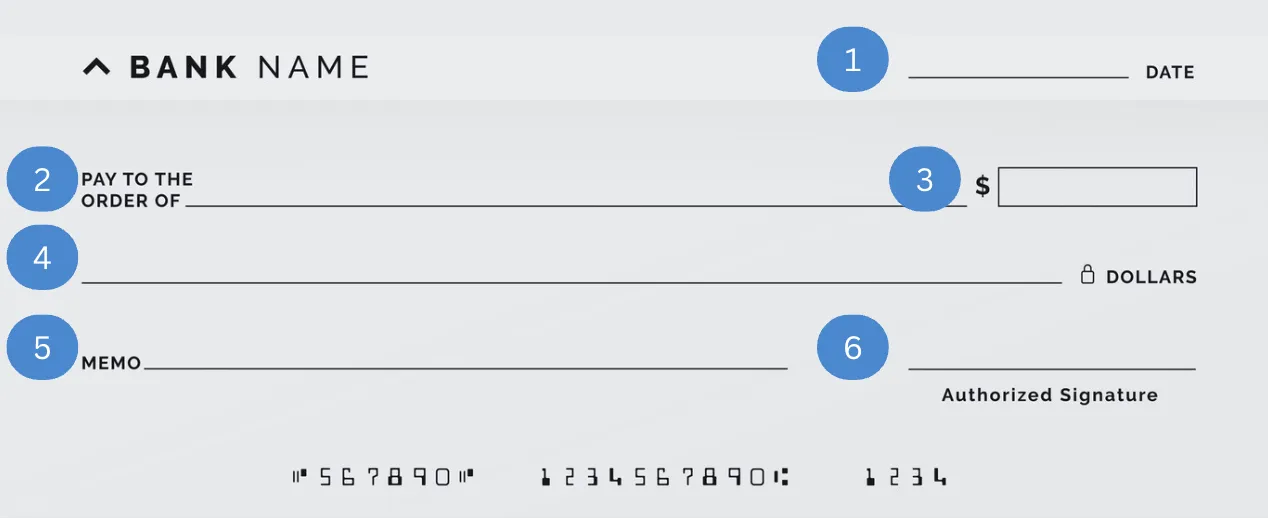
1. Write the Date
Remember that in the United States, the date format is mm/dd/yyyy.
2. Payee’s Name
Write the full name of the person to whom you are issuing the check, exactly as it appears on their official identification.
3. Amount in Numbers
Write the numerical amount clearly.
4. Amount in Words
Write the amount in words, including cents.
5. Add a Memo
You may include a note specifying the reason for the payment.
6. Sign the Check
Sign the check legibly in the space designated for the drawer.
7. Review the Information
Ensure that all information is accurate to avoid issues for the payee when cashing the check.
It is essential to complete checks legibly, without strike-throughs or corrections, as these may invalidate the document.
How to Correctly Write Numbers in Words on a Check
Writing amounts in words may be confusing when dealing with U.S. dollars. The following points should be kept in mind:
- Dollar amounts must be written in full words
- Cents must be written as fractions
- Avoid using dollar symbols or similar notations
- If there is leftover space at the end of the line, draw a line to prevent fraud
- For example, $1,000.75 is written as: One thousand and 75/100 dollars
Cash Checks and Manage Your Money Easily with Comun
As you can see, knowing how to fill out a check is useful for sending and receiving money in the United States. It is a reliable and accessible alternative if you do not have a banking account.
However, issuing and cashing a check can also require significant time and effort. That’s why you can skip the trip to the bank, avoid wasting time or money on gas, and cash your check directly from your phone using Comun—no lines, no questions, no complications.
Discover Comun, the only platform designed to serve the needs of immigrant communities in the United States, with support available in Spanish.
Why Choose Comun?
- Open your account with an official ID from your country
- Access a mobile app specifically designed for immigrants in the U.S.
- Make payments, receive your salary, and manage your finances
- Send money to your loved ones in LATAM for just a $2.99 transfer fee
Frequently Asked Questions
Still have questions about how to fill out a personal check? See our FAQ section.
What if I Make a Mistake Filling Out a Check?
If there are strike-throughs or inconsistencies in the amounts, the check must be voided and a new one used.
How Do I Void a Check?
Write the word VOID in large letters on the front of the check.
What Information Appears on the Back of a Check?
The back of the check contains the endorsement, meaning the payee’s signature for cashing the check.
Checking account
What to Do if Your Alza Account Was Closed
8 min de lectura
If your Alza account was closed, you can open an account with Común using your passport, consular ID, or another Latin American ID — no Social Security Number required. The process takes about 3 minutes.
Similarities Between Alza and Común
Sending money to Latin America: Both Alza and Común offer remittance services, letting users send money to friends and family in Latin America quickly and efficiently.
Debit card and checking account: Users on both platforms get a debit card linked to a checking account; Común offers a Visa card, allowing worldwide transactions and access to funds.
Virtual Visa debit card: Común provides a checking account connected to a physical and virtual Visa debit card, emphasizing the importance of this offering for the financial stability and inclusion of Latino families.
Flexible application process: Both platforms let users apply for an account using various forms of ID, like an international passport, consular card, SSN, or ITIN.
ATM fee reimbursement: Alza users could withdraw cash from any ATM worldwide with full fee reimbursement. Común also supports ATM withdrawals, ensuring convenient access to cash.
Advantages of Switching to Común: Modern Banking Solutions
One of Común's standout features is its commitment to transparency and cost-effectiveness. Unlike traditional banks and even Alza, Común doesn't charge opening fees, monthly maintenance fees, and has no minimum balance requirements. This makes it an ideal option for those looking to avoid unnecessary banking fees and keep more of their hard-earned money. Here are a few more standout features of a Común account:
Financial inclusion: Común is dedicated to promoting financial inclusion by providing modern banking solutions tailored to the unique needs of Latino families. They address the challenges Latinos face in accessing traditional financial services and emphasize the importance of financial education. This commitment ensures the Latino community has access to an inclusive, supportive banking experience.
Broader ID acceptance:
- Común: Accepts any official government-issued ID, not just passports or consular cards. This makes it easier for a wider range of people to open an account.
- Alza: Limited to specific forms of ID, which could be restrictive for some users.
Simplified address verification:
- Común: Applicants can verify their home address using their phone's geolocation. This feature is particularly beneficial for immigrants who may not have traditional proof-of-address documents.
- Alza: Required physical proof of address, which could be a challenge for those in non-permanent housing or living with relatives.
Extensive cash deposit network:
- Común: Offers access to the largest cash deposit network in the U.S., with more than 90,000 locations, including popular retailers like Walgreens, Walmart, and Dollar General.
- Alza: Didn't specify as extensive a cash deposit network, limiting convenience for cash deposits.
24/7 customer service:
- Común: Provides customer service around the clock, ensuring help is available anytime, any day of the week.
- Alza: Customer service availability wasn't highlighted as a 24/7 feature.
With Común, you'll never feel alone managing your finances. They offer top-tier customer service available seven days a week via chat, email, or phone. That means you can get help whenever you need it, making your banking experience smooth and worry-free.
Open your bank account¹ in 3 minutes with your country's ID²
- No minimum balance fees
- Send money to your home country safely
- Get paid up to 2 days early³
- Send money to your home country safely
- And much more!
Making the Switch to Común: Financial Inclusion
Switching from Alza to Común is simple and hassle-free. As a trusted financial partner, Común understands Latino families' unique needs. You can apply for a Común account online in minutes using a variety of ID documents like a passport, consular card, or ITIN. Once your account is set up, you can easily transfer your funds to Común. The fastest way would be to withdraw cash from your Alza account and then deposit it at any cash deposit location Común offers using the barcode option in Común's cash deposit feature.
The transition from Alza to Común is designed to be smooth and straightforward, helping you achieve financial freedom. Here's how you can make the switch:
Open a Común account: Visit the Común website or download the Común app to start your application. Use any government-issued ID and your phone's geolocation to verify your address.
Transfer your funds: To transfer your funds to your Común account, we recommend first withdrawing cash from your Alza account. Then, you can go to any cash deposit location Común offers and deposit your cash using the barcode option. This option doesn't require your physical card, so you can deposit cash from your Alza account immediately after being approved for a Común account.
Another quick option that doesn't require your Común card is transferring your Alza funds directly from your Alza account to your Común account using your account number and routing number. You can find this information under Account Information in Settings.
Set up direct deposits: Update your direct deposit information with your employer or any other income source to ensure uninterrupted access to your funds.
Current Común Offerings
One of Común's founding principles is inclusivity. As a customer-focused digital bank, Común doesn't require a Social Security Number (SSN) to open an account. Unlike many traditional banks, this feature is particularly beneficial for immigrants and people who may not have access to traditional forms of ID. Común focuses on providing secure banking solutions for everyone, regardless of immigration status. Común also aims to be a financial hub for Latino immigrants, offering a comprehensive banking solution with expanded resources tailored to their needs. To welcome former Alza customers, Común has several incentives:
- Hassle-free application: Apply using any government-issued ID and easily verify your address through your smartphone.
- Enhanced customer support: Benefit from 24/7 customer service to assist with any questions or issues during your transition.
- Extensive cash deposit options: Enjoy the convenience of depositing cash at more than 90,000 locations nationwide.
Conclusion: Secure Your Financial Future With Común for Financial Stability
As Alza prepares to close its doors, Común offers a robust, user-friendly alternative that not only matches but goes beyond the services Alza provided. With no fees, an extensive cash deposit network, and unmatched customer support, Común is the ideal banking solution for former Alza customers. Make the switch today and experience the superior banking experience Común has to offer.
Make the switch today and experience the benefits of a banking platform that truly puts you first. Visit the Común website to learn more and start your new banking journey.
For more information and to start your application, visit Común's official website here: https://www.comun.app
Why do digital bank accounts like Alza get closed?
Reasons vary by institution — they can include inactivity, identity verification issues, or changes in the provider's policies. Check directly with Alza for your specific case.
What do I do if my account was closed and I need an alternative?
You can open an account with Común using a valid government-issued ID — passport, consular ID, or one of over 100 accepted Latin American IDs.
What do I need to open my new account with Común?
Just your valid government-issued ID. No Social Security Number or ITIN required, and the process is 100% online.
Frequently asked questions
Can I open a Común account if my previous account was closed by another provider?
Yes, as long as you have a valid government-issued ID, you can open your Común account without issue.
Do I need a Social Security Number to open my Común account?
No, we accept a passport, consular ID, or other Latin American IDs.
How long does it take to open my new account?
About 3 minutes, with instant approval in most cases.
Will I lose my financial history if I switch providers?
History within another platform doesn't transfer automatically; your new Común account starts fresh.
Does Común charge a fee to open the account?
No, there's no opening fee, monthly fee, or minimum balance required.
What should I do with the money in my old account?
Contact your previous provider directly to learn the process for withdrawing your funds before the account closes completely.
.avif)
Immigration
What is SSN? Everything you need to know if you are a resident in the U.S.
8 min de lectura
An SSN (Social Security Number) is a 9-digit number issued by the U.S. government. It is required for working legally, filing taxes, and accessing financial services in the United States. As an immigrant, you may apply for an SSN if you have an eligible visa or Green Card — or use an ITIN as an alternative. If you have newly arrived in the U.S., you likely have questions about how to handle certain procedures. Therefore, we will explain what the SSN is, what it is for, how to apply for it, how much it costs, and what the benefits are of having this identifier.
What is the Social Security Number (SSN)?
The Social Security Number (SSN) is a series of 9 digits issued by the Social Security Administration (SSA, or Administración del Seguro Social in Spanish). It is issued to citizens, permanent residents, and eligible temporary residents, in accordance with their immigration status.
Its main function is to serve as a unique identification number that allows the government to track specific data for each person, such as their income, financial information, and employment history. This makes it possible to determine, in each particular case, eligibility to access Social Security benefits such as retirement, disability, among others.
In addition to facilitating access to these benefits, the Social Security card serves as official identification for employment onboarding, driver’s licenses (in some states), and opening bank accounts.
How to obtain the Social Security Number in the United States?
An important point about the Social Security Number in the U.S. is that there are three different types:
- For citizens born in the United States
- For citizens born abroad
- For non-citizens with lawful resident status
In the case of lawful permanent residents, it is necessary to obtain a Green Card or a visa with valid work authorization issued by the Department of Homeland Security (DHS), such as H-1B or L-1.
The process of obtaining the SSN varies depending on immigration characteristics. If you requested the SSN during your visa processing—through the “Application for Immigrant Visa and Alien Registration” form or the DS-260 electronic format, “Immigrant Visa Electronic Application”—DHS will contact the Social Security Administration directly to carry out the process.
Get your SSN in just 4 steps
If you did not request the SSN during your visa process, the first thing you should do is gather the following documentation:
- A valid passport with the Machine Readable Immigrant Visa (MRIV) or a Permanent Resident Card (Form I-551)
- Birth certificate
Once you have gathered the documentation, follow these steps:
- Download and complete the SS-5 application
- Go to an SSA office
- Present the original documents
- Wait 7 to 14 days to receive the Social Security card by mail
What to do if your SSN card is lost?
If your Social Security card is lost, it is important to take security measures immediately to avoid identity theft, fraud, or misuse of your personal data.
Report the theft or loss of this document to the police and then file a complaint with the Federal Trade Commission (FTC).
Afterwards, go to the Social Security Administration, complete the SS-5 form again, and bring the corresponding documents for replacement of the card.
Avoid carrying the card with you unless necessary and keep it in a safe place. Generally, you do not need to present your physical card but rather the number, which does not change even if you replace the card.
5 benefits of having an SSN
If you are still wondering what the SSN is for, you should know that this document provides multiple benefits of different kinds, such as the following:
1. Employment
For permanent residents, the greatest benefit of the SSN is that it grants work authorization, enables income tracking, as well as the payment of taxes and legal obligations. Presenting this document is an indispensable requirement during formal hiring processes in the United States.
2. Credit
The SSN is also typically required to apply for loans and credit from banks and financial institutions in the United States; in this way you can access assets such as real estate, a car, or other types of services.
3. Banking services
Accessing financial services is essential for immigrant workers in the United States, whether to receive wages or send money to their countries of origin. Generally, the SSN is a requirement to access a bank account and credit and debit cards, among other services.
4. Government benefits
There are other benefits available, such as unemployment insurance in the event of dismissal, and access to retirement and Medicare starting at age 65, for eligible permanent residents.
5. Taxes
The SSN functions as the taxpayer’s personal identification number, which makes it easier to file tax returns and report income and expenses. Another alternative for residents who do not have an SSN is the ITIN, issued by the Internal Revenue Service (IRS), which serves to fulfill tax obligations and grants other benefits.
In short, the Social Security Number—beyond being an administrative procedure—facilitates economic and social integration in the United States because it serves to track income and expenses and facilitates access to basic rights such as work, health, and banking, which are essential for integrating into society.
How much does it cost to get an SSN?
It is important to clarify that the Social Security card process does not involve any cost, whether you do it for the first time or as a replacement due to theft or loss.
Stay alert to potential fraud and avoid making payments to unauthorized third parties. If you have any doubts, go directly to your local Social Security office and report any suspicious activity.
Read more: Don’t miss our guide to investment basics for immigrants
Simplify your financial life upon arriving in the United States with Comun
As you can see, the SSN is highly relevant to establishing a stable life in the United States because it facilitates access to work, health services, and financial products that are essential for carrying out daily tasks such as payments and money transfers.
Comun is a financial platform designed to make life easier for immigrants in the United States by facilitating their integration into the financial system from day one.
- Open your account with an official ID from your country of origin
- Receive a Visa debit card and make purchases easily in physical stores and online
- Access a mobile application and manage your finances from the palm of your hand
- Send remittances to your home country for a fee starting at $2.99 USD, up to the applicable limits
- Forget about hidden fees and complicated processes
- Access support available in Spanish and English
With Comun, discover the most accessible way to manage your finances for everyday life in the United States.
Frequently Asked Questions
If you still have questions, consult our Frequently Asked Questions section.
What should I do if someone uses my SSN without permission?
Report immediately at IdentityTheft.gov and place a fraud alert.
How many times can I replace my SSN card?
Up to 3 times per year and a maximum of 10 times in your lifetime.
Is it mandatory to have an SSN to open an account with Comun?
Comun allows you to open an account with official ID from your country.

Financial Education
What is a certified check and how can you make sure it’s valid?
8 min de lectura
What is a certified check and how does it work?
Certified checks are a common form of payment for thousands of immigrants living in the United States, especially for major purchases such as rent payments, buying a car, and legal settlements.
However, it is not always clear why the certification process matters and how it differs from other types of checks.
A certified check is a physical payment order that has been reviewed in advance by a financial institution to ensure there are sufficient funds in the issuer’s bank account. This is the fundamental reason it’s considered a safer form of payment than a personal check.
Below, we explain in detail what a certified check is, how it works, and why it’s important to understand the differences from other types of checks.
What is a certified check?
A certified check is a type of check with guaranteed funds, since the issuing bank has verified the money exists in the checking or personal account.
This makes it a safer form of payment than personal checks, because the bank sets aside the amount to be paid so it can be collected by the payee.
How is a certified check issued?
Issuing a certified check is a straightforward process you can complete directly at the financial institution of your choice.
- The customer requests the check
The account holder must go to a bank and request a certified check, specifying the payee and the amount.
- Customer identification
You must present an official ID to verify that you are the holder of the savings or checking account from which the funds will be drawn.
- The bank freezes the amount in the account
The bank then certifies there are sufficient funds to cover the check and freezes them to ensure the payee can cash it.
- Signature certification
You must sign the check before finishing the process so the bank can confirm the signature matches the one on file.
Affixing the certification stamp
Finally, once the bank has verified the funds and the signature, it places a certification stamp to document completion of the process.
Differences between a certified check and a cashier’s check
A cashier’s check is another way to make secure payments using a physical instrument. In this case, the bank branch issues the check after receiving the customer’s payment, so the funds come from the bank itself.
Below is a comparison between a cashier’s check and a certified check.
Cashier’s check
Certified check
Security
High; the bank verifies sufficient funds and places a hold for the payee.
Very high; the check is backed by the bank and does not depend on the issuer’s account.
Cost
At some banks they have no cost at others up to approximately $15.
Depends on the bank; typically $10–$20.
Issuance time
At the branch, after funds are verified.
Immediate.
When is a certified check typically required?
A certified check is commonly used for significant transactions or large amounts. This gives the recipient assurance that funds are available.
- Paying an apartment security deposit.
When finalizing a lease or purchasing an apartment, the landlord or agent may request payment via certified check to guarantee funds.
- Buying a used car.
Whether dealing directly with owners or dealerships, a certified check can be a suitable option because of the security it provides.
- Closing an important contract or legal settlement.
For example, to pay fees, settlements, or indemnities, certified checks provide security for both parties.
- For tuition or school fees.
Some educational institutions accept certified checks as a form of payment, especially for international or first-time payments.
Do you know what to do if a check is stolen or lost? We explain it here!
Practical tips for using certified checks safely
While certified checks are among the safest payment methods due to the bank’s verification process, there are still fraud attempts using forged documents.
With this in mind, keep these tips in mind to avoid becoming a victim of check fraud.
How to know if a check has funds and avoid scams
- Verify with the issuing bank.
Call the bank directly and provide the check number, account holder, and amount; ask them to confirm authenticity and that funds are guaranteed. Make sure you call the bank’s official number, not the one printed on the check.
- Be alert if you receive an overpayment check.
A common scam is sending a check for more than the amount due and asking for the difference in cash. Confirm the check’s validity with the bank before proceeding.
- Wait for the check to clear before handing over any goods.
Clearing can take 3–10 days. Make sure the funds have fully settled and are not just on hold.
- Avoid accepting checks from unknown parties.
Whenever possible, accept checks only from people you trust. If you must take a check, follow the security measures above.
Manage your money securely with Común
In this article we explained what a certified check is, how it’s issued, how it differs from cashier’s checks, and how to use this payment method safely.
While certified checks can be a good payment option, a checking account in the U.S. is a much more secure and practical way to manage money.
Meet Común, your financial ally in the United States!
Send, receive, and cash money within and outside the United States. Our platform lets you move your money easily, quickly, and securely. You need a qualifying official ID from your country of origin to get started.
Open your account with Común today and discover a financial platform tailored to you.
Frequently Asked Questions (FAQ)
Where can I get a certified check in the United States?
You can request certified checks at financial institutions such as banks, credit unions, and some digital banks.
How much does it cost to get a certified check at the bank?
The cost depends on the bank but is typically between $10 and $15.
What other types of checks exist in the U.S. besides certified checks?
Other types of checks in the United States include: Money order; Personal check; Cashier’s check.
International Money Transfers
Money Transfers: From Traditional Methods to Digital Innovations
8 min de lectura
Money transfers have evolved from traditional methods like checks and money orders to instant digital solutions. With Común, most international remittances arrive within minutes, with no need to visit a branch.
The financial evolution of money transfer methods from traditional practices to digital innovations marks a crucial shift, revolutionizing how we think about and manage our finances in our bank accounts and beyond. This transition isn't just about technological advancement — it reflects a fundamental shift in user expectations, security standards, and global connectivity, especially in international money transfers and seamless bank account integration.
Accelerating Transactions: The Digital Revolution in Money Transfers
The rise of digital platforms and money transfer apps has transformed the speed and accessibility of transactions. Where bank transfers between financial institutions once took days to complete, digital innovations now enable instant money transfers, letting users transfer money around the world in just a few business days or even instantly. This monumental shift in convenience lets users send money or transfer funds from one bank account to another 24/7, without the traditional visit to a bank or credit union.
These changes encapsulate the journey from traditional methods like bank transfers and bank-to-bank transfers to the digital innovations now dominating our financial ecosystem. As we continue exploring these developments, it's clear that ways of transferring money — from using a debit card for instant transfers to leveraging payment app capabilities like Google Pay and Apple Pay — aren't just evolving, they're being redefined for a new era of global connectivity and digital empowerment, making money transfer apps an indispensable tool in our daily lives.
Navigating International Money Transfers: Considerations
Additionally, the rise of mobile apps, from money transfer services like Cash App to full banking apps, has democratized access to financial services. These platforms offer user-friendly interfaces that simplify the money transfer process, whether sending money abroad through international transfers or managing domestic transfers between checking and savings accounts within the same bank. This broadens financial inclusion, letting even those with a basic savings account or checking account participate easily in bank transfers and person-to-person payments.
It's equally important to have a solid understanding of the regulatory framework surrounding international money transfers. This includes being aware of anti-money laundering (AML) laws and the various transfer limits imposed by different countries. These regulations are designed to prevent financial crimes and ensure the security of cross-border transactions. Following these laws not only helps avoid legal complications, but also ensures your transactions process without unnecessary delays.
In addition to choosing the right service and understanding regulations, it's also helpful to be aware of the exchange rates offered by different services. Exchange rates can significantly affect the final amount received on the other end, especially for large transactions. It's also crucial to consider delivery times, especially if the transfer is time-sensitive. While some services can transfer funds almost instantly, others may take several business days. This can be particularly important in emergency situations or when making payments with strict deadlines.
Exploring Different Money Transfer Options: Wire, ACH, and Beyond
Digital advances have also introduced a new level of security and transparency to money transfers. With modern encryption and authentication technologies, including features like fraud detection, financial transactions — whether internal transfers, external transfers, or even online payments for online purchases — are safer than ever.
Money transfer apps have become a safe haven for personal finances, offering real-time transaction tracking and ensuring that transferring money — from a linked bank account via Automated Clearing House (ACH) transfers or direct deposit — stays secure and straightforward. ACH transfers stand out for domestic efficiency and cost-effectiveness, ideal for regular payments like salaries and bills. Additionally, traditional methods like checks, cash deposits, and money orders retain their usefulness for specific scenarios, offering tangible options in a predominantly digital world.
The Rise of Person-to-Person (P2P) Money Transfer Apps
P2P transfer apps have fundamentally transformed how we exchange money, making transactions as simple as sending a message. These apps let users send funds directly to others, using just an email address or phone number, eliminating the need for intermediaries. Among the many options available, several apps have gained prominence, each standing out for its distinctive features.
For example, some apps are celebrated for their integration with social networks, enhancing the social aspect of money transfers. Others prioritize security, offering advanced encryption and authentication methods to protect transactions. There are also apps designed to facilitate cross-border payments by simplifying the process of sending money internationally, offering competitive exchange rates and low fees. This diversity ensures there's a P2P transfer app suited to practically every need and preference, reflecting the dynamic, user-centered evolution of financial technology.
Decoding the Costs: Fees in Money Transfers
The rise of mobile apps, from money transfer services like Cash App to full banking apps, has democratized access to financial services. These platforms offer user-friendly interfaces that simplify the money transfer process, whether sending money abroad through international transfers or managing domestic transfers between checking and savings accounts within the same bank. This broadens financial inclusion, letting even those with a basic savings account or checking account participate easily in bank transfers and person-to-person payments.
Understanding the fees associated with money transfers is pivotal for managing your finances effectively and avoiding unexpected costs. The fee landscape for transfers can vary significantly, spanning service charges, transaction fees, and currency conversion fees, among others. Transparency around these fees is crucial — so it's essential to choose services that offer clear, straightforward information about all the costs involved.
Service charges and transaction fees are often the most visible costs associated with transferring money. These can vary widely depending on the provider and transfer method chosen. For example, traditional bank transfers might carry higher fees compared to online platforms or mobile apps. Currency conversion fees also play a significant role, especially for international transfers, where money needs to be exchanged from one currency to another. Some services build their profit into the exchange rate offered, making it less favorable than the market rate. This practice underscores the importance of scrutinizing the exchange rates provided, not just the explicit fees.
This approach not only helps you make informed decisions, but also helps avoid hidden charges that can add up. To minimize these costs, adopting strategies like selecting the transfer method best suited to your needs — considering factors like speed, destination, and amount — and diligently comparing providers to find the best rates and lowest fees can lead to significant savings. By prioritizing transparency and using cost-minimizing strategies, users can navigate the complexities of money transfers more confidently and economically.
Send abroad with peace of mind with your Común account¹
Open your account in 3 minutes!
Conclusion
In conclusion, the shift from traditional methods to digital innovations in money transfers represents a significant advancement in financial management. Digital platforms and money transfer apps have revolutionized how we send money, providing unprecedented convenience, speed, and security. From seamless bank account transfers to the global reach of international money transfers, these digital solutions offer a full range of services that meet our diverse financial needs.
By emphasizing transparency, these platforms minimize hidden fees, making it easier than ever to manage our savings and checking accounts. Additionally, innovations like instant transfers and robust fraud detection technology have made money transfer apps a reliable option for consumers. As we continue embracing these digital advances, the essence of mastering money transfers lies in leveraging technology to enhance our personal finance capabilities, ensuring we can navigate the complexities of modern financial transactions with confidence and cost-effectively.
How have money transfers changed over time?
From checks, money orders, and bank transfers that took days, to mobile apps that process payments and remittances in minutes.
What advantages do digital transfers have over traditional methods?
Greater speed, real-time tracking, and the ability to send money without leaving home. With Común, you can send a remittance from the app anytime.
Are traditional methods still useful?
Yes, checks and cash are still relevant in certain cases, such as when the recipient doesn't have a digital bank account.
Frequently asked questions
Why are digital transfers faster than traditional ones?
Because they use real-time processing networks, instead of the multi-day cycles of traditional banking methods.
Do I need to visit a branch to send money with Común?
No, the entire process happens through the app, with no need to visit any physical location.
Are traditional methods like checks still valid?
Yes, they're still useful in certain cases, though digital apps tend to be faster and more convenient.
How fast does a remittance sent through Común arrive?
Most arrive within minutes, depending on the country and delivery method.
Can I track my transfer in real time?
Yes, the app shows you your transfer's status while it's being processed.
Is sending money digitally safer than by check?
Both methods have different protections; digital apps usually offer additional verification and encryption.

Instant payments
How to send money to someone using Zelle from Común: 2026 guide
8 min de lectura
With Común you can link a debit card from another U.S. bank to your account — no Común physical card required — to send and receive money right away, even if you don't have funds in your balance.
How do I link an external card to my Común account?
In the app, go to the external cards section and add your debit card from another U.S. bank (Bank of America, Wells Fargo, Chase, or another). Común verifies the card is yours with a micro-deposit of less than $1.00 that you confirm in the app — we'll never ask for your bank password.
What can I do once the card is linked?
Send and receive payments and remittances using that card, even if your Común balance is $0. This is useful if you just opened your account and don't have your physical card yet, or if you prefer to keep your main money in another bank while using Común to move payments.
What cards can I link?
Valid debit cards, issued in the U.S., in your name, that allow sending and receiving funds. You can add up to 2 cards during your first 60 days with the account. Credit and prepaid cards aren't accepted.
Frequently asked questions
Do I need my physical Común card to send money?
No, if you have a linked external card, you can send and receive money right away without it.
Which banks can I link?
Any U.S. bank that issues debit cards in your name — Bank of America, Wells Fargo, Chase, and many others.
How does Común verify the card is mine?
With a micro-deposit of less than $1.00 to the linked account, which you confirm in the app. That money is yours to keep.
How many external cards can I add?
Up to 2 debit cards during your first 60 days with the account.
Why was my card rejected?
The most common reasons: the name doesn't match your account, it's a credit card, or it wasn't issued in the U.S.
Is it safe to link an external card?
Yes — Común never asks for your bank password or sensitive information during the process.
Community
What You Need to Open an Account at Común¹
8 min de lectura
Unmatched Ease of Opening an Account
Opening a checking account with Común is simple and hassle-free, addressing the barriers to financial exclusion typically faced by the immigrant community. Accepting over 100 forms of identification², including social security numbers from Latin American countries, Común ensures that immigrants have access to essential banking services. The application process is quick, taking less than 5 minutes, and is free of additional or hidden fees, minimum balance requirements or monthly commissions. This inclusiveness is central to Común's mission of fostering financial stability and growth.
Mobile Deposit Options
Común: Común offers a convenient mobile deposit feature that allows users to deposit cash at more than 88,000 locations in the United States, including major retailers such as Walgreens, Dollar General and Walmart. This extensive network ensures that users can easily find a deposit location near them, making the process of adding money to their accounts simple and hassle-free.
Traditional Banking: Although many traditional banks offer mobile deposit options, they often restrict these to check deposits through a mobile app. Cash deposits typically require a visit to an ATM or bank branch, which can be less convenient and more time-consuming than Común's extensive cash deposit network.
Utility in Today's World: In today's fast-paced environment, the flexibility to deposit cash in a wide range of accessible locations is invaluable, especially for individuals who may not have easy access to traditional banking services or who work non-traditional hours when banks are closed.
International Remittances
Común: Común excels in facilitating international remittances⁴, allowing users to send money abroad quickly and with lower fees compared to many traditional banks and remittance services. The process is enhanced with real-time notifications, keeping the sender informed from the moment the money is sent until it is received.
Traditional Banking: Traditional banks generally offer international transfer services, but these can be expensive and slow, with transfers sometimes taking several days to complete. In addition, the fees associated with traditional bank remittances can be significantly higher.
Usefulness in Today's World: In a globalized economy, the ability to send money across borders quickly and affordably is crucial. Many families rely on remittances for financial support, and businesses need efficient ways to handle international transactions. Común's streamlined and cost-effective service effectively meets these modern demands.
Advance Salary Access
Común: Común offers the ability to connect wages to the application and receive payment up to two days in advance³. This feature incurs no additional fees, providing significant relief during financial emergencies or when planning ahead.
Traditional Banking: Some traditional banks have begun to offer similar features, but they are often tied to specific types of accounts or require a minimum balance. The accessibility and ease of use of early access to Común's salary is not always matched in traditional environments.
Usefulness in Today's World: With the rise of gig economy jobs and irregular pay schedules, having early access to wages can provide a buffer against financial instability. This feature is particularly valuable for those living paycheck to paycheck, offering a cushion that can help avoid overdraft fees and late payments.
Unlike traditional banking institutions, Común's innovative features are designed to meet the needs of today's diverse and mobile population, particularly benefiting the immigrant community in the U.S. By providing services that offer greater convenience, lower costs and greater accessibility, Común not only addresses common challenges faced by its users, but also empowers them toward greater financial freedom and stability. As we move toward a more interconnected and fast-paced world, the importance of responsive and inclusive financial services continues to grow, something Común is uniquely positioned to offer.
Robust Security and Customer Support
Security and customer support are paramount at Común. With FDIC-insured accounts and Visa protection on virtual Visa debit card transactions, Común customers can manage their funds with confidence. Innovative security features such as biometric logins and instant transaction notifications keep your money safe. In addition, Común offers 24/7 customer support in English and Spanish, ensuring that help is always available in your preferred language.
Commitment to Zero Fees and Upward Mobility
Común stands out not only for offering zero fees for account opening, monthly maintenance or minimum balances, but also for its commitment to helping its users move up the financial ladder. Común acts as a financial partner, supporting financial transactions without the burden of excessive fees. This commitment aligns with the goal of enabling upward mobility for immigrants, who contribute significantly to the U.S. economy.
Customized Features and Benefits
Común goes beyond traditional financial services by offering features designed to meet the unique needs of the immigrant community. Users can send money abroad with low or no fees, deposit cash at more than 88,000 locations nationwide, including free ATM withdrawals, and connect their accounts to popular payment apps such as CashApp and Venmo. Comun's platform also allows customers to receive their paychecks up to two days early through direct deposit, further enhancing their financial flexibility and stability.
Conclusion
Común is not just a financial services provider, but a platform dedicated to transforming the banking experience for immigrants in the U.S. With its user-focused design, commitment to financial freedom and robust features, Común is destined to become a vital tool for achieving financial stability and growth for its users. Whether you are looking to manage your daily finances or send money to loved ones abroad quickly and securely, Común offers a reliable, inclusive and efficient banking solution.
Foundational Moment: Did you know?
Founded by entrepreneurs Mark Selcow and Andres Santos in New York, Común was built to empower families and enable upward mobility, particularly for the immigrant family. The company has garnered significant investment from prominent firms such as Costanoa Ventures, FJ Labs and South Park Commons, underscoring the tremendous opportunity to serve the financial needs of immigrant families and improve the lives of every individual.

Instant payments
Discover how to sign up for Zelle and move your money without complications
8 min de lectura
Are you looking for an option to send and receive money within the United States? In the digital era, it is essential to have access to an immediate, secure, and free transfer service.
Sometimes sending and receiving money can be challenging due to high fees or limited access to the banking system. For this reason, knowing how to register for Zelle and learning about alternative solutions such as Comun will be extremely useful for sending money without complications through the most efficient services.
In this guide, we will explain what Zelle is, how to register, what requirements are necessary to send and receive money, and why Comun works as a complementary solution to expand your options when facing restrictions that could hinder your access to mobile payment services.
What Is Zelle and How Does It Work for Your Daily Payments?
Zelle is a digital P2P (peer-to-peer) payment service available in the United States. It is associated with more than 20,200 traditional and digital banks and credit unions, such as Bank of America, Wells Fargo, Ally Bank, Capital One, and Navy Federal Credit Union. Zelle is well known for its wide coverage and ease of transferring funds between users of this system.
Other advantages of Zelle include:
- Near-Instant Transfers
Users can receive their money within minutes. - Ease of Use
It is directly linked to bank applications, eliminating the need for an external app. - Security
It is backed directly by banking institutions, so you can be confident that your money will reach its destination. - Usage Fees
You can send and receive money without paying commissions to other Zelle users.
Please note that Zelle is only available within the United States. If you need to make international transfers, find the best options here.
How Does Zelle Work?
Zelle operates through its connection with their affiliated banks’ applications. To send and receive money, you must first verify that your bank is part of this service’s network.
If so, complete your registration directly through your bank’s online platform and begin sending and receiving money to your account using a phone number or email address.
Using Zelle is very practical for daily transactions such as paying rent or purchasing goods and services. It is also a secure way to send money to family and friends.
In addition to Zelle, there are other alternatives for sending and receiving money within the United States. Discover the 6 best mobile apps of 2025.
What Changed in Zelle in January 2025?
Zelle announced an important change in its application that took effect in April 2025. The change consists of eliminating transfers through its standalone app, as the service can now only be accessed through the online banking platforms of U.S. financial institutions integrated into its network.
If you wish to download the Zelle app, you may still use it to review your payment history.
How to Download Zelle to My Phone: Key Requirements to Register and Use It Without Complications
To have a Zelle account, you only need to meet the following requirements:
- U.S. Mobile Phone Number or Email Address
To use Zelle, you only need to register a phone number and an email address. Your contacts can use either of these to send you money easily. - U.S. Bank Account
Since Zelle operates directly through bank connections, having an account with one of the institutions integrated into its network is mandatory.
Check the list of banks that offer Zelle on their website and ensure you will be able to use the service in 2025. - Banking Application
Finally, you must download your financial institution’s mobile banking app, as you will access Zelle through it.
What Can I Do If I Cannot Open an Account in the United States ?
Sometimes, opening an account is not accessible for many individuals, whether due to lack of required documentation or insufficient credit history.
If this is your situation, Comun is a great alternative for sending money to your loved ones safely, quickly, and at low cost.
Comun is a platform that understands the needs of immigrant communities in the United States. Open your account today and experience an accessible alternative for your finances.
4 Simple Steps to Register for Zelle
If you are wondering how to open a Zelle account, simply follow these steps:
1. Open Your Bank’s Mobile Application (If It Is a Zelle Partner)
Once you verify that your bank works with Zelle, open the mobile application and register if you have not done so yet.
2. Locate the Transfers and Payments Section
In the main menu, click on the transfers and payments section, then select “Send Money with Zelle.”
3. Register Your U.S. Phone Number or Email Address
To send and receive money with Zelle, it is necessary to register a U.S. phone number and an email address.
4. Link Your Bank Account
Confirm your information and start sending and receiving money with Zelle quickly after completing a test transaction.
With Your Comun Account, Make and Receive Payments Easily and Quickly
Undoubtedly, Zelle is an excellent tool for bank transfers, offering a fast and very simple service to use. Although it is only available to users of participating banks, it has broad coverage.
While Zelle represents a practical solution for many users, it has limitations such as requiring an eligible U.S. bank account.
Comun, on the other hand, is an alternative solution that goes beyond traditional limitations, as it allows you to send international transfers using your official national identification. It is designed for immigrants in the United States and offers simplified financial management. This service provides you with:
- A debit card to make purchases at physical establishments
- Access to a mobile app for better financial control
- The ability to send remittances to your loved ones for a fee starting at $2.99 per transaction up to the applicable limits
- The opportunity to join our community that understands your needs
Download the Comun app and enjoy transparent, easy, and personalized finance designed for you.
Immigration
Benefits of Having an ITIN in the U.S. for Non-Citizens
8 min de lectura
How to get an ITIN
The ITIN is obtained through IRS Form W-7 along with identity and foreign status documentation. A passport is the only document that satisfies both requirements on its own. The process takes between 7 and 11 weeks.
1. It allows federal tax filing
The ITIN allows you to file tax returns with the IRS, including claiming credits such as the Child Tax Credit and the Earned Income Tax Credit.
2. Access to credit and financial services
Some banks and credit unions accept an ITIN as an alternative ID to an SSN for opening accounts. Platforms like Común do not require either an SSN or an ITIN.
3. It facilitates business operations
For entrepreneurs, the ITIN is vital for filing business taxes and applying for an Employer Identification Number (EIN).
4. It supports residence and immigration processes
Consistently filing taxes with an ITIN can demonstrate good moral character, a factor considered in some immigration cases.
5. It helps establish identity and secure income
In the absence of an SSN, the ITIN is recognized by financial institutions and government agencies as a valid identification number.
6. Access to state services and benefits
In some states, the ITIN allows access to a driver’s license, health insurance, or in-state college tuition rates.
7. It protects against tax identity theft
Using the ITIN consistently links your tax data to your identification number, reducing the risk that someone files a return in your name.
Frequently asked questions about ITIN benefits
What is the ITIN used for in daily life?
The ITIN allows you to file tax returns with the IRS, claim tax credits such as the Child Tax Credit, open bank accounts at institutions that accept it, and in some states access services such as driver’s licenses or in-state tuition. It is the tax identification number for those who do not qualify for an SSN.
Does the ITIN give me the same rights as an SSN?
No. The ITIN is exclusively for tax purposes. It does not authorize you to work legally in the U.S., does not generate Social Security credits, does not provide automatic access to federal benefits such as Medicare or unemployment, and is not equivalent to an SSN for most government procedures. It is a tool for tax inclusion, not immigration status.
Does filing taxes with an ITIN affect me in an immigration process?
In general, filing taxes with an ITIN can be beneficial in immigration processes because it demonstrates a history of tax compliance and “good moral character,” one of the criteria evaluated in some adjustment-of-status cases. However, the impact varies by case — consult an immigration attorney before using it as an immigration strategy.
Can I open a bank account with an ITIN?
Some banks do accept an ITIN. Bank of America and certain local banks have specific programs for ITIN holders. However, many large banks require an SSN. Alternatives like Común do not require either an SSN or an ITIN — they accept a passport, consular ID, or other Latin American IDs for immediate account opening.
Does the ITIN help me access credit in the U.S.?
Yes, partially. Some credit card issuers and lenders accept an ITIN. Certain mortgage programs (ITIN loans) allow you to buy a home without an SSN. Building credit history with an ITIN is possible, although more limited than with an SSN. Credit built with an ITIN generally does not automatically transfer if you later obtain an SSN.
How do I apply for an ITIN if I have never had one?
You submit IRS Form W-7 along with identity and foreign-status documentation — a passport is the only document that satisfies both requirements on its own. You can mail it with your tax return, go in person to an IRS Taxpayer Assistance Center, or apply through an authorized Certifying Acceptance Agent (CAA), which is the fastest and safest method.
International Money Transfers
Alternatives to Western Union: Explore Reliable Options for Your Remittances
8 min de lectura
There is no doubt that Western Union has established itself as a leading company in the remittance industry, with over 145 years in the market.
Since its inception, Western Union has enabled people without access to a banking account to make quick money transfers, which has been particularly significant for rural and immigrant communities in the United States.
According to recent data, in 2023, 12% of remittances sent from the United States to Latin America and the Caribbean were carried out through Western Union, making it one of the leading money transfer services worldwide.
Today, remittances are essential to the lives of millions of Latin American migrants in the United States. In this article, we address alternatives to Western Union that solve problems such as high fees, unfavorable exchange rates, and complicated processes by offering more modern, accessible, and fair financial services.
Why Look for Alternatives to Western Union?
For over a century, Western Union has worked to bring families together through international money transfer services, offering multiple delivery options and broad coverage.
However, over the years, new services have emerged that address areas where Western Union can improve, such as:
High and Variable Fees
One of the main challenges faced by the immigrant community in the United States when sending money is the high money transfer fees, which significantly affect the final amount received.
For example, according to Western Union’s price calculator, the cost to send $500 USD to Mexico via an agency with cash pickup is $15 USD.
Uncompetitive Exchange Rates
In addition to fees, international transactions involve currency exchange, which can be detrimental to the recipient depending on the exchange margin used.
In the previous example of using the Western Union price calculator, the dollar exchange rate is 18.17 MXN, compared to the official rate of 18.64 MXN, meaning the recipient receives 9,081 MXN instead of 9,320 MXN.
Limits and Restrictions
Another factor that may negatively impact migrants sending remittances to Mexico is the limits and restrictions imposed, depending on factors such as payment method, receiving country, and identity verification.
Generally, for unverified users, the limit to send cash through Western Union is $3,000 USD per transaction. Upon verifying identity, that amount may increase.
Transaction Speed
The speed of money transfers through Western Union depends on the payment and delivery method, as detailed below:
- Debit/credit card to cash: minutes
- Debit/credit card to bank deposit: 1–2 business days
- Banking account to cash: 3–5 business days
- Banking account to banking account: up to 5 business days
- In-person cash to in-person cash: minutes
- Wire transfer to mobile wallet: up to 24 hours
Accessibility and Convenience
Western Union is known for its global reach and the accessibility of its international money transfer services.
However, for these same reasons, long lines and wait times may occur. If you need to speed up your transactions, this large-scale service might not be your most favorable option.
9 Alternatives to Western Union for Sending Money Home
If Western Union doesn't suit your needs, here are the best money transfer apps.
Comun
Comun is a comprehensive platform that not only allows money transfers within and outside the U.S., but also gives you access to a complete and efficient financial experience, including easy access to cash.
Enjoy 24/7 support also available in Spanish, and pay transparent fees starting at $2.99 USD for international money transfers, with no hidden fees.
Ria Money Transfer
Ria Money Transfer is a service similar to Western Union. It has coverage in a large number of countries worldwide and offers different payment and delivery methods, as well as partnerships with retailers like Walmart.
Wise (previously TransferWise)
Wise is a U.K.-based financial technology company that facilitates international money transfers and offers benefits such as a multi-currency account and real exchange rates.
Remitly
Remitly is a fintech that operates primarily in the United States, Canada, and Australia. It allows money transfers with options for cash pickup, bank deposit, or mobile wallet. While it is a good option for sending remittances to Latin America, it has fees and exchange rates that are not very competitive.
WorldRemit
WorldRemit is a global money transfer service with a presence in over 130 recipient countries. In addition to offering cash pickup and bank deposit options, it also allows transfers through mobile phone top-ups.
PayPal/Xoom
Xoom is a remittance company acquired by PayPal. It offers money transfers with multiple delivery methods, such as bank deposit, cash pickup, mobile wallet, or direct delivery.
MoneyGram
MoneyGram is a U.S.-based company specializing in international money transfers and person-to-person (P2P) payments. It operates in over 200 countries with various payment options.
OFX
OFX is a company specializing in international money transfers and currency exchange, with a presence in over 190 recipient countries.
Revolut
Revolut is a U.K.-based fintech offering multi-currency digital accounts, international money transfers, and investment services.
How to Choose the Most Suitable Alternative for Your Remittances
If you are still wondering which money transfer app is right for you, remember to consider the following factors before selecting an alternative to Western Union:
Fees and Real Exchange Rate
It is advisable to look for a payment service provider with clear, flat fees to ensure your family receives the maximum possible amount.
Transfer Speed
While in many cases, most apps offer quick money transfers, in others, the waiting time could be problematic for the recipient.
Sending and Withdrawal Methods
Make sure the sending methods suit your needs, whether via banking account, credit or debit card, or cash delivery.
Coverage in Your Country
Verify that the money transfer service has coverage in Latin America, and that this does not involve additional shipping fees.
Ease of Use and Customer Support
It is important to communicate easily in case of any issues. Choose an option with 24/7 Spanish-language support.
Security and Trustworthiness
Ensure the service has the necessary licenses and regulations for the places where it operates, as well as the appropriate security measures to protect your data.
Comun: A Great Financial and Remittance Alternative Designed for the Immigrant Community in the U.S.
Although Western Union is an excellent option for sending money abroad, there are better alternatives with more competitive and fair conditions that can make your money, and your family’s, go further.
It is essential to research and compare each international payment service in order to choose the option with the most suitable benefits for you.
Comun offers you an all-in-one service that allows low-cost international money transfers, along with a complete financial experience in your language.
- Open your account easily using official documentation from your country
- Make your first international money transfer free, and afterward pay a fee starting at $2.99 USD per transfer, up to the applicable limits
- Deposit cash at over 88,000 retail locations in the U.S.
- Manage your finances through a mobile app
- Access to Spanish-language support 24/7
Open your account today and discover an alternative to Western Union.
Frequently Asked Questions
Is it safe to use digital alternatives to Western Union?
Comun uses secure technology and follows U.S. financial regulations to help protect your money transfers. You can also choose from multiple payment and delivery options.
What are the hidden costs when sending money internationally?
International money transfers generate fees, in addition to the currency conversion rate.
Can I send money to a country if I don’t have a banking account?
With Comun, you can send cash even if you don’t have a traditional U.S. banking account.
What do I need to open an account with services like Comun?
A compatible Android or iOS phone and an official ID from your country.
How long does a money transfer take with these alternatives?
Money transfers with Comun are reflected within minutes or hours.
Disclosures (in footer):
“Comun is a financial technology company and not a bank. Banking services are provided by Community Federal Savings Bank; Member FDIC. The Comun Visa® Debit Card is issued by Community Federal Savings Bank, pursuant to a license from Visa U.S.A Inc. and may be used everywhere Visa Cards are accepted.”
“Funds in your account are FDIC insured up to $250,000 by ownership category through Community Federal Savings Bank (CFSB), Member FDIC, in the event CFSB fails.”
“A service provided by Service UniTeller, Inc. Service UniTeller, Inc. is licensed in all states that require a license.”
“Remittance fees start at $2.99 but may vary. Please check the app for more details.”
“Comun Inc. may earn revenue from the conversion of foreign currencies.”






Thousands of immigrants are already achieving more with their money. You can too.
Comun is a financial technology company and not a bank. Banking services are provided by Community Federal Savings Bank; Member FDIC. The Comun Visa® Debit Card is issued by Community Federal Savings Bank, pursuant to a license from Visa U.S.A Inc. and may be used everywhere Visa Cards are accepted.
Comun is a fintech company and not a bank or licensed money transmitter.
* Results may vary. For a complete list of eligible IDs and application requirements, follow this link.
^ No minimums, no maintenance fees. ATM or transfer fees may apply. See app for fee details.
‡ Direct deposit funds are typically available when we receive the payment file, up to two days before the scheduled payment date. This early availability is not guaranteed.
** A service provided by Service UniTeller, Inc. Service UniTeller, Inc. is licensed in all states that require a license. Remittance fees start at $2.99 but may vary. Please check the app for more details. Comun Inc. may earn revenue from the conversion of foreign currencies.
† Funds in your account are FDIC insured up to $250,000 by ownership category through Community Federal Savings Bank (CFSB), Member FDIC, in the event CFSB fails.